GUEST MOVIE REVIEW: The Evil Dead

In the fourth part of CM Saunders’ five-part series, he talks about another one of my favorites, The Evil Dead.

Top 5 Eighties Horror Flicks #2
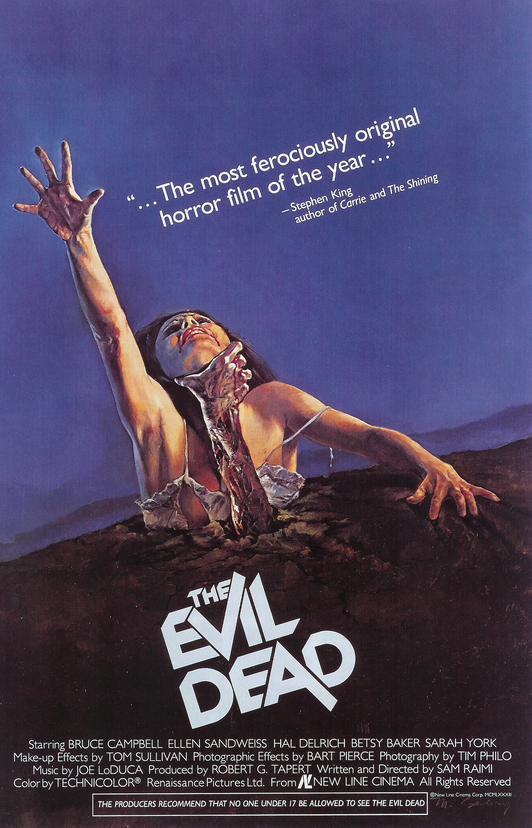
Title: The Evil Dead
Year of Release: 1981
Director: Sam Raimi
Length: 85 mins
Starring: Bruce Campbell, Ellen Sandweiss, Betsy Baker, Hal Delrich, Theresa Tilly

I remember the first time I ever saw The Evil Dead. I was in my early teens, and my folks had gone on holiday leaving me home alone. I scared myself so much that I stayed awake the entire night with every light in the house switched on. Apart from an early encounter with An American Werewolf in London, that was my first experience of being absolutely shit scared by a film. During subsequent viewings, I learned to appreciate the crude humour as well as other aspects like the kick-ass script and innovative cinematography. But that first time, it was all about pure, unadulterated fear. I was absolutely terrified, and traumatised for weeks afterwards. At that tender age, I had no idea a piece of art could stir such visceral emotions. It was epic.

If I had to pin down the single most frightening aspect of the whole movie, it would be the trapdoor to the cellar. As innocuous as it probably sounds if you haven’t seen the movie, it still gives me chills thinking about it now. In my fevered imagination it came to represent the thin barrier between good and evil, or life and death. I’d love to live off-grid in a secluded log cabin in the woods. But if it has a trap door to the cellar, you can fucking keep it.

Wait a minute, I’m getting ahead of myself. Let’s rewind a little. If you haven’t seen it, (why?), The Evil Dead goes something like this…

Five college students go on vacation to a secluded log cabin in the woods. You know they’re going to have sex and take drugs, which is bad, obvs, so you know some terrible shit is going to befall them. As I mentioned, the cabin has a trapdoor leading to the cellar. You can probably attach any one of a dozen metaphor to not just the trapdoor, but the cellar. It could represent hell (the underworld), the subconscious mind, or any number of other things. But for the sake of argument, let’s just call it what it is. It’s a trapdoor. And as you can probably tell by the way I’m still obsessing over it, it scarred me for life.

Obviously, the students go exploring, and find some audio tapes made by a researcher who talks about something called the Book of the Dead, a book of spells and incantations bound in human flesh and written in human blood. Incidentally, the original script called for the characters to be smoking marijuana when they are first listening to the tape. The actors decided to try this for real, and the entire scene had to be later re-shot due to their uncontrollable behaviour.

The tapes summon a demonic entity (or entities) and one by one the students become possessed. The next thing you know, people are speaking in tongues and getting raped by trees left, right and centre. The scene where Cheryl (Sandweiss) initially falls under the influence, levitates, and stabs her friend through the ankle with a pencil before being locked in the cellar is utterly horrifying. She keeps pushing her hands through the gap in the trapdoor and making gurgling noises. Ew. As you can probably imagine, things deteriorate drastically from that point on and pretty soon Ash (Campbell in his defining role) is locked in a nightmarish battle for survival. Things don’t improve much when he realises the only defence against his group of possessed ex-friends is to dismember them with a chainsaw. Needless to say, it gets messy. Really messy.

The only thing letting the side down is the quality of the special effects, which though innovative for the time, sometimes come across as slightly cheap and tacky. But you have to remember The Evil Dead was made over forty years ago and cost around $350,000. Finances were such an issue that the crew consisted almost entirely of acquaintances of Raimi and Campbell, who had met at high school.

Upon release, the film was met with a lot of controversy, mainly because Raimi had made it as gruesome as possible with neither interest in nor fear of censorship. Writer Bruce Kawin described The Evil Dead as one of the most notorious splatter films of its day, along with Cannibal Holocaust and I Spit on Your Grave. Largely as a result of an appearance at the 1982 Cannes Film Festival (where it was seen, and emphatically endorsed by one Stephen King) the movie did manage to generate around $2.6m, small potatoes in comparison with the $212m raked in by that year’s biggest hit Raiders of the Lost Ark.

In the UK, the film was trimmed by 49 seconds before it was granted an X certificate for cinema release. A campaign by pro-censorship organization NVLA led to it being labelled a “video nasty” and when the Video Recordings Act was passed in 1984, the video version was removed from circulation. In 1990, a further 66 seconds were trimmed from the already-censored version and it was eventually granted an 18 certificate for home video release. In 2000, the uncut version was finally released. In the US, the film received an immediate ‘X’ rating, which has since been converted to NC-17 for “substantial graphic horror violence and gore”. It remains banned either theatrically or on video in some countries.

Even the censored version is preferable to the 2013 big-budget re-boot, largely because of the unpolished, rough-and-ready approach. It’s no surprise, either, that none of the original cast with the exception of Campbell went on to have much of an impact on the Hollywood A-list. 

Trivia Corner:

The cabin (near Morristown, Tennessee) used as the film’s set was also lodging for the 13 crew members, with several people sleeping in the same room. Living conditions were terrible, and the crew frequently argued. The cabin didn’t have plumbing, so the actors went days without showering, and fell ill frequently due to the freezing weather. By the end of production, they were burning furniture to stay warm. Ironically, the cabin didn’t have a cellar, most of the cellar scenes being filmed in a farmhouse owned by producer Rob Tapert’s family in Michigan.

On the 13th of every month I put a fresh spin on a classic movie in my RetView series over at my blog. Go here to check out the archive.

Boo-graphy: Christian Saunders, a constant reader who writes fiction as C.M. Saunders, is a freelance journalist and editor from south Wales. His work has appeared in almost 100 magazines, ezines and anthologies worldwide including Fortean Times, the Literary Hatchet, ParABnormal, Fantastic Horror, Haunted MTL, Feverish Fiction and Crimson Streets, and he has held staff positions at several leading UK magazines ranging from Staff Writer to Associate Editor. His books have been both traditionally and independently published.

The fifth volume in my X series featuring ten (X, geddit?) slices of twisted horror and dark fiction plucked from the blood-soaked pages of ParABnormal magazine, Demonic Tome, Haunted MTL, Fantasia Diversity, and industry-defining anthologies including 100 Word Horrors, The Corona Book of Ghost Stories, DOA 3, and Trigger Warning: Body Horror.

Meet the local reporter on an assignment which takes him far beyond the realms of reality, join the fishing trip that goes sideways when a fish unlike any other is hooked, and find out the hidden cost of human trafficking in China. Along the way, meet the hiker who stumbles across something unexpected in the woods, the office worker who’s life is inexorably changed after a medical drug trial goes wrong, and many more.

Also features extensive notes, and original artwork by Stoker award-winning Greg Chapman.

Table of Contents:
Demon Tree
Revenge of the Toothfish
Surzhai
The Sharpest Tool
Something Bad
Down the Road
Coming Around
Where a Town Once Stood
The Last Night Shift
Subject #270374
Afterword

X X2 X3 X4 X5

GUEST MOVIE REVIEW: The Howling

In the third part of CM Saunders’ five-part series, he talks about The Howling.

Top 5 Eighties Horror Flicks #3

Title: The Howling
Year of Release: 1981
Director: Joe Dante
Length: 89 minutes
Starring: Dee Wallace, Patrick Macnee, Dennis Dugan, Christopher Stone, Slim Pickens, John Carradine, Elisabeth Brooks

Humour, often coupled with OTT excess, was a common staple in eighties horror movies. It was symptomatic of the times, when a large percentage of people had more money than they knew what to do with and many were off their tits on coke. It was a good time. This humour seems especially suited to werewolf movies as if someone way back in the day decided there was something knee-slappingly funny about people transforming into humungous wolf-like creatures and ripping innocent bystanders into bloody pieces.

While far more subtle than some examples, the humour is still evident in Joe Dante’s classic The Howling. The script, adapted from Gary Brandner’s novel by screenwriter John Sayles who had previously worked with Dante on tongue-in-cheek classic Piranha, positively drips with satire (“You were raised in LA, the wildest thing you ever heard was Wolfman Jack.”) and the humour moves centre-stage right at the very end, as if the makers simply couldn’t contain themselves any longer. But let’s not get ahead of ourselves. The fact is that even now, over four decades after it was first released, The Howling is still a brutal, terrifying, and deeply disturbing journey into the dark heart of the lycanthrope legend which has long been considered a metaphor for the beast lurking inside all of us, something which is hinted at several times throughout the movie. If you’ve never seen it, that’s something you need to rectify.

Karen White (Scream Queen Dee Wallace, star of horror staples Cujo, the original Hills Have Eyes, and Critters, but probably best known for her role in E.T.) is a television news anchor in LA who thinks she is being stalked by a serial killer. In conjunction with the police and TV crews, she takes part in a sting operation, agreeing to meet the murderer in a sleazy porno cinema. In the ensuing kerfuffle, the serial killer is shot dead by cops, but Karen is left severely traumatised by it all and suffering from PTSD and amnesia. Her therapist (Macnee, that bloke off the Avengers) suggests she and her husband (Stone) spend some time at an exclusive retreat in the countryside to help her recovery, something they are only too happy to do. Big mistake. The Colony, as they call it, is full of colourful characters, one of them being a nymphomaniac called Marsha (Brooks) who tries to seduce Karen’s husband. When he rejects her advances, she follows him into the woods and scratches his arm, thereby ‘turning’ him. They later do it next to a bonfire (snigger) in one of those scenes that you probably rewound way too much as a horny teenager, before getting creeped out by the fact that by the time they finish shagging you are essentially watching a couple of Furries getting some in make up and monster suits.

Anyway, Karen soon begins to suspect that something sketchy is going on not just with her husband, but at the retreat as a whole, and calls in a little help from her friends. That’s when things get interesting, if they weren’t interesting enough before.

There’s no getting around it, by today’s standards The Howling comes across terribly dated in parts. But the script is extremely well-written, the cast is a who’s who acting talent and, though Rick Baker deservedly won an Oscar for his creature effects on An American Werewolf in London a year later, Rob Bottin’s work here is just as impressive. You can achieve quite a lot with tiny inflatable air bags under latex skin. He lets the side down somewhat in the climactic scene where Karen, now also changed, morphs into something resembling a cocker spaniel live on air which is more hilarious than frightening, but we’ll let that one slide. I prefer to think that particular scene (a late addition tagged on to the end while Wallace was filming Cujo) is meant as one of those era-defining tongue-in-cheek moments.

An earlier section where the werewolf attacks Karen’s friend at a secluded cabin in the woods is straight-up terrifying, as is the part where our heroine comes face to face with the monster for the first time and watches transfixed as it transforms in front of her. The suspense is maintained throughout, and the action rarely lets up. There’s also a fair bit of sex and nudity which led to some reviewers, somewhat unfairly, dubbing it ‘erotic horror’. Dante (who also directed Gremlins, Innerspace and Burying the Ex, amongst others) fits all the pieces together nicely, and shows neat little touches here and there, like having Little Red Riding Hood playing in the background at one point and naming many characters after directors who made other werewolf films, like George Waggner, who directed The Wolf Man (1941). In keeping with this theme, the consensus on review aggregate site Rotten Tomatoes (where it holds a respectable 74% approval rating) reads: “The Howling packs enough laughs into its lycanthropic carnage to distinguish it from other werewolf entries, with impressive visual effects adding some bite.”

Brilliant.

Unsurprisingly, due to its success, The Howling spawned a sequel (Howling II: Your Sister is a Werewolf) in 1985. What is surprising, however, is that despite the sequel being a total flop it then led to a bunch more, none of which were very good. The most recent was the eighth installment released in 2011. In January 2020 it was announced that Andy Muschietti, director of Mama (2013) and It (2017) had been hired to direct a remake for Netflix. That should be fine, as long as they don’t decide to remake the other seven.                

Trivia Corner:

Dee Wallace and Christopher Stone were married in RL, having met on an episode of CHiPs before filming started on The Howling. They were together until his death from a werewolf bite (not really. It was a heart attack) in 1995.

On the 13th of every month I put a fresh spin on a classic movie in my RetView series over at my blog. Go here to check out the archive.

Boo-graphy: Christian Saunders, a constant reader who writes fiction as C.M. Saunders, is a freelance journalist and editor from south Wales. His work has appeared in almost 100 magazines, ezines and anthologies worldwide including Fortean Times, the Literary Hatchet, ParABnormal, Fantastic Horror, Haunted MTL, Feverish Fiction and Crimson Streets, and he has held staff positions at several leading UK magazines ranging from Staff Writer to Associate Editor. His books have been both traditionally and independently published.

The fifth volume in my X series featuring ten (X, geddit?) slices of twisted horror and dark fiction plucked from the blood-soaked pages of ParABnormal magazine, Demonic Tome, Haunted MTL, Fantasia Diversity, and industry-defining anthologies including 100 Word Horrors, The Corona Book of Ghost Stories, DOA 3, and Trigger Warning: Body Horror.

Meet the local reporter on an assignment which takes him far beyond the realms of reality, join the fishing trip that goes sideways when a fish unlike any other is hooked, and find out the hidden cost of human trafficking in China. Along the way, meet the hiker who stumbles across something unexpected in the woods, the office worker who’s life is inexorably changed after a medical drug trial goes wrong, and many more.

Also features extensive notes, and original artwork by Stoker award-winning Greg Chapman.

Table of Contents:
Demon Tree
Revenge of the Toothfish
Surzhai
The Sharpest Tool
Something Bad
Down the Road
Coming Around
Where a Town Once Stood
The Last Night Shift
Subject #270374
Afterword
X X2 X3 X4 X5

GUEST MOVIE REVIEW: The Lost Boys

Here we are with the second part of this five-part series with author CM Saunders, this one focusing on one of my favorites, The Lost Boys.

Top 5 Eighties Horror Flicks #4

Title: The Lost Boys
Year of Release: 1987
Director: Joel Schumacher
Length: 98 mins
Starring: Jason Patric, Corey Haim, Corey Feldman, Dianne Wiest, Kiefer Sutherland, Jami Gertz

Number Four in our countdown of eighties horror flicks is something that typifies the entire decade; cool, sassy, and slick, but with a dark, dangerous edge. It’s a conversation which comes up every so often. There you are, semi-drunk with a group of colleagues, or on one of those awkward Tinder dates, when in an effort to lift the tension and find some common ground, somebody asks, “So, what’s your favourite film?”

Obviously, there’s no right or wrong answer. It’s entirely subjective. But it’s still a bit of a loaded question. Say the wrong thing, and it could cloud someone’s opinion of you forever. What would your peers and prospective lovers think if you gave the accolade to Human Centipede 2? Or even worse, the Adam Sandler disaster Jack and Jill? For me, there are a few contenders (neither Human Centipede 2 or Jack and Jill is among them, you’ll be glad to know). But for a long period in my formative years, my answer was The Lost Boys.

It wasn’t always a popular choice. Horror hounds and 80’s film buffs might nod with appreciation, while others, especially the younger crowd, invariably frown and say ‘You what?’

Given that The Lost Boys came out over 35 years ago, I suppose that’s an acceptable reaction. Upon release it was a modest hit but was no Top Gun or Dirty Dancing, and has since passed into the ranks of ‘cult classic.’ That said, it has certainly aged better than most 80’s movies. Have you seen Weird Science recently? Don’t bother.

Anyway, directed by Joel Schumacher and made on a budget of just $8.5 million, the Lost Boys was a triumph of style over substance, in many ways encapsulating the decadence of the decade. It was big, brash, gaudy, and ever-so-slightly camp. Yet by the same token funny, slick, and immeasurably cool. In the case of Kiefer Sutherland, it might also be one of the very few times a lead character rocks a mullet and gets away with it.

For the uninitiated, The Lost Boys is the story of two brothers, Sam (Haim) and Michael (Patric) who move with their recently-divorced mother (Wiest) to stay with her eccentric father in Santa Carla, California. Cue lashings of teen angst and despair about feeling isolated and not fitting in and stuff. At a local comic book store, Sam bumps into the Frog Brothers (Feldman and Newlander) who warn him that the town has become overrun with vampires and give him comics to educate him about the threat, while big brother Michael falls in love with Star (Gertz) who happens to be in a relationship with a local gang leader called David (the aforementioned mullet-sporting Sutherland). Yup, you guessed it, David’s gang is actually made up of the very same vampires that have been terrorizing the town and  making people disappear, and they want the star-struck (sorry) Michael to join their ranks. Don’t forget, this was back when vampires were glitter-free and legitimately scary. The story builds to an epic showdown between good and evil featuring some fantastically creative kill scenes (“Death by stereo!”) and even better one-liners.

At the time, Lost Boys represented something of a gamble by Warner Bros. Horror comedies aimed specifically at younger audiences were an unexplored genre, and a largely untapped well. It was a constant battle with the censors to sneak in as much gore as possible without falling foul of an ‘adults only’ rating that would severely limit your cinema-going audience. To make things even more problematic, the main cast was comprised mainly of unknowns (even if one of them had a famous dad) and even director Joel Schumacher was a largely unknown quantity with only The Incredible Shrinking Woman (1981) and St Elmo’s Fire (1985) on his resume.   

Even with the benefit of having 35 years to think about it, it’s hard to pinpoint what makes Lost Boys work so well. The plot itself is a little thin with not many surprises, but the script is sharp and witty and the performances are a cut above. Given Corey Haim’s untimely end, this is how most people remember him. A piece of marketing genius, the slogan (sleep all day, party all night, never grow old, never die. It’s fun to be a vampire) captured both the imagination and the mood of a generation, while the shiny MTV-style visuals are positively spellbinding, Kiefer Sutherland made the coolest villain ever, and Jami Gertz sent pulses racing. The haunting rock-infused soundtrack, an essential component of any 80’s movie, was also a contributing factor. Even Nanook the dog deserves praise for several show-stealing scenes.

However, despite all this, Lost Boys was much more than the sum of its parts, making an undeniable impression on the Generation X psyche and paving the way for everything from Buffy the Vampire Slayer to the Twilight saga. The movie spawned two low-key sequels; Lost Boys: the Tribe (2008) and Lost Boys: the Thirst (2010) but neither set the world on fire, and a rumoured proper sequel, the Lost Girls, also directed by Joel Schumacher and which sounds pretty amazing, failed to materialize. The enduring legacy of Lost Boys ties in neatly with the source of the title, J.M. Barrie’s Peter Pan who, just like vampires, never grew up. To my knowledge he didn’t end up dissolving in a bath of garlic or being impaled on a fence post, either, so there’s that.

Trivia corner:

The producers originally wanted to call the town where Lost Boys is set Santa Cruz, because during the 1970s Santa Cruz gained a reputation as being “the Murder Capital of the World” after three infamous serial killers (Kemper, Mullin, and Carpenter, aka the Trailside Killer) hunted victims there. However, the Santa Cruz council ‘strongly objected’ to the town being portrayed in such a negative manner and allegedly withheld filming permits, forcing the producers to change the name to Santa Carla. Spoilsports.

On the 13th of every month I put a fresh spin on a classic movie in my RetView series over at my blog. Go here to check out the archive.

Boo-graphy: Christian Saunders, a constant reader who writes fiction as C.M. Saunders, is a freelance journalist and editor from south Wales. His work has appeared in almost 100 magazines, ezines and anthologies worldwide including Fortean Times, the Literary Hatchet, ParABnormal, Fantastic Horror, Haunted MTL, Feverish Fiction and Crimson Streets, and he has held staff positions at several leading UK magazines ranging from Staff Writer to Associate Editor. His books have been both traditionally and independently published.

The fifth volume in my X series featuring ten (X, geddit?) slices of twisted horror and dark fiction plucked from the blood-soaked pages of ParABnormal magazine, Demonic Tome, Haunted MTL, Fantasia Diversity, and industry-defining anthologies including 100 Word Horrors, The Corona Book of Ghost Stories, DOA 3, and Trigger Warning: Body Horror.

Meet the local reporter on an assignment which takes him far beyond the realms of reality, join the fishing trip that goes sideways when a fish unlike any other is hooked, and find out the hidden cost of human trafficking in China. Along the way, meet the hiker who stumbles across something unexpected in the woods, the office worker who’s life is inexorably changed after a medical drug trial goes wrong, and many more.

Also features extensive notes, and original artwork by Stoker award-winning Greg Chapman.

Table of Contents:
Demon Tree
Revenge of the Toothfish
Surzhai
The Sharpest Tool
Something Bad
Down the Road
Coming Around
Where a Town Once Stood
The Last Night Shift
Subject #270374
Afterword

X X2 X3 X4 X5

GUEST MOVIE REVIEW: The Fog

This is the first in a five-part series by author CM Saunders where he discusses with us his top five 80s horror picks. I hope it encourages you to either watch (or maybe re-watch) some old classics. I know it really helped me to get some of my Halloween spirit back this year, and since Halloween isn’t over until I say it’s over, you’ve got plenty more time to sit back and enjoy these.

Top 5 Eighties Horror Flicks #5

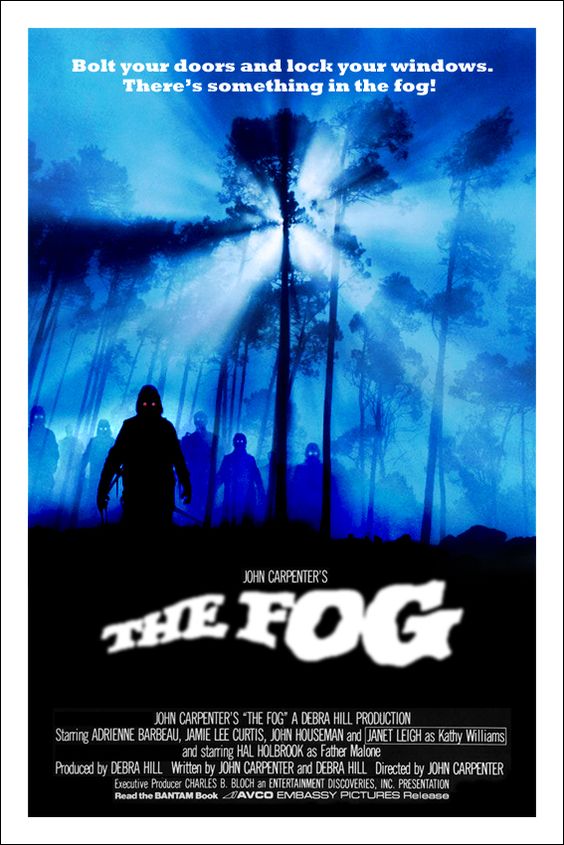
Title: The Fog
Year of Release: 1980
Director: John Carpenter
Length: 89 minutes
Starring: Adrienne Barbeau, Jamie Lee Curtis, Hal Holbrook, Janet Leigh

Any horror movie aficionado of a certain age will tell you that the eighties were a special time. Yes, some of the music was questionable and the fashion sense largely atrocious. Plus, there was no internet meaning that you had to physically go to shops to buy things. There were no cellphones, either, so you usually had to go by yourself. Crazy, I know. But the movies were something else. What they lacked in special effects and CGI they more than made up for in wit and atmosphere. That’s why I’ve decided to mark this Halloween spooktacular with a rundown of the top 5 horror flicks of the decade. You’ll probably be familiar with most of them. If not, seek them out immediately. Despite the big shoulder pads and spiky hair, you won’t be sorry.

One more thing before we get started; this list, as with most lists, is entirely subjective. If you don’t like it, make your own damn list.

Following the success of Halloween two years earlier, John Carpenter was considered hot shit in Hollywood and virtually given free license to do what he wanted on the Fog, albeit on a modest budget. He didn’t disappoint. Being sandwiched between Halloween and Escape from New York the Fog is often overlooked, but remains one of the jewels in carpenter’s crown. 

As the Californian coastal town of Antonio Bay nears its hundredth anniversary, paranormal activity begins to rocket. When a huge chunk of masonry falls out of a wall in his church, town priest Father Malone (Holbrook) finds his grandfather’s journal hidden in the alcove. When he reads it, he uncovers a terrible secret. The original townsfolk, led by Malone’s grandfather, deliberately sank a clipper ship, the Elizabeth Dane, and plundered it for gold, which was then used to establish the town and build the church. Cut to the present day, and a fishing boat is out at sea when it is engulfed by a mysterious glowing fog. You guessed it, there’s something in there. Specifically, it’s the Elizabeth Dane, and her very angry (and very dead) crew.

The heart and soul of San Antonio is the local radio station, seemingly managed by Stevie Wayne (Barbeau) all on her lonesome. The radio station is set up in an old lighthouse, meaning Stevie is in pole position to see the glowing fog, which suspiciously moves against the wind, approach the town. Weatherman Dan helpfully calls to tell her about it, but unfortunately, Weatherman Dan could make a strong case for being the stupidest man in the world and he is dead moments later. Instead of just calling it a night and going home, Stevie then takes to the airwaves to implore any passing strangers to go to her house, address provided, to save her son who is stuck there with the soon-to-be-dead babysitter. A short time later, she apparently gives up on him altogether and shifts her attention to saving the villagers instead who have gathered for a Centenary celebration. In an apparent attempt to help the crew of the Elizabeth Dane find them quicker, she tells them all to gather in the church where an epic showdown takes place.  

As well as writing, directing, and even pulling off a brief cameo role, John Carpenter also composed the musical score. I didn’t notice the significance until I sat down and actually listened to it. It consists of the usual deep, ominous, brooding tones, which are then mimicked by lighter tones. Same chords, different tones. When I thought about it, that effect conjured up the notion of being stalked or followed, which I imagine to be an effective tool to use on the subconscious whether intentional or otherwise. The music is instrumental (boom!) in making the Fog such an atmospheric, satisfying, well-made chiller. The plot is ultimately a tad predictable, but there’s just enough gore and jump scares to keep things interesting.

The fate of the Elizabeth Dane is said to be based on that of an actual wrecking which took place off the coast of California near the town of Goleta in the 19th century. This particular kind of skulduggery appears to have been mercifully rare in America. However, it was a lot more prevalent in Britain (LINK). John Carpenter also claimed to be partly inspired by a visit to Stonehenge with his co-writer/producer (and then-girlfriend), Debra Hill while in England promoting Assault on Precinct 13 in 1977. They visited the site in the late afternoon, and saw an eerie fog in the distance. Though carpenter and Hill worked together on The Fog, Halloween and several other projects, by the time the Fog came to be filmed Carpenter was married to Adrienne Barbeau. Unusually, both Carpenter and Hill were involved in the 2005 remake starring Selma Blair and Tom Welling, which managed to stay more-or-less faithful to the original.  

Trivia Corner:

Worried the film might flop, the distribution company, AVCO Embassy Pictures, spent around $3 million on advertising and promotion, mostly on expensive TV, radio and print ads. They also spent a considerable amount installing fog machines in the lobbies of cinemas where the film was showing. That was almost three times the amount the film cost to make. However, the gamble paid off as it generated over $21 million at the Box Office.

On the 13th of every month I put a fresh spin on a classic movie in my RetView series over at my blog. Go here for the archive.

Boo-graphy: Christian Saunders, a constant reader who writes fiction as C.M. Saunders, is a freelance journalist and editor from south Wales. His work has appeared in almost 100 magazines, ezines and anthologies worldwide including Fortean Times, the Literary Hatchet, ParABnormal, Fantastic Horror, Haunted MTL, Feverish Fiction and Crimson Streets, and he has held staff positions at several leading UK magazines ranging from Staff Writer to Associate Editor. His books have been both traditionally and independently published.

The fifth volume in my X series featuring ten (X, geddit?) slices of twisted horror and dark fiction plucked from the blood-soaked pages of ParABnormal magazine, Demonic Tome, Haunted MTL, Fantasia Diversity, and industry-defining anthologies including 100 Word Horrors, The Corona Book of Ghost Stories, DOA 3, and Trigger Warning: Body Horror.

Meet the local reporter on an assignment which takes him far beyond the realms of reality, join the fishing trip that goes sideways when a fish unlike any other is hooked, and find out the hidden cost of human trafficking in China. Along the way, meet the hiker who stumbles across something unexpected in the woods, the office worker who’s life is inexorably changed after a medical drug trial goes wrong, and many more.

Also features extensive notes, and original artwork by Stoker award-winning Greg Chapman.

Table of Contents:
Demon Tree
Revenge of the Toothfish
Surzhai
The Sharpest Tool
Something Bad
Down the Road
Coming Around
Where a Town Once Stood
The Last Night Shift
Subject #270374
Afterword

X X2 X3 X4 X5

GUEST BOOK REVIEW by William Meikle: Something Wicked This Way Comes Part 3

Green Town 2:
Something Wicked This Way Comes
Ray Bradbury

Genre: Coming of Age, Horror, Halloween
Publisher: William Morrow Paperbacks
Original Publication Date: 9.17.1962
Pages: 314

One of Ray Bradbury’s best-known and most popular novels, Something Wicked This Way Comes, now featuring a new introduction and material about its longstanding influence on culture and genre.

For those who still dream and remember, for those yet to experience the hypnotic power of its dark poetry, step inside. The show is about to begin. Cooger & Dark’s Pandemonium Shadow Show has come to Green Town, Illinois, to destroy every life touched by its strange and sinister mystery. The carnival rolls in sometime after midnight, ushering in Halloween a week early. A calliope’s shrill siren song beckons to all with a seductive promise of dreams and youth regained. Two boys will discover the secret of its smoke, mazes, and mirrors; two friends who will soon know all too well the heavy cost of wishes…and the stuff of nightmares.

Few novels have endured in the heart and memory as has Ray Bradbury’s unparalleled literary masterpiece Something Wicked This Way Comes. Scary and suspenseful, it is a timeless classic in the American canon.

Something Wicked This Way Comes – A Review (Part 3)

Part 2: Departures

The end game begins with the two boys completely under the influence of Mr Dark. They are frogmarched through town, as if they’re being shown off, and they are unable to do anything but comply. They are taken to the carnival where Mr Dark gathers the crowd for one last trick of the night – the infamous bullet trick. He asks for a volunteer to fire the weapon. There are seemingly no takers… then Will’s father steps forward.

It’s a wonderful moment. I almost felt like cheering. And now we come to the face-off. With the help of the crowd, Will’s father manages to free Will from the carnival’s clutches long enough to get him by his side to help aim the weapon. It’s a wonderfully tense scene, and we can almost see Mr Dar begin to sweat. Things aren’t quite going his way. And things get worse for the carnival. Using the crowd’s laughter, Will’s father takes his shot… and kills the Dust Witch.

The dad and Will flee into the mirror maze to search for Jim, another wonderfully tense little scene where Dad looks to son and son looks to Dad and they see they are mirror images of each other.

“And then, at last, he gave the maze, the mirrors, and all Time ahead, Beyond, Around, Above, Behind, Beneath or squandered inside himself, the only answer possible.”

Dad laughs, and the maze trembles. He takes note, and laughs again, the spell of the carnival finally broken.

The mirror maze collapses in shards and fragments. Jim is not among them; he is running in the dark as the carnival closes down, with both the autumn people and Dad and Will looking for him.

They find Jim at the carousel. Jim takes the ride into his future, still under the carnival’s influence, but is stopped and thrown off by Will’s love for her, leaving Jim in a stupor on the grass with Will watching over him while Dad heads for a final confrontation with Mr Dark.

It all comes down to this; a father standing between the boys and the darkness.

Mr Dark has disguised himself as another boy, but Dad sees through him, sees his fears. He hugs the boys close, the power of love starving the dark. The boy succumbs, the carnival falls with him… but Jim is still in a death-like trance.

But Dad knows what is needed. Joy and laughter will bring the boy back; he gets Will to join him in capering and singing and dancing. The power of their love and joy brings Jim back to them.

“They yanked Jim. Jim flew. Jim came down dancing.”

The carnival has fallen to ruin around them. Only the carousel remains, a last temptation for all three of them. They turn their backs on it, and make for home.


“Then, as the moon watched, the three of them together left the wilderness behind and walked into the town.”

I thoroughly enjoyed this reading, and I hope you’ve enjoyed my real-time walk through it.

I’m older now than Will’s dad in the book, and it’s a different experience reading it now than it was when I was Will’s age. The nostalgia factor is strong now, and Will’s dad’s thoughts on aging and death resonate strongly. But as ever with Bradbury, it’s the magic that’s the thing, magic that brings back youth.

And I feel young again.

Boo-ology: William Meikle is a Scottish writer, now living in Canada, with more than twenty five novels published in the genre, and over 300 short story credits in thirteen countries. His work has appeared in a number of professional anthologies. When he is not writing, he plays guitar, drinks beer, and dreams of forture and glory.

Website
Goodreads