Halloween Extravaganza: INTERVIEW: Linda D. Addison

Meghan: Hello, Linda. Welcome to Meghan’s House of Books. Tell us a little bit about yourself.

Linda D. Addison: I’m the second oldest of 10 children, been making up fables since I can remember. Currently, I have over 350 poems, stories and articles in print. I write what sings in me, so I’ve created work that’s been labeled horror, fantasy, science-fiction. I’ve worked most of my life as a software developer, but now retired to write full-time.

Meghan: What are five things most people don’t know about you?

Linda D. Addison: Ok, here we go:

  • I’m a character in the Star Trek Wiki (“Linda Addison was a Human female who served in the Federation Starfleet in the 24th century.”).
  • I took belly dancing lessons years ago and had one public performance (at Necon).
  • In 11th grade, I won a scholarship to travel to western Europe with the World Youth Forum, which completely changed my life.
  • I’ve been practicing tai chi for more than 20 years.
  • I’m in IMDB as background cast from The Girl Next Door film (book by Jack Ketchum).

Meghan: What is the first book you remember reading?

Linda D. Addison: Fun with Dick and Jane. This was the first book I remember holding in school and thinking, I want to make these one day. I had no idea what that meant but I never forgot that moment.

Meghan: What are you reading now?

Linda D. Addison: For my own pleasure: at this very moment: I Am Not Your Final Girl poetry collection by Claire C. Holland, which I got into because of hearing her read one of her poems. After that I had to buy her book and I’m enjoying it very much. In general, I read several books at the same time, the ones started on the top of a tall pile: Pimp my Airship by Maurice Broaddus; Lady Bits by Kate Jonez; The King of the Wood by J. Edwin Buja. Outside of these I’m reading tons of poetry for the next issue of Space & Time Magazine.

Meghan: What’s a book you really enjoyed that others wouldn’t expect you to have liked?

Linda D. Addison: I read A Prayer for Owen Meany by John Irving in the early 1990’s and put me on the road to reading Irving. That book’s story and main character were so entirely different than anything I had been reading.

Meghan: What made you decide you want to write? When did you begin writing?

Linda D. Addison: My mother was a magnificent storyteller. I grew up believing everyone made up stories, so my imagination was always engaged, an overlay to reality like The Matrix. I had no choice but to write, it was the natural outcome for me as soon as I learned to put words to paper. My earliest memory of a story I wrote was a take off of Alice in Wonderland in elementary school.

Meghan: Do you have a special place you like to write?

Linda D. Addison: I like to write in my very comfy chair in living room where I can see the mountains. In a day I’ve been know to move to the dining room where I can see my courtyard; my office, even my bedroom has a writing corner. When I’m not home I can write anywhere as long as I have music on earphones.

Meghan: Do you have any quirks or processes that you go through when you write?

Linda D. Addison: I don’t have something I always do, but when I’m home I like to write either with silence, or music without vocals (like Miles Davis) or depending on what I’m writing, movies running with sound off (Star Wars, Alien, etc.).

Meghan: Is there anything about writing you find most challenging?

Linda D. Addison: Hmmm, just having enough time to get it down each day, it’s a balancing act between writing my stuff and being involved with other projects with other people.

Meghan: What’s the most satisfying thing you’ve written so far?

Linda D. Addison: The last thing I’ve completed, a poetry collection, The Place of Broken Things, released July 2019 written with Alessandro Manzetti. It was easy, fun and uplifting, we each wrote a third of the poems separately & a third together. Our voices/approaches were different enough to inspire each of us to create some weirdly, wonderful work.

Meghan: What books have most inspired you? Who are some authors that have inspired your writing style?

Linda D. Addison: This is the hardest questions to answer. I could write a book of lists. In elementary school I read every book of fables in our classrooms (Yellow, etc), Aesop’s Fables, filling my head with talking magical animals. Junior High, High School I read the science-fiction section of the library, A through Z, fantasy with dragons; non-genre authors like: Shakespeare, Poe, Kafka, Ralph Ellison, James Baldwin, Langston Hughes. The pattern of reading widely continues to this day, more than anything I struggle to find time to read and write.

Meghan: What do you think makes a good story?

Linda D. Addison: I’m a big character person—I can follow a story many places if you hook me into the character.

Meghan: What does it take for you to love a character? How do you utilize that when creating your characters?

Linda D. Addison: I love characters who have levels of personality, willing to pay the price for what they want/need, whether they are perceived as good or bad, I like characters that have a bit of both, like real people. I try to do the same when I create my characters.

Meghan: Which, of all your characters, do you think is the most like you?

Linda D. Addison: I can’t think of one particular character who is most like me, there’s a little bit of me in many of my stories, some emotion/reaction/memory of mine.

Meghan: Are you turned off by a bad cover? To what degree were you involved in creating your book covers?

Linda D. Addison: A bad cover is not good for anyone. I’ve read work with covers that weren’t as professional as they could be, so it won’t stop me, but I know it turns off others. I’m very happy with the covers of my books; they have been published by small/medium presses and I’ve had input, final sign off on them. They are each special in a different way. The cover to How To Recognize A Demon Has Become Your Friend by Jill Bauman always attracts people when I do signings.

The cover of The Place of Broken Things, was created by Adrian Borda, an artist bought to my attention by Alessandro Manzetti (co-creator of book) and we decided together which piece of art to use. I’m absolutely delighted with the cover art, it’s a great representation of the title: that broken place, that broken character.

Meghan: What have you learned creating your books?

Linda D. Addison: Each book teaches me something different. There’s are many steps that go into going from the first sentence/poem line to a finished manuscript. I’m constantly looking to increase my technique and editing abilities. The main things: write my first draft as wild as I want; re-write/edit like a warrior; get someone with edit skills for a final read. When looking for a market/publisher spend time checking for a good fit. Good production is important (including covers). Marketing/Sales, I”m always learning something new about using social media to help get the word out.

Meghan: What has been the hardest scene for you to write so far?

Linda D. Addison: The poem “Philly’s Little Boy” in the book The Place of Broken Things was very emotional because I read how children were treated in American slavery to incorporate real details.

Meghan: What makes your books different from others out there in this genre?

Linda D. Addison: It’s difficult to step outside my writing but I’ve been told my poetry is accessible because of the emotion it invokes and my genre fiction reflects real human situations.

Meghan: How important is the book title, how hard is it to choose the best one, and how did you choose yours (of course, with no spoilers)?

Linda D. Addison: Book titles are very important, they set the mood for the reader, draw them in. It’s been easy for me to select titles since they come to the surface as the book is written. For collections that include poetry, the book title is often the title of a poem. I even have a document full of possible titles, like lines of poems. Alessandro and I had a title for our collection before we even started writing; the first poem we wrote was The Place of Broken Things. The words in the title set the open tone for what we wrote from then on.

Meghan: What makes you feel more fulfilled: Writing a novel or writing a short story?

Linda D. Addison: I started writing poetry mostly and it was very easy, like listening to a song. Writing short stories sometimes took more work (outlining, editing, etc). The last couple of years even writing fiction has also become very organic. Now I’m completing my first novel (well, the first I would let anyone read) and to my delight it’s been flowing very nicely.

Meghan: Tell us a little bit about your books, your target audience, and what you would like readers to take away from your stories.

Linda D. Addison: Most of my books are considered horror, which is more psychological than graphic. My science-fiction is mostly about characters than things. I don’t know what my target audience would be but I hope readers are touched/inspired/entertained.

Meghan: Can you tell us about some of the deleted scenes/stuff that got left out of your work?

Linda D. Addison: I have lots of poems that were taken out of collections because they didn’t work, and bits and pieces of stories that haven’t been finished. These are things that might be useful in the future so they’re never thrown away for good.

Meghan: What is in your “trunk”?

Linda D. Addison: There are stories I’ve published that I want to expand into longer pieces (ex. “Whispers During Still Moments”, my vampire story in the Dark Thirst anthology).

Meghan: What can we expect from you in the future?

Linda D. Addison: I’m very excited about having a poem in the next issue of Weird Tales Magazine #364. Look for a story of mine in “New Scary Tales to Tell in the Dark” anthology (HarperCollins, 2020), which was a blast writing.

Movies have always been inspiring for me so I’m beyond thrilled about Mourning Meal, a film inspired by my poem of the same title, being released in 2020 by award winning producer, screenwriter Jamal Hodge. My poem, with the fantastic actor Rüya Koman, is the first episode of a 2020 web series called “Poetry & Death” also by Jamal Hodge.

Meghan: Where can we find you?

Linda D. Addison: Website ** Facebook ** Twitter

Meghan: Do you have any closing words for your fans or anything you’d like to say that we didn’t get to cover in this interview?

Linda D. Addison: I have three words for my fans: “I love you”.

Linda D. Addison, award-winning author of four collections, including How to Recognize A Demon Has Become Your Friend, the first African-American recipient of the HWA Bram Stoker Award, received the 2016 HWA Mentor of the Year Award and the 2018 HWA Lifetime Achievement Award. Check out her latest poetry in The Place of Broken Things, writen with Alessandro Manzetti (Crystal Lake Publishing, 2019). She is excited about the 2020 release of a film (inspired by my poem of same name) Mourning Meal, by producer and director Jamal Hodge.

How to Recognize a Demon Has Become Your Friend

Who doesn’t need to know How To Recognize A Demon Has Become Your Friend? From the first African-American to receive the HWA Bram Stoker award, this collection of both horror and science fiction short stories and poetry reveals demons in the most likely people (like a jealous ghost across the street) or in unlikely places (like the dimension-shifting dreams of an American Indian). Recognition is the first step, what you do with your friends/demons after that is up to you.

The Place of Broken Things

Bram Stoker Award® winners Linda D. Addison and Alessandro Manzetti use their unique voices to create a dark, surrealistic poetry collection exploring the many ways shattered bodies, minds, and souls endure. 

They created poems of visionary imagery encompassing death, gods, goddesses and shadowy, Kafkaesque futures by inspiring each other, along with inspiration from others (Allen Ginsberg, Pablo Neruda, Phillis Wheatley, etc.).

Construction of The Place started with the first bitten apple dropped in the Garden. The foundation defined by the crushed, forgotten, and rejected. Filled with timeless space, its walls weep with the blood of brutality, the tears of the innocent, and predatory desire. Enter and let it whisper dark secrets to you.

Proudly represented by Crystal Lake Publishing—Tales from the Darkest Depths.

Halloween Extravaganza: Steve Thompson: STORY: Wee Man and the Eejit

Wee Man & the Eejit
as Told by Sean “Burly” O’Shea

“There he stood, all of three-foot and six inches, clad in his finest green outfit, now covered in rancid muck. The big eejit that pushed him in the ditch had a bit much of the black stuff. He was acting the maggot he was. Trying to impress his floozie, hoping to score some fun time between her legs. The wee man, well, he wasn’t taking no shite from no codger. A real chancer that fella was getting a Mountain Leprechaun all hepped up. Everyone round these parts knows you don’t feck with a Mountain Leprechaun, a valley one maybe, worse they can do is change you into a potato until sunrise. You just pray to all hell nobody cooks you for their supper.

I saw that happen to a young lad once you know, and at sunrise when he changed back, his legs, well, they was chewed off just above the knees they was. Some yoke thought it would be a great riot to take a bite out of him when he was a potato just to see what would happen. Heads or tails he said twirling the potato in his hands before he took a good old chomp out of the damn thing. It was a riot all right; the poor lad screaming with blood gushing everywhere and everyone running around like a bunch of chickens with their heads lopped off. He lived though, that’s him right over thar in front of Flanagan’s bar in the wheelchair.

Now where was I, oh yeah, some folks leaned a lesson tonight, just cause it’s Halloween don’t mean that everyone you see on the street is wearing a costume. That lad found out the hard way cause he’s not from ‘round here, and he sure as all hell didn’t know we have real Leprechauns that come into town during celebrations. I mean Jesus, Mary and Joseph, I can still smell the ass juice that shot down the eejit’s leg when the wee man transformed into a troll and bit his fecking head off.”

Steve Thompson is the author of two short and flash fiction collections. You can check out his 2 latest short stories “Kill Point Club” in the anthology When the Clock Strikes 13 from his In Your Face Publishing that he started in June 2019 and “Malignant” which he co-wrote with Kenneth W. Cain which is in the Shallow Waters 2 flash fiction anthology by Crystal Lake Publishing.

When the Clock Strikes 13

Tick – tock 
Tick – tock 
Tick – tock

Your time is running out. When the clock strikes 13, all manners of hell will break loose.

When the Clock Strikes 13 is a collection of thirteen short horror stories by some of the best horror and dark fiction authors writing today. Inside, you will find stories to frighten, shock and gnaw at your inner fears, and take you places that belong only in the dark recesses of your mind. There are monsters on these pages; some are human, some are not. 

Table of Contents 
Introduction by Joe Mynhardt 
“The Boy in the Pond” by Mark Allan Gunnells 
“Open Waters” by Richard Thomas 
“Memories” by John R. Little 
“Detrition of War” by Kenneth W. Cain 
“Comes the Red Man” by Tom Deady 
“Mommy’s Girl” by Somer Canon 
“Taking Up Carpentry” by Justin M. Woodward 
“Kill Point Club” by Steve Thompson 
“Calm Down Time” by Richard Chizmar 
“Carrion: My Wayward Son” by James Newman 
“Bear” by Michelle Garza and Melissa Lason 
“When Arachnids Attack” by Sheri White 
“A Song Above” by Glenn Rolfe 
Afterword by Steve Thompson 

Halloween Extravaganza: INTERVIEW: Steve Thompson

Meghan: Hi, Steve. Welcome to the new Meghan’s House of Books. Tell us a little bit about yourself.

Steve Thompson: I live in Moncton, New Brunswick, Canada with my girlfriend, Lisa. I recently retired from my day job as a housekeeping supervisor at our city hospital after 30 years of service. I’m now dunking my foot into the unknown depths of the publishing world and hoping I don’t drown. I have 8 pets at home, 4 dogs and 4 cats that take up a large part of my day. 3 of those dogs are Boston Terriers and one is a Chorkie, and never in my life did I ever think I could love any animal as much as those dogs; the cats, well, they’re just evil.

Meghan: What are five things most people don’t know about you?

Steve Thompson: 1- I never graduated from high school because I was given the choice to quit or get kicked out 3 months before graduation. 2 – Most people know I am scared of heights, What they don’t know is if I get into a situation that I am up too high, I need to get down ASAP, even if it means jumping and I don’t know what is the greater fear, the heights or wanting to jump to get out of that situation. 3 – When I was 15, I broke into a portable classroom and peed in the desk drawer of a teacher I didn’t like because he bullied a lot of his students. 4 – When I was nine or ten years old I loved to burn things with a magnifying glass; plastic car models, the long grass in the fields next to our house and insects, I burned a lot of insects, and I didn’t turn out to be a serial killer. Got 4 out of 5.

Meghan: What is the first book you remember reading?

Steve Thompson: The Stand by Stephen King

Meghan: What are you reading now?

Steve Thompson: Finishing up In the Scrape by James Newman and Mark Steensland with Jeff Strand’s Five Novellas on deck.

Meghan: What’s a book you really enjoyed that others wouldn’t expect you to have liked?

Steve Thompson: Jackie Collin’s Hollywood Wives. I read this back in the 80’s because it was the only book in the house at the time that I hadn’t already read.

Meghan: What made you decide you want to write?

Steve Thompson: Reading Stephen King books is what turned me on to reading and writing.

Meghan: When did you begin writing?

Steve Thompson: About 25 years ago, but mostly it was just farting around, writing short stories for myself and some friends. I only started to take writing seriously about 6 years ago.

Meghan: Do you have a special place you like to write?

Steve Thompson: In my computer room/library.

Meghan: Do you have any quirks or processes that you go through when you write?

Steve Thompson: Nope.

Meghan: Is there anything about writing you find most challenging?

Steve Thompson: Everything, but mostly it’s the show don’t tell I struggle with but it is getting better the more I write. Also keeping my focus on one story at a time. Right now, I have 7 short stories that are half done and I keep jumping back and forth between them, writing a line or 2 on one story than a line or 2 on another.

Meghan: What’s the most satisfying thing you’ve written so far?

Steve Thompson: That would be my short story “Kill Point Club” from the anthology When the Clock Strikes 13. It was a fun story to write and I had a great time with it. I used the names of some of the other authors in the anthology as characters and then killed them off. Fun Times.

Meghan: What books have most inspired you?

Steve Thompson: The Stand by Stephen King, Animosity and Odd Man Out by James Newman. These are the only books I can remember ever pissing me off to the point I almost threw the books across the room and to make me shed a tear.

Meghan: Who are some authors that have inspired your writing style?

Steve Thompson: Stephen King, James Newman, and Richard Laymon to name a few.

Meghan: What do you think makes a good story?

Steve Thompson: Believable characters that grow on you and you care what happens to them, because if you don’t care the story just feels flat and lifeless. If something happens to a character, I want to be able to feel something for them and not just Johnny fell off a bridge and drowned and think who cares I wish they would all fall off a bridge and drown so this story would end.

Meghan: What does it take for you to love a character?

Steve Thompson: Again, I’ll say believable characters. Characters you can relate to and it doesn’t matter whether you love them or hate them as long as you feel something.

Meghan: How do you utilize that when creating your characters?

Steve Thompson: I try to make my characters as real as possible, I use characteristics from people I know or myself and then throw in a few quirks.

Meghan: Which, of all your characters, do you think is the most like you?

Steve Thompson: There’s a little piece of me in all my characters, so there really isn’t just one that is most like me.

Meghan: Are you turned off by a bad cover?

Steve Thompson: No, bad covers don’t turn me off. There’s a ton of great books out there with crap covers. It’s what’s inside that counts.

Meghan: To what degree were you involved in creating your book covers?

Steve Thompson: I had pretty much full control on my book covers for better or worse, except for When the Clock Strikes 13. I wanted all the authors involved to be ok with the cover before I finalized it.

Meghan: What have you learned creating your books?

Steve Thompson: I learned that I still have a lot to learn.

Meghan: What has been the hardest scene for you to write so far?

Steve Thompson: There was a rape and torture scene in my short story “Pearl” that was hard to write and I ended up cutting most of it out because it was too graphic. I still got some flak for it from a few readers telling me they didn’t like what happened to the girl and I would just reply well, you’re not supposed to like it and if you did, I’d think there was something wrong with you.

Meghan: What makes your books different from others out there in this genre?

Steve Thompson: I don’t really know, but all my stories are written in a very simple form that anyone can understand. You definitely don’t need a dictionary beside you to read one. Nothing takes me out of a story faster than not knowing the meaning of some words.

Meghan: How important is the book title, how hard is it to choose the best one, and how did you choose yours (of course, with no spoilers)?

Steve Thompson: The title is very important and can sometimes be hard to choose the right one. I try to make the title reflect what is inside the book.

Meghan: What makes you feel more fulfilled: Writing a novel or writing a short story?

Steve Thompson: I have never written a novel or novella for that matter; I love short stories. Reading them and writing them.

Meghan: Tell us a little bit about your books, your target audience, and what you would like readers to take away from your stories.

Steve Thompson: My short story collections are a mix of sci-fi and horror with one collection having a few non-fiction stories in it from periods of my life that have stuck with me. I just hope readers will enjoy the stories. If only one person likes the story, I still call that a win.

Meghan: Can you tell us about some of the deleted scenes/stuff that got left out of your work?

Steve Thompson: I tend to ramble on at times and then delete most of it.

Meghan: What is in your “trunk”?

Steve Thompson: Body parts. Just kidding. Or am I. Actually, I’m thinking about turning one of my short stories (Johnny Dewitt) into a novella.

Meghan: What can we expect from you in the future?

Steve Thompson: Right now, I am working on a short story collection and hopefully going forward with a signed limited-edition chapbook with one of my favorite authors.

Meghan: Where can we find you?

Steve Thompson: Amazon, Facebook, and In Your face Books.

Meghan: Do you have any closing words for your fans or anything you’d like to say that we didn’t get to cover in this interview?

Steve Thompson: I would like to thank you for doing this interview with me, my very first one, and thanks to everyone that read it until the end.

Steve Thompson is the author of two short and flash fiction collections. You can check out his 2 latest short stories “Kill Point Club” in the anthology When the Clock Strikes 13 from his In Your Face Publishing that he started in June 2019 and “Malignant” which he co-wrote with Kenneth W. Cain which is in the Shallow Waters 2 flash fiction anthology by Crystal Lake Publishing.

When the Clock Strikes 13

Tick – tock 
Tick – tock 
Tick – tock

Your time is running out. When the clock strikes 13, all manners of hell will break loose.

When the Clock Strikes 13 is a collection of thirteen short horror stories by some of the best horror and dark fiction authors writing today. Inside, you will find stories to frighten, shock and gnaw at your inner fears, and take you places that belong only in the dark recesses of your mind. There are monsters on these pages; some are human, some are not. 

Table of Contents 
Introduction by Joe Mynhardt 
“The Boy in the Pond” by Mark Allan Gunnells 
“Open Waters” by Richard Thomas 
“Memories” by John R. Little 
“Detrition of War” by Kenneth W. Cain 
“Comes the Red Man” by Tom Deady 
“Mommy’s Girl” by Somer Canon 
“Taking Up Carpentry” by Justin M. Woodward 
“Kill Point Club” by Steve Thompson 
“Calm Down Time” by Richard Chizmar 
“Carrion: My Wayward Son” by James Newman 
“Bear” by Michelle Garza and Melissa Lason 
“When Arachnids Attack” by Sheri White 
“A Song Above” by Glenn Rolfe 
Afterword by Steve Thompson 

Halloween Extravaganza: INTERVIEW: Mark Sheldon

Meghan: Welcome to Meghan’s House of Books, Mark. It’s a pleasure to have you here today. Tell us a little bit about yourself.

Mark Sheldon: I’m thirty-seven and I live in Southern California with my wife of ten years, Betsy. We don’t have any children, but several nephews and a niece that keep us plenty occupied.

Meghan: What are five things most people don’t know about you?

Mark Sheldon:

  • I was born in Hawaii.
  • I traveled up the Yangtze River a few years before the Three Gorges Dam was built.
  • I lived in Germany for three months when I was in third grade. The only German I really remember is the phrase “Ich bin ein kleines gewerbegebiet,” which translates roughly into “I am a little business district.” I was an odd child.
  • I also write music.
  • My spirit animal is a penguin.

Meghan: What is the first book you remember reading?

Mark Sheldon: First one I read by myself was definitely Green Eggs and Ham.

Meghan: What are you reading now?

Mark Sheldon: Stephen King’s The Green Mile. It’s been on my bucket list to read that one for decades, and finally gotten around to it.

Meghan: What’s a book you really enjoyed that others wouldn’t expect you to have liked?

Mark Sheldon: Ooh, that’s a hard one, because I really wear my heart on my sleeve as far as the kind of books I read. Closest answer I can give is that I didn’t hate The Cursed Child nearly as much as the majority of the Harry Potter fandom did.

Meghan: What made you decide you want to write? When did you begin writing?

Mark Sheldon: I’ve been writing for as long as I can remember – and I’m pretty sure that before that I was telling stories. Earliest story I remember writing was in Kindergarten, and was about a mystical crystal from outer space which created the dinosaurs, and when it’s power died out so did they, and that was why they went extinct. Had pictures and everything.

Meghan: Do you have a special place you like to write?

Mark Sheldon: Someday, when Betsy and I get our dream home, I’ll have a writing nook and all that jazz, but at this point in my life I pretty much squeeze in my writing where and when I can.

Meghan: Do you have any quirks or processes that you go through when you write?

Mark Sheldon: Normally I’m a very thorough plotter. I had sketched out the detailed plots of all twelve books of The Noricin Chronicles before I even wrote the first book. With the Sarah Killian books, I’ve gone for a more free-form approach, where I’m basically just writing as I go along. I have the overall story arc in my mind, but I haven’t done any sketching or pre-plotting on paper before I set down to write each book. It’s proven both liberating and challenging, but I think the freeform technique lends itself well to Sarah’s frenetic personality.

Meghan: Is there anything about writing you find most challenging?

Mark Sheldon: The “afterwork” – promoting, etc. I love writing, I love the editing process, and everything leading up to publication, but I’m a fairly humble person by nature, so “selling myself” isn’t something that comes naturally to me.

Meghan: What’s the most satisfying thing you’ve written so far?

Mark Sheldon: I’ve very fond of my short story, The Life of Death, which was included in Crystal Lake’s anthology Fear the Reaper. As suggested by the title, it’s the story of Death’s life and the events that pushed her to don the cloak and scythe.

Meghan: What books have most inspired you? Who are some authors that have inspired your writing style?

Mark Sheldon: Too many to list for sure, but top of the list would be everything by Douglas Adams. I loved the books of Dean Koontz when I was a teenager, but have kind of grown out of him now that I’m older. J.K. Rowling has had a huge impact on me as a reader and writer – not just Harry Potter, but I am extremely fond of her Robert Galbraith books as well (Casual Vacancy was well-written, but not really my personal cup of tea). Dan Brown is sort of my guilty pleasure author.

Meghan: What do you think makes a good story?

Mark Sheldon: If only it were that easy, heh! I think the characters are the most important part of any story. You could have an amazing plot, but who cares if there isn’t anyone you care about inside of that plot? That said, I have always been a sucker for a good surprise ending.

Meghan: What does it take for you to love a character? How do you utilize that when creating your characters?

Mark Sheldon: I love any character with snark. I am something of a smart-ass myself, so I love characters that can hold their own in a verbal joust. I think that should be fairly evident to anyone who has read the first chapter of Sarah Killian: Serial Killer for Hire.

Meghan: Which, of all your characters, do you think is the most like you?

Mark Sheldon: The trio of Mike, Dan, and Shelley from The Noricin Chronicles are probably the closest representation of the different aspects of my personality. Mike being the socially awkward nerd, Dan being the idealist who believes in standing up for what is right, and Shelley the smart-ass.

Meghan: Are you turned off by a bad cover? To what degree were you involved in creating your book covers?

Mark Sheldon: I wouldn’t necessarily say I’m turned off by a bad cover, though an intriguing one certainly will catch my eye more. For The Noricin Chronicles, since I was self-publishing and had a budget of $0.00, I designed all the covers myself, except for the first one. For the Sarah Killian books, both covers were designed by Ben Baldwin, an artist with Crystal Lake, so I wasn’t quite as involved with those designs obviously, but I gave Ben some basic ideas about the books’ themes, events, and Sarah’s character, and he went from there.

Meghan: What have you learned creating your books?

Mark Sheldon: I think most people imagine authors as sort of fantastical gods, creating their worlds and characters, divining the events and trials that their subjective characters will have to face. The truth is, at least as I and several other writers I know have found, we don’t have nearly as much control over what we write once the pen starts moving. Amy Reyshell in The Noricin Chronicles was particularly stubborn about doing what she wanted, regardless of what I had sketched out for the plot ahead of time.

Meghan: What has been the hardest scene for you to write so far?

Mark Sheldon: I don’t want to give away any spoilers, but the end of The Relics of Time (Book 5 of The Noricin Chronicles), was definitely the hardest scene I’ve written so far. I had to do things in that book that made Betsy stop talking to me for a few hours. That said, the first scene of Sarah Killian three is going to be extremely difficult for me to write when I get to it – I can’t really get into why without spoiling the end of Book 2 – and will almost certainly surpass The Relics of Time in becoming the hardest scene I may ever write.

Meghan: What makes your books different from others out there in this genre?

Mark Sheldon: For the Sarah Killian books that’s easy, because I’m not aware of any other horror-espionage books out there. Not saying they don’t exist, but they haven’t come across my radar yet if they do. The Noricin Chronicles was written to be more of a mainstream work, however it’s still relatively unique, I think, in the way that I blended history and literature into my original story. Other writers have certainly tackled blending history with an original story or pre-existing literature with a new story, but there aren’t many books out there that did both to the extent that I did in The Noricin Chronicles.

Meghan: How important is the book title, how hard is it to choose the best one, and how did you choose yours (of course, with no spoilers)?

Mark Sheldon: I’d say the title is even more important than the cover – especially in the current age of digital books, there are instances where the title is the first and maybe only impression a reader will get before reading the summary and deciding if they want to buy. For Sarah Killian: Serial Killer for Hire, the title was really what came first, so that was easy and the rest of the story just evolved out of me figuring out exactly how a serial killer who worked for hire would function. The title for the second book – Sarah Killian: The Mullets of Madness – came to my mind as I was writing the first book, when early on Sarah mentioned that there were few things in the world she could stand less than a man with a mullet. As soon as she had said that, the title Mullets of Madness struck me as a good name, and I knew that I would be using it for her at some point in the series.

Meghan: What makes you feel more fulfilled: Writing a novel or writing a short story?

Mark Sheldon: There is certainly more of a buildup for the completion of writing a novel. Months or even years of writing, re-writing, re-re-writing, so of course the satisfaction of finally having come to completion on that is really incomparable. However, there’s also something very satisfying about being able to tell a complete story in such a succinct format as the short story form. So I’d say both are very fulfilling, just in very different ways.

Meghan: Tell us a little bit about your books, your target audience, and what you would like readers to take away from your stories.

Mark Sheldon: Like I mentioned earlier, Sarah Killian is a very unique blend of horror-espionage. Sarah works for a secret organization known as T.H.E.M. – the Trusted Hierarchy of Everyday Murderers. T.H.E.M. contracts out various types of killers – such as your standard assassins – but Sarah’s branch of Professional Serial Killers is a somewhat more specialized breed of killer for hire. When put on assignment, Sarah will blend herself into a community for months – maybe even years – at a time, creating two separate personalities within that community: the “dupe,” who is the everyday person that Sarah pretends to be while on assignment, and the profile of the killer who will be taking out the group of people that she has been contracted to exterminate. She uses various tools out of the James Bond and Mission: Impossible playbooks to help her create these personas and blend into the community without raising suspicion.

Meghan: Can you tell us about some of the deleted scenes/stuff that got left out of your work?

Mark Sheldon: There really isn’t too much from Sarah Killian that ended up on the cutting room floor. My editors at Crystal Lake have been very generous with the editing process and been more interested in technical details than re-working my vision, so I’m very grateful for that. I mentioned earlier that the character of Amy Reyshell in The Noricin Chronicles gave me some difficulty – as I’d originally drafted it, she and Dan weren’t supposed to start dating until around the fifth book, however about hallway through book four I think it was (it’s been almost ten years since I’ve published them, and I’m not one to re-read my own books after they’ve been finished), she said to me, “To hell with that shit, I’m not waiting any longer” and made out with Dan in front of the whole school.

Meghan: What is in your “trunk”?

Mark Sheldon: Not sure if this entirely qualifies, but I have a book I wrote called The Motif which I finished a few years ago and is waiting for the right home to publish it. It’s a suspense novella about a song that drives people to murder-suicide when they hear it. Sort of like The Ring, but with an MP3 file instead of a video tape.

Meghan: What can we expect from you in the future?

Mark Sheldon: Sarah Killian 3 is the next project I’m going to start working on. Sarah’s primary story arc will be completed with that book – not saying that this will be the end of her books, I will always be open to continuing on with her story if the inspiration strikes, but for now I will be wrapping up her current storyline with the third book. After that, I have a sci-fi horror book that’s been plugging around in the back of my brain for a while that I would like to actualize. And from there on – who knows?

Meghan: Where can we find you?

Mark Sheldon:

Facebook: Author Mark Sheldon, Mullets of Madness, Noricin Chronicles

Twitter: I sadly had to retire my Twitter account, due to being hacked, and
have not had the time or energy to start a new one from scratch.

Website ** Email

Meghan: Do you have any closing words for your fans or anything you’d like to say that we didn’t get to cover in this interview?

Mark Sheldon: Just thank you for this opportunity, and I always love hearing from people who have enjoyed my writing!

Mark Sheldon is the author of The Noricin Chronicles and the Sarah Killian series. He has also published a collection of short stories titled Mores From the Maelstrom. He lives in Southern California with his wife Betsy.

Sarah Killian 1: Serial Killer (for Hire!)

Meet Sarah Killian, a professional serial killer (for hire!) with a twisted sense of humor.

Sarah Killian is not your average thirty year-old single woman. Foul-mouthed, mean-spirited, and a text-book-case loner. Also, she is a Professional Serial Killer. 

In this Crime Fiction / Thriller novel with a twisted sense of humor, Sarah works for T.H.E.M. (Trusted Hierarchy of Everyday Murderers), a secret organization of murderers for hire headed up by the mysterious Zeke. You’ll be surprised to learn who their biggest clients are. Conspiracy theories, anyone? 

But a wrench is thrown into the clockwork of Sarah’s comfortable lifestyle when, on her latest assignment, she is forced to take on an apprentice, Bethany—a bubbly, perky, blonde with a severe case of verbal-vomit. In short, Bethany is everything Sarah is not. 

Will Sarah be able to adjust and work with her new apprentice, or will she break her contract with T.H.E.M. and murder the buxom bimbo?

So if you’re looking for a strong female lead that doesn’t care what you think, in a book similar to the best of Dean Koontz and J.A. Konrath, then look no further than Sarah Killian – Serial Killer (For Hire). 

Just don’t call her an ‘assassin.’ You might not live long enough to regret it.

Sarah Killian 2: The Mullet of Madness

Have you ever woken one morning with a burning, insatiable desire to go out and kill someone?

Sarah Killian, a notoriously foul-mouthed and mean-spirited serial killer for hire, along with her cohort assassin Mary Sue Keller, are back on assignment for the Trusted Hierarchy of Everyday Murderers (T.H.E.M.).

After receiving an ominous warning from a mark-gone-wrong, it becomes clear that Nick Jin—Sarah’s former nemesis—is still at large and singling her out.

Sarah and Mary Sue are dispatched to Tennessee to discreetly kill off an accused family of KKK organizers, but their true mission is to lure Nick Jin into a trap. But will Nick—always several steps ahead of T.H.E.M.—see their bait for what it is? One thing is guaranteed: blood will be shed.

In the spirit of Sidney Sheldon, Dean Koontz, and Joss Whedon,The Mullets of Madness is a truly unique blend of horror, suspense and espionage.

Halloween Extravaganza: INTERVIEW: Mark Cassell

Meghan: Hi, Mark! Welcome to Meghan’s House of Books. Thank you for stopping by. Let’s start with something easy: Tell us a little bit about yourself.

Mark Cassell: It’s an honour to be here, thank you.

I’m a UK author who leans towards cosmic horror and the supernatural. My sci-fi, fantasy and steampunk work contains a splash of horror somewhere, though I am not one for a gore-fest. My dreams are often apocalyptic, and at 5 o’clock most mornings you’ll find me cradling coffee at my writing desk. I live near the sea with my wife and many pets, keep fit doing gym stuff but love pizza and chocolate (not on the same plate).

Meghan: What are five things most people don’t know about you?

Mark Cassell:

No. 1 : I suffer from tinnitus possibly due to the dozens of metal gigs I attended in the 1990s.
No. 2 : I breed mealworms.
No. 3 : I have only one dental filling, and swear it’s because I drink a lot of milk.
No. 4 : I once came second place in a Fancy Dress competition dressed as a toffee.
No. 5 : In my early 20s I occasionally worked as a spotlight operator for an Elvis impersonator.

Meghan: What is the first book you remember reading?

Mark Cassell: Unfortunately I can’t remember either title or author, let alone how old I was when I read it, but the visuals have stuck with me ever since. The story featured a little girl whose strange friend, a gangly and mischievous creature, lurked in the shadows at the bottom of her garden. This peculiar companion would call her name “Eniiiiid, Eniiiiid…” and encourage the girl to misbehave. I’d love to know what book that was.

Meghan: What are you reading now?

Mark Cassell: Simon R. Green’s fantasy novel Down Among the Dead Men. It’s a swords and sorcery tale, a simple read, and a nice break from my usual genre.

Meghan: What’s a book you really enjoyed that others wouldn’t expect you to have liked?

Mark Cassell: Yann Martel’s Life of Pi. A truly stunning novel that some may recognise as the 2012 movie directed by Ang Lee. It features an Indian boy on a lifeboat with a Bengal tiger named Richard Parker.

Meghan: What made you decide you want to write? When did you begin writing?

Mark Cassell: At school when I was ten years old, I wrote something which later I’ve wondered what my teacher thought after reading it. The story followed a boy who discovers a treehouse in the woodland beyond his garden. He climbs up to find boxes filled with dead animals, and shelves stacked with jars containing human brains. When he goes back the next day, all that remains of the treehouse is a charred trunk from where a fire had ravaged it.

As for when I decided to “properly” write, I guess that was when I hit my mid-thirties. The weirdness hasn’t changed much during that gap of a couple of decades.

Meghan: Do you have a special place you like to write?

Mark Cassell: There’s a room in our house that’s dedicated to books. My desk is wedged in the corner next to a vivarium, the home of my little buddy, Arnie the bearded dragon. I’m not a writer who can sit in a noisy coffee shop, nor on a park bench. For me, I need to plug in to my tunes to crack on with the project at hand.

Meghan: Do you have any quirks or processes that you go through when you write?

Mark Cassell: There’s a process I go through which probably isn’t anything special. I print out a hard copy and attack it with the Red Pen of Doom. No matter the length, I cannot let a story out of my sight until it’s gone through at least one round with the Red Pen.

Meghan: Is there anything about writing you find most challenging?

Mark Cassell: Fighting the Procrastination Demon. He’s a frequent problem.

Meghan: What’s the most satisfying thing you’ve written so far?

Mark Cassell: My Lovecraftian steampunk horror book titled In the Company of False Gods. It follows wheelchair-bound Attacus who’s commissioned to build a clockwork construct, though he doubts his abilities. Once powered up, his creation escapes and runs amok, destroying more than just the town he calls home. Hunting his deadly automaton forces him to confront his past. He had no idea his creation would take him to the threshold between worlds.

And I had no idea this book would remain one of my favourites. I really need to revisit that genre again. Yeah, there’s certainly a splash of horror in that one.

Meghan: What books have most inspired you? Who are some authors that have inspired your writing style?

Mark Cassell: Back when I was a teenager, James Herbert kicked my love for horror into overdrive with his novel Magic Cottage. Also, Clive Barker‘s early work like Weaveworld and The Damnation Game, and later Imajica truly inspired me. Alongside Brian Lumley‘s incredible Necroscope series, I’d say these three British authors led me down the dark path I now tread.

Meghan: What do you think makes a good story?

Mark Cassell: For a novel there must be a spark within the first three pages, along with characters who carry that spark to the last page. As for a short story, the first paragraph needs to slap you in the face either with a genius hook or a character the reader will undoubtedly care about. I’m a tough nut to crack, and life is short, so when I read something it must grip me pretty damn quickly.

Meghan: What does it take for you to love a character? How do you utilize that when creating your characters?

Mark Cassell: Characters need to be human and I love it when I can immediately relate. There must be a connection between character and reader. When I create my own characters, I try to emulate that. I want to make my readers immediately tune in. It helps using all the senses, so as to make the reader land on the page and see through the character’s eyes.

Meghan: Which, of all your characters, do you think is the most like you?

Mark Cassell: Undoubtedly it’s Leo from my novel The Shadow Fabric. As a debut, it was inevitable the main character would somehow reflect me. Not the tormented mysteries that unravel throughout the story. That’s all fiction, honest! I’m talking about his travels round the world, his knee injury, and his penchant for wearing combat trousers. Also, I know damn well he acts like me.

Meghan: Are you turned off by a bad cover? To what degree were you involved in creating your book covers?

Mark Cassell: I’ve been lucky enough to work with three book cover guys, and they deserve a mention: Christopher Shoebridge, Redski Redd, and Paul Ashby. When it comes to reading I can be incredibly picky, as already mentioned, so there are many factors that could put me off. But I may let off a dodgy book cover – as long as it’s not too bad – however if a blurb begins with Inspector/Detective blah-blah-blah, I’ll drop it and look for something else. Call me unfair, I know, but that honestly puts me off. And I have no idea why.

Meghan: What have you learned creating your books?

Mark Cassell: It’s not an easy process. This writing thing is a hard game to play and I admit in getting bogged down in striving for perfection. To top that off, I find myself swinging between an existence as an introvert and an extrovert. There are days I simply wish to hide in a cave and write, while on others I’m happy to attend book signings at conventions. Marketing needs to be full on for much of the time, so yeah, it’s hard work. But equally rewarding.

Meghan: What has been the hardest scene for you to write so far?

Mark Cassell: In my book Hell Cat of the Holt, there’s a sad scene where the main character is utterly stricken with grief. At the time of writing, I was not in a good place and my life had turned upside down, so that particular scene was a tough one.

Meghan: What makes your books different from others out there in this genre?

Mark Cassell: When I first came into the writing game, I was bored to death of detectives with drinking problems, each hunting vampires and werewolves and Hollywood-type evils, and I was incredibly tired of zombies and the like, all causing predictable havoc. With that in mind, I listed every cliché that made me yawn.

That list was long.

So when plotting my debut novel I stripped naked the old tropes of witchcraft and demonology. I recognised that I needed to be different and so had to lay my own foundations, to devise a new kind of evil, a fresh menace. Essentially a novel of demons and deceit, The Shadow Fabric became a tale of a sentient darkness and a 17th-century device. Based in modern day, it’s the story of one man’s struggle to unravel his past. As he learns more, he begins to mistrust all those around him. Including himself.

My short stories and subsequent books have followed that marker, and I’m proud to say that the reviews have often mentioned the fresh angle the story delivers.

Though there is one problem with this: it makes me far from prolific.

Meghan: How important is the book title, how hard is it to choose the best one, and how did you choose yours (of course, with no spoilers)?

Mark Cassell: Sometimes a title comes first and other times last. For instance, I was once invited to write for a Christmas anthology and immediately came up with “Away in a Mangler.” After that, the story flowed. However, the title of my debut novel The Shadow Fabric came along in 1993 during my college years, though I didn’t begin writing it until 20 years later.

Meghan: What makes you feel more fulfilled: Writing a novel or writing a short story?

Mark Cassell: Novels are a long slog. Short stories are precisely that: short, quick and to the point. My brain is all over the place at the best of times, and so I’ve found I attack short stories considerably easier.

Meghan: Tell us a little bit about your books, your target audience, and what you would like readers to take away from your stories.

Mark Cassell: I’ve been lucky enough to meet readers at book signings and conventions, and so I’ve learnt what it is they enjoy about my books. It seems to boil down to two things: firstly, the subtly in which I explore the evil within us as a species, and also the evils beyond the walls of our reality (whichever genre I step into). Secondly, the extensive research I go into hasn’t gone unnoticed. I believe in order to create a solid story, no matter the length, it’s important to establish something that which is already grounded. It’s that what connects the reader.

Meghan: Can you tell us about some of the deleted scenes/stuff that got left out of your work?

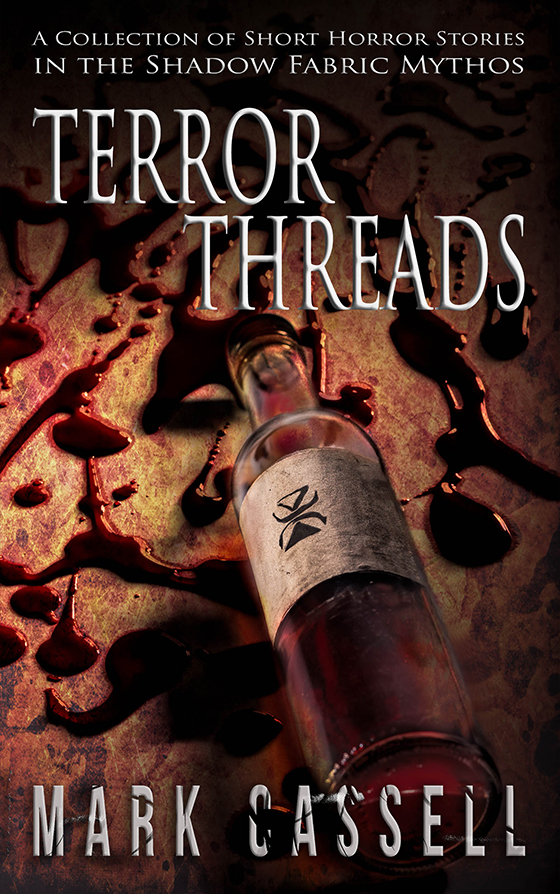
Mark Cassell: Many deleted scenes have become short stories I’ve later sold to anthologies, and now feature in my collections, Sinister Stitches and my most recent release, Terror Threads. There’s always something left over, lurking in a folder somewhere. Or if not, they remain as scribbles in my notebook, awaiting just the right story.

Meghan: What is in your “trunk”?

Mark Cassell: A prequel to The Shadow Fabric, revealing the troubled history of a couple of key characters from the novel.

Meghan: What can we expect from you in the future?

Mark Cassell: I’m neck deep in a novel titled PARASITE CROP, so I’m cracking on with that. Although at the moment I’ve set aside writing short stories, I do have a couple soon released by both KJK Publishing and Crystal Lake Publishing.

Meghan: Where can we find you?

Mark Cassell: Website (and a free book) ** Twitter ** Facebook

Meghan: Do you have any closing words for your fans or anything you’d like to say that we didn’t get to cover in this interview?

Mark Cassell: Often readers ask where I find inspiration, so I’ll answer that here.

Usually it’s desolation and ruins. Barren ground, an expanse of nothingness, empty places, void of anyone else, that kind of thing. I think what intrigues me is that there can be beauty and serenity in the way nature takes over, the way the elements tear down anything manmade. Think of the pattern of rust, the pockmarked sandstone from an assault by the wind, and the tangle of determined weeds. Relentless, often silent deterioration or even growth, and it will always be there long after we die.

I see through it and use it, injecting new life into that which is otherwise derelict. My stories have featured castle ruins and ancient rock, rusty machines and collapsed outhouses. Even a part of my novel was set in … um … if I told you, I’d spoil the twist … Incidentally, most of my dreams are apocalyptic and I think that’s why I’ve turned my hand to dystopian cyberpunk; a scorched landscape where my characters roam free.

Mark Cassell can label himself as author, artist, and actor, but his passion is clearly stamped in the written word. As the author of the best-selling Shadow Fabric Mythos, as series of books about demons, devices and deceit, he has a penchant for ignoring typical horror tropes, casting them into the void. Although best known for cosmic horror, he also writes steampunk, sci-fi, and dark fantasy, with work published in numerous reputable anthologies. More about Mark can be found at his website.

The Shadow Fabric

Leo remembers little of his past. Desperate for a new life, he snatches up the first job to come along. On his second day he witnesses a murder, and the Shadow Fabric – a malevolent force that controls the darkness – takes the body and vanishes with it. Uncovering secrets long hidden from humankind, Leo’s memory unravels. Not only haunted by the past, a sinister presence within the darkness threatens his existence and he soon doubts everything and everyone… including himself. 

Now Leo must confront the truth about his past before he can embrace his future. But the future may not exist. 

THE SHADOW FABRIC is a story revealing the unknown history of witchcraft and the true cause of the Great Fire of London. A supernatural novel of sins, shadows, and the reanimated dead.

In the Company of False Gods

When commissioned to build a clockwork construct, wheelchair-bound Attacus doubts his abilities. Once powered up, his creation escapes and runs amok, destroying more than just the town he calls home. Hunting his deadly automaton forces him to confront his past. 

He had no idea his creation would take him to the threshold between worlds. 

And soon he finds himself… 

In the Company of False Gods.

Terror Threads

Pull a thread… and you’ll be dead. 

Ten standalone tales in the best-selling Shadow Fabric Mythos. Each story of ghosts, of demons, of the occult, weaves the mythos tighter and proves we all have the power to see in the dark. Both an introduction to the Shadow Fabric and a companion book, this collection of horror stories contains the following: 

  • Dust Devils: When a driving instructor’s pupil fails to turn up for a lesson, he doesn’t just drive off. He investigates… things.
  • A Story of Amber: Two brothers and a grandfather’s secret. This is a story that begins in childhood and ends in adulthood.
  • Claimed: In Yellowstone Country Park things are black.
  • The Rebirth: A primary school teacher’s lesson fails to go to plan when a peculiar Easter egg lands in her possession.
  • Dead Lines: An artist learns she is not the only one holding the brush.
  • Pile of Dirt: After a serious accident, all you want to do is relax in your garden. But the mysterious pile of dirt that has appeared on your lawn bugs the hell out of you.
  • The Commission: A photographer’s commission proves to be a pain in the neck.
  • Diagonal Dead: It’s a shame that dead can’t stay dead, especially those who are discovered in a wall cavity.
  • Demon Alcohol: Staying at a bed and breakfast in a quaint harbour town, Tammy is not in the mood for uninvited guests. Especially when she’s hungover and the guests are demons.
  • A Sunset Companion: The low October sun can cause road accidents by blinding drivers… but perhaps there are other causes in the surrounding woodland.

Most of the stories featured in this collection have been previously published in anthologies.