Halloween Extravaganza: INTERVIEW: John Quick

Meghan: Welcome back… well, sort of back… back to the annual Halloween Extravaganza, but welcome TO the brand new blog. It’s been awhile since we sat down together. What’s been going on since we last spoke?

John Quick: A lot, actually. I think we last talked after the release of The Journal of Jeremy Todd, and since then I’ve released three more novels, a novella, and another short story collection. In other words, a lot, lol.

Meghan: Who are you outside of writing?

John Quick: A husband, father, geek, and stuck in the 80’s, I guess, lol! I’ve got a horrid day job to help pay the bills so I can do this writing thing, but love spending time with my wife and kids, and friends playing D&D or board games or just hanging out talking about Marvel MCU movies, Doctor Who, and other geek-related subjects. Basically, I’m a guy who never grew up, but had to grow up because I’m in my forties, lol.

Meghan: How do you feel about friends and close relatives reading your work?

John Quick: As long as they remember I’m not what I write, I’m good with it. Two of my closest friends are actually beta readers. I let them do it, because they’re the kind of friends who don’t care if they tell me it’s shit when it is. They could care less about my feelings and more about making sure my career actually goes somewhere. As to family, my wife reads everything, albeit slowly, and while my mother supports my career as a writer, she can’t get past the swearing in my books, much less the subject matter.

Meghan: Is being a writer a gift or a curse?

John Quick: It’s both. It’s a gift because it gives me a way to release the things that wind up trapped inside my head (take that how you will). It’s also introduced me to some of the most awesome people I’ve ever met. I’ve had more than one person comment that when I’m at a con with my contemporaries, I seem happier than normal, and more in my element than they’ve ever seen me. It’s also a curse because it’s a compulsion to do what I do. I get grumpy when the writing’s not going well, and occasionally get depressed with the way the business end of this whole thing works. Make no mistake, this is a job, just one that is immensely more satisfying than anything else I’ve ever done. Like every job, though, it has its good days and its bad. You have to take both if you want to do this.

Meghan: How has your environment and upbringing colored your writing?

John Quick: For a long time, I tried to ignore my environment and upbringing. It seemed that everything was in rural Maine or in a big city. Once I finally stopped being ashamed of my humble beginnings, and kind of made Tennessee a character of its own in my work, things got much, much easier.

Meghan: What’s the strangest thing you have ever had to research for your books?

John Quick: Wow, I don’t even know. I’ve given up on having a normal search history in Google, I’ll put it that way. Maybe it’s the real stories behind the concept of succubi, or what a stun gun does to a human face when that particular warning is ignored. I really don’t know.

Meghan: Which do you find the hardest to write: the beginning, the middle, or the end?

John Quick: The beginning. I always have a scene come into mind right away, but it’s usually once things start going. I hate having to write up to that point, but love going past it.

Meghan: Do you outline? Do you start with characters or plot? Do you just sit down and start writing? What works best for you?

John Quick: I am a total pantser. When a story comes into my head, it’s a scenario, including the people involved in it. Then I start writing and wait for them to introduce themselves and show me how they’re going to deal with that scenario. The exception is the final book of a potential fantasy trilogy I’m working on, where I had to outline it to keep everything straight in my own head. It made it very tough to work on. The outline’s finished, but the actual writing is ongoing, if you’re curious.

Meghan: What do you do when characters don’t follow the outline/plan?

John Quick: I let them lead me. If I don’t know where the story’s going, how will the reader?

Meghan: What do you do to motivate yourself to sit down and write?

John Quick: I treat it like the job it is. Simple as that. And as complicated.

Meghan: Are you an avid reader?

John Quick: Absolutely. I couldn’t write if I didn’t read a lot, too.

Meghan: What kind of books do you absolutely love to read?

John Quick: Horror or fantasy, and I want believable characters and a story that sucks me in.

Meghan: How do you feel about movies based on books?

John Quick: They’re hit or miss. I can deal with them as long as they keep the spirit of the original work. You mess with character motivations, development, or how they act, and we’ve got issues, though. That’s why I hated Legend of the Seeker. I loved the Sword of Truth novels, but the TV show acted like they only read the first book and ignored the rest.

Meghan: Have you ever killed a main character?

John Quick: Sure. In the fantasy series. But that’s almost a trope now, isn’t it?

Meghan: Do you enjoy making your characters suffer?

John Quick: The way I see it, if the reader loves the character, and the character suffers, so will the reader. Isn’t that what horror’s all about?

Meghan: What’s the weirdest character concept that you’ve ever come up with?

John Quick: Most of my characters are normal-ish. If they don’t feel real, I don’t use them. Hence, most aren’t any weirder than I am (again, take that how you wish, lol).

Meghan: What’s the best piece of feedback you’ve ever received? What’s the worst?

John Quick: Best? Don’t put your eggs in one basket. I’ve worked with several small presses, as well as doing some self-publishing. Because of that, I’m not as afraid of any one of those falling apart. I have alternates if I need them.

The worst? Try a Facebook ad. I did, and I might as well have flushed the money down the toilet. It might work for someone else, but it sure didn’t for me.

Meghan: What do your fans mean to you?

John Quick: I write for myself (write the story you want to read). That said, I’m still adjusting to the fact I actually have fans! Those I have, though, I love dearly. They make me feel I’m on the right path with this, and they make me feel it’s all worthwhile. While, as I said, I write for me, there is a part of me that hopes they like it too, and worries about it after every release.

Meghan: If you could steal one character from another author and make them yours, who would it be and why?

John Quick: Brian Keene’s Levi Stoltzfus. I’d love to throw him in one of the Cochran books and have those two deal with a case. I think that would be a blast.

Meghan: If you could write the next book in a series, which one would it be, and what would you make the book about?

John Quick: That’s a tough one. While it’s not a proper series, I’d love to play with the characters from Neil Gaiman’s Sandman comic series. I’d do a story about a guy who’s slowly going insane, and bring in the Endless to make it really hit home. I can see how all of them could fit into the story. Would he pull out of it, or would he succumb to it? I’d have to write it to find out, but it would definitely be interesting getting there, either way!

Meghan: If you could write a collaboration with another author, who would it be and what would you write about?

John Quick: I’m actually doing that right now. It’s about a band in 1984 that makes a bargain with something for fame and fortune, and the impact that has on their lives over the years. I don’t want to say more about it right now; you’ll just have to see it when it’s finished.

Meghan: What can we expect from you in the future?

John Quick: I have a new novel coming out in November from Silver Shamrock, called Hidden Hearts (though the title may change). It’s a ghost story / haunted house novel that contains some of the most emotional stuff I’ve ever written. Beyond that, I’ve got a few things in the works that may or may not pan out, so keep watching to see how they develop!

Meghan: Where can we find you?

John Quick: I’m everywhere. Facebook (personal profile or fan profile), Twitter, Instagram, or my website.

Meghan: Do you have any closing words for your fans or anything you’d like to say that we didn’t get to cover in this interview or the last?

John Quick: I could never have guessed how my life was going to turn out when I first started this a few years ago, and am thrilled beyond belief at how it’s gone. Thank you to everyone for all the support, and I can’t wait to see where you let me go in the future!

If you ask his wife, John Quick is compelled to tell stories because he’s full of baloney. He prefers to think he simply has an affinity for things that are strange, disturbing, and terrifying. As proof, he will explain how he suffered Consequences, transcribed The Journal of Jeremy Todd, and regaled the tale of Mudcat. He lives in Middle Tennessee with his aforementioned long-suffering wife, two exceptionally patient kids, four dogs that could care less so long as he keeps scratching that perfect spot on their noses, and a cat who barely acknowledges his existence.
Halloween Extravaganza: INTERVIEW: Mark Tufo

Meghan: Hi, Mark. Welcome to Meghan’s House of books. Tell us a little bit about yourself.

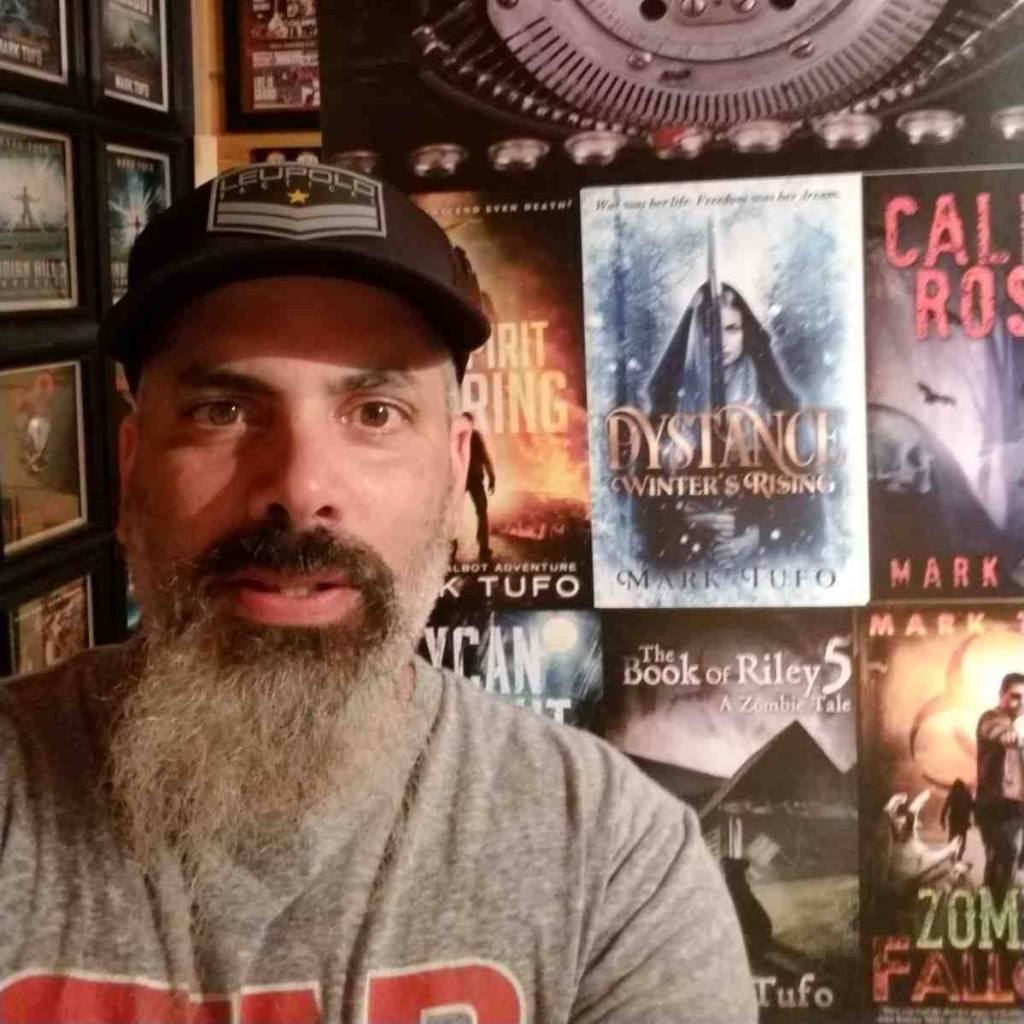
Mark Tufo: Hi. First off, thank you for having me on your page, I truly appreciate it. My name is Mark Tufo. I’ve been writing professionally now for about ten years and have over 40 full length books to my credit. I am also allowed to feed three spoiled bull dogs.

Meghan: What are five things most people don’t know about you?

Mark Tufo: Damn my life is already like an open book this might be tough. Okay first off, contrary to popular belief I like cats. Let’s see, Jaws pretty much screwed with my ability to enjoy the ocean. Reading IT killed any love I may have had for clowns. I have OCD and ADD which means that I need to finish everything if I’m not being distracted by shiny things. I think that’s five!

Meghan: What is the first book you remember reading?

Mark Tufo: Another tough one, as a kid I went to the library a LOT, but maybe the first book the stuck with me was IT.

Meghan: What are you reading now?

Mark Tufo: Bloody Rose by Nicholas Eames, kind of throws the whole fantasy genre on its ear.

Meghan: What’s a book you really enjoyed that others wouldn’t expect you to have liked?

Mark Tufo: I really liked The Host by Stephanie Meyer.

Meghan: What made you decide you want to write? When did you begin writing?

Mark Tufo: I decided to write as a way to alleviate the stress of being laid off, I was reading a bunch and seemed a natural progression. I’ve always loved to write ever since grade school, never thought I’d be doing it professionally though.

Meghan: Do you have a special place you like to write?

Mark Tufo: I generally write while I’m parachuting, so it’s about a three minute window where I’m typing furiously, or my office.

Meghan: Do you have any quirks or processes that you go through when you write?

Mark Tufo: Well coffee is involved but that’s probably a standard, I also have very loud music on. Sounds strange but it drowns out the rest of the world.

Meghan: Is there anything about writing you find most challenging?

Mark Tufo: It’s the editing, writing to me is by far the easiest aspect of this entire endeavor it’s once the book is completed that the real work begins.

Meghan: What’s the most satisfying thing you’ve written so far?

Mark Tufo: It’s funny, commercially it is one of my least successful books but I am particularly proud of The Spirit Clearing.

Meghan: What books have most inspired you? Who are some authors that have inspired your writing style?

Mark Tufo: I couldn’t even begin to list all of the authors that have inspired me. I grew up and remain a huge Stephen King fan so there’s influence there and Susanna Clarke is also someone that writes an incredible tale, I just wish she was a little more prolific.

Meghan: What do you think makes a good story?

Mark Tufo: Suspense is a key element, the need to read that next page, to see what’s going to happen but it’s the characters that matter the most, if you don’t care if they live or die then you aren’t vested in the story and at that point it doesn’t matter what they’re doing.

Meghan: What does it take for you to love a character? How do you utilize that when creating your characters?

Mark Tufo: Whether a reader loves or hates a character I think depends on how relatable the character is. Most of my characters are every person types, they are imperfect, they have flaws, aspects we all have.

Meghan: Which, of all your characters, do you think is the most like you?

Mark Tufo: Many mistakenly believe Michael Talbot and myself are interchangeable but that guy is nuts.

Meghan: Are you turned off by a bad cover? To what degree were you involved in creating your book covers?

Mark Tufo: Being an author you’d think I’d know better but yeah an off-putting cover can set the tone.

Meghan: What have you learned creating your books?

Mark Tufo: I’ve learned that my grasp of the English language is rudimentary at best and without a great editor I’m pretty sure I’d be asking people if they wanted fries with that. Not that there’s anything wrong with that, just at this age I should have probably moved on.

Meghan: What has been the hardest scene for you to write so far?

Mark Tufo: Really any time a character I care for dies, it’s a difficult process, you’d think it would get easier, if anything it’s tougher. I wonder if George R.R. Martin offers any courses?

Meghan: What makes your books different from others out there in this genre?

Mark Tufo: I think it is the blend of sarcasm and humor, people seem to like laughing one page and hiding under their covers the next.

Meghan: How important is the book title, how hard is it to choose the best one, and how did you choose yours (of course, with no spoilers)?

Mark Tufo: To me I think the cover is more important, as for the title I like for it to give an idea of what readers can expect in the pages. Also without giving everything away. Although how brilliant was John Dies at the End as a title?

Meghan: What makes you feel more fulfilled: Writing a novel or writing a short story?

Mark Tufo: I don’t write many shorts, usually just for special occasions or freebies around the holidays. Sure there’s a satisfaction when completing one but for me I find it to be more fulfilling to write a full length book, something you have time to develop characters with and really flesh the story out. Shorts always seem rushed to me.

Meghan: Tell us a little bit about your books, your target audience, and what you would like readers to take away from your stories.

Mark Tufo: My books… well I like to write what I read, I’ve got a zombies series, werewolves, vampires, paranormal, young adult, science fiction, I’m sure eventually I’ll get around to a historical romance. My target audience, the planet I guess. I mean who doesn’t want a world-wide audience? As for a take away, my hope would be that the few hours they spent with my stories they found fun and entertaining, if that’s the case it’s a win.

Meghan: Can you tell us about some of the deleted scenes/stuff that got left out of your work?

Mark Tufo: I have a propensity to go darker in my stories than intended, can’t write three quarters of a book in PG format to then all of a sudden hit a hard R. I’ve also offed characters that I’ve had to back track and re-write. I don’t know why I keep killing people! I might need help.

Meghan: What is in your “trunk”? (It doesn’t necessarily have to be book related.)

Mark Tufo: I am attempting to build a life size R2D2, I am a person that works well when directions are present, this project has none and I find myself frozen in indecision a bunch!

Meghan: What can we expect from you in the future?

Mark Tufo: Well the hope is that the statute of limitations will expire soon and the future won’t entail jail. Oh wait that’s probably not what you were talking about. Um in terms of books, I’ll be releasing ZF13 and 14, A Shrouded World 5 and 6 (a project with my friend John O’Brien), then another collaboration, The Bleed, with Chris Philbrook and David Moody. Then there’s a few shorts that ended up in some anthologies, I’m also currently working on my first fantasy. I think for now that might be it. ☺

Meghan: Where can we find you?

Mark Tufo: I’m all over the place on Facebook. I also have two fan pages, a website, or if you want to reach out by email.

Meghan: Do you have any closing words for your fans or anything you’d like to say that we didn’t get to cover in this interview?

Mark Tufo: I’d like to thank all of the fans and readers that have supported me over the last ten years. I cannot thank you enough for allowing me to do what I love. Without you, well I’m just some weird guy tapping away at a keyboard, Now that I think of that I guess that’s still true but now I get paid to do it!

Mark Tufo was born in Boston Massachusetts. He attended UMASS Amherst where he obtained a BA and later joined the US Marine Corp. He was stationed in Parris Island SC, Twenty Nine Palms CA, and Kaneohe Bay Hawaii. After his tour he went into the Human Resources field with a worldwide financial institution and has gone back to college at CTU to complete his masters.

He has wrote the first installment of the Indian Hill trilogy in college, it sat in his garage until July 2009 when he published it on Kindle. He has since written the Zombie Fallout series and is working on a new zombie book.

He lives in Maine with his wife, three kids and two English bulldogs. 

Visit him at his website, blog, or Facebook Author Page for news on his next two installments of the Indian Hill trilogy and upcoming installments of the Zombie Fallout series.

Halloween Extravaganza: INTERVIEW: Jonathan Janz

Meghan: So, you’ve made it back for round three, Jonathan, where the questions get more and more difficult.

What are your go-to horror films?

Jonathan Janz: A few I’ve watched and rewatched are (of course) Jaws, which is one of my top-three films ever. I also love Ravenous, which I probably watched ten times over a few months back in the early 2000s. Another would be the original Halloween for the way it builds suspense bit by bit.

Meghan: What makes the horror genre so special?

Jonathan Janz: So many traits make horror special, but one of the ones I appreciate the most is its diversity of subject matter. It can be supernatural or non-supernatural, grounded or completely surreal. It can have creatures. It can be set in another time and place. The possibilities are endless.

Meghan: Have any new authors grasped your interest recently?

Jonathan Janz: Sarah Read really blew me away with The Bone Weaver’s Orchard. A couple others that are doing great work are Tim Meyer and John Quick.

Meghan: How big of a part does music play in creating your “zone”? What do you listen to while writing?

Jonathan Janz: It’s integral to my process. I listen to Baroque music (usually played by Yo-Yo Ma) when I write, and it really gets my creativity flowing. It also drowns out the noise of my house, and with three kids and two dogs, that can be pretty important sometimes.

Meghan: How active are you on social media? How do you think it affects the way you write?

Jonathan Janz: Relatively active, though I’ve had to scale back. I simply don’t have time to be on there much. It doesn’t affect my writing much, though I do see interesting items there sometimes that pique my interest.

Meghan: What is your writing Kryptonite?

Jonathan Janz: My busy schedule. Everyone thinks he/she is busy, but I’d put my schedule beside anyone’s and give him/her a run for his/her money. I have two full-time jobs (teaching at one of the most demanding public schools in the nation, as well as being an author), a family to love and take care of, the entire business side of writing (every day I have a punch list of maybe seven or eight tasks I try to get done), my ninety-four-year-old grandpa to help, three different teams to coach (in three different sports), a house to maintain, my fitness to keep up, and… oh yeah, a wife I’d like to see a lot more often. I simply wish there were more hours in the day.

Meghan: If you were making a movie of your latest story/book, who would you cast?

Jonathan Janz: In my current work-in-progress, I’d cast Chris Hemsworth as one of the characters and Nick Offerman as another. Those two would play really well off each other.

Meghan: If you had the choice to rewrite any of your books, which one would it be and why?

Jonathan Janz: GARDEN OF SNAKES. It’s my one “trunk novel,” and I still love certain aspects of the story. I just didn’t know how to write it back then, and it showed in the final product.

Meghan: What would the main character in your latest story/book have to say about you?

Jonathan Janz: He’d tell me to breathe, to lighten up a bit so I could get more sleep.

Meghan: Did you hide any secrets in your books that only a few people will find?

Jonathan Janz: I absolutely do. Writing is an intensely personal act, so some of the stuff would only be detected by people who know me well. Brian Keene does that a lot with my work, most recently in The Dark Game.

Meghan: How much of yourself do you put in your books?

Jonathan Janz: So much! Most of the time, though, it’s accidental, and I’m not even aware of it until I notice it later, or after publication, when someone points it out to me.

Meghan: Have you ever incorporated something that happened to you in real life into our novels?

Jonathan Janz: Many of the events in Children of the Dark are based on real-life occurrences. I lived in that house, on that street, beside that graveyard, and in front of that woods. That was my baseball field and my hometown. Those were my friends. It’s incredibly autobiographical, and I think that shows in a positive, poignant way.

Meghan: Are your characters based off real people, or did they all come entirely from your imagination?

Jonathan Janz: Some of both, though more of the latter than the former. I’d say my imagination is the food, and other people are the seasonings I sprinkle in.

Meghan: How do you think you’ve evolved creatively?

Jonathan Janz: I’ve grown much more confident. I now can look at something I’ve written and say, “That doesn’t work,” and go back and delete it or change it. That takes a strong stomach because you’re admitting to yourself that you made a mistake or that you were off track for a day or three.

Meghan: What is the most difficult part of your artistic process?

Jonathan Janz: Letting go of a book. I edit and edit and edit and would probably keep doing that in perpetuity if I didn’t force myself to let it go at some point.

Meghan: Does writing energize or exhaust you?

Jonathan Janz: Definitely both. I get so excited when I write something that works, but when I’m done each day I feel like I’m in a fog. I tell my wife and kids it’s like Han Solo unfreezing from carbonite.

Meghan: Do you read your book reviews? How do you deal with the bad ones? Have you ever learned something from a negative review and incorporated it into your writing?

Jonathan Janz: I read them less and less, and there are people whose reviews I don’t even glance at because I know where they’re coming from, and it’s not a happy place. They have value, and I’ve read positive and negative reviews that have both helped me, but I simply don’t have the time to look at them much anymore because I’m too busy creating.

Meghan: Why are your ambitions for your writing career? What does “literary success” look like to you?

Jonathan Janz: Someday, I’d like to write full time. I’m in no hurry to get there, and if I could write now, I don’t think I would because I truly love teaching too much. But at some point that would be a blast.

Jonathan Janz is the author of more than a dozen novels and numerous short stories. His work has been championed by authors like Joe R. Lansdale, Jack Ketchum, and Brian Keene; he has also been lauded by Publishers Weekly, Library Journal, and School Library Journal. His ghost story The Siren and the Specter was selected as a Goodreads Choice nominee for Best Horror. Additionally, his novel Children of the Dark was chosen by Booklist as a Top Ten Horror Book of the Year. Jonathan’s main interests are his wonderful wife and his three amazing children. You can sign up for his newsletter, and you can follow him on Twitter, Instagram, Facebook, Amazon, and Goodreads.

Halloween Extravaganza: INTERVIEW: Mark Cassell

Meghan: Hi, Mark! Welcome to Meghan’s House of Books. Thank you for stopping by. Let’s start with something easy: Tell us a little bit about yourself.

Mark Cassell: It’s an honour to be here, thank you.

I’m a UK author who leans towards cosmic horror and the supernatural. My sci-fi, fantasy and steampunk work contains a splash of horror somewhere, though I am not one for a gore-fest. My dreams are often apocalyptic, and at 5 o’clock most mornings you’ll find me cradling coffee at my writing desk. I live near the sea with my wife and many pets, keep fit doing gym stuff but love pizza and chocolate (not on the same plate).

Meghan: What are five things most people don’t know about you?

Mark Cassell:

No. 1 : I suffer from tinnitus possibly due to the dozens of metal gigs I attended in the 1990s.
No. 2 : I breed mealworms.
No. 3 : I have only one dental filling, and swear it’s because I drink a lot of milk.
No. 4 : I once came second place in a Fancy Dress competition dressed as a toffee.
No. 5 : In my early 20s I occasionally worked as a spotlight operator for an Elvis impersonator.

Meghan: What is the first book you remember reading?

Mark Cassell: Unfortunately I can’t remember either title or author, let alone how old I was when I read it, but the visuals have stuck with me ever since. The story featured a little girl whose strange friend, a gangly and mischievous creature, lurked in the shadows at the bottom of her garden. This peculiar companion would call her name “Eniiiiid, Eniiiiid…” and encourage the girl to misbehave. I’d love to know what book that was.

Meghan: What are you reading now?

Mark Cassell: Simon R. Green’s fantasy novel Down Among the Dead Men. It’s a swords and sorcery tale, a simple read, and a nice break from my usual genre.

Meghan: What’s a book you really enjoyed that others wouldn’t expect you to have liked?

Mark Cassell: Yann Martel’s Life of Pi. A truly stunning novel that some may recognise as the 2012 movie directed by Ang Lee. It features an Indian boy on a lifeboat with a Bengal tiger named Richard Parker.

Meghan: What made you decide you want to write? When did you begin writing?

Mark Cassell: At school when I was ten years old, I wrote something which later I’ve wondered what my teacher thought after reading it. The story followed a boy who discovers a treehouse in the woodland beyond his garden. He climbs up to find boxes filled with dead animals, and shelves stacked with jars containing human brains. When he goes back the next day, all that remains of the treehouse is a charred trunk from where a fire had ravaged it.

As for when I decided to “properly” write, I guess that was when I hit my mid-thirties. The weirdness hasn’t changed much during that gap of a couple of decades.

Meghan: Do you have a special place you like to write?

Mark Cassell: There’s a room in our house that’s dedicated to books. My desk is wedged in the corner next to a vivarium, the home of my little buddy, Arnie the bearded dragon. I’m not a writer who can sit in a noisy coffee shop, nor on a park bench. For me, I need to plug in to my tunes to crack on with the project at hand.

Meghan: Do you have any quirks or processes that you go through when you write?

Mark Cassell: There’s a process I go through which probably isn’t anything special. I print out a hard copy and attack it with the Red Pen of Doom. No matter the length, I cannot let a story out of my sight until it’s gone through at least one round with the Red Pen.

Meghan: Is there anything about writing you find most challenging?

Mark Cassell: Fighting the Procrastination Demon. He’s a frequent problem.

Meghan: What’s the most satisfying thing you’ve written so far?

Mark Cassell: My Lovecraftian steampunk horror book titled In the Company of False Gods. It follows wheelchair-bound Attacus who’s commissioned to build a clockwork construct, though he doubts his abilities. Once powered up, his creation escapes and runs amok, destroying more than just the town he calls home. Hunting his deadly automaton forces him to confront his past. He had no idea his creation would take him to the threshold between worlds.

And I had no idea this book would remain one of my favourites. I really need to revisit that genre again. Yeah, there’s certainly a splash of horror in that one.

Meghan: What books have most inspired you? Who are some authors that have inspired your writing style?

Mark Cassell: Back when I was a teenager, James Herbert kicked my love for horror into overdrive with his novel Magic Cottage. Also, Clive Barker‘s early work like Weaveworld and The Damnation Game, and later Imajica truly inspired me. Alongside Brian Lumley‘s incredible Necroscope series, I’d say these three British authors led me down the dark path I now tread.

Meghan: What do you think makes a good story?

Mark Cassell: For a novel there must be a spark within the first three pages, along with characters who carry that spark to the last page. As for a short story, the first paragraph needs to slap you in the face either with a genius hook or a character the reader will undoubtedly care about. I’m a tough nut to crack, and life is short, so when I read something it must grip me pretty damn quickly.

Meghan: What does it take for you to love a character? How do you utilize that when creating your characters?

Mark Cassell: Characters need to be human and I love it when I can immediately relate. There must be a connection between character and reader. When I create my own characters, I try to emulate that. I want to make my readers immediately tune in. It helps using all the senses, so as to make the reader land on the page and see through the character’s eyes.

Meghan: Which, of all your characters, do you think is the most like you?

Mark Cassell: Undoubtedly it’s Leo from my novel The Shadow Fabric. As a debut, it was inevitable the main character would somehow reflect me. Not the tormented mysteries that unravel throughout the story. That’s all fiction, honest! I’m talking about his travels round the world, his knee injury, and his penchant for wearing combat trousers. Also, I know damn well he acts like me.

Meghan: Are you turned off by a bad cover? To what degree were you involved in creating your book covers?

Mark Cassell: I’ve been lucky enough to work with three book cover guys, and they deserve a mention: Christopher Shoebridge, Redski Redd, and Paul Ashby. When it comes to reading I can be incredibly picky, as already mentioned, so there are many factors that could put me off. But I may let off a dodgy book cover – as long as it’s not too bad – however if a blurb begins with Inspector/Detective blah-blah-blah, I’ll drop it and look for something else. Call me unfair, I know, but that honestly puts me off. And I have no idea why.

Meghan: What have you learned creating your books?

Mark Cassell: It’s not an easy process. This writing thing is a hard game to play and I admit in getting bogged down in striving for perfection. To top that off, I find myself swinging between an existence as an introvert and an extrovert. There are days I simply wish to hide in a cave and write, while on others I’m happy to attend book signings at conventions. Marketing needs to be full on for much of the time, so yeah, it’s hard work. But equally rewarding.

Meghan: What has been the hardest scene for you to write so far?

Mark Cassell: In my book Hell Cat of the Holt, there’s a sad scene where the main character is utterly stricken with grief. At the time of writing, I was not in a good place and my life had turned upside down, so that particular scene was a tough one.

Meghan: What makes your books different from others out there in this genre?

Mark Cassell: When I first came into the writing game, I was bored to death of detectives with drinking problems, each hunting vampires and werewolves and Hollywood-type evils, and I was incredibly tired of zombies and the like, all causing predictable havoc. With that in mind, I listed every cliché that made me yawn.

That list was long.

So when plotting my debut novel I stripped naked the old tropes of witchcraft and demonology. I recognised that I needed to be different and so had to lay my own foundations, to devise a new kind of evil, a fresh menace. Essentially a novel of demons and deceit, The Shadow Fabric became a tale of a sentient darkness and a 17th-century device. Based in modern day, it’s the story of one man’s struggle to unravel his past. As he learns more, he begins to mistrust all those around him. Including himself.

My short stories and subsequent books have followed that marker, and I’m proud to say that the reviews have often mentioned the fresh angle the story delivers.

Though there is one problem with this: it makes me far from prolific.

Meghan: How important is the book title, how hard is it to choose the best one, and how did you choose yours (of course, with no spoilers)?

Mark Cassell: Sometimes a title comes first and other times last. For instance, I was once invited to write for a Christmas anthology and immediately came up with “Away in a Mangler.” After that, the story flowed. However, the title of my debut novel The Shadow Fabric came along in 1993 during my college years, though I didn’t begin writing it until 20 years later.

Meghan: What makes you feel more fulfilled: Writing a novel or writing a short story?

Mark Cassell: Novels are a long slog. Short stories are precisely that: short, quick and to the point. My brain is all over the place at the best of times, and so I’ve found I attack short stories considerably easier.

Meghan: Tell us a little bit about your books, your target audience, and what you would like readers to take away from your stories.

Mark Cassell: I’ve been lucky enough to meet readers at book signings and conventions, and so I’ve learnt what it is they enjoy about my books. It seems to boil down to two things: firstly, the subtly in which I explore the evil within us as a species, and also the evils beyond the walls of our reality (whichever genre I step into). Secondly, the extensive research I go into hasn’t gone unnoticed. I believe in order to create a solid story, no matter the length, it’s important to establish something that which is already grounded. It’s that what connects the reader.

Meghan: Can you tell us about some of the deleted scenes/stuff that got left out of your work?

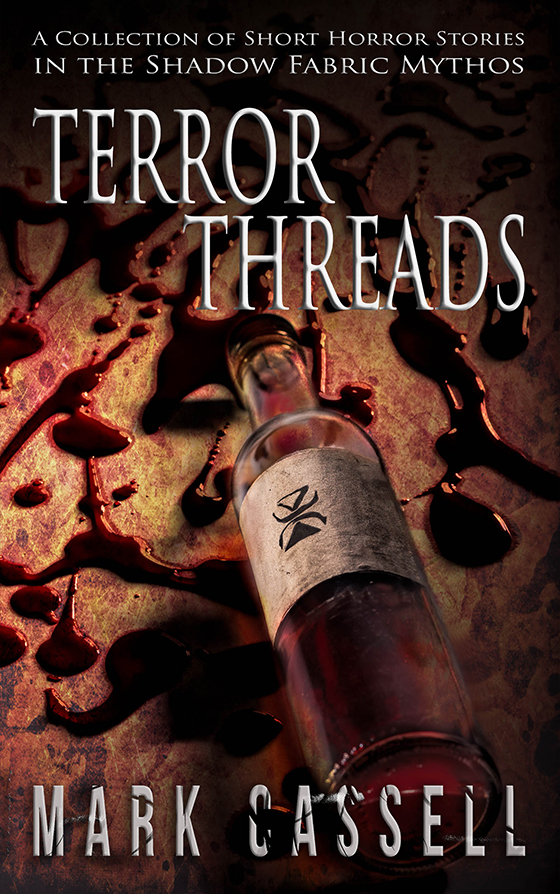
Mark Cassell: Many deleted scenes have become short stories I’ve later sold to anthologies, and now feature in my collections, Sinister Stitches and my most recent release, Terror Threads. There’s always something left over, lurking in a folder somewhere. Or if not, they remain as scribbles in my notebook, awaiting just the right story.

Meghan: What is in your “trunk”?

Mark Cassell: A prequel to The Shadow Fabric, revealing the troubled history of a couple of key characters from the novel.

Meghan: What can we expect from you in the future?

Mark Cassell: I’m neck deep in a novel titled PARASITE CROP, so I’m cracking on with that. Although at the moment I’ve set aside writing short stories, I do have a couple soon released by both KJK Publishing and Crystal Lake Publishing.

Meghan: Where can we find you?

Mark Cassell: Website (and a free book) ** Twitter ** Facebook

Meghan: Do you have any closing words for your fans or anything you’d like to say that we didn’t get to cover in this interview?

Mark Cassell: Often readers ask where I find inspiration, so I’ll answer that here.

Usually it’s desolation and ruins. Barren ground, an expanse of nothingness, empty places, void of anyone else, that kind of thing. I think what intrigues me is that there can be beauty and serenity in the way nature takes over, the way the elements tear down anything manmade. Think of the pattern of rust, the pockmarked sandstone from an assault by the wind, and the tangle of determined weeds. Relentless, often silent deterioration or even growth, and it will always be there long after we die.

I see through it and use it, injecting new life into that which is otherwise derelict. My stories have featured castle ruins and ancient rock, rusty machines and collapsed outhouses. Even a part of my novel was set in … um … if I told you, I’d spoil the twist … Incidentally, most of my dreams are apocalyptic and I think that’s why I’ve turned my hand to dystopian cyberpunk; a scorched landscape where my characters roam free.

Mark Cassell can label himself as author, artist, and actor, but his passion is clearly stamped in the written word. As the author of the best-selling Shadow Fabric Mythos, as series of books about demons, devices and deceit, he has a penchant for ignoring typical horror tropes, casting them into the void. Although best known for cosmic horror, he also writes steampunk, sci-fi, and dark fantasy, with work published in numerous reputable anthologies. More about Mark can be found at his website.

The Shadow Fabric

Leo remembers little of his past. Desperate for a new life, he snatches up the first job to come along. On his second day he witnesses a murder, and the Shadow Fabric – a malevolent force that controls the darkness – takes the body and vanishes with it. Uncovering secrets long hidden from humankind, Leo’s memory unravels. Not only haunted by the past, a sinister presence within the darkness threatens his existence and he soon doubts everything and everyone… including himself. 

Now Leo must confront the truth about his past before he can embrace his future. But the future may not exist. 

THE SHADOW FABRIC is a story revealing the unknown history of witchcraft and the true cause of the Great Fire of London. A supernatural novel of sins, shadows, and the reanimated dead.

In the Company of False Gods

When commissioned to build a clockwork construct, wheelchair-bound Attacus doubts his abilities. Once powered up, his creation escapes and runs amok, destroying more than just the town he calls home. Hunting his deadly automaton forces him to confront his past. 

He had no idea his creation would take him to the threshold between worlds. 

And soon he finds himself… 

In the Company of False Gods.

Terror Threads

Pull a thread… and you’ll be dead. 

Ten standalone tales in the best-selling Shadow Fabric Mythos. Each story of ghosts, of demons, of the occult, weaves the mythos tighter and proves we all have the power to see in the dark. Both an introduction to the Shadow Fabric and a companion book, this collection of horror stories contains the following: 

  • Dust Devils: When a driving instructor’s pupil fails to turn up for a lesson, he doesn’t just drive off. He investigates… things.
  • A Story of Amber: Two brothers and a grandfather’s secret. This is a story that begins in childhood and ends in adulthood.
  • Claimed: In Yellowstone Country Park things are black.
  • The Rebirth: A primary school teacher’s lesson fails to go to plan when a peculiar Easter egg lands in her possession.
  • Dead Lines: An artist learns she is not the only one holding the brush.
  • Pile of Dirt: After a serious accident, all you want to do is relax in your garden. But the mysterious pile of dirt that has appeared on your lawn bugs the hell out of you.
  • The Commission: A photographer’s commission proves to be a pain in the neck.
  • Diagonal Dead: It’s a shame that dead can’t stay dead, especially those who are discovered in a wall cavity.
  • Demon Alcohol: Staying at a bed and breakfast in a quaint harbour town, Tammy is not in the mood for uninvited guests. Especially when she’s hungover and the guests are demons.
  • A Sunset Companion: The low October sun can cause road accidents by blinding drivers… but perhaps there are other causes in the surrounding woodland.

Most of the stories featured in this collection have been previously published in anthologies.

Halloween Extravaganza: INTERVIEW: Matt Hayward

Meghan: So, you’ve made it back for round three, Matt, where the questions get more and more difficult. [laughs manically]

What are your go-to horror films?

Matt Hayward: The Thing, Night of the Living Dead, Dog Soldiers, Killer Klowns from Outer Space, Street Trash, Evil Dead 2. I go from classic to trashy in a heartbeat.

Meghan: What makes the horror genre so special?

Matt Hayward: Horror knows no limits. You can have a comedy, romance, thriller, or any other genre, all within a horror story. Horror has a way of tackling taboo subjects you might not find anywhere else. It’s unique in facing social / political situations head-on.

Meghan: Have any new authors grasped your interest recently?

Matt Hayward: Chad Lutzke is a new name on my radar, I’m embarrassed to admit. He’s a killer writer, and I’ve been floored by everything he’s put out. Jeremy Hepler, too.

Meghan: How big of a part does music play in creating your “zone”? What do you listen to while writing?

Matt Hayward: I wish I could write to music, but, being a musician, it pulls my attention too much. That said, I listen to stuff before I write, soundtracks and bluesy stuff. Lately I’ve been on a Colter Wall, Blackwater Fever, True Detective soundtrack kinda kick.

Meghan: How active are you on social media? How do you think it affects the way you write?

Matt Hayward: It’s a necessary evil, unfortunately. If I could, I’d axe the internet and pull a ‘Bentley Little’.

Meghan: What is your writing Kryptonite?

Matt Hayward: If we’re talking what I hate when I read, I’d say stale prose. I don’t mind overused tropes – the haunted house, vampires, zombies – as long as I’m reading a fresh take and the writing remains captivating. On Writing books go a long way.

Meghan: If you were making a movie of your latest story/book, who would you cast?

Matt Hayward: The latest release was A Penny For Your Thoughts with Robert Ford, so… Aaron Paul as Joe, Dakota Fanning as Ava, and Danny McBride as Kenny.

Meghan: If you had the choice to rewrite any of your books, which one would it be and why?

Matt Hayward: I’d leave ‘em be, warts ‘n’ all. They’re a nice snapshot of where I was skill-wise, and I like the progression. I just want to concentrate on making the next one better. If I fix one, I’d fix the current one ten years down the road and so on. Let sleeping dogs lie.

Meghan: What would the main character in your latest story/book have to say about you?

Matt Hayward: Probably call me a sadist. I messed up his life pretty good. He had to use dental floss to catch a fish. Did you know that’s a thing? YouTube’s full of guys going floss fishing.

Meghan: Did you hide any secrets in your books that only a few people will find?

Matt Hayward: Absolutely. I’ve dotted characters in the backgrounds of books (Henry Stapleton from Practitioners makes a brief cameo in A Penny For Your Thoughts, for example), surnames crop up here and there, and I have one person, a single name, mentioned in every book I’ve ever written. That’ll make sense eventually.

Meghan: How much of yourself do you put in your books?

Matt Hayward: Quite a bit. Brian Keene said I ‘bleed on the page’ and I accept that as quite a high compliment. I try and keep my social/political beliefs private, I’ll never be ‘preachy’, but a lot of my own experiences and perspectives are there. If there’s not a grain of truth to the work, I’ll feel like I’ve cheated myself, and readers by proxy. I’ve shelved three novels for that very reason.

Meghan: Have you ever incorporated something that happened to you in real life into your novels?

Matt Hayward: Yup. As mentioned above, like a lot of writers, I mine past experiences. I won’t kiss and tell, though.

Meghan: Are your characters based off real people, or did they all come entirely from your imagination?

Matt Hayward: A bit of A and a bit of B. Sometimes, when the story or situation is based on something real, then the characters are, too. Occasionally, though, they’re purely speculative. Kenny from A Penny For Your Thoughts, for example, he’s completely made-up. Just a fun guy the story called for. Peter from What Do Monsters Fear? or Tony, the kid from my upcoming book, are very much real.

Meghan: How do you think you’ve evolved creatively?

Matt Hayward: I’ve learned to stop worrying and just write the next book. Now that I’ve taken a few punches and gone a few rounds, I know that some things I think are golden, people don’t like. And some things I’m unsure of, people really love. There’s no way to gauge it, so if you’re new to writing – don’t worry. Just keep putting your ass in the chair and pumping out the words. Have fun.

Meghan: What is the most difficult part of your artistic process?

Matt Hayward: The most difficult thing about writing is having patience. A book I wrote two years ago is still doing the rounds, whereas I’m already three books ahead. When that sees the light of day, I’ll need a refresher when I speak about it – it’ll be entirely foreign to me. That, and back cover copy. Talking about my writing Kryptonite – back cover copy makes me need a drink.

Meghan: Does writing energize or exhaust you?

Matt Hayward: Depends on the project. Some days it’s tiresome, I think any writer will admit that, but I always manage to plow through regardless. I’d feel much worse if I let the exhaustion overwhelm me and not work. Besides, no matter my mood, when I’m finished with a day’s writing, I always feel better.

Meghan: Do you read your book reviews? How do you deal with the bad ones? Have you ever learned something from a negative review and incorporated it into your writing?

Matt Hayward: I try and leave reviews for the readers. That said, I was directed to a pretty funny review of The Faithful in which the reviewer was shocked to find so much blasphemy. It’s a novel about a religious cult written by an Irishman, I really don’t think they thought their purchase through. Even still, I’m grateful they read it.

Meghan: What are your ambitions for your writing career? What does “literary success” look like to you?

Matt Hayward: I’d like to have a core readership that gets what I write. I’ve had a couple of talks about movie adaptions in the past, but that side of the business is alien to me, and it’s a fickle beast. That said, I would like to see something transition to the big screen. I signed with an agent earlier this year, and we’re currently subbing to the traditional market, so I’m excited to see where that leads. All I can do is continue to sharpen my skills and try to surpass my last work. As long as people are reading them, I’ll keep writing them.

Matt Hayward is a Bram Stoker Award-nominated author and musician from Wicklow, Ireland. His books include Brain Dead Blues, What Do Monsters Fear?, Practitioners (with Patrick Lacey), The Faithful, and A Penny for Your Thoughts (with Robert Ford). He compiled the Splatterpunk Award-nominated anthology Welcome to the Show and wrote the comic book This Is How It Ends (now a music video) for the band Walking Papers. Matt received a nomination for Irish Short Story of the Year from Penguin Books in 2017. He is represented by Lane Heymont of the Tobias Literary Agency and can be found on Twitter or at his website.

A Penny for Your Thoughts (with Robert Ford)

Fresh from a stretch in prison, Joe Openshaw is living at home with his father and trying to get his life together again. He has let go of old habits, especially the ones that turned him into an addict and helped land him in prison.

On a hike along the Lowback Trail, Joe stumbles on one of the town’s oldest secrets–buried long ago, if not forgotten.

It’s an unusual but safe enough treasure–a jar of old pennies. What interests Joe isn’t the pennies themselves, but the pieces of paper taped to every coin–a child’s handwritten wish on each one.

When the first few wishes come true, they are simple things. Fun. Harmless.

Except as time goes on, Joe realizes they aren’t really wishes at all…they’re exchanges, and the bill was racking up.

Nothing is free in life. 

Sooner or later, you always pay.

Various States of Decay: A Collection

From the Bram Stoker Award-nominated author of What Do Monsters Fear? and A Penny For Your Thoughts comes twenty new tales of terror!

Including the Irish Short Story of the Year-nominated Intercepting Aisle Nine

From a white doomsday crawling with abominable beasts to the bizarre case of a marketing company advertising within people’s dreams, these stories explore the extremes of Hayward’s prose–contrasting the heartfelt with the deeply disturbing.

These are… VARIOUS STATES OF DECAY