Am I the only one who remembers thinking as a child that when I grew up I would buy as much candy as I wanted and eat it every day? As an adult, other than a brief flirtation with Sugar Babies, Candy Corn still has a strong hold on me. I can’t even imagine eating only one candy corn. Once I start eating them, one by one, I can’t stop until my teeth ache and my stomach starts to whine. Other than the obvious ingredient of sugar, I was curious what else made up this innocent-looking, yet seductive deliciousness.
Curiosity has lead me to research many things, but usually it’s stuff like quantum mechanics, etc. Finding out that the place of origin for candy corn was Philadelphia was interesting, since I grew up there. Maybe that explained its hold over me? Originally it was called “Chicken Feed” when it was created in the 1880s. I’m pretty sure if they had kept that name I wouldn’t be writing about it now. It’s mainly made from sugar, corn syrup, honey & salt; well, that’s all the different kinds of sweet that accounts for the I-can’t-stop-eating-it-ness.
Millions of pounds are produced each year, which is how it’s on every store counter I pass in October. Sometimes research turns up information I wish I had never found, like there are variations of candy corn created for other holidays, not just Halloween. What the—!
There’s brown/orange/white candy corn for Thanksgiving (okay, I did know about this since it’s slyly shown up in October), red/green/white for Christmas, red/pink/white for Valentine’s Day, blue/white/red for Independence Day in the United States, and Bunny Corn for Easter (two color candy: pink/green/yellow/purple mixes). The madness goes on: caramel apple, green apple candy corn, s’mores, pumpkin spice, carrot corn, birthday cake…
There’s other forms the insidious flavor has invaded: candy corn flavored bagels, flavored martinis, Halloween costumes, beer, smoothies, deep fried, etc. Of course, a “Candy Corn” movie was released in 2019, since Tony Todd is in it I’ll have to track it down.
There are studies on how people eat each piece (whole or nibble from narrow end or the wide end), truth is I’ve done all three.
In case you think I’m the only one to obsess about this there are many essays online about candy corn. Elise Taylor wrote an essay for Vogue magazine in 2017 titled: “Candy Corn: You Either Love It or Hate It, There Is No In-Between”. There’s all kinds of statistics about people hating and loving candy corn. From Taylor’s article: “As Halloween comes and goes, so will the candy corn debate. But in late September, it’ll creep back into our consciousness and conversations again, a sugary Pennywise the Clown ready to terrorize your teeth, your towns, and your Twitter feed.”
I found a “Candy corn lovers support group” on FaceBook but I don’t think they’re going to help me control this problem because the first photo is for candy corn soda. So my little exclusion has opened up a door to eating candy corn all year long, in flavors and forms I never imagined—Noooooooo!!!
Who doesn’t need to know How To Recognize A Demon Has Become Your Friend? From the first African-American to receive the HWA Bram Stoker award, this collection of both horror and science fiction short stories and poetry reveals demons in the most likely people (like a jealous ghost across the street) or in unlikely places (like the dimension-shifting dreams of an American Indian). Recognition is the first step, what you do with your friends/demons after that is up to you.
Bram Stoker Award® winners Linda D. Addison and Alessandro Manzetti use their unique voices to create a dark, surrealistic poetry collection exploring the many ways shattered bodies, minds, and souls endure.
They created poems of visionary imagery encompassing death, gods, goddesses and shadowy, Kafkaesque futures by inspiring each other, along with inspiration from others (Allen Ginsberg, Pablo Neruda, Phillis Wheatley, etc.).
Construction of The Place started with the first bitten apple dropped in the Garden. The foundation defined by the crushed, forgotten, and rejected. Filled with timeless space, its walls weep with the blood of brutality, the tears of the innocent, and predatory desire. Enter and let it whisper dark secrets to you.
Proudly represented by Crystal Lake Publishing—Tales from the Darkest Depths.
Wee Man & the Eejit as Told by Sean “Burly” O’Shea
“There he stood, all of three-foot and six inches, clad in his finest green outfit, now covered in rancid muck. The big eejit that pushed him in the ditch had a bit much of the black stuff. He was acting the maggot he was. Trying to impress his floozie, hoping to score some fun time between her legs. The wee man, well, he wasn’t taking no shite from no codger. A real chancer that fella was getting a Mountain Leprechaun all hepped up. Everyone round these parts knows you don’t feck with a Mountain Leprechaun, a valley one maybe, worse they can do is change you into a potato until sunrise. You just pray to all hell nobody cooks you for their supper.
I saw that happen to a young lad once you know, and at sunrise when he changed back, his legs, well, they was chewed off just above the knees they was. Some yoke thought it would be a great riot to take a bite out of him when he was a potato just to see what would happen. Heads or tails he said twirling the potato in his hands before he took a good old chomp out of the damn thing. It was a riot all right; the poor lad screaming with blood gushing everywhere and everyone running around like a bunch of chickens with their heads lopped off. He lived though, that’s him right over thar in front of Flanagan’s bar in the wheelchair.
Now where was I, oh yeah, some folks leaned a lesson tonight, just cause it’s Halloween don’t mean that everyone you see on the street is wearing a costume. That lad found out the hard way cause he’s not from ‘round here, and he sure as all hell didn’t know we have real Leprechauns that come into town during celebrations. I mean Jesus, Mary and Joseph, I can still smell the ass juice that shot down the eejit’s leg when the wee man transformed into a troll and bit his fecking head off.”
Steve Thompson is the author of two short and flash fiction collections. You can check out his 2 latest short stories “Kill Point Club” in the anthology When the Clock Strikes 13 from his In Your Face Publishing that he started in June 2019 and “Malignant” which he co-wrote with Kenneth W. Cain which is in the Shallow Waters 2 flash fiction anthology by Crystal Lake Publishing.
Your time is running out. When the clock strikes 13, all manners of hell will break loose.
When the Clock Strikes 13 is a collection of thirteen short horror stories by some of the best horror and dark fiction authors writing today. Inside, you will find stories to frighten, shock and gnaw at your inner fears, and take you places that belong only in the dark recesses of your mind. There are monsters on these pages; some are human, some are not.
Halloween has always been my favorite of all holidays. The earliest Halloween I remember, I was about four or five years old – mostly I remember it, because my dad had a fairly extensive video made of the party with his now-antique VHS recorder. My mom went as a witch, dad was Count Dracula, and I was a lion (though I didn’t wear the head piece very much because it was too hot!) We had this big walk-in pantry that we’d turned into a haunted maze, we had a bucket for bobbing for apples on the porch, dad had carved two pumpkins into Bert and Ernie heads, and there were skeletons and ghosts hanging everywhere.
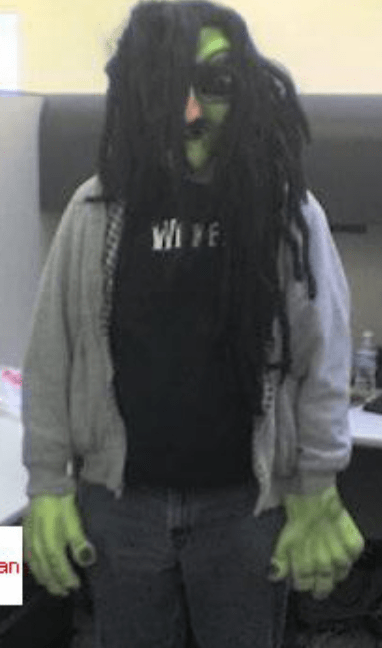
Dressing up in costumes, though, I think was always my favorite part. My favorite costume of all time was one I made first back when I was going to college in Boston. I bought a UFO alien mask and gloves, stitched a pair of Groucho Marx onto the mask, and pulled on a hoodie sweatshirt over the whole thing so that I was an alien trying to pose as a human. A few years later, I added on a Rastafari dreadlocks wig to the ensemble. No particular reason, really.
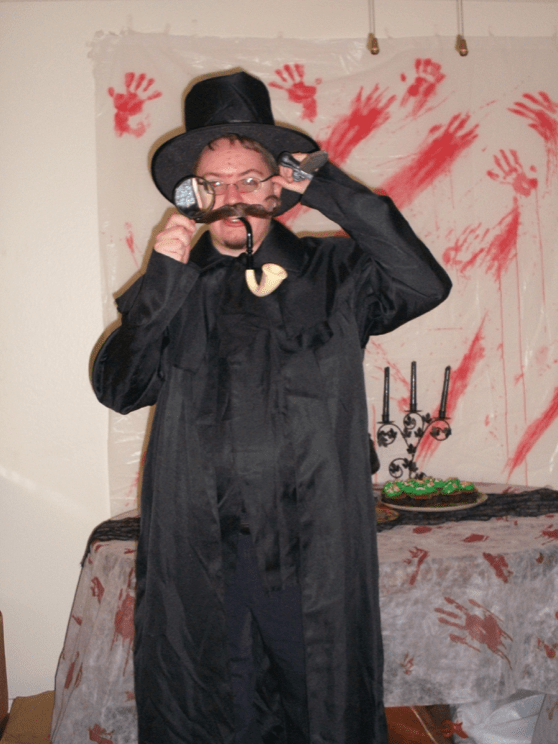
Another year I went as Sherlock The Ripper – I had a long black coat and top hat, fake handlebar mustache, a bloody knife, and a Sherlock Holmes pipe and magnifying glass. At night he put on a fake mustache and went around London dissecting Protestants. By day, he removed the mustache and pretended to attempt to solve the crimes he had committed, so as to alleviate suspicion. That year, my wife Betsy went as Afronighty, the Roman Goddess of Dusk. Our theme was that we were bad high school essays.
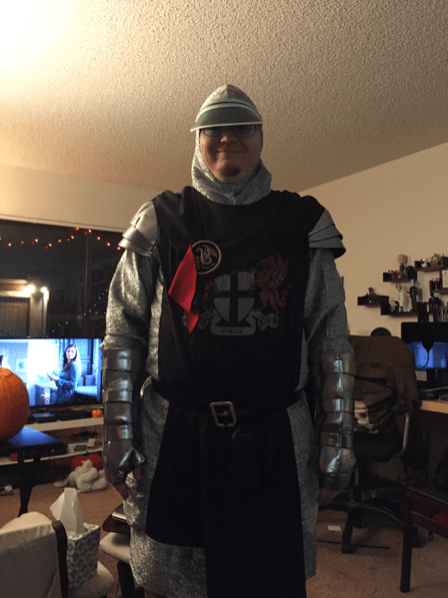
Most recently, I punned out my job as a hotel night auditor and went as Sir Abacus, a Knight Auditor of the Rounded-Up Table. I had the full knight’s armor complete with an old-school accountant’s visor and a spool of calculator tape attached to my belt. The hotel’s general manager loved it so much she insisted I wear it on my shift, despite the official dress code policy.
Meet Sarah Killian, a professional serial killer (for hire!) with a twisted sense of humor.
Sarah Killian is not your average thirty year-old single woman. Foul-mouthed, mean-spirited, and a text-book-case loner. Also, she is a Professional Serial Killer.
In this Crime Fiction / Thriller novel with a twisted sense of humor, Sarah works for T.H.E.M. (Trusted Hierarchy of Everyday Murderers), a secret organization of murderers for hire headed up by the mysterious Zeke. You’ll be surprised to learn who their biggest clients are. Conspiracy theories, anyone?
But a wrench is thrown into the clockwork of Sarah’s comfortable lifestyle when, on her latest assignment, she is forced to take on an apprentice, Bethany—a bubbly, perky, blonde with a severe case of verbal-vomit. In short, Bethany is everything Sarah is not.
Will Sarah be able to adjust and work with her new apprentice, or will she break her contract with T.H.E.M. and murder the buxom bimbo?
So if you’re looking for a strong female lead that doesn’t care what you think, in a book similar to the best of Dean Koontz and J.A. Konrath, then look no further than Sarah Killian – Serial Killer (For Hire).
Just don’t call her an ‘assassin.’ You might not live long enough to regret it.
Have you ever woken one morning with a burning, insatiable desire to go out and kill someone?
Sarah Killian, a notoriously foul-mouthed and mean-spirited serial killer for hire, along with her cohort assassin Mary Sue Keller, are back on assignment for the Trusted Hierarchy of Everyday Murderers (T.H.E.M.).
After receiving an ominous warning from a mark-gone-wrong, it becomes clear that Nick Jin—Sarah’s former nemesis—is still at large and singling her out.
Sarah and Mary Sue are dispatched to Tennessee to discreetly kill off an accused family of KKK organizers, but their true mission is to lure Nick Jin into a trap. But will Nick—always several steps ahead of T.H.E.M.—see their bait for what it is? One thing is guaranteed: blood will be shed.
In the spirit of Sidney Sheldon, Dean Koontz, and Joss Whedon,The Mullets of Madness is a truly unique blend of horror, suspense and espionage.
“Mom,” the daughter called as her mother entered into the Louisiana homestead, “did you get anything that isn’t shit?”
Her mother had been at the supermarket for the majority of the day, leaving the daughter alone at home, forcing her to lie under the tin roof and listen to the sounds of the rain pattering against the roof of the shack. After the death of the Husband, it was just the two of them deep in the murky swamp among the mosquitos, alligators, copperheads, and bears. They lived in a messily strewn together shack that only had one room. Mother usually slept on a blowup mattress on the floor, while Daughter had the luxury of using their couch as a bed. Other than that, they had a record player, a bug zapping lamp, an ancient wood stove, some rusted silverware, and a refrigerator. Filling their yard was a sea of trash, that would have smelled hideously, but blended in with the scent of the mold, mud, and still water of the swamp. Mother was far too lazy to clean up or take any of the trash to the landfill when she went out to the supermarket. It wasn’t like she was a hard worker or anything, seeing as they lived off of welfare checks that were sent to the family for Mother’s “injuries.”
“Watch your language, please,” Mother quipped back at her, stepping over a mountain of cigarette cartons, fast food boxes, soda boxes, and laundry. She held the groceries tightly in her hands: more cigarettes and a giant box of Goldfish. She set one of the bags full of dozens of cigarette cartons on the floor, then started to shake the Goldfish box, as if she was jiggling a present to see what was inside. It was easy to hear them sloshing around on the inside. The smiling fish on the front cover seemed to mock the rest that would soon meet their fate. In a way, it was disturbing that Pepperidge Farms could be so egregious by killing millions without a second thought, but then again, it was all for the greater good.
“Goldfish for dinner again?” Daughter whined. Mother frowned at her ungratefulness, but shrugged it off; she wasn’t at all in the mood to get in a fight that night.
“A nice man gave me a discount,” Mother retorted, “we actually talked awhile. His name was Mark. He even gave me his telephone number!”
Daughter sighed, rolling her eyes back.
“I’m not rushing it again, you know that! Mommy has just been… really lonely. I asked him if he wanted to get dinner sometime.”
“What did he say?”
“He was such a nice man, really! He said he would love to do something with me. He even asked asked me if I wanted to go over to his house to watch some movies this weekend! He was just splendid!” There was that word again. Every time that Mother found a male interesting, she seemed to describe everything with him as splendid. She would often bring one of them over for a night or two, and Daughter would usually go for long walks when this happened, only for a new man to be in Mother’s Life within a month or so.
“That’s great, ma, that really is.” In the dim candlelight of the shack, Mother’s operculum looked smaller than usual. Daughter almost wanted to compliment her, but she didn’t have the energy.
“Are you hungry, baby? I bet you’ve been so bored all day,” she asked her child with a slow blink of her eye. Mother’s skin almost looked like a rainbow of colors, looking entrancingly beautiful in the light. How Daughter wished that skin would shed like that of a copperhead. Maybe if she was able to have Mother’s skin, the kids at school would make fun of her less. She wondered if Mother knew how jealous she was.”
“Starving! Let’s eat!” Daughter begged.
The two sat down in the sludge on top of the mattress, their unnaturally skinny legs crossed over each other. Mother sat the Goldfish in between them, letting the screams from the inside howl into the shack. She pulled two rusty forks from under the mattress, taking one for herself and giving the other to Daughter, who nervously eyed Mother’s red, gelatin-like eggs in one of the corners of the shack.
“Mother, you never told me, who is the father of them?”
“That isn’t your business, now is it?”
“Yes, it is. It’s pretty moist out here, Mother, so most of them will probably survive till adulthood. I wanna know who made my siblings. Why are they red?”
“We can’t support all of them, you know that. We’ll probably have to eat some to stay alive.”
Daughter kept her mouth shut. She knew how disturbing and vile the suggestion was. Even still, her gills flared up in anger. She watched as Mother pried open the cardboard container in front of them, then they both took a good whiff of the contents. Inside of the box was a gallon and a half of water, and dozens of meatball sized fish were rushing from side to side, urging for some kind of escape. Unfortunately, the fish were too small to leave the box, and even if they somehow scaled the walls the two would happily be able to devour them.
“Are you going to eat?” Mother asked, noticing that she was staring off into space.
“You said you were hungry! So you better eat! I spent good money on these!” Mother practically screamed, then jammed her fork into the box, piercing one of the fish like Poseidon’s trident. The blood of the fish instantly began to float through the water, making the rest of them violently rush into the walls to escape, but to no avail. Mother yanked the fork from the murky water but had only grazed the fish, poking through its stomach and piercing through its intestines. The scales easily crumbled away for the might of the rusty fork, forcing the intestines to leave the flapping body of the creature and wrap around the silver, like a macabre rope. The fish dangled in the air, violently convulsing and gasping for water. Daughter watched in horror at the amusement Mother found in the creature’s torture. After a few more agonizing moments that sent blood splattering onto the mattress, she brought the fork above her head, letting the fish dangle above her mouth. With a quick chomp of her teeth, which were some of the only parts of her that were still human, she swallowed the creature and separated it from the intestines wrapped around the fork, sending the black grime of its digested food splattered against her face. Mother gleefully giggled, running her fins over his lips and letting the fluid slowly drip into her mouth.
Daughter’s stomach grumbled, and suddenly, she found herself craving the salty taste of their scales, the irony taste of their blood, and the cool rubbery texture of their insides.
“Do you think my eggs will taste this good?” Mother finally asked after the two spent nearly ten minutes feasting on the squirming animals.
“I think they will, Ma,” Daughter replied, rubbing her stomach, “but I ate too much.”
“Maybe we can have them tomorrow,” Mother responded.
“Sure.”
“They don’t have to know that their mommy got a little hungry, do they? After all, I made them with love,” she said, softly purring, eyeing her children. They were puny inside of the translucent red eggs as they wobbled around. If only they could understand what the two were talking about. Would they be happy if the same woman who created them would be devouring them? Would they embrace death, or they would be afraid of their mother?
William Becker is an 18-year-old horror author with a mind for weirder sides of the universe. With an emphasis on complex and layered storylines that tug harshly on the reader to search for deeper meanings in the vein of Silent Hill and David Lynch, Becker is a force to be reckoned within the horror world. His works are constantly unfathomable, throwing terror into places never before seen, while also providing compelling storylines that transcend the predictable jumpscares of the popular modern horror.
His first novel, Weeping of the Caverns, was written when he was 14. After eight months of writing, editing, and revising, the story arrived soon after his 15th birthday. During the writing sessions for his debut novel, he also wrote an ultra-controversial short story known as THE WHITE SHADE that focused on the horrors of a shooting. Living in a modern climate, it was impossible for THE WHITE SHADE to see the light of day. Following a psychedelic stint that consisted of bingeing David Lynch movies, weird art, and considering the depth of the allegory of the cave wall, he returned to writing with a second story, THE BLACK BOX, and soon after, his second novel, Grey Skies.
A man is arrested after a strange series of barbaric animal killings in the Rocky Mountains. He is taken away from his family, and then placed behind bars, but not even the solid confines of prison can save him from the hellish nightmare that begins to unfold.
Roman Toguri finds himself burying the body of a nun in Boone, North Carolina. As the skies darken and it begins to storm, he is forced to shove the corpse into his trunk and take it home for the night, unaware of the torment that playing God will bestow upon him.
Enter Hell with two bonus short stories: The White Shade, an ultra-violent look into the mind of a mass shooter, and The Black Box, a psychedelic dive into weird horror.
I used to dream of bloodthirsty wolves. I used to dream of apocalyptic warfare and loved ones with sloughing faces, who were either ripped from my arms or liquefied in my embrace. I used to dream of severed hands and broken teeth and corpses draped in antique lace, whose bones sounded like forest fires as they clambered and howled for my blood.
I think they dreamed of me too.
The dark was different when we were together, hazier, paler, like we were meeting in misty moorlands instead of my messy bedroom. As if entranced by this melding of worlds, I would open my eyes, sit up in bed, and see them as clearly as the words on this screen. There was never a tussle, never an attack. Just staring. Silent warnings and soft curses. I don’t know how long we dreamt of each other, but come morning it felt like I hadn’t slept a wink. Throughout my youth and well into adulthood, these waking dreams disrupted my sleep and caused bouts of insomnia that lasted days. And unfortunately, consuming horror fiction made matters worse.
Following my first viewing of Del Toro’s The Orphanage, Tomás, a young character who wears a burlap sack mask to hide his deformed face, entered my room. He stood beside my bed, his tiny fingers curling the burlap up his chin, threatening to show me the deformities the movie didn’t. Blinking hard, pinching my arm, and burying myself in covers didn’t help. It only brought us closer.
And then, a strange magic occurred. A phrase came into my mind, which I then repeated for reasons I can’t explain. I could still see Tomás with my eyes closed and blankets over my head, the burlap revealing new horrors by the second, but this phrase made him stop. It made him release the mask and back away. The phrase and its strange magic made him disappear.
The words I repeated that night were: “Danny Marble and the Application for Non-Scary Things.” It made no sense, but there was an undeniable power in it. The next day I began writing a book of the same name about a child with waking nightmares, and though it’s now out of print, I still regard it as one of my best stories.
I’ve written quite a lot thanks to nightmares, including one of my bestselling books, “Rabbits in the Garden,” but inspiration isn’t exactly a fair trade-off for insomnia. So, in attempt reduce the frequency of my nightmares, I stepped away from reading and watching horror. And unfortunately, it worked.
Creating horror didn’t affect me, but I noticed a drastic drop-off in nightmares when I reduced my intake. I didn’t hide it the change either. When I did panels at conventions, an inky cohort inevitably brought up how I, a horror writer, didn’t read or watch horror anymore, and we all had a good laugh at the contradiction.
As much as I missed my creepy inspirado, movies especially, I liked sleeping through the night more. My once frequent nightmares morphed into adventures. There were still scary elements, but with my cat Tyler as my trusty sidekick, there was nothing we couldn’t handle. We rode the avalanching debris of collapsing buildings. We slept in the trees of enchanted forests. And when we had to flee from danger, I picked him up and ran, pushing through crowds and leaping over downed power lines until my arms ached. Sometimes they even hurt the next morning. But over three years, throughout countless complex worlds I explored with Tyler, I didn’t experience one waking nightmare. I didn’t dream of wolves, and they didn’t dream of me.
Part TWO
My hands started shaking after Tyler died. For over a year, I watched him shrink from a squishy 20lbs beast to a 2lbs sack of bones, ignorant to how his sickness was also shrinking me. Not being able to afford the tests to identify the cancer, let alone remove it, hit me hard. Because I chose an artist’s life—a poor life—it felt like I’d condemned him to suffer. My best friend. My soul mate. My boy.
Surprisingly, Tyler’s physicality was the only thing that changed over the months. His personality remained the same: affectionate, dickish, and always at my side. Tiny as he became, he was still Tyler.
Until he wasn’t.
I knew it would be hard to let go, but I had no idea how it would irrevocably alter my life. After we said goodbye to our little man, I threw myself back into work. I’d been in the middle of writing a novel and decided to continue. In hindsight, it was a terrible idea, as I’m rewriting all of that horrible prose almost four years later. But at the time it seemed the only way I could cope.
I finished the novel and began a large flash fiction project soon after. A few weeks later, I noticed the trembling in my hands. I wrote it off as a symptom of grief, of which I had many, but as my mourning progressed and other symptoms receded, the shaking intensified. Even when my hands weren’t physically trembling, it sure as hell felt like they were. It came in waves, much like grief itself, feeling like insects hatching in my fingertips, skittering down my arms, and converging in my chest like a nest of restless beetles.
I hid it for months, which I’m certain made it worse. There were times it struck me while I was writing and I had to stop because I felt like my skin was going to shake right off my bones. One day while writing in a bar, the feeling hit me with such overwhelming agony I threw my pen as far as I could. After apologizing and retrieving it, I texted my husband and finally told him what was going on.
I also started speaking about it on the podcast I co-hosted with Jack Wallen. I decided it was probably best if I took a break from writing since it was obviously causing so much stress. But after spending the last decade with a pen almost constantly in hand, not writing was just as agonizing. So I occupied my hands with things that didn’t stress me out as much. I drew. I played handheld games like Professor Layton and Bejeweled.
But with no improvement, I had no choice but to drag my uninsured ass to a doctor. That’s when I began worrying about what else besides grief was causing the shakes. Maybe all the bouts of tendinitis I’d gotten from pipetting had taken a permanent toll. Or maybe it was something deeper; the fact that my father has cancer certainly heightened those fears.
But friends (and Google searches) kept bringing up the same question: Could this be as simple as anxiety and panic attacks?
No, because anxiety isn’t simple. Nor are panic attacks, clinical depression, or any other invisible illness, especially when you don’t have insurance. But I finally forced myself into a doctor’s office, where it became clear within minutes that I’d been experiencing severe anxiety and depression since Tyler’s death–and likely before. The doctor was kind enough to give me a discount and Zoloft for my depression and Xanax for panic attacks. Over three years later, I’m jazzed to report that my hands only shake when I have panic attacks, and even then, I’m able to cope with medication, yoga, and breathing techniques.
Depression and anxiety are as much a part of me as mourning Tyler. And they’ll be there forever, on the edge of my mind. But over time I’m learning to use them as stepping stones rather than brick walls.
Part THREE
If you Google Zoloft dreams, you’ll find posts from dozens of people who say the drug increases the vividness of their dreams, often to the point of nightmares. It’s not true in my case, but there has been a significant change since I started the drug.
I’m gorging myself on a healthy diet of horror again. In the four years since Tyler’s death, I’ve consumed more horror than I did in the decade preceding it, and I haven’t had one waking nightmare. I haven’t had much I’d even consider a “scary dream.”
But I also haven’t found a story in a dream in ages. I haven’t woken with monsters in my mind and inspiration in my guts, or had to rifle through my bedside table for a paper and pen before the idea vanished. Now my bad dreams consist of packing and unpacking everything I own, in new houses, in hotel rooms, always in a hurry. And then there are dreams of auditoriums full of friends and family telling me I’m a shitty person, that I’m untrustworthy and useless and undeserving of their love.
And you know what? I miss my monsters. They stole sleep from me, but they gave me inspiration. They made me cry out of fear, but they didn’t make me feel worthless. Perhaps it’s best that they’re gone, tucked away with childish things, but I can’t help wondering if there’s a magic I’m now missing. Would I have found more phrases like “Danny Marble and the Application for Non-Scary Things?” Would I have unlocked more doors, discovered more worlds, if I hadn’t interrupted the horror flow all those years ago?
I might never know the answer, but one thing is clear: it’s a fair trade-off now. I can ingest horror fiction and sleep through the night. I can use all manner of terrifying sources for inspiration and know that my hands won’t shake when I write. I can support my horror-writing friends again and find magic in their phrases instead.
Now that the sun has set and I’ve taken my pill, I’m off to watch Hold the Dark on Netflix. Here’s hoping it’s a beautiful nightmare.
Jessica McHugh is a novelist and internationally produced playwright running amok in the fields of horror, sci-fi, young adult, and wherever else her peculiar mind leads. She’s had twenty-three books published in eleven years, including her bizarro romp, The Green Kangaroos, her Post Mortem Press bestseller, Rabbits in the Garden, and her YA series, The Darla Decker Diaries. More information on her published and forthcoming fiction can be found on her website.
Perry Samson loves drugs. He’ll take what he can get, but raw atlys is his passion. Shot hard and fast into his testicles, atlys helps him forget that he lives in an abandoned Baltimore school, that his roommate exchanges lumps of flesh for drugs at the Kum Den Smokehouse, and that every day is a moldering motley of whores, cuntcutters, and disease. Unfortunately, atlys never helps Perry forget that, even though his older brother died from an atlys overdose, he will never stop being the tortured middle child.
Set in 2099, THE GREEN KANGAROOS explores the disgusting world of Perry’s addiction to atlys and the Samson family’s addiction to his sobriety.
Patience is not Darla Decker’s strong suit. Surviving sixth grade is tough enough with an annoying older brother, a best friend acting distant, and schoolwork. After adding instructive kissing games and the torturous wait for a real date with her biggest crush, Darla is perpetually torn between behaving like an adult and throwing temper tantrums.
Games of flashlight tag, and the crazy cat lady roaming Shiloh Farms in a “demon bus,” serve as distractions during her parents’ quarrels and her anxiety about show choir auditions. Yet the more Darla waits for her adulthood to begin, the more she learns that summoning patience won’t be the hardest part of being eleven.
A frank and funny look at the path to adulthood, DARLA DECKER HATES TO WAIT begins a journey of love, loss, and the nitty-gritty of growing up through Darla Decker’s eyes.
The toppings: Terror and torment. The crust: Stuffed with dread and despair. And the sauce: Well, the sauce is always red.
Whether you’re in the mood for a Chicago-style deep dish of darkness, or prefer a New York wide slice of thin-crusted carnage, or if you just have a hankering for the cheap, cheesy charms of cardboard-crusted, delivered-to-your-door devilry; we have just the slice for you.
At twelve years old, Avery Norton had everything: a boyfriend who was also her best friend, the entirety of Martha’s Vineyard as her playground, and her very own garden to tend. By thirteen, it was all over.The discovery of a secret crypt in the basement starts the Norton family down many unexpected avenues, including one that leads to Avery’s arrest for murder and her subsequent imprisonment in Taunton State Lunatic Asylum.
Set in 1950s Massachusetts, Rabbits in the Garden follows Avery Norton’s struggle to prove her innocence, exact her revenge, and escape Taunton with her mind intact.





 Meghan's House of Books