In the murky London gloom, a knife-wielding gentleman named Jack prowls the midnight streets with his faithful watchdog Snuff – gathering together the grisly ingredients they will need for an upcoming ancient and unearthly rite. For soon after the death of the moon, black magic will summon the Elder Gods back into the world. And all manner of Players, both human and undead, are preparing to participate.
Some have come to open the gates. Some have come to slam them shut.
And now the dread night approaches – so let the Game begin.
Author: Roger Zelazny Illustrator: Gahan Wilson Genre: Fantasy, Horror, Gaslamp Publisher: Avon Books Publication Date: September 1, 1994 Pages: 280
Intro
Roger Zelazny‘s A Night in the Lonesome October is a wonderful book in every sense of the word, and perfect October reading, set as it is in the month leading up to Halloween. Each chapter of the book covers a day, and in this series of potted reviews here, I’ll cover them in the same way, reading a chapter a day through to the climax. I’m reading the hardcover of the gorgeous edition illustrated by Gahan Wilson, but it’s also available in paperback, ebook and audiobook.
It’s gorgeously written, humorous, completely immersive and one of the greatest things since sliced bread. Do yourself a favor and get onto this straight away. Follow me along by reading a chapter a day for the Halloween season – you can thank me later.
October 1st
We start with an introduction to our narrator. Snuff is a loyal companion to Jack, a mysterious figure from Whitechapel who spends time walking the streets righting wrongs and digging in graveyards for ‘materials’ to help with his work. An introductory foreword shows Snuff to be a dog that can talk to other animals. He has a sardonic, almost comical narrative voice that leads you in very cosily to Day 1.
Snuff is on his rounds of Jack’s house, checking that the ‘things’ are where they should be. The thing in the mirror is quiet, but the thing in the cupboard is restless and mouthy until Snuff puts it in its place. Snuff is a guard dog. It’s who he is. It’s what he does.
So we’ve already established there’s something going on, Jack’s motives are murky to say the least and he’s preparing for something that sounds nasty at the end of the month, something that possibly involves the ‘things’ he’s collecting. But Snuff is loyal to Jack, and we already love Snuff, so we’re along for the ride.
Day one, and I’m already back on the hook.
Boo-graphy: William Meikle is a Scottish writer, now living in Canada, with more than thirty novels published in the genre press and over 300 short story credits in thirteen countries.
He has books available from a variety of publishers including Dark Regions Press, Crossroad Press and Severed Press, and his work has appeared in a number of professional anthologies and magazines.
He lives in Newfoundland with whales, bald eagles and icebergs for company.
When he’s not writing he drinks beer, plays guitar, and dreams of fortune and glory.
The Green & the Black — A small group of industrial archaeologists head into the center of Newfoundland, investigating a rumor of a lost prospecting team of Irish miners in the late Nineteenth century.
They find the remains of a mining operation, and a journal and papers detailing the extent of the miners’ activities. But there is something else on the site, something older than the miners, as old as the rock itself.
Soon the archaeologists are coming under assault, from a strange infection that spreads like wildfire through mind and body, one that doctors seem powerless to define let alone control.
The survivors only have one option. They must return to the mine, and face what waits for them, down in the deep dark places, where the green meets the black.
Behind the Veil — Can she keep the secrets of her past to rescue a girl tormented by a ghost?
In 1920s Los Angeles, Letitia Hawking reads the veil between life and death. A scrying bowl allows her to experience the final moments of the deceased. She brings closure to grief-stricken war widows and mourning families. For Letitia, it is a penance. She knows no such peace.
For Alasdair Driscoll, it may be the only way to save his niece, Finola, from her growing night terrors. But when Letitia sees a shadowy figure attached to the household, it rouses old fears of her unspeakable past in England.
When a man comes to her about his missing daughter, the third girl to go missing in as many months, Letitia can’t help him when she can’t see who’s taken them.
As a darkness haunts Letitia’s vision, she may not be given a choice in helping the determined Mr Driscoll, or stop herself falling in love with him. But to do so risks a part of herself she locked away, and to release it may cost Letitia her sanity and her heart.
Boo-graphy: Beginning a writing journey with an epic 21 book series, Ejay started her author career in 2014 and has taken on the ups and downs of self-publishing with her fantasy series The Last Prophecy since 2016. At the start of 2019, she put the series on the backburner to write Behind the Veil in 25 days, and signed a publishing contract for the gothic noir novel to independent publisher Literary Wanderlust. Behind the Veil is set for release on the October 1st 2021. She resumed self-publishing a scifi series, Queen of Spades, released across 2020 and 2021, as well as signing another contract with Literary Wanderlust for NA fantasy, Echo of the Evercry. Believing in more than one path to a career in publishing, Ejay pursues self-publishing alongside querying traditional publishers with multiple manuscripts.
It was cold when they kicked him out of the pub. Joseph only wanted to buy a bottle to take home. They hadn’t sold it to him after he vomited in the gentlemen’s. But tonight, of all nights, he needed it.
Just like every other night, really.
The rain drenched him, but he didn’t care.
All he wanted was a drink.
He didn’t want to see his family, sitting around the table praising his brother John for the promotion at the bank. Declining the inner invitation, Joseph had made excuses before John’s mocking laughter caught him at the door.
“Let him go, mother, he’s tight already.”
Joseph had proven to himself that his level of sobriety was nigh on angelic then, compared to what he was now. The world swam, and he struggled even to see in the dreary night.
He was lost.
The streets kept turning about, the normal route that should have taken him up Beverly and onto Gardner found him on Vista. Rain turned to sleep as he stumbled through the sleepy streets.
It was lucky, he thought, because if he hadn’t been drunk the cold would’ve bothered him. He’d get home. The rain had momentarily confused him. As the downpour turned to frozen slush on the pavement, the slippery surface caught his unwary feet.
There was a flash, and the sidwalk was level with his eyes.
He blinked away stars, feeling an echo inside his head, and the world went black, streetlamps dying out… only to come back. Joseph studied them, fading in and out, waiting for it to stop.
A part of him assessed the damage, cold and distant. This was bad. He’d fallen and given himself a severe concussion. It wasn’t the first time. The last time had been… had been…
Joseph tilted his head to the side so he could retch, agony rushing through him, sharp this time as he spat out the contents of his liquid dinner.
“This no’ good,” he muttered to himself, staring at the amount of vomit on the pavement.
Joseph got to his knees, and his stomach regurgitated yet more liquid, the stench of alcoholic bile bringing up everything until his body was curled in its own excess.
Pain lanced through his head, an iron spike that squeezed his eyes shut, and he didn’t see the men talking toward him.
“Tad ossified, sir?” one asked.
“Might be.” Joseph slit an eye open to see two policemen there and breathing a sigh of relief. At least he wasn’t about to be robbed. That would have been the highlight of the evening. Or possibly it had turned worse; it was the police after all.
“I’m trying to get to 161 South Gardner,” he said, searching for excuses not to be dragged to the drying out tank. His father wouldn’t bail him out, and when he treated like he had tonight, he meant it.
“All good, sir,” the policeman said. “We’ll get you home.”
They picked him up under the arms, the journey foggy until he was standing in the porch’s light. The policemen knocked on the door and Joseph couldn’t stop them in time.
The maid opened it, her mouth dropping open at Joseph’s state and the presence of two officers.
“Oh, I’ll get Mr. Norman.” She dashed off.
Joseph tried to pull away, to stand on his own two feet, but even with his stomach empty of alcohol he was still drunk. His head hurt, thumping in pulse to the angry pounding of his father’s footsteps.
“Thank you, officers,” his father said and shook their hands, a glimpse of paper in his palm. The officers’ smiles were wide at the thick wad of money – the cause for their kindness, which continued as they tipped their hats and left.
“Walk around back and get in the guesthouse, boy,” his father intoned, not letting Joseph in. “I will not disgrace your mother by letting you into this house. I will not let you ruin John’s good fortune because you’ve pissed your own pathetic life away. You were a doctor, and then you drowned in a bottle. I should have told you I was disowning you, but I didn’t want you to come home like this, you’re a disgrace…”
It went on.
Joseph stopped listening, and he didn’t even notice when his father shut the door. How long he’d been standing out on the porch he was uncertain, the world’s tears falling on his shoulders. He turned around, walking around the outside of the house and down the side path to the guesthouse.
The door handle didn’t want to open.
The deck chairs around the covered pool were inviting, even with the cold, but the bitter chill was getting worse. He had to get into the guesthouse. There was a gas heater inside if he could concentrate long enough to open the door.
Another shove pushed the door open, and it slammed when he fell against it. Stumbling steps took him to the center of the room, but looking about it was as welcome as the rain covered chairs outside. Dust sheets covered the furniture and became the ghosts of his past. Silent and accusatory, he waited to hear their pleas to make the pain stop, though they were naught but memories.
Standing alone in the dusty space, Joseph fell to his knees and cried.
No family.
Friends dead in the war.
Few who understood what being in the medical tents was like, what it did to you, night after night. The endless screams and the visions that haunted him.
During the day now, it was worse, he could see them during the day… he could see them right now…
Letitia wrenched herself away, manifested as physical reeling, and her hand slapped down on the table. The end had been so subtle, it had wrapped about her with the tentative touch of a spider, coming closer to bite her and share the death with Joseph. She gripped the wood, absorbed the warmth in her palm, sweat on her upper lip, and a chill on her skin from the cold of Joseph’s death.
“Ms. Hawking, are you all right?” Mrs. Norman asked.
“Please,” Letitia said, before quieting her tone. “A moment, please.”
The traces faded, fingers of death slipping her by as she recovered her breath and grounded herself in her own body.
Letitia didn’t know what she would tell those patrons. They wanted to know if it wasn’t their fault and to be sure Joseph hadn’t passed with regrets. The guesthouse was an eerie reminder of their transgression, but it wasn’t because Joseph was there, since he was glad to be gone from the world. It was their own guilt.
“Ms. Hawking,” Mr. Norman said, voice gruff, disbelief on his face. Opening his mouth to contest her, she cut him to the quick.
“You were there, at the door, when the policemen brought him home.”
She watched the skin of his pale cheeks become reddened, and she pushed on.
“You told him how… unimpressed you were after the police left.” Letitia didn’t stop, even as Mr. Norman glanced with shame at the now sobbing Mrs. Norman. “You told him to go out the back, not to make a fuss.”
Letitia changed the sentence, rephrased it so Mr. Norman wouldn’t be any more embarrassed than he already was, and at least now Mrs. Norman knew what had happened. She could guess for herself what exchanged between her husband and son.
“And… at-at the end?” Mrs. Norman asked through a series of tearful hiccups.
Letitia chose her words with care, wanting the Normans to go away at peace but warier of how to treat their other children.
“Joseph was relieved to pass on,” Letitia said, watching the father close his eyes in reprieve. “You were right, Mr. Norman, he wasn’t fine after the war, and he didn’t know how to make it better. This would not be the first time someone has come to me with a son or husband who was stolen by the war long after it ended. But Joseph saved many lives, he did dreadful things for those lives, but there are men who went home because of him. Not whole, but they went home.”
She let silence fill the space.
“But he never said,” Mr. Norman exclaimed. Letitia didn’t expand as he stared at her, fury and shame burning pink brands on his cheeks.
She let silence fill the space.
“But he never said,” Mr. Norman exclaimed. Letitia didn’t expand as he stared at her, fury and shame burning pink brands on his cheeks.
“He isn’t here,” Letitia said, “and he’s far better for it.”
Mrs. Norman clung to her husband, who was now wrapping an arm around her.
“I’d like a moment with my wife.”
“I cannot leave the room, Mr. Norman,” Letitia said, apology in every nuance of her words, “since what I have done today is difficult and leaves behind a residue.”
“We should leave, William,” Mrs. Norman said, composure returning as she rose with the help of her husband. “Thank you very much for your time, Ms. Hawking.”
“I hope I’ve brought you some level of closure,” Letitia said, coming to take Mrs. Norman’s outstretched hand and allowing a brief embrace before she pulled back, both arms on Mrs. Norman’s shoulders. “Now, go home, and when spring comes clean the guesthouse from top to bottom. There is nothing there than an echo of another victim of the Great War, and he does not reside there.”
Suffering, Mrs. Norman went to the door.
Mr. Norman was behind her, holding out his hand for Letitia’s, and like the incident with the policemen, there were folded notes in his hand. At least another twenty dollars.
Letitia stared down at them before lifting her eyes to see the desperate hope of Mr. Norman.
If she took them, he would close the matter, the last page of a book. That certainty was so stark in the lines of his face she didn’t need to open herself to se his personality. He was revolting enough as it was, and it left a sour taste in her mouth.
“Mr. Norman,” Letitia said, low enough for his ears alone. “You’ve paid me for my services already. And now you need never bring your family the shame of disowning your son.”
“You saw-” he stopped, hands clenching around the money. She met his gaze, and after a long moment, he was the first to break away.
Letitia went to the door where Mrs. Norman had put on her coat, and the pair left, Mrs. Norman the only one to look back for a final goodbye.
There was no sinister figure on the landing, and Letitia closed the door.
But something about the session was wrong.
Nothing too untoward occurred. It was smooth from beginning to end, except for one small anomaly.
Letitia went to the table and sat back in her chair, and instead of looking at the bowl, she tilted her head back to glance at the chandelier over the table. It had candles in some of its holders, placed to cast the right light on the mirror that hung from its center.
Round and twice the size of the scrying bowl, the mirror was suspended from three chains, making it secure and avoiding sway as much as possible. It was tilted at such an angle so that when Letitia looked into it, she saw the scrying bowl.
This was a different type of seeing. The bowl would drag her in and take her to the critical moments before death to experience it herself.
Letitia always found the exact cause before she sought a person’s end. Innocent and accidental deaths were easy – she’d take a few gentle moments to relate to loved ones without getting too close to the cause. Others were in sickness or injury, even the battlefield itself. She’d be with them until their death approached. Those who died at the hands of a murderer were no forewarned, or what little they saw came too late to Letitia. It was why she would not take murder cases. There were instances where the victim succumbed to shock before death or were even taken unaware. Delving into their fate when she wasn’t sure what was coming risked her dying with them.
Old Mother Borrows hadn’t wanted to talk about what happened if Letitia got that far. But then she hadn’t needed to tell Letitia. Her own expeirence had cut her to the bone, tore her soul to shreds, and left her a wreck. Old Mother Borrows was lucky to find enough sense within to repair.
When Letitia used the mirror, there were simply visions, the sensation akin to the images that played in her head as she read works of fiction or watched a silent film at the cinema. But like the bowl that could drag her into the death, so too was the mirror dangerous. She could become lost in reading…
The chair was her safety. She would fall to one side, or on the table, when she became too tired.
There was no such safeguard against the scrying bowl.
She read the scrying mirror.
It was far easier to slide into its vision, which reflected the remnants left in the scrying bowl of Letitia’s last visit. Though it was still distant to her, she knew what she thought.
Joseph’s death replayed in her mind, but this time she was only an observer, not lost in his emotion. She was a figure on the street, following him home, watching him fall over, remembering his subsequent pain. The humiliating scene at the front door was a thousand times worse at a distance without the alcohol or splitting pain to distract her from the horrible words of Mr. Norman. For a moment Letitia wished she could have made Mr. Norman squirm all the more, but it was a brief and selfish wish. His tirade abated when Mrs. Norman came looking to see who it was, and Mr. Norman shut the door without a backward glance.
Letitia studied the scene from across the street, but now she came closer to Joseph, not watching him but the shadows.
Nothing alerted her senses or was wrong about the situation, but she followed, fading into the guesthouse. Joseph stood in the center of the room, crying before falling to the floor and curling up into a ball against the cold and all the nightmares the world had given him.
Letitia knelt beside him, aware of what was coming and unable to stop it, but still she touched Joseph’s forehead with a cool hand.
A figure leaned over her.
She shrieked, slamming onto the floor as she came off her chair. Broken out of the vision, she stared around her ordinary session room. The shadow had disappeared, but there was no mistaking its presence.
The figure, while terrifying her, had a discernible difference from the one she’d seen behind Mr. Driscoll. In the world of visions, she would evade it’s form, even if the sense of dread was triggered by her own underlying fear. Unlike the being who’d glared over Mr. Driscoll’s shoulder, this figure had emanated no such ill intent within the vision of Joseph’s death.
But if a being of shadow haunted her session, then being anywhere near Mr. Driscoll could risk the very damage that left her body scarred and her mind on the edge of insanity.
No amount of money would bring Letitia willingly back there, not when she’d already experienced what lay beyond the veil.
Boo-graphy: Beginning a writing journey with an epic 21 book series, Ejay started her author career in 2014 and has taken on the ups and downs of self-publishing with her fantasy series The Last Prophecy since 2016. At the start of 2019, she put the series on the backburner to write Behind the Veil in 25 days, and signed a publishing contract for the gothic noir novel to independent publisher Literary Wanderlust. Behind the Veil is set for release on the October 1st 2021. She resumed self-publishing a scifi series, Queen of Spades, released across 2020 and 2021, as well as signing another contract with Literary Wanderlust for NA fantasy, Echo of the Evercry. Believing in more than one path to a career in publishing, Ejay pursues self-publishing alongside querying traditional publishers with multiple manuscripts.
Behind the Veil — Can she keep the secrets of her past to rescue a girl tormented by a ghost?
In 1920s Los Angeles, Letitia Hawking reads the veil between life and death. A scrying bowl allows her to experience the final moments of the deceased. She brings closure to grief-stricken war widows and mourning families. For Letitia, it is a penance. She knows no such peace.
For Alasdair Driscoll, it may be the only way to save his niece, Finola, from her growing night terrors. But when Letitia sees a shadowy figure attached to the household, it rouses old fears of her unspeakable past in England.
When a man comes to her about his missing daughter, the third girl to go missing in as many months, Letitia can’t help him when she can’t see who’s taken them.
As a darkness haunts Letitia’s vision, she may not be given a choice in helping the determined Mr Driscoll, or stop herself falling in love with him. But to do so risks a part of herself she locked away, and to release it may cost Letitia her sanity and her heart.
Meghan: Hi, William. Welcome back to our annual Halloween Extravaganza. What is your favorite part of Halloween?
William: I have a confession.
I don’t celebrate Halloween, and haven’t since I was a kid. Back in Scotland when I was growing up, Halloween was for kids, and just for kids. I never saw an adult dressed up, never saw a house decorated for Hallowen. We kids went out ‘acting the gloshes’ which translates as ‘pretending to be ghosts’ and, as we were all poor as church mice, that mostly consisted of an old sheet with holes cut for eyes.
We went round the local houses, not trick or treating as such… we had to tell a joke or sing a song to get a reward which in those days was often a toffee apple. I always enjoyed the singing (I found out later that I perform well in front of audiences with guitar in hand).
About the only thing I recognize when watching North American Halloween is dunking for apples in a big bucket of water. Some of the old folk in town still insisted we did that before we’d get a treat… an apple usually.
It being the end of October, in the West of Scotland, Halloween was often damp, windy and sometimes downright miserable as a lot of folks didn’t bother to participate.
So my favorite part of Hallowween these days is watching in bemusement what a big deal gets made of it over here in the New World.
Meghan: What is your favorite Halloween tradition?
William: We didn’t have pumpkins in Scotland. We carved swedes (we call them tumchies) with kitchen knives, a process that took hours and caused many a bruised knuckle, then stuck a candle in them. I can still smell the roasted turnip even now fifty years and more on.
It’s a very old tradition. Carved swedes have been found in old graves all the way back to the Neolithic.
And there’s something spooky about the manic grin on a carved turnip that no amount of artistry in pumpkin carving can match. That was always my favorite part of the night.
Meghan: If Halloween is your favorite holiday (or even second favorite holiday), why?
William: See above. I do like seeing kids enjoy themselves, but I’m a bit bemused as to how much adults get into it here in North America.
Meghan: What are you superstitious about?
William: Not a lot really. I am a believer in the supernatural, having had several encounters that leads me to think that the land of Faerie is close by us, so if I’m somewhere with a faerie tradition (there are more than a few places in Scotland and also some here in Newfoundland) I try not to piss off the wee folk and always say hello and thank you when crossing ‘their’ bridges.
Meghan: What/who is your favorite horror monster or villain?
William: The same one it has been for fifty years. It’s not strictly horror, but it has to be KONG. I first saw the big guy back in the late ’60s in his 1933 incarnation, and around the same time I caught the Japanese Godzilla vs Kong movie, and that was it, I was hooked on big beasties.
The recent resurgence, firstly with Jackson‘s Kong ( which I loathe in places and love in other places) through to Skull Island and Godzilla vs Kong has me like a kid in a toy shop.
Meghan: Which unsolved murder fascinates you the most?
William: It’s always been the Whitechapel Ripper case. I’ve read numerous books, seen all the movies, and remain no closer to having a clue as to who Jack might have been.
His crimes cast a shadow over the whole late-Victorian era in London, and his effect on popular culture down the years has been remarkable. He’s become almost mythic. I wonder if the perpetrator had any idea what he was starting… and indeed, was that the point?
Meghan: Which urban legend scares you the most?
William: Back in the 1950s, in the Gorbals area of Glasgow, about 20 miles north of where I lived, stories were going around about missing children, believed killed. The culprit was said to be a seven-foot vampire, with iron teeth, lurking in the Southern Necropolis graveyard.
One night after school, hundreds of children of all ages armed themselves with blades and crosses, stakes and dogs and descended upon the Necropolis to hunt it. The children prowled the graveyard as night fell, checking behind trees and headstones for the awful creature that might be lurking.
They never caught it of course, but the story passed into legend.
I heard about it when I was around ten years old in ’68 and it gave me a recurring nightmare that still pops up every few years.
Meghan: Who is your favorite serial killer and why?
William: I don’t have a ‘favorite’ serial killer. I find the idea of having that kind of empathy with them to be a strange concept. But there’s one or two that intrigue me.
Again in 1968, which was kind of a formative time for my horror roots, a serial killer was operating in Glasgow, as I said before only 20 miles from us. Bible John, as he was known, was stalking a nightclub, quoting bible verse, abducting young women and killing them. It filled the news at the time and we schoolkids were obviously fascinated.
There were 3 confirmed deaths, several other possibles.
He was never caught.
When I was at university in the late ’70s in Glasgow rumours spread that he was still around, still working the same area. We all kept a close eye on our female friends when we were out and about town.
Meghan: How old were you when you saw your first horror movie? How old were you when you read your first horror book?
William: The first time I remember being terrified at the movies was not at a horror movie as such, but at the transformation scene in Jerry Lewis‘ The Nutty Professor which I was taken to see by my mum… I can’t have been more than six years old at the time. All that strobing red lighting and screaming soundtrack had me getting out of my seat and heading for the door before fascination had me turning back to see…
The first horror movie I remember seeing was a rerun of the original The Blob in around 1967 when I was nine. I thought it was a hoot and loved every minute of it, and it gave me a lifelong love of big blobs in film. There’s a particularly good one in one of the early B&W Hammer movies X-The Unknown that I love to bits.
The first X-rated horror movie I saw in the cinema was when I sneaked in to The Exorcist on its first run in 1973. I’d already read the book so knew broadly what to expect, but it certainly made an impact.
As for books…
I got early nightmares in around ’67 from a first read of The Hobbit, my dreams being plagued by Gollum and red eyes in dark places for a while.
The first outright horror book I remember reading was one of the Pan Books of Horror collections, probably some time in 1969 IIRC. My granddad was an avid reader and had boxes of paperbacks lying around. I’d pick them up and read them, which is how I discovered the likes of Alistair MacLean, Ed McBain, Louis L’Amour and many more. One day I picked up #6 in the PBOH series and was immediately hooked. That led me on almost directly to Dennis Wheatley, then H.P. Lovecraft and then, in ’74, a chap called Stephen King came along and everything changed.
Meghan: Which horror novel unsettled you the most?
Dread is a word you don’t see used much in association with horror fiction any more. And it’s a shame, because used properly, slow building dread can be more horrific than any gore or bloodletting.
Fortunately, there are writers who understand this, and one of the best examples can be found in The Ceremonies, which starts slow, gets slower, but accumulates dread along the way like a wool suit collecting cat hairs. And it’s a marvel of timing, precision and skill, with its cast of great characters all circling around the central motifs, each of them catching glimpses of the whole but none completely understanding what they are being shown, or why.
The slow build, taking care and attention to let us get to know, if not like, the main characters, gives their respective fates at the climax emotional resonance, and a depth that’s often lacking in fiction in the field.
The book is one of the wonders of modern weird fiction.
I was only 17 when I first saw this classic, and wasn’t really prepared for the depth of sadness and misery that has hold of the main characters all the way through. It’s a simply stunning piece of work, with the director Roeg keeping us unsure as to what’s going on all the way through to the shock at the end. It’s lived with me ever since. Donald Sutherland‘s best movie, Roeg‘s best movie, and one of the all time great horror movies.
As an aside, Roeg‘s use of color, in particular red, to highlight important plot points meant that when I first saw The Sixth Sense and saw that Shamalyan had done the same, I saw the end coming a long way off…
Meghan: What is your favorite Halloween costume?
William: I still have a nostalgic fondness for that white sheet I mentioned earlier but if I were to do it today (and had the money) I’d splash out on a good gorilla suit and go round as KONG for the night. That would be lovely.
Meghan: What is your favorite Halloween-themed song?
William: That would have to be THE MONSTER MASH, not the Boris Pickett version but the one by the very silly Bonzo Dog Doo Dah Band, a bunch of English eccentrics who did a brilliant cover version.
Meghan: What is your favorite Halloween candy or treat? What is your most disappointing?
William: As I don’t really do Halloween, I don’t really have one. And in Scotland we didn’t have ‘candy’, we had ‘sweeties’. My favourite as a lad was black liquorice dipped in sherbet – I’m weird that way.
I remember being disappointed as a kid by a very old and sad Tangerine.
Meghan: Thanks, William. This has been great, learning more about you. Before you go, what are your top three Halloween movies and books.
Boo-graphy: William Meikle is a Scottish writer, now living in Canada, with more than thirty novels published in the genre press and over 300 short story credits in thirteen countries.
He has books available from a variety of publishers including Dark Regions Press, Crossroad Press and Severed Press, and his work has appeared in a number of professional anthologies and magazines.
He lives in Newfoundland with whales, bald eagles and icebergs for company.
When he’s not writing he drinks beer, plays guitar, and dreams of fortune and glory.
The Green & the Black — A small group of industrial archaeologists head into the center of Newfoundland, investigating a rumor of a lost prospecting team of Irish miners in the late Nineteenth century.
They find the remains of a mining operation, and a journal and papers detailing the extent of the miners’ activities. But there is something else on the site, something older than the miners, as old as the rock itself.
Soon the archaeologists are coming under assault, from a strange infection that spreads like wildfire through mind and body, one that doctors seem powerless to define let alone control.
The survivors only have one option. They must return to the mine, and face what waits for them, down in the deep dark places, where the green meets the black.
After my appearance on an episode of his Bizzong! podcast, the esteemed Mr. Frank described me as “the Martha Stewart of extreme horror.” Now, there’s a moniker I never would have expected, but, nonetheless, gleefully embraced.
(The invariable immediate follow-up question is usually “so then who’s your Snoop?”, the answer to which is equally invariable and immediate: Jeff Burk, forever one of my favorite people in the world!)
Anyway, this came about because of my propensity to bake creepy cookies and cupcakes, and make creepy crafts, many of which I like to bring to events or present to my fellow creepy creatives. They’re great for book launches, readings, conventions, surprise gifts.
Many of these demented experiments spring from my own imagination, or are inspired by the works of others; I’ve done doll-mods, crafts, and baked goods inspired by book covers, characters, concepts, etc. I made death’s head moths for the fine folks at Death’s Head Press, sent the publisher at Bloodshot Books a giant painted ceramic bloodshot eyeball, and gave Brian Keene a batch of handmade “clickers.”
But, for the purposes of this post, I’m going to focus solely on weird shit I’ve made based on some famous horror films. Doll-mods, mostly, with a few other odds and ends (mainly odds) thrown in.
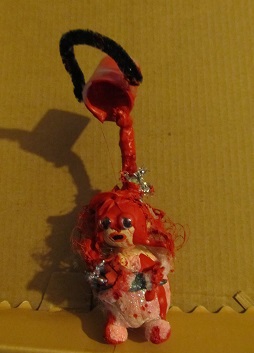
The earliest of these, chronologically speaking, was this nut-people version of Carrie at the prom, which I made for my daughter:
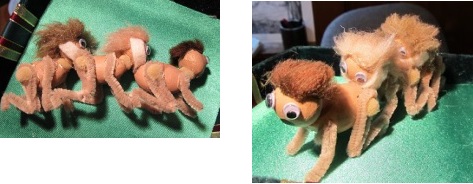
Also from the nut-people line, a nice little nightmare I like to call the Pecan Centipede:
Which, by the way, had a much larger cousin one year for Halloween:
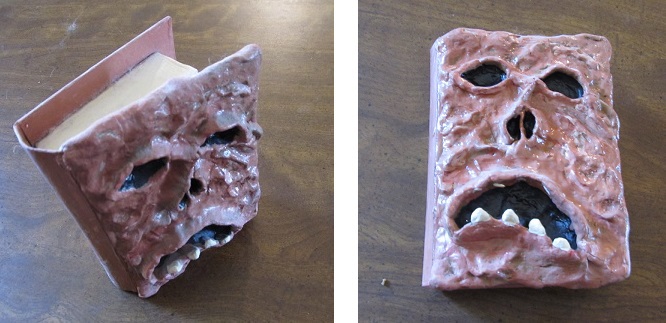
Now, at some point along the line, I’d ordered a bunch of craft supply ‘book boxes,’ which aren’t boxes to store books but boxes shaped like books. A DIY Necronomicon was, of course, a must!
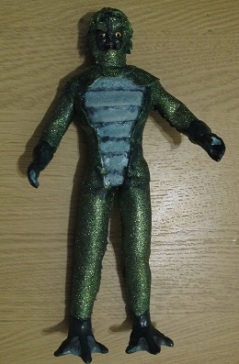
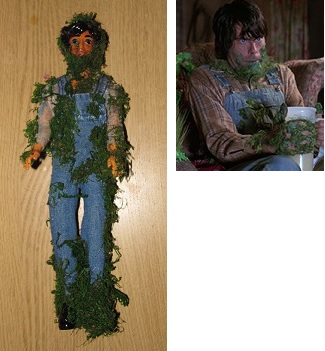
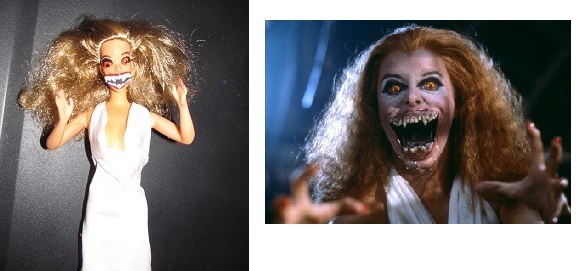
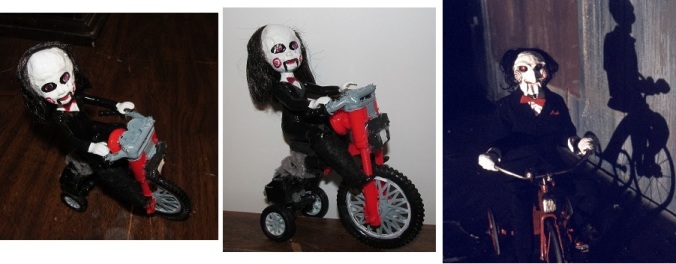
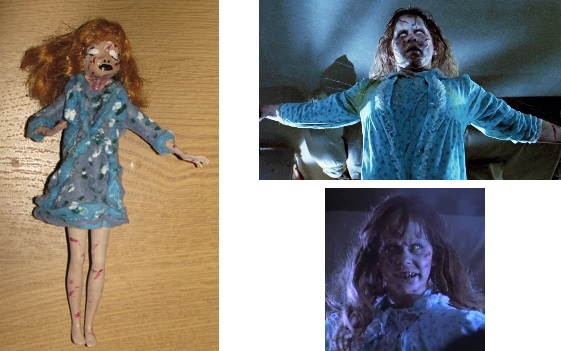
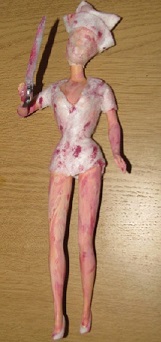
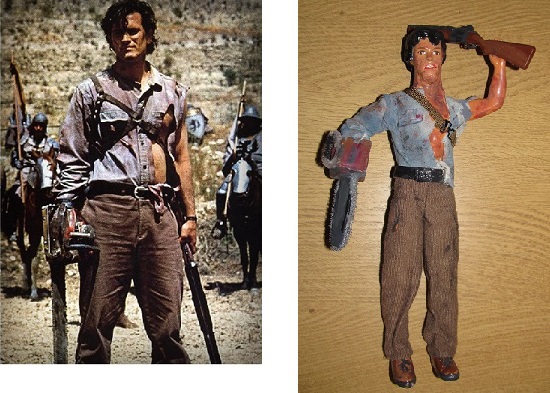
The doll-mods, though, always provide the biggest challenge, and tend to be the most fun. I’ve included pics from the movies I used as my reference in most cases, to see how close I was able to get with little more than a hot glue gun and paint.
Whenever I’m asked my favorite horror monster, the answer has got to be the classic Gill-Man. He was my daughter’s fave, too; while other kids were checking out cartoon movies from the library, she would beeline right for Creature From The Black Lagoon every time. So, naturally, I had to make a doll of him for her!
Now, sometimes there are moments in movies maybe meant to be horrific, but turn out more hilarious instead. For me, one such moment is in the original Fright Night; hello, Amy!
If some of your friends are so obsessed with a franchise they even have a Friday the 13th themed wedding, well …
Speaking of things providing challenges, by the way, the hardest part of this build was having to make the damn tricycle!
One challenge, however, I did not undertake was my roommate-at-the-time’s suggestion to make this one spew green goop:
Occasionally, I will make something that creeps even me out, so I am very glad the awesome Mary SanGiovanni agreed to give this one a good home:
As terrific and fun as was Cabin in the Woods, I think we all agree the by-far best bits came when we got to see all the other options, and dream of the alternate versions of the movie that could have been. Like, say, either of these two:
Hail to the king, baby. ‘nuff said.
And, to finish with a drastic departure from crafts into cooking, who’s hungry for some SHARKTATO MEATNADO?
Yes, that is a bacon-wrapped meatloaf tornado with potatoes carved into sharks. Life is too short to make plain old boring loaf-shaped meatloaf. I could do a whole other post about those culinary experiments too.
Do I deserve the title Mr. Frank so graciously bestowed upon me? I am far from an expert, far from having my own entire multi-million-dollar brand name and empire. But, for now, I can just say — and after seeing her as a judge on Chopped, I know she’s one of the scariest people alive — your move, Martha!
Boo-graphy: Christine Morgan recently quit her night-shift job and moved from rainy Portland to sunny Southern California to help out her mom and hopefully make a plunge as a full-time writer. Several months later, she’s still reeling from the culture shock of adjusting to daytime life, but finally has a real office/library full of bookshelves and critter skeletons, as well as a dinosaur-themed bedroom. Because she is a) a grown up and b) a professional.







 Meghan's House of Books