“Well I suppose, ’tis the season and all that crap, but they are the best at what they do. Keep trying.”
“Yea, yea I will,” John said, “but are you sure they can help me with this?”
“Look, they’re fantastic, and will advise you how to do it right the first time, and if you don’t think you can pull it off on your own, they’re more than happy to come and assist you.”
John reached for his phone and dialed the number again.
“It’s ringing.”
I’m sorry, due to a higher than normal volume of calls all our agents are busy. Please remain on the line and an agent will be with you shortly. The annoying robotic voice squaked at John.
“It’s a recording, I’m on hold.”
“Stay on the line, you don’t want to lose your spot in the queue.”
John laid the phone down and put it on speaker and Burl Ives sounding like he was stuck in a tin can began singing Holly Jolly Christmas.
“Can’t you help me with this Ted?”
“I can’t, you know that. They have a license for this and I don’t.”
It’s a holly jolly Chris…
“It’s ringing again.”
“Merry Christmas, Suicide Hotline.”
Steve Thompson is the author of two short and flash fiction collections. You can check out his 2 latest short stories “Kill Point Club” in the anthology When the Clock Strikes 13 from his In Your Face Publishing that he started in June 2019 and “Malignant” which he co-wrote with Kenneth W. Cain which is in the Shallow Waters 2 flash fiction anthology by Crystal Lake Publishing.
The 2007 Ford sedan had been reupholstered, retouched, retuned. Every stained and sullied part of it cleaned, mended, replaced. Disinfected, neutralised. Purged. That was the word. The interior of the car had been purged. The way fire burns disease, erases plague. The way any smaller-scale atrocity gets itself denied: written over, glossed over, the facts whispered into the ground until the earth swallows it whole. It’s an evil thing, how eager people are to forget. The lengths they’ll go: atrocities in themselves.
Still, the car was as innocent as any blood-stained patch of earth, as blameless as the grass that grows there after. It was just a car, no matter what had happened inside of it. Engine, wheels, seats. A mode of transport free of sentience. It wasn’t the car’s fault it had been stolen. It wasn’t the car’s fault it had been used in a crime. A murder. The taking of a life. Not its fault—the mess inside. The lawyer-friend who helped Jake get the car back had warned him about that last part.
‘It’s a… mess. Inside. I’d advise you get it cleaned first. The Police can send it on for you. They know the right cleaning companies for this kind of job.’
The car had spent a year in Police custody before it was returned, enduring all the evidence-gathering and forensics-sweeping and months of aimless waiting. Because this is how inanimate objects are questioned, interrogated. How their confessions are extracted. The cops even used those words: in custody. And Jake imagined his car jailed in a locked yard, saw the ‘holding cell,’ its ‘isolation block.’ High metal-mesh fences complete with barbed wire, security guys swaggering around the perimeter with radios on their hips, batons holstered to their belts.
It was in Police custody. But now you can take it back.
Take it back. Like a jailbird relative in need of a fresh start.
Take it back.
Complete with new secrets and veiled histories. Ordeals, which it would never divulge.
Sullied. Then purged. Then returned.
You’re lucky, Jake had been told. You’re lucky you’re even getting it back at all.
It was in Police custody. Take it back. You’re lucky.
Don’t you know.
“Here it is! Good as new.”
The floor manager for SafeClean lead Jake across the lot to where the car stood waiting. His tone was jocular; proud. The Ford gleamed under the late-afternoon sun; a blank shell of spotless glass and rust-free metal. Pale blue, opalescent sheen. Reborn, almost. There was something terrible about the fact that it looked better now than it had before. Jake hardly recognised it—saw it as a stranger in that moment. The Ford was a gift from his father when he turned eighteen—an outdated heap even back then, but one with a steady frame and a solid engine. Also: it was the only true gesture his father had ever shown him. Something of value, something that had cost him. From his blank-eyed, still-mouthed father: a man who shared nothing he didn’t truly mean. Jake had never been worthy of this car. No wonder it’d allowed itself to be stolen. No wonder it had wanted to get away from him. The way a runaway kid falls in with the wrong crowd.
Here it is.
Good as new.
It not She. An unspoken understanding, between Jake and the SafeClean manager, that it would be callous to speak sentimentally about this car. Insensitive. Wrong.
“We had to do… a lot,” the manager said.
“I can imagine.”
No you can’t.
“Some stains were all the way in the front passenger seat. So in the end we just ripped that all out. It’s basically a brand new chair, except for the frame.” The manager smiled, something in his expression rich with pride.
Even a horrendous job can be well done, Jake thought. And why not? There had to be something satisfying in taking out blood stains, repairing criminal damage. Getting things back to ‘normal’ in the wake of the unthinkable. A symbolic way of righting the wrongs.
The mess inside.
“I appreciate the work,” Jake said.
“Our pleasure,” said the manager. “It’s all yours.”
It not she.
Let it be it. Let it just be it.
It’s just a car. It’s just a car.
And Jake took back his keys.
It was late afternoon on a summer Saturday when he left the lot, the day’s heat melting down to a cool caramel evening. Tangerine and peach tones layered the sky, mellowing the light, reflecting off the mirrors and glass storefront windows, the glazed surfaces of downtown commerce. He dropped the visor against the glare. For a moment red flared through his eyes; the sudden switch from bright to dim.
I’m blind, he thought.
But then his eyes adjusted, and he could see again.
It was three weeks to Christmas, and the southern hemisphere was strangling itself with faux winter cheer. It might be summer across half the planet, but the northern hemisphere tells the world what’s what, and the dictate stood that ‘Christmas’ means ‘winter’. Every section of the city was agonised by the farce. White spray paint flecked onto glass panes to look like frost. Mistletoe stickers blistered on storefront windows, warping in the heat. Shopping mall Santas sweltered in thick red suits, their cottonwool beards damp with sweat. The Christmas specials jingling out on Jake’s TV were all about magical reindeer and mittened kids, while outside a hot wind swirled baked dust across his balcony. The evenings were cool, though, and the Christmas lights came up pretty against the balmy night skies. It was already moving into a pleasant evening, with all that warm air lifting in the breeze. Jake rolled his window down. He breathed it in. The taste was like the scorched tar rolling beneath his wheels, like the wide-open flowers that grew on the hills.
Here it is! Good as new.
It not She.
Jake had never been the Christmas type. Too cynical for the happy-family falseness, the goodwill obligations. The glittery veneer layered over gritty streets. Like a smiley-face sticker smacked over something that bleeds. The murder of Cora Mason had been well-timed for this, in its own macabre way. Just enough shock to get people choking on their eggnog as they watched the evening news. What a downer. What a party-pooper. A girl getting herself gutted in a random stolen car.
Turn it off!
That’s awful!
I don’t want to hear about that!
With the ho-ho-ho echo thrumming just behind. As if evil puts itself on pause in December, just to avoid spoiling anyone’s mood. What a naive thing to expect. Jake could say a few things about that. It was his car that got stolen. His car that turned itself into a goddamn murder scene. This car his father had given him.
“Fuck Christmas,” Jake said aloud. Bitter.
Ho-ho-ho.
“Fuck Santa.” And for a moment, he almost laughed.
Good as new.
None of it would’ve happened if he hadn’t been out with Tanya that night. If she hadn’t made him go to her place, and park on that street.
“Fuck Tanya, too.”
Almost exactly a year ago. Those tinsel-strangled lampposts, those twinkling fairy lights. A hot-wired car and a girl gone off the streets. This car. His car.
It not She.
That night, nearly a year ago. An aeon ago. That last night with Tanya.
Ho-ho-ho.
It was an evening almost exactly like this. Peach-toned, balmy. Electric, the way the air feels before wild things begin. Her hand on his thigh on the drive back. Her fingers tucking in. They’d been drinking cocktails. Before that, they’d been arguing. The aftershock of the fight still shuddering between them, they’d spent their evening at the bar switching from ciders to mojitos to highballs with reconciliatory enthusiasm. The bars were full, with all the office parties and end-of-year get-togethers. It was easy to catch the fever, easy to drink too much even without the added incentive. They should’ve gone to his place, except Tanya’s apartment was closer to the bar than his, only two blocks, and—
“Let’s not take any chances, Jake, okay? Let’s just go to my place for a change.”
Outside her apartment building, he’d parked under a grey-haze streetlight that spilled murk into the shadows, smudged itself into the cement instead of illuminating it. A bad-luck spot to park. You could feel it. There was a reason it was the only open bay on the street. He’d swung in anyway, only vaguely aware of a presentient flash of doubt, dread.
Don’t park here.
Not here.
Of course the whole thing was cursed. He’d never liked going to Tanya’s place anyway. He should’ve known it would go wrong from that point. It was always better when she came to him. Better when she was in his domain. No edging around her possessions, no overwhelm of her scent, her inner life, her other existence. Better when it was his balcony, his couch, his bed. His alcohol he handed her, his cigarettes they shared. She was drunk and loose on her feet that night, and he’d known exactly how she would be—enthusiastic, playful.
“The things I want to do to you…” he’d say. He’d said. And she nipped at his neck as he closed his arms behind her waist, pressing tight. Her warm, soft belly smooth and taut against his.
Bad-luck spot.
Let’s just go to my place, she’d said.
If not for all those highballs, he wouldn’t have agreed. That last night they shared.
And this car took us there.
To her place.
For a change.
“Tanya, you bitch.”
Ho-ho-ho.
Traffic on the highway was thin, the drive pleasant for its easy stillness. Usually he only found himself on this road during rush hour, in the thick of a mid-week morning when everyone was irritated and aggressive, everybody acting out against the crush. Pushing in, crossing lanes. High-beams stab-flashing in rear-view mirrors; the insensible Morse code of the enraged. None of that now. Just a sky the colour of scorched tangerines, that pine-soap smell of his freshly-detailed car, and the road wide open ahead of him. Jake rolled his window down a few more inches, enjoying the warm, ripe air.
Got my girl, he thought.
Got my girl back.
It was stupid. It was dumb. This echo-memory thought. In the past it had been a phrase his mind repeated after a few drinks, when he looked over and saw it was Tanya standing next to him, lying beside him. Clasped close to him.
Got my girl.
Happy. Grateful. Proud. In those moments, anyway.
It would be nice to have a girl beside him, now. Right now, he thought. Something pretty curled up sweet in the brand-new seat, her feet up on the dash to show the smooth slide of her shins, the brace of her calves, the backs of her thighs curving in firm arcs where they melded into her buttocks. He imagined her dressed in something short and red. One of those slutty Christmas party dresses, all thin red velvet and white trim. They’d talk about how beautiful the sky was this evening: wild peach shades. She’d put her hand on his leg, slide it snug. He’d do the same. He’d drive faster, snitching his fingers higher up, deeper in.
Not here.
Bad-luck spot.
Jake stopped his thoughts.
Thinking, The mess inside.
Remembering, We had to do a lot.
Cora Mason had died right here, exactly in this space beside him. Glancing over, he tried imagining her. How it had been. Imagining the mess. Saw her slumped down, slack, her abdomen hacked to show the coils within. Her eyes blinking away, off. Her gaze fading as her intestines rippled out of her, spilling across the seat, her lap, the floor. Like ropes of Christmas tinsel, unravelling in loops of shining white and red.
It wasn’t right. It wasn’t right. First Tanya, riding beside him back to her place. And later Cora Mason, in that same seat.
It’s basically a brand-new chair, the SafeClean guy had said.
It better be. It better be. Carrying that kind of curse.
But who gave a fuck about Tanya, anyway? She wasn’t innocent. Not the way Cora was. Cora hadn’t known what she was climbing into. But Tanya had. Dumb bitch with her wet-eyelash smile, lips quivering like she was about to cry, saying, “Please Jake, can’t you just be nice? Can’t you just be nice for once? Huh?”
All that pleading. All that need. It turns any soft feelings sour. Would’ve been better if she’d been a little less intense.
Whatever.
It doesn’t matter now.
Bad-luck spot.
That’s all it was.
And he thought of that morning. That morning when he’d headed out of Tanya’s apartment building, ready to leave—dying to leave—and saw an empty parking bay where his car should’ve stood. As she stopped stuck behind him, useless as a plastic mannequin. Her dumb, round mouth making an O as he turned to her and said: “It’s gone.” Then:“My fucking car. It’s gone.”
This car. Of all the cars he might ever own, crash, sell. This one. And for a moment in his mind, he saw his father’s eyes.
“It’s gone.”
He’d stared at her. Like it was her fault. Because in a way, it almost was. She’d been crying earlier, and her tears had dried salt-white on her cheeks.
I don’t give a damn.
I don’t give a damn.
And he’d understood that something final had happened, here. That this time, once he left, it might truly be the end.
It was injury to all those insults, having his car stolen from outside her place. Her place, where he otherwise never would’ve been. If she hadn’t insisted. If she hadn’t told him earlier, Can’t you just be nice for once? Guilting him into trying to be soft, acquiescent. The moment came back vivid, candy-striped: the red of panic, the white of shock. He remembered the dumb, groping hope his brain had offered as he stood staring at that empty parking bay: Maybe you put it somewhere else. Maybe it got moved.
Like the car was a wallet, a phone. The key card he needed for work, and often did misplace. Something important, sure, but generally recoverable. No big deal. Inconvenient, yes, but no big—
No, you fool, he’d thought at himself. It was his father’s voice. If the car isn’t here then it’s gone, and if it’s gone then it’s been—
Snatched.
Not a perfect fit exactly, but that was the first word to mind. Snatched. Something more personal, more of a violation than a set of keys slid down the back of the couch, than a bank card left on a random shop counter. And hopeless confusion had hit him in a sick, spinning wave.
Recalling it now as he headed down the N3, Jake realised he was driving uneasy: sweat in his palms, adrenalin in his blood. Driving a little like he’d stolen this car himself. He lifted his foot. He touched the brake. The car responded smooth and easy, and he switched the gear into neutral to glide off some of the speed. Had this car ever been so smooth? He didn’t remember exactly, given how much time had passed.
Here it is.
Good as new.
The speedometer dropped. Slowing too much. He pushed the clutch back in to return to fifth, and remembered this car never liked that gear. Apparently for all the improvements, the SafeClean service hadn’t fixed that little problem. Jake free-wheeled for a few moments, shoving the stick between neutral and fourth before it eased and let him switch up.
Bitchy little thing.
That’s what he’d called the car when she’d acted up like this in the past.
Bitchy little thing.
Bitch refers to a female.
It not She, he reminded himself.
This car, cursed. That sullied passenger seat. He glanced over at it. Remembering: Some stains were all the way in…
Bitchy little thing.
It not She.
It’s a… mess. Inside.
They say viscera steams when it comes tumbling out. The inside of a body, it’s so wet and warm.
Jake moved to the fast lane.
It was a forty-minute drive home.
He was nowhere near his exit when he turned off the highway. He did it without thinking, an honest mistake—something subconscious nudging him, moving him over the lanes, sliding him into the slip road that pulled him away.
“Wait—fuck.”
He said this aloud when he realised what he’d done. Taken exit 100, a good twenty minutes before he would usually get off, and a fair way still from home. Following the signs that pointed west, not north. Getting himself turned around.
“Well, shit,” he said, slowing as he approached the yield, checking if the way was clear, already plotting the smoothest route to get back on the highway with his nose pointed in the right direction. The roads got a little tangled in this part of the city. This way on, this way off, this way to some other main artery leading somewhere else.
“Fuck it.”
He wasn’t too concerned. In a way he was okay with this mistake. Maybe even glad. He had the time, the car, a full tank. The roads were quiet, the evening was fine. It was the weekend; he could ignore the alarm tomorrow if he stayed out late.
Drive. Just drive. And see where you go.
He felt himself rise to the adventure.
That night, outside Tanya’s place. Was this how the killer had felt as he bust his way into Jake’s car? As he ripped the wires and sparked it into life? Steered Jake’s Ford out onto the dark, sparkle-lit street and headed up the road, away? Adrenalin buzz, sense of freedom, sense of power. Because when he saw the car parked there by the bushes, surely he’d thought: A good-luck spot. As in the building across the road, up on the second floor where the streetlights hit the windows low, Jake and Tanya were buzzing on their own adrenalin, a different sense of freedom. Oblivious as two over-sexed high school kids who’ve finally got each other alone. While somewhere a few blocks away, Cora Mason stepped into the warm night, her intestines coiled neatly inside of her, her unopened belly smooth and soft under the sheath of her thin, breezy dress.
Seems they were all lost in illusion for those last few moments, those final innocent hours. Too many festive lights twinkling in everyone’s eyes. Before the blow-out. Before the theft. Before the girl.
Snatched.
What kind of dumb bitch accepts a lift from a stranger, anyway? On a holiday night, out late. Hooligans in the bars and maniacs on the streets. Everybody knows this city. Everybody knows.
Christmas. You could blame Christmas. That goodwill to all men crap wrapping around the common psyche, softening the walls. No woman would normally trust a lift from a stranger. Not any other time of year. It was all the sparkling tinsel, it was all those magical reindeer and mittened kids on the television, all that ho-ho-ho going on in everyone’s ears.
Hey, you need a lift?
His smile would have been disarming, wide. Concerned. She wouldn’t have noticed the spilled wires at his knee. She wouldn’t have known the car wasn’t his.
Hey, you need a lift? This isn’t safe, you know.
Don’t you know.
Yes, you could say it was because of Christmas, that a girl like Cora climbed into this car.
And Jake thought again of Tanya. Of him and Tanya. How similar it was, in a way. All that good-time holiday cheer, softening their walls. Like all of a sudden, they mattered to each other. She seemed to think, anyway. For those few hours there. Then: resentment stinging the edges of her smile, the corners of her eyes. After that: the rejection. Her rejection of him. Saying: This isn’t worth it.
No, his rejection of her. Him saying back: Well where’s the worth?
That look on her face like he’d slapped her. Stepping away from him, her hands rising to her throat. Saying, her voice shaking: You need to go.
Why was he thinking about this now? When it had been months since he’d last let his mind turn it over. A year since they’d last locked eyes. A year adjusting to life without her touch, her voice on the phone, her teeth nipping his neck as he shoved against her.
Hey, you need a lift?
Picking her up, laying her down.
This isn’t safe, you know.
Don’t you know.
The streetlights were sparse in this part of town, barely lighting the narrow, trash-crushed streets. The buildings on each side were cramped, hunkered down close to the ground as if bracing themselves for impact. Jake saw speed bumps ahead and slowed the car to meet them. A woman in a pink bathrobe was crossing further up ahead, curlers rolled up round her skull, a faded red leash dangling from her fingers. She was walking a dog, some kind of corgi mix. Limp coat, shiny black nose. It trailed behind her, snout to cement, zig-zag skittering in the stunted, urgent way smaller mongrels tend to move.
Yap-sized, Jake thought. And again, almost laughed.
On the corner up ahead, a young woman in a blue floral dress stood close to the curb’s edge, a lipstick smile scarred into her face. The dress stretched across her hips, her breasts. It was hard for Jake not to look again. Her dress was too tight, her smile fixed too wide. Another young woman, dumb enough to walk these streets alone. Day or night, it wasn’t safe in a place like this. And this was dusk in a bad part of town.
He considered slowing down, opening the window, leaning out.
Hey, you need a lift?
And if she got in, he would warn her. He would tell her. Caution her about her guts, her intestines, and what a challenge it can be to keep it all inside.
It can happen, you know, he’d tell her.
Don’t you know.
She turned her head as he neared; elegant twist of her neck. About to look at him. About to meet his eyes.
A bad-luck spot, he thought, and looked away. He sped up as he passed her. He glanced around for signs that would show him the way out.
This wasn’t how the killer had felt, he was sure. Uneasy, haunted. Strange. Or—had he? All the killer had wanted was a car. The evidence said so, anyway. A young man who’d led a hard life, but never before been known to attack. Making the murder of Cora Mason some kind of spontaneous impulse, strong and sudden. A vivid, vicious urge in him to destroy something. Drum up a few screams, shred some entrails. Anything to counter the false-cheer jingle-jangle of these Christmas-lit nights.
It’s tough to be alone.
Ho-ho-ho.
It’s tough to be alone at this time of year. Maybe he killed her only for that. Jake could almost understand. Was repulsed, in that moment, by how well he understood.
He glanced again at the seat beside him.
It’s a mess inside, his lawyer-friend had told him.
They say viscera steams when it comes tumbling out.
Jake felt the urge to check the car over. Pull over at a station, a well-lit wayside. Switch the overhead lights on and search for a dark patch; a mottled, almost-gone watermark. On the floor? Under the dash? Traces of Cora’s innards, the places where they’d lain uncoiled. Her blood, where it had sprayed, surging on those final sparks of life.
Good as new, the SafeClean guy had said.
But was that really ‘good’?
Jake turned left at the next intersection, spinning the wheel so it slid back smooth against his open palms.
The girl in the blue dress was far behind him. The woman and her dog. The stories of their evening errands. Whatever they may be.
The sky was darkening. Those sunset shades had seared to a sharp, vicious red, long and straight like a blade pressed to a throat. Stars were spreading out, filling in. Whatever Jake was looking for, this wasn’t the right place. Not the good luck spot, he realised, he’d sort of been seeking. He headed back to where the lights were better—where he knew he’d cut through the edge of a commercial area before he hit the residential roads again. But that side of town was brighter, cleaner. A few posh apartment blocks, a few chic bars. There would be plastic pine trees set up in the parking lots, there would be fairy lights strung across the eaves.
He gave the Ford a little more juice. She sped up smooth beneath him.
It not She, he stopped himself.
But then again.
No.
She.
Got my girl.
How nice it would be, to have a girl here beside him now. Something sweet in a Santa-esque dress. Big-buckled black leather belt, clinched around a delicate waist. Tanya was wearing black that night. A black cocktail dress that slid around her hips, silver bracelets jangling on her wrists.
I don’t look good in red, she’d said. And wrapped a rope of red tinsel round her neck. A boa shedding glittery scales. Red or not, she’d looked good. In those final hours. Their last night.
It’s a mess.
Yes, Jake thought.
Inside.
Yes, he thought. Yes, it is.
The night was blurring its lines too much: too unsure of itself, of what it wanted to be. Warm air and plastic snowflakes. His blood too hot against the chill within.
“There should be a girl here beside me,” he said aloud, to himself, to the empty seat beside him. And for the first time on the drive, he laughed.
Was that what the killer had felt? What he had been hoping for? Something pretty curled sweet in the seat beside him, her feet up on the dash? Maybe he was always too alone, too. Maybe he’d just wanted a girl with him that night. Something soft to share with. Talk about how beautiful the sky was that evening. Dreaming of her hand on his leg, sliding snug. His fingers on her, snitching higher up, deeper in. Maybe that was all he’d wanted. A moment they could share. It’s tough to be alone. It’s tough to be alone, at this time of year.
But Cora wouldn’t have liked that. She wouldn’t have understood. Or, even understanding, she would’ve wanted to get out. Panic rising in her throat, realising he was taking her down the wrong roads. Never mind that he hadn’t even touched her yet. Hadn’t done anything bad to her, except maybe drive a different way to what she’d thought. Her belly was still soft and taut, the skin unbroken, her entrails warm and safe within.
Where are we going?
Stop!
All that pleading. It has a way of souring any soft feelings.
Cora Mason. He thought of her slumped low on this seat beside him. Her thin, loose dress shredded, stained. Her soft, taut belly gaping wide. Her insides on the outside. Blood soaking into the seat beneath her, splashed across the dash. Festive lights dying in her fading eyes.
Got my girl, that killer must’ve thought.
Jake could almost understand.
“I haven’t got any girl,” Jake said aloud. “Just this car. Just this… car.”
It not She.
“No, fuck it. She.” Her. His girl. A year from that night, and this car was back. Blood stains all cleaned up, every inch switched and freshly scented. Smiling shiny and driving smooth like she’d never been sullied.
Purged. Returned.
A year gone by and Jake was driving this car alone, the seat empty beside him like nothing had happened. Like it had always been that way. Just him and his car and that chill in his heart, his blood too hot, his hands so tight on the wheel they were cramping.
“Tanya, my girl.”
Ho-ho-ho.
Can’t you just be nice for once? she’d said.
And he’d tried.
Just forget it, she’d told him. You need to go. Salt-stained cheeks. That look in her eyes like hurt hooked on hate. And what had happened after? Had she forgotten him by now?
It’s a terrible thing, how eager people are to forget. The lengths they’ll go: atrocities in themselves.
The parking space opposite Tanya’s building was open. Of course it was. It waited under the grey-haze streetlight that spilled murk into the shadows, smudged itself into the cement instead of illuminating it.
A good-luck spot.
He turned into it, straightened the wheel, stopped. He let the engine idle for a few minutes, thinking. Then he cut it, unclipped his seatbelt, and killed the lights. The building across the street was well-lit for Christmas, all cool whites and candy reds flickering around the window-frames, the entrance door. Tanya’s window, where the streetlights hit low. One light flickering up there. A television, a wide-screen shot. Tanya, pretty, curled up sweet. The seat empty beside her. Tanya and her Christmas tinsel. That sparkling red boa coiled around her neck. Her salt-stained cheeks, running wet. The skin of her belly, soft and taut. Her intestines coiled neat within. They say it’s warm and wet in there.
Here it is. Good as new.
Here it is. Take it back.
He sat in his car. He stared up at her window. It was hours before her light went out.
Meghan: Hi, Kenneth. It’s been awhile since we sat down together. What’s been going on since we last spoke?
Kenneth W. Cain: Yes, it has, and thank you so much for having me again. It’s been a busy year, not unlike last year, but different. I’ve taken on more editorial work as of late, working for some new publishers like In Your Face Publishing and Silver Shamrock Publishing. There’s some good opportunities coming for writers out there, so stay tuned.
Meghan: Who are you outside of writing?
Kenneth W. Cain: That’s a difficult question, as I’m not sure I really know anymore. I’ve been doing a bit of soul-searching on that question as of late, actually. I like to think I’m a good listener, in part because I care about most everyone I meet. I’m a bit of a bleeding heart, and I believe in treating people as I would have them treat me, so I strive to respect people, even when that favor isn’t returned. I guess I’m just a bit of an old hippie.
Meghan: How do you feel about friends and close relatives reading your work?
Kenneth W. Cain: Nervous. I’ve made huge strides in my writing career, yet that has never changed. I often feel ashamed of my writing, that it’s lacking too much, that I’m a hack. It’s quite difficult to turn that off, the critic, but that’s likely also part of why I’m making those leaps to begin with.
Meghan: Is being a writer a gift or a curse?
Kenneth W. Cain: Well, it’s both. It takes a lot of talent to write something good, so I have the utmost respect for anyone who does. But it’s not a great paying gig, so in that respect it’s a curse. And people can fling a 1-star review at you in seconds, after months (maybe years) of hard work. Also, it’s hard to turn off. I’m ALWAYS thinking about writing. ALWAYS.
Meghan: How has your environment and upbringing colored your writing?
Kenneth W. Cain: I grew up in more of sports-related family. It was expected I would be playing Major League Baseball by now, but that wasn’t in the cards for one reason or another. I guess I’m lucky I took an interest in writing when I did, or I might not have that to rely on. It’s been the best job I’ve had, though my boss is always nagging me. ☺
Meghan: What’s the strangest thing you have ever had to research for your books?
Kenneth W. Cain: I was actually just thinking about this the other day. Someone asked on Facebook or Twitter and it got me thinking. I’m not really sure. I’ve researched an ungodly amount of harrowing topics, but perhaps my research on Nazi Germany was the most terrifying. I wouldn’t say strange—not at first—but things pop up that shock the hell out of you. Then, next thing you know, you’re diving down a rabbit hole for hours on end, jotting notes about this and that, wondering if there’s a story there.
Meghan: Which do you find the hardest to write: the beginning, the middle, or the end?
Kenneth W. Cain: The beginning. Most stories start in the wrong place, so that’s the first challenge.
Meghan: Do you outline? Do you start with characters or plot? Do you just sit down and start writing? What works best for you?
Kenneth W. Cain: I’m a pantser, so I’m always flying by the seat of my pants. That means I know as much as the reader, and I do think that helps me determine whether a scene is working or not at times.
Meghan: What do you do when characters don’t follow the outline/plan?
Kenneth W. Cain: I celebrate. Tear down the walls. Draw outside of the lines. Be different. It’s a lot like real life, unpredictable at times, as it should be. We should celebrate our differences. Grow from them. Same with our characters.
Meghan: What do you do to motivate yourself to sit down and write?
Kenneth W. Cain: I sit and write. Nothing more to it. Though, without my morning coffee, I might be lost.
Meghan: Are you an avid reader?
Kenneth W. Cain: Slow, but yes. I’m always listening to podcasts that have stories or audiobooks, or reading my Kindle, and I’m typically editing at least one book by another writer, so there’s that too. I wish I was a faster reader though, because I’m ungodly slow, and my TBR pile is through the roof.
Meghan: What kind of books do you absolutely love to read?
Kenneth W. Cain: I like reading in my genre mostly, but I like self-help books and Sci-Fi. Space operas and such.
Meghan: How do you feel about movies based on books?
Kenneth W. Cain: Some work, most don’t. People will crucify me for this, but I thought The Count of Monte Cristo was better than the book. Same with The Postman.
Meghan: Have you ever killed a main character?
Kenneth W. Cain: Too often, I suppose. Sometimes, you don’t have a choice. I’m currently shopping a novel where the main characters all die somewhere in the middle of the story. Don’t worry. It will make sense when you finally read it.
Meghan: Do you enjoy making your characters suffer?
Kenneth W. Cain: Absolutely. Suffering is part of life. It’s part of growth. We learn from our mistakes. Our characters are no different.
Meghan: What’s the weirdest character concept that you’ve ever come up with?
Kenneth W. Cain: I recently wrote a flash piece from the POV of a tree. I guess that’s kind of strange.
Meghan: What’s the best piece of feedback you’ve ever received? What’s the worst?
Kenneth W. Cain: I’ve had a lot of great writers pay me compliments, and that’s been humbling. Very much so. But I try not to focus on those things, as they can distract from growing as a writer. But if I had to pick one, it was being compared to Matheson. I mean, that’s pretty awesome for me. Not so much for him.
The worst was an early rejection that informed me I should never write again. And I almost listened to her, too. Her rejection has a lot to do with how I carry myself in this industry now. It was a highly unprofessional response.
Meghan: What do your fans mean to you?
Kenneth W. Cain: I love to hear from them. Love to get notes, reviews, blog posts. It’s overwhelming. I’m completely honored anyone is taking the time to read my writing.
Meghan: If you could steal one character from another author and make them yours, who would it be and why?
Kenneth W. Cain: Ig from Joe Hill’s Horns. He’s just a well-rounded character. I feel like I really got to know him better than most characters.
Meghan: If you could write the next book in a series, which one would it be, and what would you make the book about?
Kenneth W. Cain: Koontz’s Frankenstein series. First off, I LOVE the original. Shelley was a master. Second, it’s an awesome series with some really cool concepts.
Meghan: If you could write a collaboration with another author, who would it be and what would you write about?
Kenneth W. Cain: I’ve been asked to collab with a few, but haven’t gotten into it so much. It could be fun, and I’d like to try it, but the writing styles would have to gel. And the personalities. My list would be long as to who I’d like to collab with. A better question might be, who wouldn’t I want to collab with?
Meghan: What can we expect from you in the future?
Kenneth W. Cain: If I can sell everything I’m shopping around right now, you’re looking at two new short story collections, a novella, two novels, and several short stories (a couple of which have already been sold). October saw two of those short stories out, though one is a reprint for a charity anthology.
Meghan: Where can we find you?
Kenneth W. Cain: All my social media links are on my website. Check it out. Stay a while.
Meghan: Do you have any closing words for your fans or anything you’d like to say that we didn’t get to cover in this interview or the last?
Kenneth W. Cain: Mostly, thank you for having me… again. And to all my readers, I’d say what I always say: Pleasant nightmares.
Kenneth W. Cain is a prolific author with four novels, four short story collections, four novellas, and several children’s books among his body of work. He is the editor for Crystal Lake Publishing‘s Tales From the Lake Volume 5 and When the Clock Strikes 13. The winner of the 2017 Silver Hammer Award, Cain is an active member of the Horror Writer’s Association, as well as a volunteer for the membership committee and chair of the Pennsylvania chapter. Cain resides in Chester County, Pennsylvania with his wife and two children.
Meghan: Hi, Karen. Welcome, welcome. Tell us a little bit about yourself.
Karen Runge: I’m a dark fiction author and occasional visual artist, based in South Africa. While my own brand of horror is more on the psychological side of things, I adore every inch of the genre and devour it in all its forms and formats. Art is my alpha and omega: books, film, music, visuals—all of it. I’m lucky to have grown up in a family full of art-inclined people, where I was free to explore these interests well beyond genre and specific tastes. My parents both hate horror, but they never stopped me from reading it. I find humanity fascinating—the wheres and whys of the things we do—and this is the major lynchpin in all my work. We’re all such a hot mess: terrible and beautiful and complex as the world is wide. I could live a thousand years and never run out of stuff to write about.
Meghan: What are five things most people don’t know about you?
Karen Runge:
I’m a huge nature lover. I volunteer for a local wildlife rehabilitation centre (we’re out in the sticks) and hike at every opportunity.
I have a phobia of pork. I mean, as food. Not just I-don’t-eat-it pickiness, but a full-on nauseous reaction at the very thought. I’d go into why, but talking about it… yeah. Phobias are phobias. Anyway. If you see me reference pork in any of my stories, be sure to strap in. There’s a reason.
This one often surprises me: I’m actually quite domesticated. I love cooking and baking and sewing: they’re interests I’ve avidly pursued from childhood. It’s great because if I can’t find something I want or like – from clothing to cakes – I can usually make it myself. Or try to, anyway. I also get a real kick out of making stuff for family and friends.
I speak three languages competently, and while Russian is a very weak fourth, I can read and write Cyrillic – which I put to regular use. Cyrillic is my go-to code. Lists, concepts, thoughts, poems… whatever I wouldn’t want people to see over my shoulder. So, my family might have some fun with that when I die.
Major confession: I have never seen Eraserhead. Yes, I know.
Meghan: What is the first book you remember reading?
Karen Runge: First actual book? Anna Sewell’s Black Beauty. I was about six or seven, barely out of school readers, but I was determined to get through it. I won the school’s annual reading trophy over that—I remember feeling so proud. I thought this was a major life achievement. Of course I had to read it again a few years later, because for all my enthusiasm much of it went way over my head. Well, I was six. There was a pretty black horse on the cover. I tried.
Meghan: What’s a book you really enjoyed that others wouldn’t expect you to have liked?
Karen Runge: I love the Narnia series. I still read those books once every few years. They’re like my literary comfort food. It’s surprising because I’m not much into Fantasy, not one for kids’ fiction, and just in general that type of book doesn’t exist on my shelves. But I grew up reading them, and have always returned to them. They’re so vivid and wholesome and beautiful.
Meghan: What made you decide you want to write? When did you begin writing?
Karen Runge: Honestly, I don’t recall a moment when this was a decision, or even a thought. It was always something I knew I wanted. My father was probably the initial spark: from a very young age he would tell me about how amazing books are and how wonderful it is to be in a world someone else has created. He inspired me to love books before I could read, so wanting to write was probably a natural next step in my little mind. I tried to write a ‘book’ when I was about eight or so—loose papers scribbled with crayon, stashed in an old suitcase and hidden in the back of my wardrobe. Since then I’ve attempted one just about every year of my life, all through school and beyond. I wish I knew where those early manuscripts were now. I probably burned them all years ago in a dramatic fit of teen despair. Seems likely.
Meghan: Do you have a special place you like to write?
Karen Runge: Not particularly, though my desk is usually best because all my stuff is in reach and I don’t have to wear pants to sit there. Ha. Otherwise I’m pretty good at blocking out external chaos. I can write in the back of a nightclub with pounding music and drunk people yelling all around me. No kidding, I have actually done this—hunkered down against a wall with a notebook on my knees, desperate to catch some line of prose before it slipped away. No matter where I am, I seldom struggle to zone out of this world and zoom into my own. Call it a natural talent.
Meghan: Do you have any quirks or processes that you go through when you write?
Karen Runge: If I’m at home and this is serious, the place needs to be clean and tidy before I sit down. Desk organised, Thesaurus out, notebooks open. Music is essential. I go for Dark Ambient these days: my Seeing Double editor, Anthony Rivera, introduced me to Lustmord and my writing hours at home have been blissful ever since. If I’m afraid, I’ll read something good before I start; even just a page or two. I find it really helps me hook in and trust the tone and flow without second-guessing myself too much.
Meghan: Is there anything about writing you find most challenging?
Karen Runge: Much of it—particularly the mental gymnastics of smoothing out how Character A ends up doing Horrific X. But with what I do, this challenge is honestly the point. In Seven Sins I wanted to find empathetic frames for seven heinous acts. In Seeing Double, I wanted to write through the eyes of psychopathic sadists. None of that is easy, but I’m there because I want to see if I can do it, and if I can, how effectively. It’s always a helluva growth process, every time. I love the challenge. That’s what gets me up in the morning, and when it’s going well, that’s what keeps me going. No matter how tough the subject matter.
Meghan: What’s the most satisfying thing you’ve written so far?
Karen Runge: I drafted my short story Sweet Old Men in an hour, while on break at work. I crashed into a corner table with an Americano and a ticking clock, and presto. Story. The final version underwent very little in the way of editing from that barely legible first draft. It came out so complete, and it’s one of my favourite things I’ve ever done. Sweet Old Men made it into Structo, a UK litmag, and later reappeared as the opening tale in my collection, Seven Sins. So that was pretty satisfying.
Meghan: What books have most inspired you? Who are some authors that have inspired your writing style?
Karen Runge: A good story is like watching a great actor. Even if the genre or the theme don’t do much for you, you’ll be mesmerised by the skill, and you’ll keep watching despite yourself. I’m turned off immediately when I spot shallow emotional reactions: stuff that betrays the artist has no idea what they’re really tapping at. The discovery of a dead body does not make people go “Oh no” and then drop a cool quip about vengefully kicking ass. A good story will catch at the nuances, will convey something real. Even if we’re going wild, there are ways to craft the unconventional and the crazy so it presents credibly and compellingly to your reader. Ask Chuck Palahniuk. Ask the masters of Magic Realism. Basically, as in most things, it’s not so much what is done so much as how it’s done. The how, for me, is often what makes it.
Meghan: What does it take for you to love a character? How do you utilize that when creating your characters?
Karen Runge: Some of the most popular and captivating characters in fiction have been the bad guys—actually, the worst guys. Patrick Bateman, Mr Hyde, Count Dracula himself. Maybe it’s not them we love, but their complexity? That definitely echoes back at me when I’m creating my own characters. If I’m getting it right I can’t not love them, no matter how vile they are. The deeper I delve, the better I understand them. Which isn’t always the greatest feeling when they’re about to do something hideous, and I have to describe it. I think without that bond, though, these types of characters tend to fall flat? So… yay for my artistic torment?
Meghan: Which, of all your characters, do you think is the most like you?
Karen Runge: Dear god, none of them I hope! Not to get stuffy, but the trick here of course is that every character an author creates is in a way a part of themselves. Even if the character is an antithesis of their own core values and beliefs, in the act of conveying that personality you’re still the one doing the filtering. So in a way, that’s an expression of you, too, only this time cast in the negative space. So my characters are all like me, and they’re not at all like me, but they’re all a part of me. If that makes sense.
Meghan: Are you turned off by a bad cover? To what degree were you involved in creating your book covers?
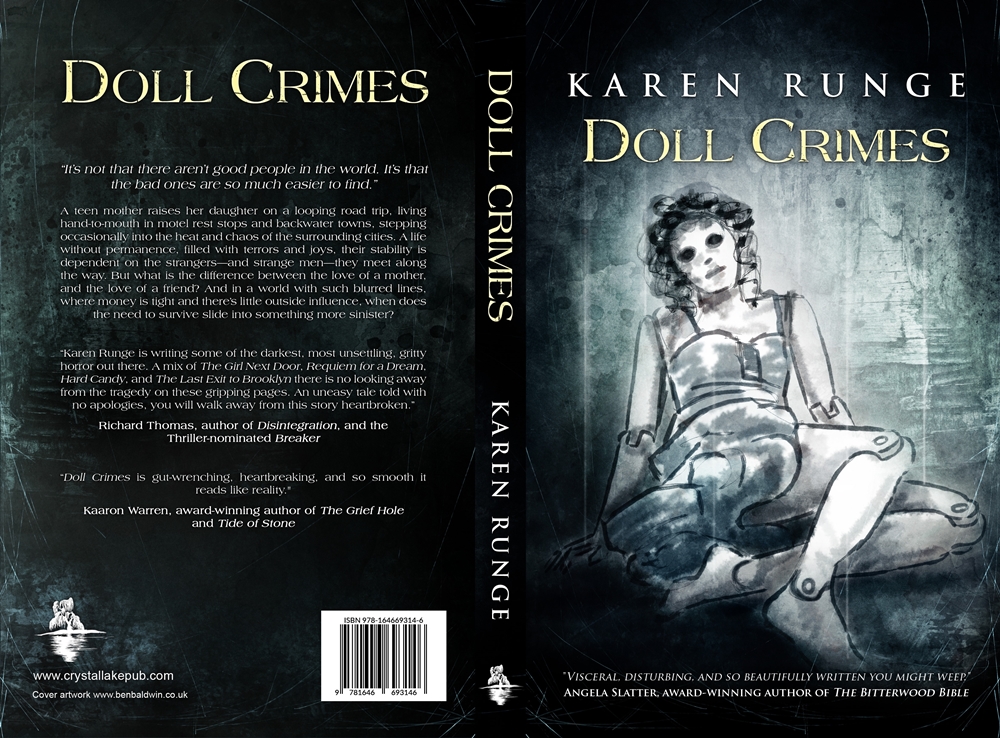
Karen Runge: I try not to be, but yes I am. If it’s pink and has bunny rabbits on it, I won’t want it on my shelves. If it’s tacky digital art with bad texturing, I’m not going to feel too solid about the quality of the content. Unless I already know the author, it’s hard not to judge a book by the art. After all, the cover is literally the first thing you see when you pick up a book. I’ve been extremely lucky with my own covers; my publishers have made fantastic choices. Seven Sins was done by Stephen Fredette, former Scruffy the Cat bandmate of editor Stona Fitch. So that cover is special in a few ways. Seeing Double was done by the gob-smackingly talented Dean Samed, whose career has since seriously taken off. As of this interview, the Doll Crimes cover is in the capable hands of Ben Baldwin. I just saw his concept sketch a few days ago and had to go scream into a pillow I loved it so much. Cover artists are a different kind of genius: it’s incredible how they manage to incorporate so much of a story’s tones and themes into one single image.
Meghan: What have you learned creating your books?
Karen Runge: That even as I’m raging at myself that I JUST CANNOT DO THIS, I can, in fact, Do This. And am busy doing it even as I’m raging about how I can’t. Looking back on these moments, they become a great practical illustration of how your own mind can be your enemy, sometimes for no real reason at all. So if I’ve learned anything from that, it’s that my negative voices are often full of shit and the best thing to do is just block them out and carry on. Save judgement for the end, and shut up about it until we get there. This mindset really helps.
Meghan: What has been the hardest scene for you to write so far?
Karen Runge: There were a couple scenes in Seeing Double that took some serious mental work, and caused me a lot of emotional strain. I know cruelty, but I am not cruel, so writing first-person from the POV of someone doing something so vicious—and write it convincingly—meant draft after draft, each time in serious psychic distress. It took a massive amount of energy, so I’m always relieved when readers tell me those scenes affected them. It means they worked. And as the creator, I definitely paid for them.
Meghan: What makes your books different from others out there in this genre?
Karen Runge: There’s a bit of a gap between literary horror and extreme horror. Actually, it’s more of a chasm with a few frazzled monkey ropes dangling in-between. I was chatting with Nikki Noir about this recently: how hard it is to find hardcore horror that doesn’t lean so deep into Schlock territory all depth is gone. Schlock is fantastic, don’t get me wrong, but there’s still a step missing here. Filmmakers got it right with New French Extremism: why isn’t the literary equivalent keeping pace? And this is really what I try to do. When I wrote Seeing Double, I aimed for a body horror that would present in a literary style. I wanted it as far from Schlock as I could get it, without diminishing the gore. I had to make the gore… well, deep. And keep it real, so nobody would mistake it for Absurdo, either. With Doll Crimes, I’m stepping away from body horror and towards its psychological equivalent: mental and emotional trauma. My stories concern themselves with the raw realities of evil in the really-real world. Inescapable, sometimes inevitable, knocking-on-your-door-right-now type subjects. But even within that, my focus is on empathy, on exploring the extreme and the unthinkable as honestly as I can, with as much insight and sensitivity as I can. Literary horror? Trauma horror? My territory lies somewhere in the space between.
Meghan: How important is the book title, how hard is it to choose the best one, and how did you choose yours (of course, with no spoilers)?
Karen Runge: For some reason I’ve never had a problem with titles? They just arrive in my head at some point and make perfect sense to me, no argument. I wish I had a more exciting answer, but I really don’t. As for importance: yes, there needs to be something different there, something that represents the key component(s) of the tale, isn’t too common/hasn’t been used, and still sounds pretty when rolling off the tongue. Tricky balances, here.
Meghan: What makes you feel more fulfilled: Writing a novel or writing a short story?
Karen Runge: They’re different, but on balance a novel probably offers me more, just with a longer wait to reach the pay-off. A short story can arrive fully-formed in a day, or work its way out over a few weeks, or get itself binned in the early stages because it’s proving to be a little nightmare you really don’t need to be dealing with. Your call. Whatever happens, they’re usually easier to get through (or at least, get them to the edits stage), purely because you’re only working with a max of roughly 8000 words? That’s much easier to thread and stitch than 50K plus. Novels take an insane amount of work, an incredible amount of mental energy. And you’re on your own in there for like a year. There’s a point of no return where even if you hate where it’s going and Every Day Is Pain, you cannot abandon it. You’re locked in, like it or not, and sometimes just about kills you. Successfully selling a short story makes me feel like I just got given a very, very pretty crown. Getting through a novel—and then successfully pitching it to a publisher—makes me feel like I just got the whole throne.
Meghan: Tell us a little bit about your books, your target audience, and what you would like readers to take away from your stories.
Karen Runge: My books and stories are about humanity—and inhumanity—first. As much as we find beauty, there is also real evil in the world. Sometimes life lines up to make the most wonderful things happen. But sometimes it does it for the opposite result, too. I find this fascinating, and in each of my works I try to represent reality and the nuanced complexities that go with each set of circumstances I create. If you prefer escapism, my books probably aren’t for you. People who enjoy my work are usually fans of people like Bloch and Ketchum and Ellis; the authors who take their souls with them when they dive into the dark. If there’s a takeaway in my work, I hope it’s the understanding that there’s more to learn from looking than by sweeping things under the carpet. There’s a reason why understanding and empathy have such a symbiotic link. Your life can change forever in just one second. Seriously. Anything can happen. As an individual, I think we do better if we stay real about that. And as a psych horror author, this is what I’m all about exploring.
Meghan: Can you tell us about some of the deleted scenes/stuff that got left out of your work?
Karen Runge: There were one or two scenes in Doll Crimes where I tried to unpin the veil for a moment and offer a more direct view of what was going on. I didn’t continue with them for a few reasons. One: this story is in a first-person POV, and lifting the veil goes against the shadowed mindset of someone who is actively being traumatised—which is what I really wanted to convey. Second: It just wasn’t necessary. What I had down was hard enough to confront without bludgeoning myself—or my readers—with it. And third: Sometimes less is more. And sometimes it’s not. But sometimes, it really is.
Meghan: What is in your “trunk”? (Everyone has a book or project, which doesn’t necessarily have to be book related, that they have put aside for a ‘rainy day’ or for when they have extra time. Do you have one?)
Karen Runge: Painting. Murals, specifically. I moved recently, and the walls here are very blank. I’m not used to it. In my last apartment, I risked the wrath of my landlord by painting a massive mural on my studio wall. (It’s okay, he’s a good dude and very kindly let me off the hook.) I like the things around me to be beautiful, or interesting, or unusual in some way. Every time I look up in this new place, I cringe at all the beige, all that emptiness. There’s only so much random stuff I can tack to the walls without looking like a hysterical teenager—and I love to personalise. For now I’m telling myself to see these walls as blank canvases. So, painting. Please.
Meghan: What can we expect from you in the future?
Karen Runge: I’m gearing up for a new short story collection. I still have a few more stories to write for it before I pitch a publisher, but hopefully this ball will start rolling sometime in the next few months. Short stories are my first love, and I’ve been so crazy with Doll Crimes for so long that I’d love to take a few deeper breaths. Plus I’m really excited about what I want to include in there. I also have a poetry collection boiling in the background. I write poetry all the time, but getting it published would be new for me. I’m still waiting to hear back from my beta reader on that before I do anything drastic, though.
Meghan: Where can we find you?
Karen Runge: You can find me on Twitter and on Facebook. I also have a kind of landing site (though I don’t blog).
Meghan: Do you have any closing words for your fans or anything you’d like to say that we didn’t get to cover in this interview?
Karen Runge: My huge, heartfelt thanks to everyone who’s followed and supported me over the years. It’s a brutal joke that writers (and artists in general) are often among the more sensitive, introverted types—where the only path to success requires we put ourselves out there in ways that just about strip the skin. It can be exceptionally hard. I’d be a mess in this if it weren’t for the beauty of some of the souls I’ve come across over the years in my career. Editors, reviewers, collaborators, fans. Friends. Random folks who say something nice. Thank you. You don’t know how deep it sometimes counts.
‘It’s not that there aren’t good people in the world. It’s that the bad ones are so much easier to find.’
A teen mother raises her daughter on a looping road trip, living hand-to-mouth in motel rest stops and backwater towns, stepping occasionally into the heat and chaos of the surrounding cities. A life without permanence, filled with terrors and joys, their stability is dependent on the strangers—and strange men—they meet along the way. But what is the difference between the love of a mother, and the love of a friend? And in a world with such blurred lines, where money is tight and there’s little outside influence, when does the need to survive slide into something more sinister?
A trio of expats living in Asia form a tenuous bond based on mutual attraction, sexual obsession and the insatiable desire to experience the deadliest of thrills.
As their relationship matures, the dangerous love triangle in which they’ve become entwined quickly escalates into a series of brutal sexual conquests as they struggle to deal with lives spinning out of control and the debilitating psychological effects of mental and physical abuse.
Known for her distinctive brand of unsettling fiction, author Karen Runge is at the top of the modern horror game in this, her premiere novel. Seeing Double is a beautifully evocative and stunningly dark coming-of-age exploration of human sexuality and the roles of masculinity and feminism, polyamorous relationships, social and psychological isolation, and the humiliation of ultimate betrayal.
A mesmerizingly dark imagination fills this collection of seven stories that explore a multitude of sins, both familiar and deadly. Love turns to lust. Crimes escape punishment. The ordinary turns strange. Women take control – or lose it. Blood flows, flesh ripens. And throughout, people, good and bad, find themselves in the inescapable grip of desire.
Karen Runge’s fresh voice resonates with those of the masters – Atwood, Oates, Mantel, King, and other writers who look bravely into the darkness and write unflinchingly about what they see there. With these disturbing but undeniable stories, Runge makes her dazzling first mark as a writer – one with a brilliant future ahead.
Am I the only one who remembers thinking as a child that when I grew up I would buy as much candy as I wanted and eat it every day? As an adult, other than a brief flirtation with Sugar Babies, Candy Corn still has a strong hold on me. I can’t even imagine eating only one candy corn. Once I start eating them, one by one, I can’t stop until my teeth ache and my stomach starts to whine. Other than the obvious ingredient of sugar, I was curious what else made up this innocent-looking, yet seductive deliciousness.
Curiosity has lead me to research many things, but usually it’s stuff like quantum mechanics, etc. Finding out that the place of origin for candy corn was Philadelphia was interesting, since I grew up there. Maybe that explained its hold over me? Originally it was called “Chicken Feed” when it was created in the 1880s. I’m pretty sure if they had kept that name I wouldn’t be writing about it now. It’s mainly made from sugar, corn syrup, honey & salt; well, that’s all the different kinds of sweet that accounts for the I-can’t-stop-eating-it-ness.
Millions of pounds are produced each year, which is how it’s on every store counter I pass in October. Sometimes research turns up information I wish I had never found, like there are variations of candy corn created for other holidays, not just Halloween. What the—!
There’s brown/orange/white candy corn for Thanksgiving (okay, I did know about this since it’s slyly shown up in October), red/green/white for Christmas, red/pink/white for Valentine’s Day, blue/white/red for Independence Day in the United States, and Bunny Corn for Easter (two color candy: pink/green/yellow/purple mixes). The madness goes on: caramel apple, green apple candy corn, s’mores, pumpkin spice, carrot corn, birthday cake…
There’s other forms the insidious flavor has invaded: candy corn flavored bagels, flavored martinis, Halloween costumes, beer, smoothies, deep fried, etc. Of course, a “Candy Corn” movie was released in 2019, since Tony Todd is in it I’ll have to track it down.
There are studies on how people eat each piece (whole or nibble from narrow end or the wide end), truth is I’ve done all three.
In case you think I’m the only one to obsess about this there are many essays online about candy corn. Elise Taylor wrote an essay for Vogue magazine in 2017 titled: “Candy Corn: You Either Love It or Hate It, There Is No In-Between”. There’s all kinds of statistics about people hating and loving candy corn. From Taylor’s article: “As Halloween comes and goes, so will the candy corn debate. But in late September, it’ll creep back into our consciousness and conversations again, a sugary Pennywise the Clown ready to terrorize your teeth, your towns, and your Twitter feed.”
I found a “Candy corn lovers support group” on FaceBook but I don’t think they’re going to help me control this problem because the first photo is for candy corn soda. So my little exclusion has opened up a door to eating candy corn all year long, in flavors and forms I never imagined—Noooooooo!!!
Who doesn’t need to know How To Recognize A Demon Has Become Your Friend? From the first African-American to receive the HWA Bram Stoker award, this collection of both horror and science fiction short stories and poetry reveals demons in the most likely people (like a jealous ghost across the street) or in unlikely places (like the dimension-shifting dreams of an American Indian). Recognition is the first step, what you do with your friends/demons after that is up to you.
Bram Stoker Award® winners Linda D. Addison and Alessandro Manzetti use their unique voices to create a dark, surrealistic poetry collection exploring the many ways shattered bodies, minds, and souls endure.
They created poems of visionary imagery encompassing death, gods, goddesses and shadowy, Kafkaesque futures by inspiring each other, along with inspiration from others (Allen Ginsberg, Pablo Neruda, Phillis Wheatley, etc.).
Construction of The Place started with the first bitten apple dropped in the Garden. The foundation defined by the crushed, forgotten, and rejected. Filled with timeless space, its walls weep with the blood of brutality, the tears of the innocent, and predatory desire. Enter and let it whisper dark secrets to you.
Proudly represented by Crystal Lake Publishing—Tales from the Darkest Depths.





 Meghan's House of Books