Halloween Extravaganza: INTERVIEW: Steve Thompson

Meghan: Hi, Steve. Welcome to the new Meghan’s House of Books. Tell us a little bit about yourself.

Steve Thompson: I live in Moncton, New Brunswick, Canada with my girlfriend, Lisa. I recently retired from my day job as a housekeeping supervisor at our city hospital after 30 years of service. I’m now dunking my foot into the unknown depths of the publishing world and hoping I don’t drown. I have 8 pets at home, 4 dogs and 4 cats that take up a large part of my day. 3 of those dogs are Boston Terriers and one is a Chorkie, and never in my life did I ever think I could love any animal as much as those dogs; the cats, well, they’re just evil.

Meghan: What are five things most people don’t know about you?

Steve Thompson: 1- I never graduated from high school because I was given the choice to quit or get kicked out 3 months before graduation. 2 – Most people know I am scared of heights, What they don’t know is if I get into a situation that I am up too high, I need to get down ASAP, even if it means jumping and I don’t know what is the greater fear, the heights or wanting to jump to get out of that situation. 3 – When I was 15, I broke into a portable classroom and peed in the desk drawer of a teacher I didn’t like because he bullied a lot of his students. 4 – When I was nine or ten years old I loved to burn things with a magnifying glass; plastic car models, the long grass in the fields next to our house and insects, I burned a lot of insects, and I didn’t turn out to be a serial killer. Got 4 out of 5.

Meghan: What is the first book you remember reading?

Steve Thompson: The Stand by Stephen King

Meghan: What are you reading now?

Steve Thompson: Finishing up In the Scrape by James Newman and Mark Steensland with Jeff Strand’s Five Novellas on deck.

Meghan: What’s a book you really enjoyed that others wouldn’t expect you to have liked?

Steve Thompson: Jackie Collin’s Hollywood Wives. I read this back in the 80’s because it was the only book in the house at the time that I hadn’t already read.

Meghan: What made you decide you want to write?

Steve Thompson: Reading Stephen King books is what turned me on to reading and writing.

Meghan: When did you begin writing?

Steve Thompson: About 25 years ago, but mostly it was just farting around, writing short stories for myself and some friends. I only started to take writing seriously about 6 years ago.

Meghan: Do you have a special place you like to write?

Steve Thompson: In my computer room/library.

Meghan: Do you have any quirks or processes that you go through when you write?

Steve Thompson: Nope.

Meghan: Is there anything about writing you find most challenging?

Steve Thompson: Everything, but mostly it’s the show don’t tell I struggle with but it is getting better the more I write. Also keeping my focus on one story at a time. Right now, I have 7 short stories that are half done and I keep jumping back and forth between them, writing a line or 2 on one story than a line or 2 on another.

Meghan: What’s the most satisfying thing you’ve written so far?

Steve Thompson: That would be my short story “Kill Point Club” from the anthology When the Clock Strikes 13. It was a fun story to write and I had a great time with it. I used the names of some of the other authors in the anthology as characters and then killed them off. Fun Times.

Meghan: What books have most inspired you?

Steve Thompson: The Stand by Stephen King, Animosity and Odd Man Out by James Newman. These are the only books I can remember ever pissing me off to the point I almost threw the books across the room and to make me shed a tear.

Meghan: Who are some authors that have inspired your writing style?

Steve Thompson: Stephen King, James Newman, and Richard Laymon to name a few.

Meghan: What do you think makes a good story?

Steve Thompson: Believable characters that grow on you and you care what happens to them, because if you don’t care the story just feels flat and lifeless. If something happens to a character, I want to be able to feel something for them and not just Johnny fell off a bridge and drowned and think who cares I wish they would all fall off a bridge and drown so this story would end.

Meghan: What does it take for you to love a character?

Steve Thompson: Again, I’ll say believable characters. Characters you can relate to and it doesn’t matter whether you love them or hate them as long as you feel something.

Meghan: How do you utilize that when creating your characters?

Steve Thompson: I try to make my characters as real as possible, I use characteristics from people I know or myself and then throw in a few quirks.

Meghan: Which, of all your characters, do you think is the most like you?

Steve Thompson: There’s a little piece of me in all my characters, so there really isn’t just one that is most like me.

Meghan: Are you turned off by a bad cover?

Steve Thompson: No, bad covers don’t turn me off. There’s a ton of great books out there with crap covers. It’s what’s inside that counts.

Meghan: To what degree were you involved in creating your book covers?

Steve Thompson: I had pretty much full control on my book covers for better or worse, except for When the Clock Strikes 13. I wanted all the authors involved to be ok with the cover before I finalized it.

Meghan: What have you learned creating your books?

Steve Thompson: I learned that I still have a lot to learn.

Meghan: What has been the hardest scene for you to write so far?

Steve Thompson: There was a rape and torture scene in my short story “Pearl” that was hard to write and I ended up cutting most of it out because it was too graphic. I still got some flak for it from a few readers telling me they didn’t like what happened to the girl and I would just reply well, you’re not supposed to like it and if you did, I’d think there was something wrong with you.

Meghan: What makes your books different from others out there in this genre?

Steve Thompson: I don’t really know, but all my stories are written in a very simple form that anyone can understand. You definitely don’t need a dictionary beside you to read one. Nothing takes me out of a story faster than not knowing the meaning of some words.

Meghan: How important is the book title, how hard is it to choose the best one, and how did you choose yours (of course, with no spoilers)?

Steve Thompson: The title is very important and can sometimes be hard to choose the right one. I try to make the title reflect what is inside the book.

Meghan: What makes you feel more fulfilled: Writing a novel or writing a short story?

Steve Thompson: I have never written a novel or novella for that matter; I love short stories. Reading them and writing them.

Meghan: Tell us a little bit about your books, your target audience, and what you would like readers to take away from your stories.

Steve Thompson: My short story collections are a mix of sci-fi and horror with one collection having a few non-fiction stories in it from periods of my life that have stuck with me. I just hope readers will enjoy the stories. If only one person likes the story, I still call that a win.

Meghan: Can you tell us about some of the deleted scenes/stuff that got left out of your work?

Steve Thompson: I tend to ramble on at times and then delete most of it.

Meghan: What is in your “trunk”?

Steve Thompson: Body parts. Just kidding. Or am I. Actually, I’m thinking about turning one of my short stories (Johnny Dewitt) into a novella.

Meghan: What can we expect from you in the future?

Steve Thompson: Right now, I am working on a short story collection and hopefully going forward with a signed limited-edition chapbook with one of my favorite authors.

Meghan: Where can we find you?

Steve Thompson: Amazon, Facebook, and In Your face Books.

Meghan: Do you have any closing words for your fans or anything you’d like to say that we didn’t get to cover in this interview?

Steve Thompson: I would like to thank you for doing this interview with me, my very first one, and thanks to everyone that read it until the end.

Steve Thompson is the author of two short and flash fiction collections. You can check out his 2 latest short stories “Kill Point Club” in the anthology When the Clock Strikes 13 from his In Your Face Publishing that he started in June 2019 and “Malignant” which he co-wrote with Kenneth W. Cain which is in the Shallow Waters 2 flash fiction anthology by Crystal Lake Publishing.

When the Clock Strikes 13

Tick – tock 
Tick – tock 
Tick – tock

Your time is running out. When the clock strikes 13, all manners of hell will break loose.

When the Clock Strikes 13 is a collection of thirteen short horror stories by some of the best horror and dark fiction authors writing today. Inside, you will find stories to frighten, shock and gnaw at your inner fears, and take you places that belong only in the dark recesses of your mind. There are monsters on these pages; some are human, some are not. 

Table of Contents 
Introduction by Joe Mynhardt 
“The Boy in the Pond” by Mark Allan Gunnells 
“Open Waters” by Richard Thomas 
“Memories” by John R. Little 
“Detrition of War” by Kenneth W. Cain 
“Comes the Red Man” by Tom Deady 
“Mommy’s Girl” by Somer Canon 
“Taking Up Carpentry” by Justin M. Woodward 
“Kill Point Club” by Steve Thompson 
“Calm Down Time” by Richard Chizmar 
“Carrion: My Wayward Son” by James Newman 
“Bear” by Michelle Garza and Melissa Lason 
“When Arachnids Attack” by Sheri White 
“A Song Above” by Glenn Rolfe 
Afterword by Steve Thompson 
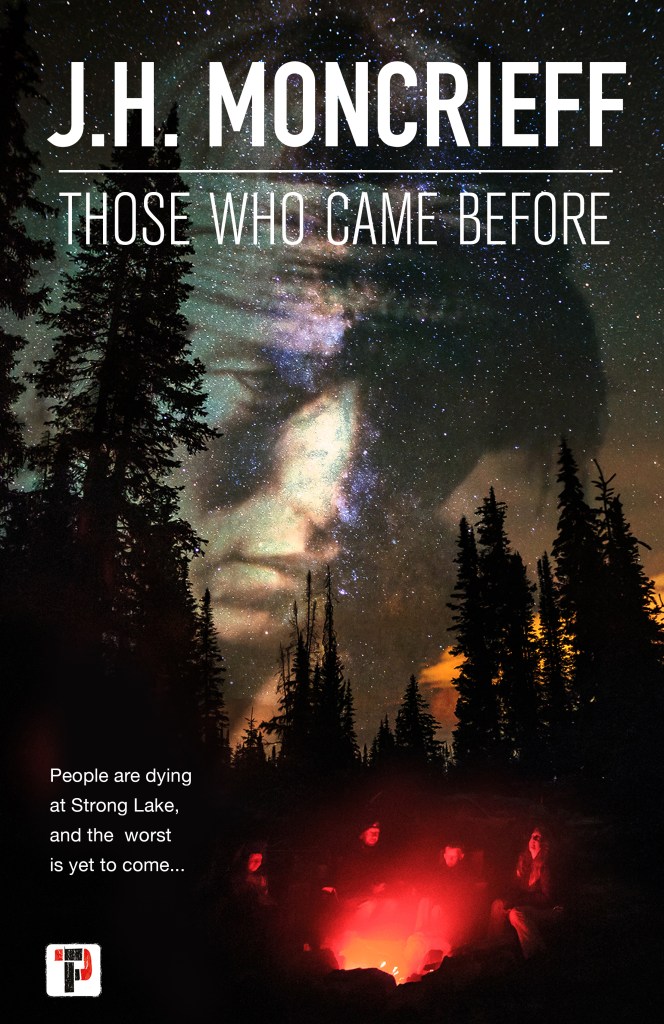
Halloween Extravaganza: INTERVIEW: J.H. Moncrieff

Meghan: Welcome to our annual Halloween Extravaganza! Tell us a little bit about yourself.

J.H. Moncrieff: I’m an avid traveler, muay thai kickboxer, and teacher who writes mysteries that explore the dark side of human nature. I love animals of all kinds, long bubble baths, and black licorice.

Meghan: What are five things most people don’t know about you?

J.H. Moncrieff:

  • Though not much scares me, I can be incredibly claustrophobic. I never know what will bring it on, but when it happens, it’s absolutely terrifying.
  • I once had a sushi roll named after me.
  • I read more true crime than any other genre, and once hoped to be a forensic psychologist.
  • I’ve been writing “books” since I was five years old (the earliest ones were more like picture books). When I was a child, an author named Budge Wilson told me I could be a writer, too. I’ve never forgotten that – or her.
  • In my journalism days, I interviewed Kiefer Sutherland, tracked down a sniper, and spent a month in Africa (not for the same story). I still write the occasional article for magazines and newspapers.

Meghan: What is the first book you remember reading?

J.H. Moncrieff: Either The Cat in the Hat by Dr. Seuss, or one of the Richard Scarry books—I can’t remember the title, but it was a treasury, and it was huge. I also liked fairytales, but of the Brothers Grimm variety.

Meghan: What are you reading now?

J.H. Moncrieff: A friend’s book: In the Valleys of the Noble Beyond: In Search of the Sasquatch. I met the author, John Zada, at a writers’ conference where we were both presenting, and we bonded over the fact that we were both writing books about sasquatches with the word ‘valley’ in the title. However, his book is non-fiction.

Meghan: What’s a book you really enjoyed that others wouldn’t expect you to have liked?

J.H. Moncrieff: People might be surprised to discover I enjoy reading lighter women’s fiction and travel memoirs. I love Maeve Binchy, Marian Keyes, and Sophie Kinsella’s Shopaholic series. I’m also a fan of a good cozy mystery where the protagonist isn’t an annoying busybody.

Meghan: What made you decide you want to write? When did you begin writing?

J.H. Moncrieff: I’m not sure I had a choice. I’ve always been a natural storyteller, both verbally and in writing. I’ve been writing stories since I learned how to write, and even before that, with pictures.

Meghan: Do you have a special place you like to write?

J.H. Moncrieff: It depends on the season. In the warmer months, I love to write on my deck amongst the squirrels and birds. When it’s cold, I prefer the bathtub. (Weird, I know, but I like it.)

Meghan: Do you have any quirks or processes that you go through when you write?

J.H. Moncrieff: Some would say the above is a quirk. Other than that, I like to burn a scented candle, but I don’t have to. What I do need is silence. Any kind of noise, and sadly, even music, can distract me.

Meghan: Is there anything about writing you find most challenging?

J.H. Moncrieff: Fitting writing into a busy life, and actually writing when I have the time. I struggle with getting as much done as I’d like.

Meghan: What’s the most satisfying thing you’ve written so far?

J.H. Moncrieff: A non-fiction article that helped a blind man regain his sight (he found out about an eye surgeon who could work miracles). It’s hard to top that. In fiction, it would be a novel called The Last Bit of Light, which is about a woman who buys an old plantation house on a Caribbean island, only to discover it’s haunted by the ghost of a slave. The ghost has his own point of view, from the moment he’s kidnapped in West Africa until the day he dies in a rebellion. It’s a complicated book that involved a ton of research, and I’m really proud of it, but it might never be published, because the combination of ghost story, historical novel, and women’s fiction is a bit different, to say the least.

Meghan: What books have most inspired you? Who are some authors that have inspired your writing style?

J.H. Moncrieff: It’s almost a cliché, but definitely Stephen King. Some of Elizabeth Berg’s writing, especially her way of describing “ordinary” things, is so beautiful it makes me want to weep, but I could never aspire to that. When I was a child, books about ghosts, monsters, and unexplained phenomenon inspired me. I was a big fan of the Time Life Mysteries of the Unknown series. One of the best gifts I’ve ever received was the entire set of those books.

Meghan: What do you think makes a good story?

J.H. Moncrieff: Characters you care about. A plot that holds your attention and isn’t predictable. Suspense and a bit of mystery—readers should be wondering about something. I like well-rounded characters with flaws, and it’s cool if the setting is intriguing.

Meghan: What does it take for you to love a character? How do you utilize that when creating your characters?

J.H. Moncrieff: I have to be able to empathize with them in some way, or at least find them interesting. I’m a bit different when it comes to my own characters, because I don’t consciously “create” them. They appear in my head and start telling me their story, and I give them all the agency they need. I’m never quite sure what they’re going to do. Keeps life interesting.

Meghan: Which, of all your characters, do you think is the most like you?

J.H. Moncrieff: None of my characters as a whole, but there are little elements in some of them. Jackson’s sarcasm (GhostWriters series). Nøkken from Monsters in Our Wake shares a lot of my opinions, especially about the destruction of the environment. Chief Kinew’s love of reading (Those Who Came Before). Josh’s teddy bear is based on one I was given as a child (The Bear Who Wouldn’t Leave).

Meghan: Are you turned off by a bad cover? To what degree were you involved in creating your book covers?

J.H. Moncrieff: I mostly feel sympathetic towards the author when I see a bad cover. As for me, in some cases I had a lot of involvement, and in others, very little. My first cover was a bit embarrassing, but that version of the book is now out of print. The new cover is great.

Meghan: What have you learned creating your books?

J.H. Moncrieff: I learned something different from all of them. As a whole, I’ve learned that if I just trust my process (letting the characters lead the story), it’ll all work out. This is harder than it sounds when I’m in the middle of a book and have no idea where it’s going or how it’s going to end.

Meghan: What has been the hardest scene for you to write so far?

J.H. Moncrieff: In one of my earlier books, a preteen girl is gangraped and murdered by a group of teenagers. My editor at the time told me not to flinch—that to do it justice, it had to be graphic. After I finished writing it, I threw up. Then I cried. My characters are very real to me. It was also very hard to kill Lutalo from The Last Bit of Light. I knew he had to die, but I kept putting it off. I bawled pretty hard that day.

Meghan: What makes your books different from others out there in this genre?

J.H. Moncrieff: My supernatural suspense are different because they’re set in unusual, haunted places all over the world that I’ve actually visited. My horror books are different because the “monsters” are usually not the evil ones. There’s something unexpected in all of them. I’d call it horror with heart—they’re psychological, and rely on the interaction of characters rather than gore.

All my books tend to have the underlying theme of “The sins of the past are revisited in the present.” It’s not intentional, but I do believe the bad things we’ve done can come back to haunt us. Sometimes literally.

Meghan: How important is the book title, how hard is it to choose the best one, and how did you choose yours (of course, with no spoilers)?

J.H. Moncrieff: The title is extremely important. I also find it extremely difficult to come up with one, in most cases. I often let my readers decide. For my upcoming release, Those Who Came Before, I held a contest on my Facebook page and the best title won. The Last Bit of Light took forever to name. I went through dozens and dozens of prospective titles before I landed on the right one.

Meghan: What makes you feel more fulfilled: Writing a novel or writing a short story?

J.H. Moncrieff: Writing a novel, because of the time, energy, and skill involved. Not that short stories don’t require skill, but to maintain interest throughout 300 pages or more, and to make sure all loose ends are tied up in a satisfying conclusion, is exceptionally difficult. I still don’t find it easy and I’ve written fourteen novels now, with two more nearing completion.

Meghan: Tell us a little bit about your books, your target audience, and what you would like readers to take away from your stories.

J.H. Moncrieff: I primarily write supernatural suspense, thrillers, and psychological horror, so I just say “dark fiction” to make it easier. They tend to be set in unusual places around the world: a haunted island off the coast of Venice, a Chinese ghost city, the notorious Dyatlov Pass—or in the case of Those Who Came Before, a cursed campground.

While I hope to be entertaining, I also want to provoke thought with my work. Those Who Came Before shines a light on some of the horrible injustices and cruelty Native Americans suffered and are still suffering; City of Ghosts is fictional, but delves into the way girls were considered expendable in China; and Monsters in Our Wake features a sea creature who is pissed off at the oil industry for ruining his home. If my novels make people think, that’s all I can ask for.

My target audience is avid readers who understand sarcasm, aren’t offended by off-color characters, love to travel or wish they could, and don’t want their endings wrapped up in a neat bow. It helps if they’re willing to explore other cultures and perspectives without judgement.

Meghan: Can you tell us about some of the deleted scenes/stuff that got left out of your work?

J.H. Moncrieff: Usually I don’t delete much anymore, but an upcoming Audible Original release (Dragonfly Summer) used to be a hundred pages longer. As I’ve gained more experience, I’ve gotten better at learning where to start a story and what to leave out. I don’t think anything was left out of Those Who Came Before.

Meghan: What is in your “trunk”?

J.H. Moncrieff: Oh, I have so many. I’ve had an idea for a children’s picture book series for years now. I’d love to have time to go through the photos from my travels and post a few, get some of them edited and printed. And there’s a bookcase that needs to be painted… I also love reading cookbooks and trying new recipes, but once my classes gear up in the fall, there’s never enough time.

Meghan: What can we expect from you in the future?

J.H. Moncrieff: Book Five in the GhostWriters series, Mask of Ghosts. My latest creature feature, Valley of the Sasquatch. Dragonfly Summer, a psychological thriller, which should be released in December. Another psychological thriller about a couple who decide to tackle an unsolved cold case (title TBD). So many books, so little time!

Meghan: Where can we find you?

J.H. Moncrieff:

Website ** Books
Facebok ** Instagram ** Twitter ** Pinterest

Meghan: Do you have any closing words for your fans or anything you’d like to say that we didn’t get to cover in this interview?

J.H. Moncrieff: I’d just like to thank everyone who has read my books, reviewed them, shared them. I love hearing from readers, and those emails and messages make my day. Being an author can be isolating, and I’m an extrovert—I need human contact, which is why I started teaching writing and marketing. To hear that something I wrote affected someone, or made them feel better, or kept them up all night… what could be better than that?

J.H. Moncrieff’s City of Ghosts won the 2018 Kindle Book Review Award for Best Horror/Suspense. Reviewers have described her work as early Gillian Flynn with a little Ray Bradbury and Stephen King thrown in for good measure. She won Harlequin‘s international search for “the next Gillian Flynn” in 2016. Monsters in Our Wake, her deep-sea thriller with Severed Press, hit the top of Amazon’s horror bestsellers list, beating King’s re-released It to the top spot. Her supernatural suspense GhostWriters series has earned rave reviews from Kirkus, BlueInk, and Library Journal.

Moncrieff began her writing career as a journalist, tracking down snipers and canoeing through crocodile-infested waters. Her articles have appeared in many publications, including Chatelaine, FLARE, Writer’s Digest, and The Globe and Mail. She also spent years working in marketing, public relations, and communications, and now teaches workshops all over the world.When not writing, she loves exploring haunted places, advocating for animal rights, and summoning her inner ninja in muay thai class.

Those Who Came Before
Amazon ** Goodreads ** Flame Tree ** Chapters/Indigo

People are dying at Strong Lake, and the worst is yet to come.

An idyllic weekend camping trip is cut short when Reese Wallace’s friends are brutally murdered. As the group’s only survivor, Reese is the prime suspect, and his story doesn’t make much sense. A disembodied voice warning him to leave the campground the night before? A strange, blackened tree that gave him an electric shock when he cut it down for firewood?

Detective Greyeyes isn’t having any of it―until she hears the voice herself and finds an arrowhead at the crime scene―an arrowhead she can’t get rid of. Troubling visions of a doomed Native American tribe who once called the campground home, and rumors of cursed land and a mythical beast plague the strangest murder case she’s ever been a part of.

Halloween Extravaganza: Mark Sheldon: A Brief History of My Creative Mash-Up Halloween Costumes

Halloween has always been my favorite of all holidays. The earliest Halloween I remember, I was about four or five years old – mostly I remember it, because my dad had a fairly extensive video made of the party with his now-antique VHS recorder. My mom went as a witch, dad was Count Dracula, and I was a lion (though I didn’t wear the head piece very much because it was too hot!) We had this big walk-in pantry that we’d turned into a haunted maze, we had a bucket for bobbing for apples on the porch, dad had carved two pumpkins into Bert and Ernie heads, and there were skeletons and ghosts hanging everywhere.

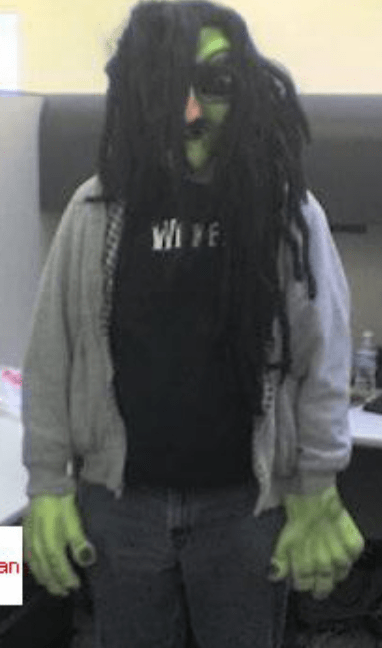
Dressing up in costumes, though, I think was always my favorite part. My favorite costume of all time was one I made first back when I was going to college in Boston. I bought a UFO alien mask and gloves, stitched a pair of Groucho Marx onto the mask, and pulled on a hoodie sweatshirt over the whole thing so that I was an alien trying to pose as a human. A few years later, I added on a Rastafari dreadlocks wig to the ensemble. No particular reason, really.

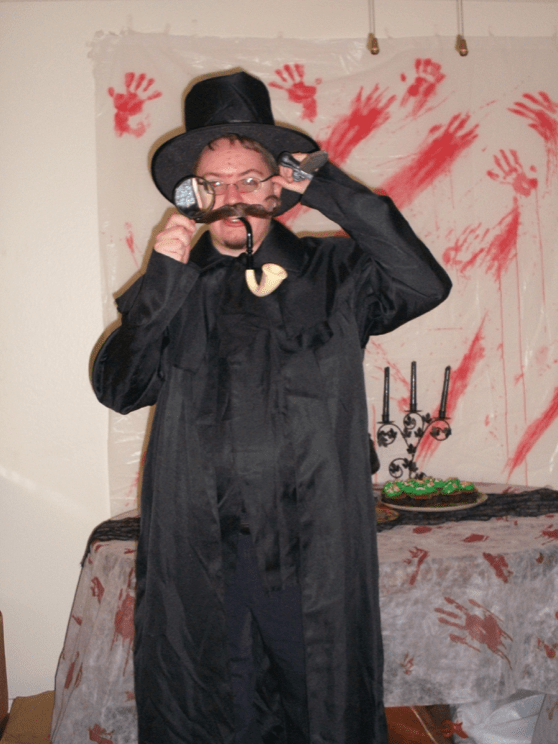
Another year I went as Sherlock The Ripper – I had a long black coat and top hat, fake handlebar mustache, a bloody knife, and a Sherlock Holmes pipe and magnifying glass. At night he put on a fake mustache and went around London dissecting Protestants. By day, he removed the mustache and pretended to attempt to solve the crimes he had committed, so as to alleviate suspicion. That year, my wife Betsy went as Afronighty, the Roman Goddess of Dusk. Our theme was that we were bad high school essays.

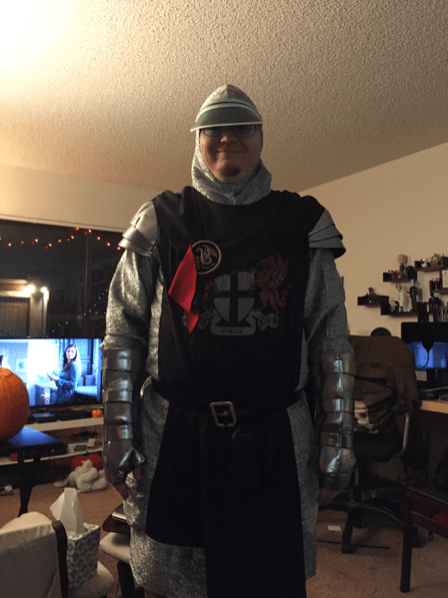
Most recently, I punned out my job as a hotel night auditor and went as Sir Abacus, a Knight Auditor of the Rounded-Up Table. I had the full knight’s armor complete with an old-school accountant’s visor and a spool of calculator tape attached to my belt. The hotel’s general manager loved it so much she insisted I wear it on my shift, despite the official dress code policy.

Mark Sheldon is the author of The Noricin Chronicles and the Sarah Killian series. He has also published a collection of short stories titled Mores From the Maelstrom. He lives in Southern California with his wife Betsy.

Sarah Killian 1: Serial Killer (for Hire!)

Meet Sarah Killian, a professional serial killer (for hire!) with a twisted sense of humor.

Sarah Killian is not your average thirty year-old single woman. Foul-mouthed, mean-spirited, and a text-book-case loner. Also, she is a Professional Serial Killer. 

In this Crime Fiction / Thriller novel with a twisted sense of humor, Sarah works for T.H.E.M. (Trusted Hierarchy of Everyday Murderers), a secret organization of murderers for hire headed up by the mysterious Zeke. You’ll be surprised to learn who their biggest clients are. Conspiracy theories, anyone? 

But a wrench is thrown into the clockwork of Sarah’s comfortable lifestyle when, on her latest assignment, she is forced to take on an apprentice, Bethany—a bubbly, perky, blonde with a severe case of verbal-vomit. In short, Bethany is everything Sarah is not. 

Will Sarah be able to adjust and work with her new apprentice, or will she break her contract with T.H.E.M. and murder the buxom bimbo?

So if you’re looking for a strong female lead that doesn’t care what you think, in a book similar to the best of Dean Koontz and J.A. Konrath, then look no further than Sarah Killian – Serial Killer (For Hire). 

Just don’t call her an ‘assassin.’ You might not live long enough to regret it.

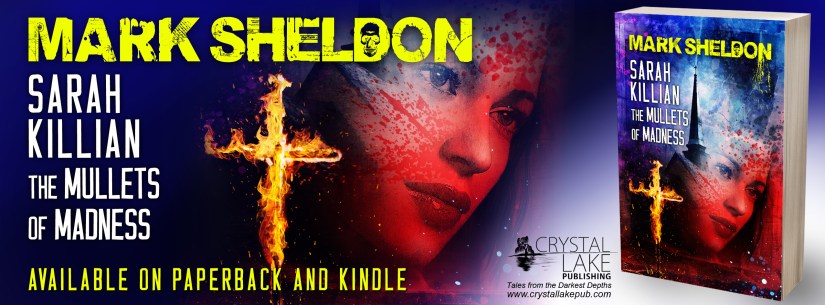
Sarah Killian 2: The Mullet of Madness

Have you ever woken one morning with a burning, insatiable desire to go out and kill someone?

Sarah Killian, a notoriously foul-mouthed and mean-spirited serial killer for hire, along with her cohort assassin Mary Sue Keller, are back on assignment for the Trusted Hierarchy of Everyday Murderers (T.H.E.M.).

After receiving an ominous warning from a mark-gone-wrong, it becomes clear that Nick Jin—Sarah’s former nemesis—is still at large and singling her out.

Sarah and Mary Sue are dispatched to Tennessee to discreetly kill off an accused family of KKK organizers, but their true mission is to lure Nick Jin into a trap. But will Nick—always several steps ahead of T.H.E.M.—see their bait for what it is? One thing is guaranteed: blood will be shed.

In the spirit of Sidney Sheldon, Dean Koontz, and Joss Whedon,The Mullets of Madness is a truly unique blend of horror, suspense and espionage.

Halloween Extravaganza: INTERVIEW: Mark Sheldon

Meghan: Welcome to Meghan’s House of Books, Mark. It’s a pleasure to have you here today. Tell us a little bit about yourself.

Mark Sheldon: I’m thirty-seven and I live in Southern California with my wife of ten years, Betsy. We don’t have any children, but several nephews and a niece that keep us plenty occupied.

Meghan: What are five things most people don’t know about you?

Mark Sheldon:

  • I was born in Hawaii.
  • I traveled up the Yangtze River a few years before the Three Gorges Dam was built.
  • I lived in Germany for three months when I was in third grade. The only German I really remember is the phrase “Ich bin ein kleines gewerbegebiet,” which translates roughly into “I am a little business district.” I was an odd child.
  • I also write music.
  • My spirit animal is a penguin.

Meghan: What is the first book you remember reading?

Mark Sheldon: First one I read by myself was definitely Green Eggs and Ham.

Meghan: What are you reading now?

Mark Sheldon: Stephen King’s The Green Mile. It’s been on my bucket list to read that one for decades, and finally gotten around to it.

Meghan: What’s a book you really enjoyed that others wouldn’t expect you to have liked?

Mark Sheldon: Ooh, that’s a hard one, because I really wear my heart on my sleeve as far as the kind of books I read. Closest answer I can give is that I didn’t hate The Cursed Child nearly as much as the majority of the Harry Potter fandom did.

Meghan: What made you decide you want to write? When did you begin writing?

Mark Sheldon: I’ve been writing for as long as I can remember – and I’m pretty sure that before that I was telling stories. Earliest story I remember writing was in Kindergarten, and was about a mystical crystal from outer space which created the dinosaurs, and when it’s power died out so did they, and that was why they went extinct. Had pictures and everything.

Meghan: Do you have a special place you like to write?

Mark Sheldon: Someday, when Betsy and I get our dream home, I’ll have a writing nook and all that jazz, but at this point in my life I pretty much squeeze in my writing where and when I can.

Meghan: Do you have any quirks or processes that you go through when you write?

Mark Sheldon: Normally I’m a very thorough plotter. I had sketched out the detailed plots of all twelve books of The Noricin Chronicles before I even wrote the first book. With the Sarah Killian books, I’ve gone for a more free-form approach, where I’m basically just writing as I go along. I have the overall story arc in my mind, but I haven’t done any sketching or pre-plotting on paper before I set down to write each book. It’s proven both liberating and challenging, but I think the freeform technique lends itself well to Sarah’s frenetic personality.

Meghan: Is there anything about writing you find most challenging?

Mark Sheldon: The “afterwork” – promoting, etc. I love writing, I love the editing process, and everything leading up to publication, but I’m a fairly humble person by nature, so “selling myself” isn’t something that comes naturally to me.

Meghan: What’s the most satisfying thing you’ve written so far?

Mark Sheldon: I’ve very fond of my short story, The Life of Death, which was included in Crystal Lake’s anthology Fear the Reaper. As suggested by the title, it’s the story of Death’s life and the events that pushed her to don the cloak and scythe.

Meghan: What books have most inspired you? Who are some authors that have inspired your writing style?

Mark Sheldon: Too many to list for sure, but top of the list would be everything by Douglas Adams. I loved the books of Dean Koontz when I was a teenager, but have kind of grown out of him now that I’m older. J.K. Rowling has had a huge impact on me as a reader and writer – not just Harry Potter, but I am extremely fond of her Robert Galbraith books as well (Casual Vacancy was well-written, but not really my personal cup of tea). Dan Brown is sort of my guilty pleasure author.

Meghan: What do you think makes a good story?

Mark Sheldon: If only it were that easy, heh! I think the characters are the most important part of any story. You could have an amazing plot, but who cares if there isn’t anyone you care about inside of that plot? That said, I have always been a sucker for a good surprise ending.

Meghan: What does it take for you to love a character? How do you utilize that when creating your characters?

Mark Sheldon: I love any character with snark. I am something of a smart-ass myself, so I love characters that can hold their own in a verbal joust. I think that should be fairly evident to anyone who has read the first chapter of Sarah Killian: Serial Killer for Hire.

Meghan: Which, of all your characters, do you think is the most like you?

Mark Sheldon: The trio of Mike, Dan, and Shelley from The Noricin Chronicles are probably the closest representation of the different aspects of my personality. Mike being the socially awkward nerd, Dan being the idealist who believes in standing up for what is right, and Shelley the smart-ass.

Meghan: Are you turned off by a bad cover? To what degree were you involved in creating your book covers?

Mark Sheldon: I wouldn’t necessarily say I’m turned off by a bad cover, though an intriguing one certainly will catch my eye more. For The Noricin Chronicles, since I was self-publishing and had a budget of $0.00, I designed all the covers myself, except for the first one. For the Sarah Killian books, both covers were designed by Ben Baldwin, an artist with Crystal Lake, so I wasn’t quite as involved with those designs obviously, but I gave Ben some basic ideas about the books’ themes, events, and Sarah’s character, and he went from there.

Meghan: What have you learned creating your books?

Mark Sheldon: I think most people imagine authors as sort of fantastical gods, creating their worlds and characters, divining the events and trials that their subjective characters will have to face. The truth is, at least as I and several other writers I know have found, we don’t have nearly as much control over what we write once the pen starts moving. Amy Reyshell in The Noricin Chronicles was particularly stubborn about doing what she wanted, regardless of what I had sketched out for the plot ahead of time.

Meghan: What has been the hardest scene for you to write so far?

Mark Sheldon: I don’t want to give away any spoilers, but the end of The Relics of Time (Book 5 of The Noricin Chronicles), was definitely the hardest scene I’ve written so far. I had to do things in that book that made Betsy stop talking to me for a few hours. That said, the first scene of Sarah Killian three is going to be extremely difficult for me to write when I get to it – I can’t really get into why without spoiling the end of Book 2 – and will almost certainly surpass The Relics of Time in becoming the hardest scene I may ever write.

Meghan: What makes your books different from others out there in this genre?

Mark Sheldon: For the Sarah Killian books that’s easy, because I’m not aware of any other horror-espionage books out there. Not saying they don’t exist, but they haven’t come across my radar yet if they do. The Noricin Chronicles was written to be more of a mainstream work, however it’s still relatively unique, I think, in the way that I blended history and literature into my original story. Other writers have certainly tackled blending history with an original story or pre-existing literature with a new story, but there aren’t many books out there that did both to the extent that I did in The Noricin Chronicles.

Meghan: How important is the book title, how hard is it to choose the best one, and how did you choose yours (of course, with no spoilers)?

Mark Sheldon: I’d say the title is even more important than the cover – especially in the current age of digital books, there are instances where the title is the first and maybe only impression a reader will get before reading the summary and deciding if they want to buy. For Sarah Killian: Serial Killer for Hire, the title was really what came first, so that was easy and the rest of the story just evolved out of me figuring out exactly how a serial killer who worked for hire would function. The title for the second book – Sarah Killian: The Mullets of Madness – came to my mind as I was writing the first book, when early on Sarah mentioned that there were few things in the world she could stand less than a man with a mullet. As soon as she had said that, the title Mullets of Madness struck me as a good name, and I knew that I would be using it for her at some point in the series.

Meghan: What makes you feel more fulfilled: Writing a novel or writing a short story?

Mark Sheldon: There is certainly more of a buildup for the completion of writing a novel. Months or even years of writing, re-writing, re-re-writing, so of course the satisfaction of finally having come to completion on that is really incomparable. However, there’s also something very satisfying about being able to tell a complete story in such a succinct format as the short story form. So I’d say both are very fulfilling, just in very different ways.

Meghan: Tell us a little bit about your books, your target audience, and what you would like readers to take away from your stories.

Mark Sheldon: Like I mentioned earlier, Sarah Killian is a very unique blend of horror-espionage. Sarah works for a secret organization known as T.H.E.M. – the Trusted Hierarchy of Everyday Murderers. T.H.E.M. contracts out various types of killers – such as your standard assassins – but Sarah’s branch of Professional Serial Killers is a somewhat more specialized breed of killer for hire. When put on assignment, Sarah will blend herself into a community for months – maybe even years – at a time, creating two separate personalities within that community: the “dupe,” who is the everyday person that Sarah pretends to be while on assignment, and the profile of the killer who will be taking out the group of people that she has been contracted to exterminate. She uses various tools out of the James Bond and Mission: Impossible playbooks to help her create these personas and blend into the community without raising suspicion.

Meghan: Can you tell us about some of the deleted scenes/stuff that got left out of your work?

Mark Sheldon: There really isn’t too much from Sarah Killian that ended up on the cutting room floor. My editors at Crystal Lake have been very generous with the editing process and been more interested in technical details than re-working my vision, so I’m very grateful for that. I mentioned earlier that the character of Amy Reyshell in The Noricin Chronicles gave me some difficulty – as I’d originally drafted it, she and Dan weren’t supposed to start dating until around the fifth book, however about hallway through book four I think it was (it’s been almost ten years since I’ve published them, and I’m not one to re-read my own books after they’ve been finished), she said to me, “To hell with that shit, I’m not waiting any longer” and made out with Dan in front of the whole school.

Meghan: What is in your “trunk”?

Mark Sheldon: Not sure if this entirely qualifies, but I have a book I wrote called The Motif which I finished a few years ago and is waiting for the right home to publish it. It’s a suspense novella about a song that drives people to murder-suicide when they hear it. Sort of like The Ring, but with an MP3 file instead of a video tape.

Meghan: What can we expect from you in the future?

Mark Sheldon: Sarah Killian 3 is the next project I’m going to start working on. Sarah’s primary story arc will be completed with that book – not saying that this will be the end of her books, I will always be open to continuing on with her story if the inspiration strikes, but for now I will be wrapping up her current storyline with the third book. After that, I have a sci-fi horror book that’s been plugging around in the back of my brain for a while that I would like to actualize. And from there on – who knows?

Meghan: Where can we find you?

Mark Sheldon:

Facebook: Author Mark Sheldon, Mullets of Madness, Noricin Chronicles

Twitter: I sadly had to retire my Twitter account, due to being hacked, and
have not had the time or energy to start a new one from scratch.

Website ** Email

Meghan: Do you have any closing words for your fans or anything you’d like to say that we didn’t get to cover in this interview?

Mark Sheldon: Just thank you for this opportunity, and I always love hearing from people who have enjoyed my writing!

Mark Sheldon is the author of The Noricin Chronicles and the Sarah Killian series. He has also published a collection of short stories titled Mores From the Maelstrom. He lives in Southern California with his wife Betsy.

Sarah Killian 1: Serial Killer (for Hire!)

Meet Sarah Killian, a professional serial killer (for hire!) with a twisted sense of humor.

Sarah Killian is not your average thirty year-old single woman. Foul-mouthed, mean-spirited, and a text-book-case loner. Also, she is a Professional Serial Killer. 

In this Crime Fiction / Thriller novel with a twisted sense of humor, Sarah works for T.H.E.M. (Trusted Hierarchy of Everyday Murderers), a secret organization of murderers for hire headed up by the mysterious Zeke. You’ll be surprised to learn who their biggest clients are. Conspiracy theories, anyone? 

But a wrench is thrown into the clockwork of Sarah’s comfortable lifestyle when, on her latest assignment, she is forced to take on an apprentice, Bethany—a bubbly, perky, blonde with a severe case of verbal-vomit. In short, Bethany is everything Sarah is not. 

Will Sarah be able to adjust and work with her new apprentice, or will she break her contract with T.H.E.M. and murder the buxom bimbo?

So if you’re looking for a strong female lead that doesn’t care what you think, in a book similar to the best of Dean Koontz and J.A. Konrath, then look no further than Sarah Killian – Serial Killer (For Hire). 

Just don’t call her an ‘assassin.’ You might not live long enough to regret it.

Sarah Killian 2: The Mullet of Madness

Have you ever woken one morning with a burning, insatiable desire to go out and kill someone?

Sarah Killian, a notoriously foul-mouthed and mean-spirited serial killer for hire, along with her cohort assassin Mary Sue Keller, are back on assignment for the Trusted Hierarchy of Everyday Murderers (T.H.E.M.).

After receiving an ominous warning from a mark-gone-wrong, it becomes clear that Nick Jin—Sarah’s former nemesis—is still at large and singling her out.

Sarah and Mary Sue are dispatched to Tennessee to discreetly kill off an accused family of KKK organizers, but their true mission is to lure Nick Jin into a trap. But will Nick—always several steps ahead of T.H.E.M.—see their bait for what it is? One thing is guaranteed: blood will be shed.

In the spirit of Sidney Sheldon, Dean Koontz, and Joss Whedon,The Mullets of Madness is a truly unique blend of horror, suspense and espionage.

Halloween Extravaganza: INTERVIEW: Kenzie Jennings

Meghan: Hello, Kenzie. Welcome to the new Meghan’s House of Books. Tell us a little bit about yourself.

Kenzie Jennings: I’m an English professor living in the humid tourist-hub of central Florida, and I keep wondering why I’m still here because I hate hot weather. It may have to do with having a job with benefits and time off to write, all of that sort of thing, but I’m not sure. I may need to get out more.

Meghan: What are five things most people don’t know about you?

Kenzie Jennings:

  • I’ve never had a single best friends. I’m a military brat (and was a military spouse), which might be the reason I’ve never had one.
  • I hate vegetables. All of them. I eat them only because I have to… because ADULTING, that’s why.
  • I was once a portrait photographer for a company that shall not be named due to its suckiness.
  • At one time, I lived not far from a sumo training facility and dorm – known as a “stable” or “beya” (I was living in Tokyo, and many people I know know this about me, but not about the sumo thing). The first hint for us (my ex and me) were the huge towers of empty pizza boxes we kept seeing that had been left outside the building for the garbage-men. No one else in Tokyo would’ve had an appetite quite like that.
  • My mom once hired a medium to communicate to the ghosts in our house, and my parents had bought a house with, obviously, a lot of history to it. My little sister had kept seeing an old woman in her bedroom, just watching her there, and years later, when another family was living there, the little boy who had that room said the same thing. So, naturally, the most logical thing to do would be to hire someone to have a nice chat and a cuppa with the resident “nanny” there.

Meghan: What is the first book you remember reading?

Kenzie Jennings: L. Frank Baum’s Oz books (the creepiest children’s series ever, IMHO).

Meghan: What are you reading now?

Kenzie Jennings: Student essays

Meghan: What’s a book you really enjoyed that others wouldn’t expect you to have liked?

Kenzie Jennings: Around the World With Auntie Mame. I love the sour wit of the narrator and all the oddball characters… oh, and I loved the Rosalind Russell movie, too, by the way, so reading the novels was just… fitting for me.

Meghan: What made you decide you want to write? When did you begin writing?

Kenzie Jennings: I began writing when I was 9 or 10 when I was at my loneliest, if anything, to open new doors and make up imaginary friends to love and villains to fight.

Meghan: Do you have a special place you like to write?

Kenzie Jennings: I often wind up writing on my sofa in the living room, which is so comfy but, later, so bad for my back. It forces me to get up to go for a walk in order to stretch out the kinks.

Meghan: Do you have any quirks or processes that you go through when you write?

Kenzie Jennings: I have a really mad collection of virtual Stickies all over my desktop screen, some for characters, some for plot turns, but most of them for continuity so that I don’t forget who did what, who has what, what happened at one point to whom, etc. Continuity is my weak point. I can’t remember anything.

Meghan: Is there anything about writing you find most challenging?

Kenzie Jennings: Besides continuity, I find plot development especially difficult. I can come up with a great concept, but I can never seem to figure out what comes next. It takes me awhile— sometimes weeks, even months, to figure out where things are going.

Meghan: What’s the most satisfying thing you’ve written so far?

Kenzie Jennings: Jayne, Juxtaposed was the most satisfying work I’ve ever done. It’s a (and forgive the awful genre term) “chick lit” superhero novel. It took me 5 years to complete, and I wrote it during the worst possible time in my life thus far.

Meghan: What books have most inspired you? Who are some authors that have inspired your writing style?

Kenzie Jennings: Donna Tartt’s The Secret History, Jeff Strand’s Pressure, Bentley Little’s The Ignored & The Store, Natsuo Kirino’s Out, Helen Fielding’s Bridget Jones’ Diary, Gillian Flynn’s Sharp Objects, Jenn Ashworth’s A Kind of Intimacy, Jack Ketchum’s Off Season & Old Flames… (among many more)… have all inspired me. I don’t know if they’ve inspired my writing style, but they have certainly presented the kind of character development and storytelling I enjoy.

Meghan: What do you think makes a good story?

Kenzie Jennings: Interesting protagonists that change, strong dramatic tension (heavy climaxes help, too, and that just sounded really dirty of me), a good sense of description, believable dialogue, and a satisfying ending make for a good story to me.

Meghan: What does it take for you to love a character? How do you utilize that when creating your characters?

Kenzie Jennings: I don’t have to love any character to make me interested in her or him. Some of the most fascinating characters to me are the most awful “people” with complex motivations. I’ve more respect for authors who can make us root for the unpleasant ones as well as the usual suspects, those shiny, idealized heroines and heroes. One of the most common critical notes from male readers who’ve read my stuff is that I don’t craft “nice” or “(more) likeable” female protagonists, but it isn’t always necessary to do so. Female protagonists can be unlikable. I mean, authors like Ruth Rendell and Gillian Flynn created a whole collection of them, for shit’s sake, and I really believe that’s why we’re hooked by their work. Not only that, my characters must be—above all—complicated. They can be darkly funny, awkward, prissy, anxious, lost, silly, and so on, sure, but if they’re not complex, and sometimes even quite difficult, they’re not authentic to me.

Meghan: Which, of all your characters, do you think is the most like you?

Kenzie Jennings: None of my characters are really like me, but they may have certain qualities, idiosyncrasies, or situations that mirror (or have mirrored) my own. For example, in Reception, the protagonist, Ansley Boone, suffers from benzodiazepine withdrawal syndrome, something I’d been afflicted with for years having been overprescribed and then (horribly) weaned off lorazepam. I’ve used both my research and my own experiences with it to, more or less, craft what she’s going through. That said, she’s more impulsive than I could ever be, and she makes some truly horrible decisions along the way.

Meghan: Are you turned off by a bad cover? To what degree were you involved in creating your book covers?

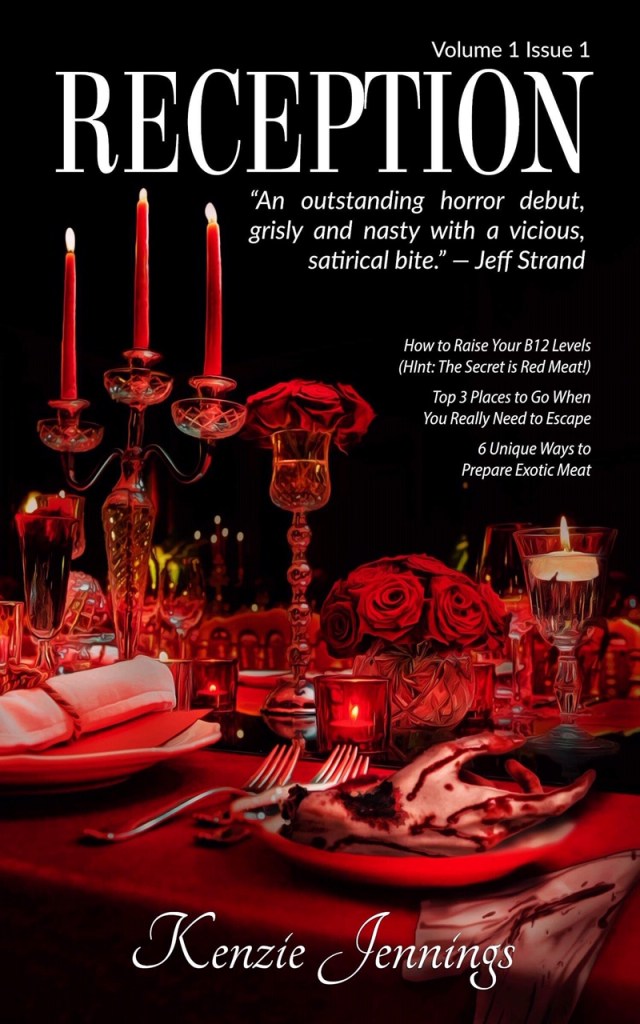
Kenzie Jennings: I am utterly turned off by a bad cover. Who isn’t, really? Bad font style, outdated stock photos, busy-background-dark-font, all of it… Just no. I was incredibly fortunate to be invited to offer input for Reception’s cover. Not only that, Jarod and Patrick from Death’s Head Press hired a friend of mine, the immensely talented Lynne Hansen, to do the cover, and she definitely made it sing. It’s a glorious, gorgeous cover that grabs one’s attention. It’s also darkly funny too, and I love that sort of thing. (It’s purposefully made to look like a wedding magazine cover)

Meghan: What have you learned creating your books?

Kenzie Jennings: It’s okay to gamble some when writing. There are readers for everything. Not everyone is going to dig Reception because it’s gory and shocking in places, but I kept on telling myself it was okay for me to write what I actually wanted to write.

Meghan: What has been the hardest scene for you to write so far?

Kenzie Jennings: The last scene/ending of Reception. I completely rewrote that ending three times. The one I settled on will be the most polarizing for readers, but I don’t care. It’s how it HAS to end.

Meghan: What makes your book different from others out there in this genre?

Kenzie Jennings: The narrators’ voice(s). I’d like to say something more sophisticated than that, but that’s it really. Although, I’ve never read a cannibals-at-a-wedding novel.

Meghan: How important is the book title, how hard is it to choose the best one, and how did you choose yours (of course, with no spoilers)?

Kenzie Jennings: Titles are as important as the cover. I am not all that clever at coming up with titles. An ex-boyfriend (also a writer) came up with Jayne, Juxtaposed, which was brilliant and simple, but now if I continue it on as a series, each title will have to be like it, and now that the ex is not around anymore, I’m kind of unsure where to go with it. Reception was easy because… well, it’s about a wedding… and things go bonkers at the reception.

Meghan: What makes you feel more fulfilled: Writing a novel or writing a short story?

Kenzie Jennings: Writing a novel makes me feel more fulfilled. I am awful at short stories. I didn’t used to be. Nowadays, I’m so into long form that I’ve forgotten how to keep things to a minimum. It’s not that I ramble. I don’t think I do. But I like crafting connected scenes and developing characters that change slowly (and meaningfully) rather than rapidly.

Meghan: Tell us a little bit about your books, your target audience, and what you would like readers to take away from your stories.

Kenzie Jennings: Since I’m fairly new to this novel-writing thing, I’ll simply mention Reception. Its tag line is “A wedding already burdened with family drama goes batshit when, during the reception, the groom’s family reveals themselves to be cannibals.” I think readers who like their stories with some contemporary family drama and gore will love it. I don’t know what sort of target audience that is though. It’s for horror readers, for sure. As for readers taking away something from it, how about something like… I hope they simply enjoy the ride, and we’ll see how we do with that?

Meghan: Can you tell us about some of the deleted scenes/stuff that got left out of your work?

Kenzie Jennings: I made some cuts to some of the more frivolous set up scenes, like the one in the salon, which was a lot longer than I’d intended. Some of the more humorous bits were removed because they were silly and made no sense in the long run.

Meghan: What is in your “trunk”?

Kenzie Jennings: I have way too much in my “trunk,” some of it probably junk. Most are short stories I don’t know how to finish. One day though.

Meghan: What can we expect from you in the future?

Kenzie Jennings: I’m working on a psychosexual horror thriller titled Nice Girl about a woman who, to put it mildly, doesn’t care much for being rejected. I was inspired in part by an opinion piece I’d read in Medium about the Incel subculture that spawned the likes of Elliott Rodger and Alek Minassian. The general thesis of the piece was that women could never be Incels (even though the term was created and self-appointed by a woman) because we’re taught to blame ourselves when we’re rejected rather than blame the men who rejected us. I thought… well, I guess it’s time to develop a story about a female Incel.

Meghan: Where can we find you?

Kenzie Jennings: Website ** Amazon ** Twitter ** Facebook

Meghan: Do you have any closing words for your fans or anything you’d like to say that we didn’t get to cover in this interview?

Kenzie Jennings: To get in a celebratory wedding mood, have a glass of bubbly while reading Reception… and don’t eat anything too heavy. You’ll need to run at some point.

Kenzie Jennings is an English professor currently residing and sweltering in the humid tourist hub of central Florida. She has written pieces for a handful of news and entertainment publications and literary magazines throughout the years. Back when she was young and impetuous, she had two screenplays optioned by a couple of production companies, but her screenwriting career ended there, and she hasn’t looked back since. Reception is her debut novel.

Reception

While her rehab counselor’s advice replays in her mind, Ansley Boone takes on the role of dutiful bridesmaid in her little sister’s wedding at an isolated resort in the middle of hill country, a place where cell reception is virtually nonexistent and everyone else there seems a stranger primed to spring. Tensions are already high between the Boones and their withdrawal suffering eldest, who has since become the family embarrassment, but when the wedding reception takes a vicious turn, Ansley and her sister must work together to fight for survival and escape the resort before the groom’s cannibalistic family adds them to the post wedding menu.