Setting is such a vital component of any horror story, to the extent that the place in which the narrative is framed can become a central character.
Take, for example, the eponymous building in Shirley Jackson’s 1959 novel The Haunting of Hill House, which she describes so chillingly as being “not sane.” Susan Hill’s 1983 ghost story The Woman in Black finds protagonist Arthur Kipps shacked up and shivering in Eel Marsh House, a haunted pile that is accessible only via the ominously named Nine Lives Causeway. In these narratives, the setting becomes an omnipresent, living (or un-dead) force to be reckoned with. The Queen of all horror storytellers, Mary Wollstonecraft Shelley, describes a body of water in Frankenstein; or, The Modern Prometheus (1818) as, “a vast sheet of fire…beautiful yet terrific.” This mirrors the spark of life that gives Victor’s creature his agency, but also foreshadows the elemental fury and revenge that takes hold of him as he searches for the meaning of his existence.
When the time came for me to write my fifth novel, the folk horror Hearthstone Cottage, I knew I had to go back to the rural west coast of Scotland featured in my third book The Jack in the Green. I used moodboards of photos from my travels, and watercolours of old crofters cottages to paint a picture of the building and its surrounding landscape in my mind. Story discussions with my friend, director of photography Alan Stewart, decided that the region should be the Kintail Mountains with its dramatic lochs and peaks.
But I also needed a stone circle in the story and drew on my many pilgrimages to the Rollright Stones and Avebury in England in order to create my fictional ‘Spindle Stones’. As any academic folk horror book will remind you, isolation is a key element to this sub genre, and I needed a title that would help to convey that feeling of being alone in the landscape. I sent a shortlist of cottage names to my editor, the wonderful Don D’Auria, and he picked my favourite — Hearthstone Cottage.
Fast forward to summer of this year when i took a well earned break after editing the book. The road led me to the Wales/Shropshire border, where I’ve traveled many times.
There’s a white-knuckle inducing road, with a lovely old cottage on the corner. So every time I’ve driven past it, I’ve felt that jolt of fear from the road, along with the aesthetic beauty of the cottage. This time around there was a tractor in the road, causing all the traffic to slow down.
And for the very first time, I saw the name of the cottage I’ve driven past so many times over the years…
“2 Hearths Cottage!”
Beauty and terror rolled into one place. I wonder if the name had subliminally become etched into my subconscious, until it was ready to emerge in the waking nightmares of my new novel.
So, when you stay the night at Hearthstone Cottage, be warned — it really does have a history of terror.
“Lee creates an atmosphere of unease and foreboding that culminates in explosive violence and terror. Rife with frightening imagery, ghosts, and visceral horror, this tale will please the most ardent of horror fans.” – Booklist
Mike Carter and his girlfriend Helen, along with their friends Alex and Kay, travel to a remote loch side cottage for a post-graduation holiday. But their celebrations are short-lived when they hit and kill a stag on the road. Alex s sister Meggie awaits them in the cottage, adding to the tension when her dog, Oscar, goes missing. Mike becomes haunted by a disturbing presence in the cottage, and is hunted by threatening figures in the highland fog. Reeling from a shock revelation, Mike begins to lose his grip on his sanity. As the dark secrets of the past conspire to destroy the bonds of friendship, Mike must uncover the terrifying truth dwelling within the walls of Hearthstone Cottage.
Hearthstone Cottage is out now from Flame Tree Press: Amazon ** Flame Tree Publishing ** and all good stockists of haunted cottage novels
Frazer Lee is a novelist, screenwriter and filmmaker. His screenplay credits include the acclaimed horror/thriller feature Panic Button, and multi-award winning short films On Edge, Red Lines, Simone, and The Stay. Frazer’s screenwriting and story consultant engagements have included commissions for Movie Mogul, The Asylum, Mediente, eMotion, and Vanquish Alliance Entertainment.
His film and television directing credits include the multi award-winning shorts On Edge and Red Lines, and the promo campaign for the Discovery Channel series True Horror With Anthony Head. He was awarded the Edgar Allan Poe Gothic Filmmaker of the Year Award for his film The Stay. Frazer was named one of the Top 12 UK directors in MySpace.com s Movie Mash-up contest by a panel including representatives from 20th Century Fox, Vertigo Films, and Film Four.
Frazer is Senior Lecturer in Creative Writing at Brunel University London and is an active member of the Horror Writers Association and International Thriller Writers. His guest speaking engagements have included The London Screenwriters Festival and The Guerilla Filmmakers Masterclass. Frazer Lee lives with his family in Buckinghamshire, England just across the cemetery from the actual Hammer House of Horror.
Meghan: Hi, Frazer. It is an HONOR having you here today. Tell us a little bit about yourself.
Frazer Lee: Hello! Thanks for hosting me, and I must say that I love Meghan’s House of Books ☺ Forgive me while I switch to third person for the ‘official author bio’…
Frazer Lee is a novelist, screenwriter, and filmmaker. His debut novel The Lamplighters was a Bram Stoker Award® Finalist for Best First Novel. Winner of the Edgar Allan Poe Gothic Filmmaker of the Year Award for The Stay, his film credits also include the acclaimed feature film Panic Button. Frazer resides with his family in Buckinghamshire, just across the cemetery from the real-life Hammer House of Horror.
Meghan: What are five things most people don’t know about you?
Frazer Lee:
I have a mysterious scar on my right hand.
An obsessive fan of The Cure, I have seen the band play like 38 times so far. (I know that isn’t very many, so I’m working on it.)
I was vegetarian for twenty-five years, but recently became pescatarian after recurring fever dreams involving flapping fish in an ocean storm.
My middle name is Alaric.
I am unable to converse until I am on my 2nd coffee. (I’m drinking my 2nd right now, luckily.)
Meghan: What is the first book you remember reading?
Frazer Lee: The Gauntlet by Ronald Welch, which transported me to a medieval world. Oh my goodness, what a book. I cried when I finished it because I didn’t want it to be over and I felt so bereft.
Meghan: What are you reading now?
Frazer Lee: I am studying for my PhD so I am neck deep in Ernst Cassirer’s Language and Myth. If you don’t hear from me in a day or two, send help.
Meghan: What’s a book you really enjoyed that others wouldn’t expect you to have liked?
Frazer Lee: Perhaps Miracles of Life by J.G. Ballard because it is rather on the sentimental side and my reputation as a hardened cynic goes before me?
Meghan: What made you decide you want to write? When did you begin writing?
Frazer Lee: I started writing stories in junior school because I lived in Staffordshire and needed to escape somewhere. (As Lou Reed and John Cale once sang, when you’re growing up in a small town, and you’re having a nervous breakdown, you just have to get out of there.) Reading, and writing, did exactly that. (Some of) my teachers encouraged me, and for that I am eternally grateful. I remember smiling when my school report said, “I look forward to Frazer’s first novel.” Took a while, but I got there in the end.
Meghan: Do you have a special place you like to write?
Frazer Lee: I like to write surrounded by trees, with my cat by my side, but I also like to write on the move, on trains, planes, in cafes, but never in automobiles – that’s too dangerous.
Meghan: Do you have any quirks or processes that you go through when you write?
Frazer Lee: I like to write to music without lyrics, and I enjoy playing physical CDs and vinyl, so I often go through a kind of stop-start-stop again dance when I’m finding the right groove in which to begin a book. I talk to myself A LOT. And that 2nd coffee thing I mentioned earlier also applies to the writing, more often than not.
Meghan: Is there anything about writing you find most challenging?
Frazer Lee: Nagging self-doubt can be a problem. That feeling that it’s not coming out quite how you’d hoped or imagined and what’s the point anyway? Like most things in life, it’s nothing that a stroll in the woods can’t sort out. Grit your teeth, roll the dice, come and have a go if you think you’re hard enough.
Meghan: What’s the most satisfying thing you’ve written so far?
Frazer Lee: I wrote a scenario about a grown man trapped in the skin of a young boy and he does this insanely disgusting thing with a big syringe and someone’s buttock fat… I don’t know if it was satisfying but it sure did make me cackle a lot writing it!
Meghan: What books have most inspired you? Who are some authors that have inspired your writing style?
Frazer Lee: My favourite novel of all time is still Frankenstein; or, the Modern Prometheus by Mary Wollstonecraft Shelley. Bloody hell though, it has everything. Familial drama and tragedy, impossible highs and unfathomable lows, beautiful imagery that ties the whole experience together so memorably. And through it all, the terror of loving – and of losing. I think that mash-up of the Gothic and cutting edge science has had a long lasting effect on me. Perhaps it’s not surprising that I love J.G. Ballard’s writing so much as he continues that blend of new ideas/technology with the structure of a classic murder mystery or police procedural, but adds such a uniquely perverse dimension to proceedings that sometimes makes you feel grubby for just reading the book.
Meghan: What do you think makes a good story?
Frazer Lee: An idea. A character, her vividly rendered world, and a seemingly insurmountable problem.
Meghan: What does it take for you to love a character? How do you utilize that when creating your characters?
Frazer Lee: Cheesy as it may sound, there’s that sweet spot when they’re speaking to you as you write them. If I can feel how they feel, hopefully readers can feel that too. I’m attracted to deeply flawed characters. The deeper those flaws, the more interesting I find them. There are no sexual athletes and crack-shots in my stories, more likely a bunch of barely functioning failures. That’s not for everyone, I know. If you want shiny, try your luck at a casino. I’ll wait for you in the basement bar.
Meghan: Which, of all your characters, do you think is the most like you?
Frazer Lee: I doubt that I’m the best person to judge that, but maybe the Skin Mechanic? (I’m a dab hand with a flesh-comb too.)
Meghan: Are you turned off by a bad cover? To what degree were you involved in creating your book covers?
Frazer Lee: I’ve been lucky that I’ve rather enjoyed my book covers so far. My editors and publishers always involve me in the process with a questionnaire, where I get to drop heavy hints about things I’d like to see or un-see. They are never quite as you imagined them, though, and that’s all part of the fun I think.
Meghan: What have you learned creating your books?
Frazer Lee: I’ve learned that it’s good to have a level of attack, but that’s it’s also good to let the thing breathe a bit and to never kid yourself that you have all the answers.
Meghan: What has been the hardest scene for you to write so far?
Frazer Lee: That was a scene in The Jack in the Green because it’s based on something horrible that happened in my early childhood. I won’t go into the details because I’m having a pretty good day so far and I don’t really want to go there again… into the dark… not now anyhow, maybe later.
Meghan: What makes your books different from others out there in this genre?
Frazer Lee: I think that would be for the readers to decide. Maybe each and every book is unique in its combination of character and plot. You could give the same outline and character bios to two different writers and they would create completely different books. I’ve learned that one reader’s “different good” may be another reader’s “different bad” so there’s nothing to be gained from trying to guess which way it’s going to play. I think just be true to yourself, the character, the story and it’ll come out how it has to.
Meghan: How important is the book title, how hard is it to choose the best one, and how did you choose yours (of course, with no spoilers)?
Frazer Lee: The title is usually one of the easiest parts of the creative process for me. Occasionally, you might need a second opinion. I had a few different titles for Hearthstone Cottage and sent them over to my amazing editor Don D’Auria, and he resoundingly preferred the one that’s now on the book spine. And he was right, of course. He so often is (but don’t tell him that, whatever you do!)
Meghan: What makes you feel more fulfilled: Writing a novel or writing a short story?
Frazer Lee: A story well told is a story well told. How well, that’s always up for debate of course. It’s just a sense that the story is the best it can be at that given time, subject to deadlines, and any other constraints, before the story wriggles free of your grasp and you have to hand it over to readers. There is a sense of fulfillment to having gone through that process, and there’s no difference really in how that feels whether it’s a short story, or a novel, or a short film or a feature length movie screenplay, in my experience.
Meghan: Tell us a little bit about your books, your target audience, and what you would like readers to take away from your stories.
Frazer Lee: Each of my books does something a little different with the horror ingredients of isolation, confrontation, and transformation. My target audience is, honestly, anyone who will make the time to pick it up and give it a whirl. I’d like readers to take what they will from my tales, but as I write primarily in the horror genre, I do hope they take away some nightmares with them. You’re welcome.
Meghan: Can you tell us about some of the deleted scenes/stuff that got left out of your work?
Frazer Lee: I write to pretty detailed outlines, so there aren’t really deleted scenes as such. But anything tangential has to go, unless it works. The deleted bits are often the most uninteresting and expository asides about the minutiae of a character’s life, or their belief system (or lack of one). Hopefully what remains serves the character and their story and keeps the forward momentum going. Sometimes moments that are too gratuitously visceral or violent get edited out in favour of what you don’t get to see, because that’s often far more disturbing and scary.
Meghan: What can we expect from you in the future?
Frazer Lee: I am working on a new horror novel for Flame Tree Press called Greyfriars Reformatory. It’s a haunted institution story with a post-modern twist. I have a script doctor commission on a movie screenplay that I’m contractually not allowed to talk about. And I’m developing another film project or two for my sins, which are legion.
Meghan: Do you have any closing words for your fans or anything you’d like to say that we didn’t get to cover in this interview?
Frazer Lee: Hee, I find the concept that I would have ‘fans’ ludicrous…
I would just like to thank you again for hosting me on the blog today, and to say to anyone who has ever read my stories or watched my films, thank you for taking the time and I hope to see you again soon in your nightmares!
One of Frazer’s early short stories received a Geoffrey Ashe Prize from the Library of Avalon, Glastonbury. His short fiction has since appeared in numerous anthologies including the acclaimed Read By Dawn series.
Also a screenwriter and filmmaker, Frazer’s movie credits include the award-winning short horror films On Edge, Red Lines, Simone, The Stay, and the critically acclaimed horror/thriller feature (and Amazon #1 movie novelization) Panic Button.
Frazer lectures in Creative Writing and Screenwriting at Brunel University London and Birkbeck, University of London. He resides with his family in leafy Buckinghamshire, England just across the cemetery from the actual Hammer House of Horror.
Mike Carter and his girlfriend Helen, along with their friends Alex and Kay, travel to a remote loch side cottage for a post-graduation holiday. But their celebrations are short-lived when they hit and kill a stag on the road. Alex’s sister Meggie awaits them in the cottage, adding to the tension when her dog, Oscar, goes missing. Mike becomes haunted by a disturbing presence in the cottage, and is hunted by threatening figures in the highland fog. Reeling from a shock revelation, Mike begins to lose his grip on his sanity. As the dark secrets of the past conspire to destroy the bonds of friendship, Mike must uncover the terrifying truth dwelling within the walls of Hearthstone Cottage.
Meghan: Hey, John! Welcome back to the Halloween Extravaganza. It’s been awhile since we sat down together. What’s been going on since we last spoke?
John Wayne Comunale: I’ve been staying pretty busy on the road doing conventions. I’m usually somewhere different every two weeks.
Meghan: Who are you outside of writing?
John Wayne Comunale: An awesome dude 4 life.
Meghan: How do you feel about friends and close relatives reading your work?
John Wayne Comunale: I’m all for it. The more readers the better. I could give a shit what anyone thinks of me, especially people I’m related to.
Meghan: Is being a writer a gift or a curse?
John Wayne Comunale: Being a writer is who I am, and writing is what I do. It’s neither of these things, nor have I ever considered it to be.
Meghan: How has your environment and upbringing colored your writing?
John Wayne Comunale: I’m sure it’s had some affect and influence in a periphery sense, but I don’t think either of these are significant to me.
Meghan: What’s the strangest thing you have ever had to research for your books?
John Wayne Comunale: I’ve researched witchcraft and demonology to add realism to certain parts, but I don’t think that’s very strange.
Meghan: Which do you think is the hardest to write: the beginning, the middle, or the end?
John Wayne Comunale: I don’t think about things like this. When you do I believe you’re just manifesting unnecessary resistance against what you’re trying to do. If you think you’re hung up on something, and then say how hard it is for you whenever it comes up, it always will be.
Meghan: Do you outline? Do you start with characters or plot? Do you just sit down and start writing? What works best for you?
John Wayne Comunale: I start with a general idea and just go. I don’t outline or do character bios or any of that. I don’t like to be forced to walk a line even from myself.
Meghan: What do you do to motivate yourself to sit down and write?
John Wayne Comunale: I’ve committed myself to doing it, and meeting goals on a daily basis.
Meghan: Are you an avid reader?
John Wayne Comunale: Yes.
Meghan: What kind of books do you absolutely love to read?
John Wayne Comunale: Anything that bends reality.
Meghan: How do you feel about movies based on books?
John Wayne Comunale: Whatever.
Meghan: Have you ever killed a main character?
John Wayne Comunale: Of course.
Meghan: Do you enjoy making your characters suffer?
John Wayne Comunale: I’m not garnering a type of enjoyment from making a character do anything. I get enjoyment out of writing regardless.
Meghan: What can we expect from you in the future?
John Wayne Comunale: To be on the road eternally. My next book, The Cycle, comes out on January 4th, 2020 from Grindhouse Press.
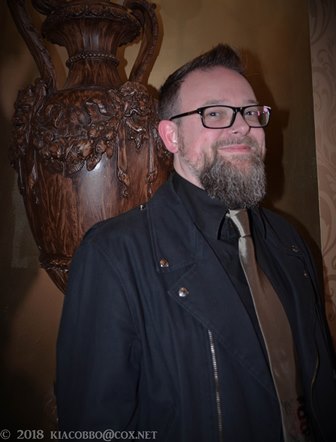
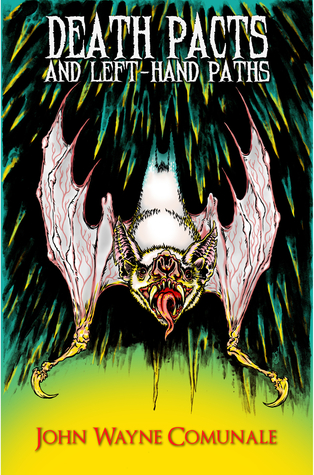
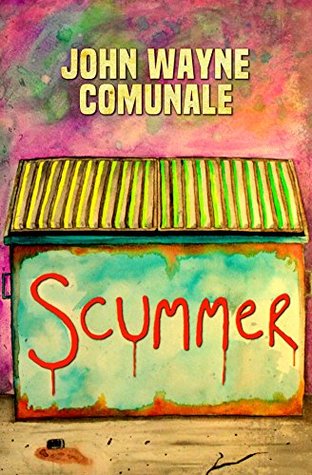
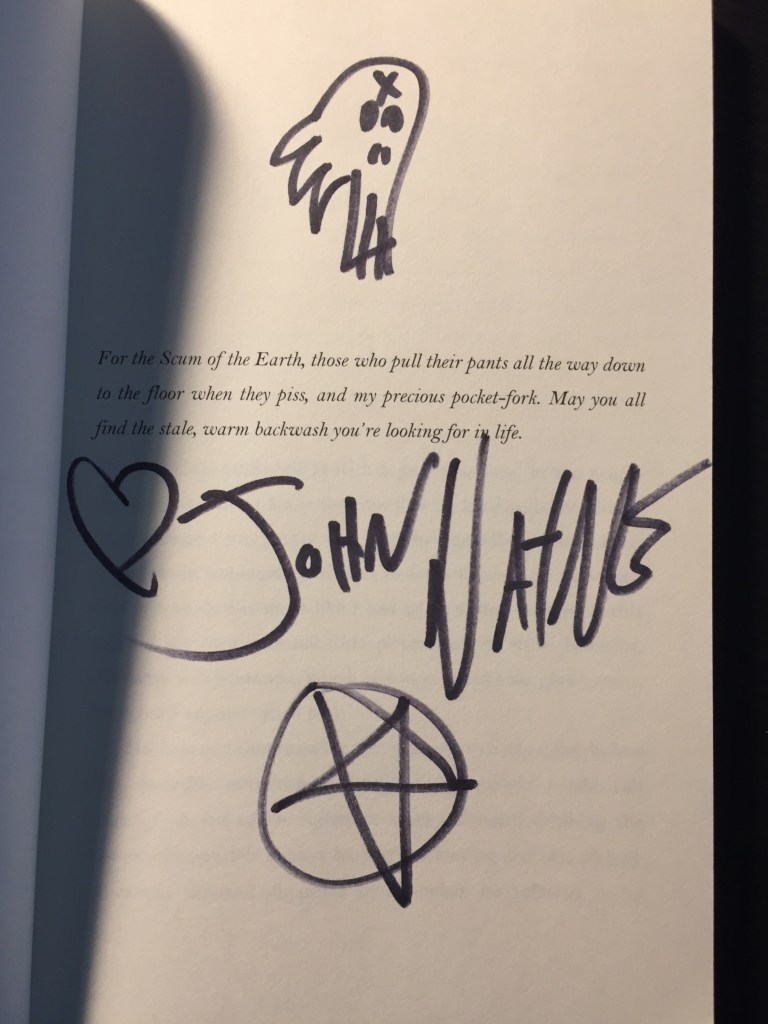
John Wayne Comunale lives in Houston Texas to prepare himself for the heat in Hell. He is the author of books such as Death Pacts & Left-Hand Paths, Scummer, As Seen on TV, and Sinkhole, and also hosts the weekly storytelling podcast John Wayne Lied to You. He fronts the punk rock disaster, johnwayneisdead, and travels around the country giving truly unique performances of the written word.
John Wayne was an American actor who died in 1979.
Everyone is looking for shortcuts in life, but rarely do they find the kind they’re looking for, and when they do it never turns out like they thought. But what if you were to accidentally fall into cahoots with an other-worldly creature who could provide those shortcuts and so much more? Of course, there’s always a price attached to such favors, but killing gets easier the more you do it, and everything is great as long as the rewards outweigh the risk. That is until you find out this was never true and you’ve inadvertently set into motion something so horrible you lack the capacity to understand or accept it.
A filthy barfly haunts the bar down the road. He lives off the leftover dregs of the patrons’ beers and spent cigarettes he finds on the ground. He may be living in the trunk of someone’s car. His name is Scummer. He’s mysterious and elusive. He’s unbound by inhibitions and you want to be just like him.
Artie is a serial killer obsessed with As Seen On T.V. products. Collecting and modifying these items is his only passion outside of killing, which he’s been doing a long time. Far longer than most of his peers, but Artie always took special care to make sure he remained free. Now a strange, small man has moved next door to him, and the smell of popcorn hangs thick in the air. After a few odd interactions with him, Artie starts to wonder if there’s something other than himself that’s kept him from being caught.
After the hurricane, Reggie and Betsy discover a portion of their backyard has begun to sink. Fearing the ground will open up and swallow their house sooner rather than later Reggie calls the city to come fix it, but pushback from the local Sheriff slows the process down by a day. Come nightfall the power goes out, the sinkhole opens, and a busload of ghoulish children crawl to the surface for their first meal in fifty-two years.
A.S. Chamber’s popular main character, Sam Spallucci, is a paranormal investigator in Lancaster (UK). Here he explains to us why this character works so well in that particular place.
A question I am frequently asked is, “Why have you set stories about a paranormal investigator in Lancaster of all places?”
When I first moved to this hidden jewel of the North West, tucked away to the side of the M6, I was but a mere university undergraduate. Living on the campus a few miles south of the city, I rarely ventured into town. However, when I did, it was normally at night time to frequent the pubs and clubs. I was soon drawn into a world the like of which I had never experienced before. Having grown up in a small market town which had undergone numerous rejuvenations, I had only ever heard of these mystical little routes between buildings known as alleys and had never actually seen them up close.
Lancaster was (and still is) full of them.
The city’s heyday was in Georgian times when the majority of the hoi polloi wandered around on foot. Only the rich had access to carriages and, as a result, most of the main roads were narrow and the small footpaths that connected them were even more of a squeeze. Wandering around as a bright-eyed fresher, I could not help but be attracted to these tiny veins and arteries of my new home. As I passed one in the middle of the night, I could easily imagine what creatures might lurk down its shadowy depths and I would automatically cross to a lighter side of the high street to avoid being dragged away for some nocturnal creature’s midnight snack.
Time and familiarity tend to eradicate childish fears. So it was that, in my twenties, I started to see these little footpaths as less a potential lair for the undead and more a quick shortcut home from work. They lost their edge and became just like everything else in my early working years, part of the norm. I would stroll down them without giving a thought to ghosties or beasties that might have dwelt along their cobbled paths.
Then, when I stumbled rather bemusedly into my thirties, I began to hear tell of stories regarding Lancaster’s past. Tales that portrayed the city as less of a sparkling diamond, but more of a mysterious dark orb. There were ghosts that wandered the dressing rooms of the Grand Theatre. There was the screaming head that rolled down Castle Hill.
And who, in Lancashire, has not heard about the fate of the Pendle Witches? Members of two families whose feud boiled over into allegations of Satanism and witchcraft, leading them to be incarcerated at Lancaster Castle before gruesome deaths and executions.
So it was that I started to re-evaluate my sanitised view of my city and began to once more regard its shadowy alleys with a dose of caution and a certain amount of trepidation. These were footways that had known history, and not just the peaceful type where every-day folk merrily went about their business. There were murders, deaths and destruction that had bled their way into the very cobblestones upon which I walked.
So, when I get asked the aforementioned question, I tell those who enquire to come to Lancaster. Visit this place steeped in blood-stained history and walk down its alleyways at night. Then they will see how it might just be possible that there is a werewolf roaming Williamson Park, that a vampire might happen to run a local comic shop or that maybe, just maybe, the crazy woman singing on the street corner could very well be descended from the Pendle Witches.
Lancaster’s master of the macabre is well known for marking his home town’s place on the horror map of the United Kingdom. His Sam Spallucci books, with their quirky blend of urban fantasy, film noir and dry humour, have gained a cult following over the last few years with fans journeying from around the country to see where reality meets an ever expanding universe of vampires, werewolves, angels and a plethora of other supernatural characters.
For the first time, A.S.Chambers collects the popular stories of the vampires that feature in the expanded universe of his paranormal investigator, Sam Spallucci. Follow Justice the Wild West gunslinger as he tries to come to terms with his newfound supernatural abilities and heavy weight of being a king in waiting. Then, when finally reunited with his father and newborn sister, tragedy strikes. Accompany Nightingale, the all too human regent, as she creates her first offspring before attempting to train him to shrug off his own human nature. Go out for a night on the tiles with party-loving Scorpion and Tigress, the mute blonde and the bouncy redhead, as they hunt down an unsuspecting victim, before travelling back in time to when their supernatural lives crashed into the peaceful solitude of a medieval craftsman.Also includes a new foreword by the author.
Follow a young Nightingale through the late Victorian era as she escapes from abject poverty to become the ruler of the secretive vampire society known to its members as the Children of Cain. She travels from begging on the streets to a life of servitude under a sadistic parish priest before being liberated under the light of the moon by the vampire king, Doulos. With her new father, she travels to the Wild West in search of her older sibling, only to be cast into a tale of tragedy and bloodshed.
Songbird – A Nightingale Story is set in the same universe as the Sam Spallucci series and is penned by Lancaster’s master of the macabre, A.S. Chambers.
Welcome to the world of Samuel C Spallucci; whiskey drinking, chain-smoking, trumpet playing, sci-fi watching investigator of the paranormal.
When we start a new job all we normally encounter is overbearing managers, jealous co-workers and a dodgy toilet that needs that certain wiggle to make it flush. During Sam’s first week, based in the small university city of Lancaster, he is abducted by a cult of Satanic actors, has to baby-sit a new-born vampire, investigates a teenage poltergeist and escapes the clutches of a werewolf that works in a local zoo.
Not your usual first week on a new job, but certainly one you will never forget.
Contains the stories: The Case of the Satanic Suburban Sitcom The Case of the Vexed Vampire The Case of the Fastidious Phantom The Case of the Paranoid Poltergeist The Case of the Werewolf of Williamson Park
Meghan: Hi, Austin. It’s been awhile since we sat down together. What’s been going on since we last spoke?
A.S. Chambers: Well, I seem to have been majorly busy. I now have four Sam Spallucci novels out, with a fifth one on the way. 2019 also saw the publication of a collection of vampire short stories entitled Children of Cain and a stand-alone novella Songbird, both of which are set in the same universe. Also, at the end of 2018, my fourth short horror anthology, Mourning Has Broken, hit the shelves.
Meghan: Who are you outside of writing?
A.S. Chambers: What is this thing called “outside of writing”? I have to say that it more or less dominates my life. For me, it’s a nine to five thing. If it wasn’t, then life would just elbow its way in and stop anything from getting written down. I have to be ruthlessly strict with myself and make sure that I approach my writing in a determined, professional manner. Having said that, I do chill out in the evenings. This summer I’ve been doing up my garden, planting in lots of flowering plants. I also love to go walking. I live in Lancashire in the UK and there is just a mass of beautiful open countryside to go and enjoy.
Meghan: How do you feel about friends and close relatives reading your work?
A.S. Chambers: They don’t read it until it’s finished. I tend to very secretive and keep the work closely under wraps, probably in case I have a major change of mind and swerve plots off in a completely different path. Once it’s finished, I have no problem. They can read away.
Meghan: Is being a writer a gift or a curse?
A.S. Chambers: I fail to see how writing could ever be a curse. You are creating something from within you, expressing it and putting it down on paper. This is a wondrous thing, an art form. It takes a long time to perfect and there can be times when you feel like screaming, but all beautiful things take a lot of work and effort to get right. They should never be rushed.
Meghan: How has your environment and upbringing colored your writing?
A.S. Chambers: I hold fast by the old motto, “Write about what you know.” I live in the beautiful city of Lancaster, so my urban fantasy books about the paranormal investigator Sam Spallucci are set here. I draw upon local places and even local people and events. My upbringing has also had a profound effect. Sam shares certain parts of my life: the death of his father, his education, his health. I know these things about him in an incredibly intimate way, so I can really use them to make him feel alive as a person.
Meghan: What’s the strangest thing you have ever had to research for your books?
A.S. Chambers: Oooooo… That’s a good question. I wouldn’t say it was strange, but I had to research the workings of the Victorian household and their use of servants for my vampire novella, Songbird. It was fascinating. The conditions that the young girls were forced to live and work in were deplorable. It was very close to a being a slave.
Meghan: Which do you find the hardest to write: the beginning, the middle, or the end?
A.S. Chambers: If I had to choose one of the three, it would probably be the middle. I wouldn’t say it’s the hardest, per se, but certainly the most time consuming. I always know how my stories are going to start and finish. It is up to my characters to develop the journey between the two points. When I start a novel, I always have certain scenes in my head. I make sure that I write these down first, then I see how my characters would join the dots by moving between them. As that happens, the story develops.
Meghan: Do you outline? Do you start with characters or plot? Do you just sit down and start writing? What works best for you?
A.S. Chambers: I always start with characters. My works are very much character-led. Sam is at the forefront and his friends and acquaintances around him. It’s normally a case of, “Well what shall we do to them this time?” Once I have certain pertinent scenes written, I then sketch a rough outline, highlighting flashpoints in the story which I will need to write next as they will be pivotal to plot and character development. After that, I reassess the outline and start ticking off “joining scenes” and develop other areas of the story which start to call out to me.
Meghan: What do you do when characters don’t follow the outline/plan?
A.S. Chambers: Go with the flow. You can’t fit a square peg in a round hole. If I’m writing something and think to myself, “Nope. They would not be doing that,” then I stop and have a break. Go for a walk and see the world through the character’s eyes. I then come back, start the scene afresh and let the character lead me down the rabbit hole.
Meghan: What do you do to motivate yourself to sit down and write?
A.S. Chambers: I don’t need motivation. I need peace, quiet and nice coffee. I have never had problems making myself write. It is one of the greatest pleasures in my life. However, due to my health, I do get very fatigued, so I have to make sure that I don’t overdo it and I take regular breaks. This keeps the whole process fresh and enjoyable.
Meghan: Are you an avid reader?
A.S. Chambers: Oh yes. It’s kind of hard to move for books in my house. They cover almost every wall.
Meghan: What kind of books do you absolutely love to read?
A.S. Chambers: I tend to read absolutely anything. I feel it’s really important to give anything a shot at least once because you don’t know whether you’ll like it if you just avoid it. Personally, I love Philip K Dick and Ray Bradbury. They both have a wonderfully quirky yet clean style which has me gripped from the moment I start reading. I also enjoy the Kathy ReichsTemperance Brennan books. They are good, character driven stories which I feel carry me along on an interesting ride as I try to solve the case before the heroine. However, two series which stand out the most for me are the Dexter books by Jeff Lindsay and the Barney Thomson novels by Douglas Lindsay (no relation to Jeff). Again, very character driven and thoroughly enjoyable. The Barney Thomson books, especially, stand out as they are so surreal at times due to the things that Douglas puts his characters through and you can’t help but laugh out loud.
Meghan: How do you feel about movies based on books?
A.S. Chambers: Absolutely depends on the movie. For example, The Long Midnight of Barney Thomson was adapted by Robert Carlyle and was an absolute hoot. They changed a considerable amount to bring it to life, but the feel and the atmosphere was exactly the same as the book. Likewise, Blade Runner. One of my favourite films, the original plot of the book is almost totally unrecognisable compared to the film, but the feel and the texture remain. However, you do get those productions where you think to yourself, “Dear Lord. Have you actually read the book?”
Meghan: Have you ever killed a main character?
A.S. Chambers: Technically no (Sam was “killed” but went back and changed history), but I have killed off side characters who readers liked. At the end of the day, the stories need to have a real feel to them to engage people. One of the truths of life is that bad things can happen to nice people. You need a certain amount of peril.
Meghan: Do you enjoy making your characters suffer?
A.S. Chambers: I wouldn’t say that I enjoy making them suffer, but like in the previous question, bad things can happen to nice people in real life, so fiction has to follow that too. We are the sum of our experiences, bad as well as good. The way that my characters react to suffering will ultimately determine what path they will choose. (Hmmm… I wonder if that could be some sort of spoiler?)
Meghan: What’s the weirdest character concept that you’ve ever come up with?
A.S. Chambers: A Bondage-loving Banshee. I had a twenty-something who had been cursed by her mate and every time she got “aroused” would scream and kill electronic devices in the surrounding area. Needless to say, she was fun to create.
Meghan: What’s the best piece of feedback you’ve ever received? What’s the worst?
A.S. Chambers: My short story Needs Must was published in a charity anthology some years back and one reviewer singled it out saying that “This is what horror should be.” Can’t really get much better than that. Then there was the person who read Casebook and grumbled that there was very little historical matter about Lancaster. I think he had probably been reading the wrong sort of book…
Meghan: What do your fans mean to you?
A.S. Chambers: They mean a hell of a lot. It’s great seeing them getting hyped about a new book or theorising about what’s going to happen. I’ve even had one come to an event cosplaying as the werewolf of Williamson Park. How cool is that? As an author, it’s so satisfying having people (many of whom I have never met) becoming totally invested in characters and storylines that I have created.
Meghan: If you could steal one character from another author and make them yours, who would it be and why?
A.S. Chambers: Easy one. In the later Barney Thomson books, Douglas Lindsay created a hunchbacked, deaf barber’s assistant called Igor, whose job is just to sweep up in the barbershop. All the guy can say is, “Arf,” and yet everyone knows exactly what he means and, on top of this, he is a hit with the ladies. Pure genius and, in my opinion, the best character in all the books I have ever read.
Meghan: If you could write the next book in a series, which one would it be, and what would you make the book about?
A.S. Chambers: I couldn’t possibly write in a series that has already been established by another author. It would feel like I had broken into his house, crept into his bed room and stolen all his kinky underwear that he wears at those special kind of parties. So, I’ll just stick my own series about the down at heel paranormal investigator, Sam Spallucci.
Meghan: If you could write a collaboration with another author, who would it be and what would you write about?
A.S. Chambers: I am actually working on one at the moment. In the next Sam Spallucci book, Troubled Souls, Sam will get transported back to Victorian Morecambe where he will team up with a pair of detectives, Mulberry and Touchstone, who were created by the wonderful Peter Cakebread and first appeared in his book The Morecambe Medium. We are basically taking the story and writing it from our own characters’ points of view. Sam’s adventure will appear in Troubled Souls as The Case of the Time Travelling Tea Room and Peter’s will be published at a later date.
Meghan: What can we expect from you in the future?
A.S. Chambers: Like I’ve mentioned a few times already, I am currently working on Sam Spallucci: Troubled Souls. This is the fifth book in Sam’s series and will contain angels, haunted checkouts, Indian burial grounds and at least two serial killers. I also have my fifth short story anthology at the editing process and I am working on a Young Adult set of stories set in Sam’s universe.
Meghan: Do you have any closing words for your fans or anything you’d like to say that we didn’t get to cover in this interview or the last?
A.S. Chambers: In the immortal word of Igor from the Barney Thomson books, “Arf!” I think that covers it all.
Lancaster’s master of the macabre is well known for marking his home town’s place on the horror map of the United Kingdom. His Sam Spallucci books, with their quirky blend of urban fantasy, film noir and dry humour, have gained a cult following over the last few years with fans journeying from around the country to see where reality meets an ever expanding universe of vampires, werewolves, angels and a plethora of other supernatural characters.
For the first time, A.S.Chambers collects the popular stories of the vampires that feature in the expanded universe of his paranormal investigator, Sam Spallucci. Follow Justice the Wild West gunslinger as he tries to come to terms with his newfound supernatural abilities and heavy weight of being a king in waiting. Then, when finally reunited with his father and newborn sister, tragedy strikes. Accompany Nightingale, the all too human regent, as she creates her first offspring before attempting to train him to shrug off his own human nature. Go out for a night on the tiles with party-loving Scorpion and Tigress, the mute blonde and the bouncy redhead, as they hunt down an unsuspecting victim, before travelling back in time to when their supernatural lives crashed into the peaceful solitude of a medieval craftsman.Also includes a new foreword by the author.
Follow a young Nightingale through the late Victorian era as she escapes from abject poverty to become the ruler of the secretive vampire society known to its members as the Children of Cain. She travels from begging on the streets to a life of servitude under a sadistic parish priest before being liberated under the light of the moon by the vampire king, Doulos. With her new father, she travels to the Wild West in search of her older sibling, only to be cast into a tale of tragedy and bloodshed.
Songbird – A Nightingale Story is set in the same universe as the Sam Spallucci series and is penned by Lancaster’s master of the macabre, A.S. Chambers.
Welcome to the world of Samuel C Spallucci; whiskey drinking, chain-smoking, trumpet playing, sci-fi watching investigator of the paranormal.
When we start a new job all we normally encounter is overbearing managers, jealous co-workers and a dodgy toilet that needs that certain wiggle to make it flush. During Sam’s first week, based in the small university city of Lancaster, he is abducted by a cult of Satanic actors, has to baby-sit a new-born vampire, investigates a teenage poltergeist and escapes the clutches of a werewolf that works in a local zoo.
Not your usual first week on a new job, but certainly one you will never forget.
Contains the stories: The Case of the Satanic Suburban Sitcom The Case of the Vexed Vampire The Case of the Fastidious Phantom The Case of the Paranoid Poltergeist The Case of the Werewolf of Williamson Park









 Meghan's House of Books