Halloween Extravaganza: INTERVIEW: Mark Steensland

Meghan: Hi, Mark. Welcome to Meghan’s House of Books. Tell us a little bit about yourself.

Mark Steensland: I’m not sure where to even start with this. My bio says the basics. I feel as though anything else will sound like the answers to some dating app, which isn’t what you’re looking for. At least I hope not. Frankly, I’ve always been most interested in the technical side of other artists, rather than their personal side. I’ve met some of my heroes and I don’t know that I would like to hang out with them as friends. However, I’d love to hear more about how they make artistic decisions. So I won’t tell you my favorite color, but I will tell you that I think the ending is the most important thing to know before I start writing a story. And that takes a lot of work. And sometimes that work takes a long time. But it’s made a huge difference in my approach to writing.

Meghan: What are five things most people don’t know about you?

Mark Steensland: Hey, now: those things are secrets for a reason!

Meghan: What is the first book you remember reading?

Mark Steensland: I feel fortunate that my mother made reading a priority in my early life. She read to me before bed almost every night for many years. And when I got old enough to read to her, that’s how it worked. We read The Hobbit and the The Chronicles of Narnia. In third grade, I discovered the Three Investigators series after my teacher read one of the books to the class. I think all of those books together really shaped my ideas about stories in general and writing in particular.

Meghan: What are you reading now?

Mark Steensland: I’m in between things at the moment. A lot of my reading is what I’ll call curated, which means that I read things that are related to what I’m writing. As an example, if I was writing something about high school kids, then I’d find books and stories other authors have written about high school kids to see what’s been done before and/or how they handled it.

Meghan: What’s a book you really enjoyed that others wouldn’t expect you to have liked?

Mark Steensland: When I was working on my Master’s degree in English, I took a class called “The Existential Hero in 20th Century Literature.” That class introduced me to a lot of authors I hadn’t read before, including Dostoevsky and Tolstoy. One of the first books we were assigned was Miss Lonelyhearts by Nathanael West. I almost didn’t finish reading it because I thought it was offensive. But I pushed on and discovered what the author was really doing. That book–and that class–ended up changing my life.

Meghan: What made you decide you want to write? When did you begin writing?

Mark Steensland: I can’t remember who said this, but I agree: “Writing is more a diagnosis than a job description.” I can’t remember not telling stories. I wanted to make films from the age of nine, after I saw Brian DePalma‘s Phantom of the Paradise. And once I was in high school, I started making short films and writing screenplays. It’s been a very long road.

Meghan: Do you have a special place you like to write?

Mark Steensland: I converted a portion of my garage into an office I call HOBBS END (after the tube station in Quartermass & The Pit). I have all of my books and movies in there and I am able to write undisturbed most of the time (until the cat starts scratching on the door because she wants to go outside).

Meghan: Do you have any quirks or processes that you go through when you write?

Mark Steensland: It’s all about the process as far as I’m concerned. I have a number of tests that an idea has to pass before it gets moved on to the next stage. As I mentioned earlier, it took me a long time to realize that coming up with the ending as early as possible is one of the most important parts.

Meghan: Is there anything about writing you find most challenging?

Mark Steensland: Everything! That’s part of what makes it so exciting. I really feel that every story is its own mountain, as it were. Every climb is different. Sometimes they flow easily. And sometimes it’s like pulling teeth. But the early phases of the process are probably the most difficult. Making sure that I’ve got something that really satisfies all of what I think is important about story-telling.

Meghan: What’s the most satisfying thing you’ve written so far?

Mark Steensland: All of them. And none of them. I’m not being flippant. I’m just describing the fact that writing is a lot like eating. Sure, you have a great meal. But you get hungry again. This is an important part of the human condition. I don’t think I will ever be satisfied with something to the point where I feel I don’t have to write something else. I hope not, anyway.

Meghan: What books have most inspired you? Who are some authors that have inspired your writing style?

Mark Steensland: Rod Serling was probably the earliest big influence. Watching Night Gallery and The Twilight Zone really gave me an idea of what stories can do. Those shows also introduced me to a lot of other similar writers. Dean Koontz is another who really had an impact. The paperback of Twilight Eyes was the first thing of his I read. Clive Barker‘s Books of Blood and The Hellbound Heart left the best kind of scars. I’ve read Peter Straub‘s Ghost Story and Ray Bradbury‘s Something Wicked This Way Comes repeatedly.

Meghan: What do you think makes a good story?

Mark Streensland: For me, a story has to have a clear protagonist and that protagonist has to be going after something that I understand as quickly and clearly as possible. I also think there has to be an emotional component to what they are seeking. That emotional core is then hopefully couched in a setting I haven’t seen before. As an example: take the old “star-crossed lovers” trope. This basic premise resonates with us at an emotional level because we’ve probably all been in some situation where we loved someone and it wasn’t easy. Romeo & Juliet is the drama version of that story. Add singing and dancing and you get West Side Story. Make it about vampires and werewolves and you get Twilight. Each of these is at one level about the same basic emotional stuff, but the setting has been changed and that’s what makes it feel new.

Meghan: What does it take for you to love a character? How do you utilize that when creating your characters?

Mark Steensland: As I just said, I really need a clear protagonist with a clear goal. And then they don’t give up. That’s what makes me love them. I think that’s what makes a hero, in a way. And it’s why we like to read about heroes. We want to know that we can do what other people have done. I think that’s another big part of what stories do for us.

Meghan: Which, of all your characters, do you think is the most like you?

Mark Steensland: They’re all me at some level. They can’t really be anything else, can they? In spite of what we want to believe about how much we understand other people or know what they might be feeling, we really don’t. We only know how we feel. We only know why we want what we want. So I try to put that into all the characters in my stories.

Meghan: Are you turned off by a bad cover? To what degree were you involved in creating your book covers?

Mark Steensland: I know we’re not supposed to judge a book by its cover, but I think we all do. And that means bad covers are a grave enemy. I’ve been fortunate to have great covers for everything so far. In several cases, I had 100% input. As an interesting side note, I made a short film about the evolution of the cover design for my first book, Behind the Bookcase, which shows how many sketches the artist went through before arriving at the final, award-winning design.

Meghan: What have you learned creating your books?

Mark Steensland: My stories are all about finding the emotional resolution to whatever state I’m in emotionally at the time I’m writing them. The Special, for instance, is, as many people have correctly identified, about addiction. I smoked cigarettes for years. But I don’t think I could really write effectively about that part of my personality until after I had quit. In other words, I think I needed some idea of how to resolve that issue so that I could write about the resolution of that issue. That story–for me, anyway–is a very admonitory story. It’s like a warning about what not to do. Which is a kind of resolution in itself.

Meghan: What has been the hardest scene for you to write so far?

Mark Steensland: Page one of anything. I put a lot into the preliminary work, but it still comes down to those first words. There’s so much that is communicated in terms of tone and style and voice. Sometimes it takes a long time to get settled into the right place.

Meghan: What makes your books different from others out there in this genre?

Mark Steensland: They’re written by me. Again, I don’t mean that in a flippant way. I just mean that this is true of every writer and so also true of me. Everyone is different. Everyone is going to bring something to the page that no one else can. I also believe that’s the biggest responsibility an author has: finding their individuality and doing everything they can to get that on paper.

Meghan: How important is the book title, how hard is it to choose the best one, and how did you choose yours (of course, with no spoilers)?

Mark Steensland: Titles are very important. Because of how important they are, I think it’s one of the most challenging parts of the whole process. I spend a lot of time trying to find the perfect title. And part of the perfection (as far as I’m concerned) is trying to find something that no one else has used as a title. In the Scrape, for instance, was a phrase I discovered during my research for that book.

Meghan: What makes you feel more fulfilled: Writing a novel or writing a short story?

Mark Steensland: Both are satisfying in the same way when successful. I don’t really feel a difference between one or the other.

Meghan: Tell us a little bit about your books, your target audience, and what you would like readers to take away from your stories.

Mark Steensland: I don’t think too much in terms of target audience. Outside of something specific like how Behind the Bookcase was a novel for Middle Grade readers, so there were obvious things that had to be considered in terms of vocabulary, etc. But for the other stuff, I trust that my stories will find readers who enjoy them. And this ties into the last part of this question which is that I hope people get out of my stories what they need to. As I said, The Special is about addiction and I’ve been very happy to hear from a number of readers who not only picked up on that but have commented about what the story has meant to them as well. That’s the best I can hope for.

Meghan: Can you tell us about some of the deleted scenes/stuff that got left out of your work?

Mark Steensland: I don’t recall ever leaving stuff out unless it was unnecessary. In other words, I don’t feel like there are “director’s cuts” of my books waiting to be republished. I spend too much time trying to get them the way I want them before they go to press.

Meghan: What is in your “trunk”?

Mark Steensland: Everything that I’ve ever written is in my trunk. And I work a little bit on dozens of story ideas all the time. In fact, I recently finished something that I started more than ten years ago. I simply couldn’t find the ending for it before. Then I did. So I save everything and often go through the files looking for things that can be developed or rewritten.

Meghan: What can we expect from you in the future?

Mark Steensland: I’ve got lots of things on deck. None that I can really discuss, unfortunately, because deals haven’t been finalized. I continue to reach out to other authors for collaborations and hopefully those will work out. I’m also actively pursuing movie deals for a number of the books. The feature film version of The Special should be out later this year or in early 2020 and I hope that will drive interest in other adaptations.

Meghan: Where can we find you?

Mark Steensland: Everything is on my website. That includes links to the books and movies as well as links to my social media feeds.

Meghan: Do you have any closing words for your fans or anything you’d like to say that we didn’t get to cover in this interview?

Mark Steensland: I see a lot of stuff about how you should never give up and I think that’s true. The good news is that if you’re really committed to writing, then you can’t give up. Believe me, I’ve tried. Several times. But I just keep coming back to it.

Mark Steensland first learned how to scare people at the age of four during a drive-in screening of Rosemary’s Baby. Although he was supposed to be asleep in the back of the family station wagon, he stayed awake, secretly listening. When the doctor on screen announced Rosemary’s due date as June 28th, he sat up and proudly exclaimed, “That’s my birthday!” giving his parents and siblings a shock from which they still have not recovered. Over the years that followed, he became obsessed with Aurora monster models, Dark Shadows, Famous Monsters magazine, and Rod Serling’s Night Gallery. His first professional publication was as a film journalist, in Jim Steranko‘s Prevue magazine. Numerous bylines followed in American Cinematographer, Millimeter and Kamera. As a director, his short films (including Lovecraft’s Pillow, Dead@17, Peekers, The Ugly File, and The Weeping Woman) have played in festivals around the world and earned numerous awards. His novel for young readers, Behind the Bookcase, was published in 2012 by Random House. His novella for adults, The Special, was published in late 2018 and has been made into a feature film. He currently lives in California with his wife and their three children.

Behind the Bookcase

A girl stumbles into a fantastic world in this tale perfect for fans of Coraline, Alice in Wonderland, and The Twilight Zone.

Spending the summer at her grandmother’s house is the last thing Sarah wants to do—especially now that Grandma Winnie has died—but she has no choice. Her parents have to fix the place up before they can sell it, and Sarah and her brother, Billy, have to help. But the tedious work turns into a thrilling mystery when Sarah discovers an unfinished letter her grandmother wrote: Strange things are happening behind the bookcase. . . . 

Sarah’s mother dismisses the letter as one of Grandma Winnie’s crazy stories, but Sarah does some investigating and makes a remarkable discovery: behind the bookcase is a doorway into Scotopia, the land where shadows come from. With a talking cat named Balthazat as her guide, Sarah begins an unforgettable adventure into a world filled with countless dangers. Who can she trust? And can she face her fears, not only in Scotopia, but also back at Grandma Winnie’s house, where more secrets and strange goings-on await her?

The Special

In a house on the edge of town, there is a room. In that room, there is a box. And in that box await pleasures beyond your wildest imagination…

Jerry Harford is fed up. Overworked. Underpaid. And damn near certain his wife is cheating on him. He’s never been one for revenge, but his friend Mike talks him into thinking about JERRY just this once.

Now Jerry can’t get enough of The Special. He’s obsessed, and he wants it all to himself.

Before long, Jerry’s going to learn that pleasure has a price and whoever said “Hell is the truth seen too late” was right … terribly right.

Halloween Extravaganza: INTERVIEW: Jonathan Edward Ondrashek

Meghan: Hi, Jonathan. Welcome back to the Halloween Extravaganza… and welcome to the new blog. It’s been awhile since we sat down together. What’s been going on since we last spoke?

Jonathan Edward Ondrashek: Hi, Meghan! Thanks for having me back (and for finally dropping that restraining order against me). Since we last chatted, Books 2 and 3 of The Human-Undead War trilogy have been published, I’ve co-edited two more anthologies, have had over a half dozen more shorts accepted (mostly in paying markets), and recently appeared with both Stephen King and Guy N. Smith in It Came From the Garage!, an anthology of automotive horror from Darkwater Syndicate, Inc. In addition, I’ve edited two stand-alone novellas and a novel (with professional credit on the cover, finally!), lost my day job, and became a fur-father to a massive brown wiener (dog). Oh, and masturbation. Lots of masturbation.

Meghan: Who are you outside of writing?

Jonathan Edward Ondrashek: Please see the final sentence in my answer to Question 1. Yep. I’m a sick weirdo in every way, in and outside the writing realm.

Meghan: How do you feel about friends and close relatives reading your work?

Jonathan Edward Ondrashek: I love it when they do, but I’m especially nervous anytime they mention wanting to read certain works. My stuff has progressively gotten more extreme and sexual and moral-bending, and some friends and relatives are too conservative to be the intended audience. But, at the end of the day, I want every reader I can get. Sometimes you just gotta bite down on the red ballgag and let friends and family find out how truly deranged you are.

Meghan: Is being a writer a gift or a curse?

Jonathan Edward Ondrashek: A bit of both. It’s a gift – any level of mastery over a skill is, whether it be writing or bagging groceries or laying brick. But it’s also a curse in that it permeates every aspect of my life even when I need to focus on other things. Work at the day job? Interrupted every 5 minutes for a random story idea, or a plot twist I hadn’t thought up before. Errands after work? I better give that character a more meaningful name while I’m waiting at this red light. Oh, and I should probably – Shit. Someone’s honking. Gotta roll.

It can also be a curse in that it affects my mood: If I know I can’t find time to write today, I’m miserable all fuckin’ day. If I’m able to write, I’m humping everyone’s leg whether they like it or not, goddamn it.

Meghan: How has your environment and upbringing colored your writing?

Jonathan Edward Ondrashek: My past has eked into my last few stories in greater proportions than it used to, so I’ve found my work morphing to incorporate my environments and upbringing – almost subconsciously. It’s made for some interesting settings and situations, and I plan to continue cultivating my past for horrors to exploit.

Meghan: What’s the strangest thing you have ever had to research for your books?

Jonathan Edward Ondrashek: For a scene in Patriarch (Book 2, The Human-Undead War), I had to do extensive research on blood transfusions. I had to use legitimate science and dormant math skills to figure out exactly how many liters of blood a person of X weight would have, how quickly blood flows inside the body, how quickly it can be pumped into arteries without blowing them out, the exact routes of the human circulatory system, what was a high enough blood pressure and heartrate to maintain life, what blood types meshed, and a lot more medical shit that was strange yet exciting to learn.

Meghan: Which do you find the hardest to write: the beginning, the middle, or the end? (Explain.)

Jonathan Edward Ondrashek: I tend to have an idea of the beginning and end early in the process. However, that bridge between the two doesn’t always connect as I’d envisioned it, and that’s where my frustrations surface. Those middles, for me, can sometimes be as painful as these goddamn hemorrhoids.

Meghan: Do you outline? Do you start with characters or plot? Do you just sit down and start writing? What works best for you?

Jonathan Edward Ondrashek: I’m not a good pantser, so outlining works best for me. I also don’t have a specific regimen for starting. The idea generally originates with a theme, which leads to plot, and then to character for me, though several of my works started with the character first – all depends on what impact I wish to leave on the reader. I’m not good at just sitting and writing, either. That evil fucking demon who resides within my gray matter requires me to reread and edit the previous day’s work before I can vomit new ink onto the page. He’s a mean SOB, so I listen to him, and that seems to work well for me.

Meghan: What do you do when characters don’t follow the outline/plan?

Jonathan Edward Ondrashek: I break out the cat o’ nine tails and beat the shit out of ‘em, until they stop moaning in pleasure and screech instead in pain!

In all seriousness, a few have gone rogue on me before. Rather than reel them in to fit my preconceived mold, I let them breathe on their own. It’s led to many interesting character meetups and romantic interests, twists and turns. (It has also led to many an unplanned death, so maybe the defiant bastards shouldn’t have strayed, huh? THAT’S WHAT YOU FUCKING GET, KAREN!)

Meghan: What do you do to motivate yourself to sit down and write?

Jonathan Edward Ondrashek: Motivation to sit and write has been my bane for the past year. My productivity has halted due to the daily grind of life. However, recent fan adoration has rekindled a fire. Perhaps not working for a greedy corporation and spending most waking hours embedded in their bullshit might be the final spark now . . .

Meghan: Are you an avid reader?

Jonathan Edward Ondrashek: I used to be, but have found my free time severely limited. And instead of novellas or novels, I’ve transitioned toward anthologies. I enjoy being able to rip through a short here and there without having to remember plot points or characters and whatnot when I pick the book up again. I’ve also been discovering more and more authors this way, which is always pleasant.

Meghan: What kind of books do you absolutely love to read?

Jonathan Edward Ondrashek: I don’t stray far outside horror these days, and the darker and more hardcore, the better.

Meghan: How do you feel about movies based on books?

Jonathan Edward Ondrashek: I think they’re mostly great. Yes, the adaptation from page to screen often requires plot or character changes (sometimes major, too), but movies based on books inject creativity and originality into the Hollywood atmosphere, which is currently drenched in remakes (and remakes of remakes, or remakes of movies already once adapted from books). This can also drive sales for authors who write in the same or similar genres, which is great for the writing community. I just wish Hollywood would look at the indie scene more, especially in horror. There are some stellar fucking works out there that don’t have Big Name on the cover but would make for mind-blowing, action-packed gorefests on the big screen.

Meghan: Have you ever killed a main character?

Jonathan Edward Ondrashek: Yes, I’ve killed many. Sometimes the acts of the main characters – including their deaths – are necessary elements regardless of how much I or a reader may love them.

Meghan: Do you enjoy making your characters suffer?

Jonathan Edward Ondrashek: Does a paraplegic wish she could diddle herself while watching Fifty Shades of Grey?

Fuck. Yes.

Suffering – pain – makes us remember that we’re alive. Everyone must suffer in some way to transform. As for why I enjoy it, I guess I’m just a sick fuck who gets off on putting my characters through the wringer when possible. Increases the tension, makes the character come to life, and gets the blood pumping to extremities I haven’t seen in over a decade.

Meghan: What’s the weirdest character concept that you’ve ever come up with?

Jonathan Edward Ondrashek: The sole female jackal from The Human-Undead War series was a strange one. The jackals themselves are genetic pieces of gorillas, boa constrictors, hyenas, and human mashed into one giant two-legged undead freak closely resembling a troll-werewolf hybrid, and the female jackal had to stand out from them. She’s larger, has protruding nipples that dribble at will, is protected fiercely by the primary antagonist, and her sole purpose is to breed and produce. She is able to procreate and birth a human-sized jackal within a couple hours, and then she is ready to do it all again. Since she had to have a penchant for the horn and vampires needed to evolve, she required a (somewhat vague) bestiality scene at one point, which got really fuckin’ weird.

Did I mention that she rips off her victims’ cocks and swallows them whole when she is finished with them? I didn’t? You’re welcome.

Meghan: What’s the best piece of feedback you’ve ever received? What’s the worst?

Jonathan Edward Ondrashek: The best feedback was from an editor of a recent published story. She had commented, “NOOOO… This is so cliché in contrast to otherwise fantastic writing!” This from someone at a place who saw my work as worthy enough to pay me pro rates for it, and it was the only thing she really called out in the piece. Made my day knowing that she found it fantastic otherwise, given the caliber of the press.

I can’t recall the worst feedback, so it must not have been that bad. I either ignored it or learned from it.

Meghan: What do your fans mean to you?

Jonathan Edward Ondrashek: There have been many moments in the past year where I wanted to bow out of the writing scene entirely due to depression and anxiety, slumping sales, and whatnot. But then I attended a couple conventions as a vendor and got to meet my fans face to face like I have in the past, and it pulled me out of my funk, to a degree. Seeing their sparkling eyes, their genuine interest and excitement in my work – it gives me a massive heart-on (also known as “the feels”). It reminded me of why I do this and has brought me some sanity again, so I thank the few I have!

Meghan: If you could steal one character from another author and make them yours, who would it be and why?

Jonathan Edward Ondrashek: I’d yank the original concept of Dracula away from Stoker and turn him into a true horrifying creature of the night, not some lamenting, compassionate elf that hisses every once in a while but otherwise does little or no harm to others. (I know Dracula helped horror go mainstream, but come on – Dracula is a bit of a pussy, ain’t he?)

Meghan: If you could write the next book in a series, which one would it be, and what would you make the book about?

Jonathan Edward Ondrashek: I’d write the next book in The Human-Undead War series that I had planned to do years ago. It would pick up 20 years after the events of the first trilogy with some familiar faces and many new, and with new apocalyptic turmoil brewing beneath the surface.

Meghan: If you could write a collaboration with another author, who would it be and what would you write about?

Jonathan Edward Ondrashek: David Owain Hughes. We’ve co-edited and appeared in many anthologies together, but we have yet to co-author anything. We’ve entertained the idea, and if we do, it’ll be a bizarro novella of orgasmic proportions

Meghan: What can we expect from you in the future?

Jonathan Edward Ondrashek: I’ve been promising a short story collection for a few years now and have finally amassed enough to make it happen, so hopefully 2020 will be the year for it. I’m also working on a novelette and short story collection that are all tied together in a series tentatively titled Plumb Fucked Conspiracies. (Get your tinfoil hats ready!) In addition, I’ll have a racially charged revenge story in Shadows & Teeth Volume 4 from Darkwater Syndicate, Inc (release date TBD), and my overseas bearded brother from another mother David Owain Hughes and I will be unleashing Deranged, a horror/bizarro anthology that explores fucked-up sexual kinks (cover photo below), later this year.

After that, who the fuck knows? I may not be a bestseller, I may not be a household name, and my output may have dwindled to a GRRM-esque drip, but I’ve been around for years and ain’t goin’ nowhere. You’ll see me around, ya poor suckers.

Meghan: Where can we find you?

Jonathan Edward Ondrashek: Website ** Amazon ** Facebook ** Twitter

Meghan: Do you have any closing words for your fans or anything you’d like to say that we didn’t get to cover in this interview or the last?

Jonathan Edward Ondrashek: Said it last time and I’ll say it again: Fuck the rat race. No point in toiling away for a greedy prick in a suit if it means giving up your passions. Live while you can.

Jonathan Edward Ondrashek is a horror/dark fantasy writer and editor who hisses and screeches at sunlight. He’s the author of The Human-Undead War trilogy (Dark Intentions, Patriarch, and A Kingdom’s Fall). His short stories have appeared in numerous anthologies, including the highly acclaimed VS: US vs UK Horror series, Nothing’s Sacred Volume 5, and It Came From the Garage!, which featured Stephen King and Guy N. Smith, among others. He also co-edited Deranged, F*ck the Rules, What Goes Around, and Man Behind the Mask, boundary-pushing anthologies featuring work from established and new voices in the horror genre. If he isn’t reading, editing, or writing, he’s probably drinking beer and making his wife regret marrying a lunatic. Feel free to stalk him on social media.

Deranged

Most of us have sexual fantasies. They are normally harmless, but what if the status quo wasn’t enough? What if your proclivity for climaxing tipped over the edge and into the extreme?

Would you fancy shagging a mermaid, or an otherworldly creature from another dimension or planet? Would you seek sexual revenge if some thing raped you? Maybe you’d let a ghost have its way with you, if the mood struck? Perhaps your penchant for asphyxiation would bleed over into guerrilla interrogation tactics?

What if you weren’t a necrophiliac but found yourself sopping wet after gazing into the milky white eyes of a pristine, hunky dead man?

The ten tales in this horror/bizarro tome will shock, disgust, and make your toes curl in unexpected ways.

Everyone has a kink. Some are just more deranged than others . . .

The Guilty Sickos:
Antonio Simon, Jr ** Sarah Cannavo ** Jonathan Butcher ** Colleen Anderson
Sidney Williams ** John Paul Fitch ** W.T. Paterson ** Annie Knox
C.L. Raven ** Suzanne Fox

It Came From the Garage

Shift your fear into top gear. 

Set your pulse racing with this collection of automotive horror that fires on all cylinders. This bad boy comes fully-optioned with fifteen tales of classic cars and motorcycles behaving badly; and the star-studded lineup is sure to provide all the nightmare fuel you can handle. 

So strap in and hold on, because we’re going pedal to the metal. It’s blood-soaked horror or bust, and we aren’t stopping for anything. You’re in for a ride. 

The authors who contributed to this anthology are: Stephen King, Guy N. Smith, Antonio Simon, Jr., Apara Moreiya, Stephanie Kelley, David Owain Hughes, Paige Reiring, R. Perez de Pereda, Sarah Cannavo, Alana Turner, Douglas Fairbanks, Jonathan Edward Ondrashek, Richard Ayre, Michael Warriner, and Nicholas Paschall.

Halloween Extravaganza: INTERVIEW: Bob Van Laerhoven

Meghan: Hi, Bob. Welcome to Meghan’s House of Books. It’s a pleasure to have you here today. Tell us a little bit about yourself

Bob Van Laerhoven: A little bit? That isn’t easy: I’m an old geezer of 66 now, but I’ve lived a rather hectic life. For instance, I’ve been in long-term relationships with four women – for me, long-term is more than five years – who’ve taught me so much and to whom I’ll be forever grateful for their grace, their strength, and their wisdom. I, the stupid male that I was, always thought that I could win the battle with them, but they beat me hands down. When they left me, I shed swimming-pools full of (crocodile?) tears but also felt stronger and wiser. None of the four ever treated me badly when we separated; we remained friends the best that we could. Apart from that, I’ve been a father of three children – now all in their thirties, going on forty – who saw his kids grow up, being a full-time author who worked at home. I was lucky that I only had children with one partner and that, as a worker at home, I could take care of them, which has again taught me a lot, like, for instance, the art of negotiating ☺.

At the same time, I could give in to my adventurous side by being four times a year a travel-writer voyaging to mostly conflict zones. Traveling in dangerous conditions needs perfect preparation and limited in-and-out. For my photographer and me, that limit was around two weeks, so that I was never long away from home, although I traveled frequently.

I was a travel writer from 1990 until 2004, when, at almost 51, I quit because I became more and more anxious that, ultimately, something nasty would happen. I was scared, and everybody knows that scared people attract violence, so I decided to stop. In these thirteen years, my nerves had endured an overdose of stress, I guess.

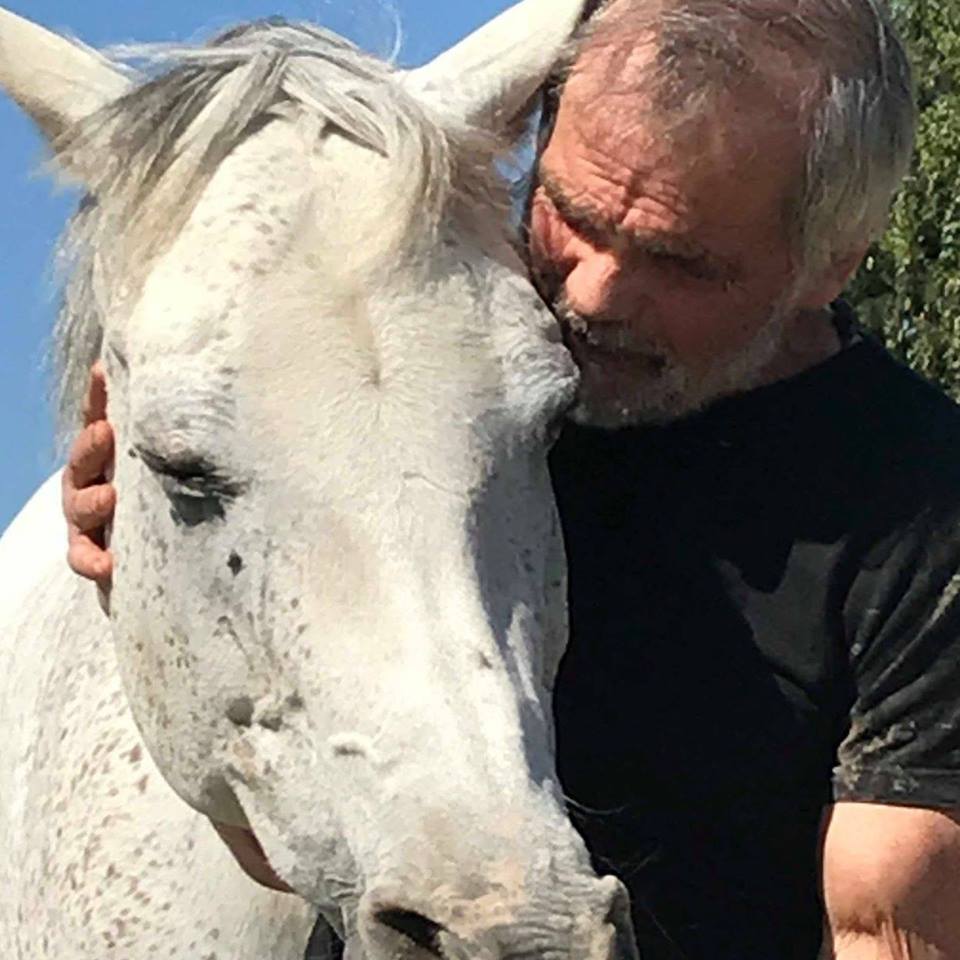
A few months later, I met my fourth and current partner, a wise woman who is an equine therapist and who introduced me into the wonderful world of therapy horses, mirroring the deepest yearnings of one’s soul, if you know how and where to look. Being a male who’s used to be impressed by feats of physical strength, I was weary and afraid of these dazzlingly beautiful animals at first, but Caroline taught me how I could gain their trust and trust them back. They’ve become my darlings, and each day is another day of learning from them.

My life has been somewhat of a roller coaster, yes, but all the good and the bad that happened taught me something and thus was worthwhile.

Meghan: Is there anything about writing that you find the most challenging?

Bob Van Laerhoven: Well, yes, there is something, everything as a matter-of-fact. Writing takes you into a strange place, where “you” are subordinate to a greater power, a Muse if you will. It will guide you, whether you want it or not, along certain paths, into stories you could never have dreamed off yourself. It’s quite challenging to find the right mind modus that helps you to ride the inspirational wave. When you have finally found that right mind-track, you write, and you write, and suddenly, you finish the story in the first draft. You’re overwhelmed with yourself (how did you do that?) but then begins another hard part: the technical side of the whole affair. And that means polishing over and over again until you think that every word is in the right place, that every sentence has the correct rhythm. And while you do that, you know that perfection in this world doesn’t exist, and your heart drops a little, but you keep on pushing against the boundaries of your talent to become the best author you can be.

Meghan: What books have most inspired you?

Bob Van Laerhoven: The inspiration came – and comes – in waves. The science-fiction novels I loved to read when I was seventeen to twenty surely inspired me because of their audacity ‘to go where no-one has gone before’ (if my memory of Star Trek-quote serves me well, which I doubt ☺). Even then, The more literary writers in the genre, like the poetic Roger Zelazny, interested me more than the others. Later in my life, I became a fan of nineteenth-century French and Russian writers, like Proust and Baudelaire, Tolstoy, and Dostoyevski, who taught me “how to dance with words.” And, still, later, I began to read more and more cross-over novels between literature and the suspense genre and knew that this was the road I had been seeking for a long time.

Meghan: What makes your books different from others out there in this genre?

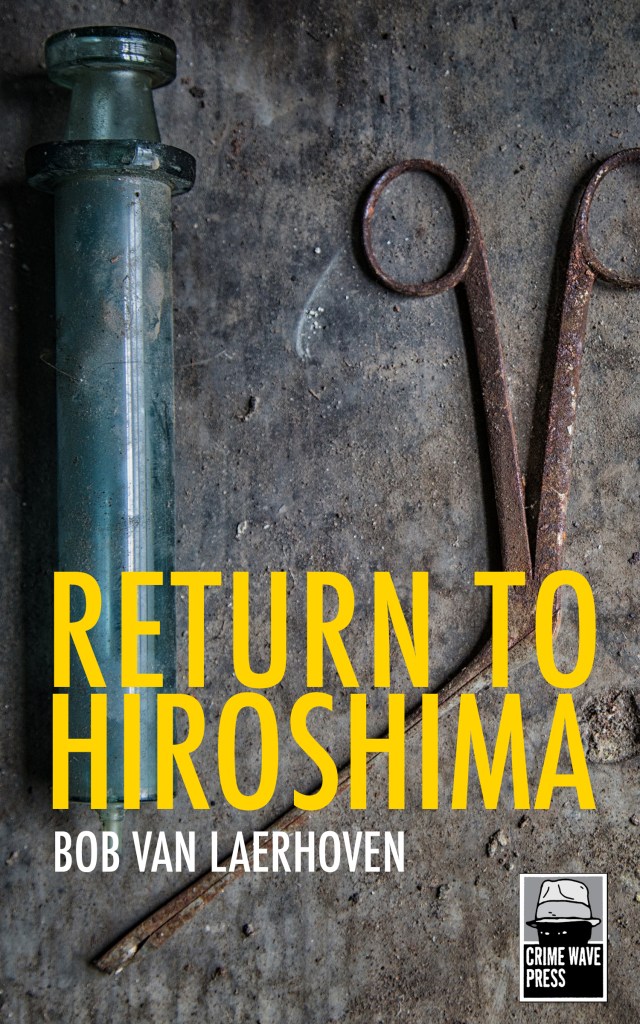
Bob Van Laerhoven: I mostly write multi-layered literary novels with a hefty dose of suspense. When I published in Flanders, Return to Hiroshima in 2010, one of the reviewers wrote: “Return to Hiroshima” is a complex and at times, gruesome story, cleverly composed by an author who creatively – and originally! – explores the boundaries of the thriller genre.” Since then, I tried to push those boundaries even further, and what I write now is literature, spiked with noir elements. I honestly believe that I’m an author who consistently tries to write literature that, at the same time, is thrilling. My other in English translated novel, Baudelaire’s Revenge is, in fact, an homage to that brilliant, nineteenth-century French poet, but at the same time, it’s a dark and thrilling novel.

Meghan: What can we expect from you in the future?

Bob Van Laerhoven: At the moment, my English editor Carly Rheilan and I are working on the English translations of two novels. The Shadow Of The Mole is situated in the Argonne-region of France during WW1. The novel was published, with great artistic reclaim, in The Netherlands and Belgium in 2015.

Here’s the translation of the Dutch blurb:

1916, Bois de Bolante in the barren French region of Argonne. The war in the trenches is raging fiercer than ever. In a deserted mineshaft, French sappeurs discover an unconscious man. Very soon, the troops nickname him The Mole. The Mole claims he has lost his memory, and he’s convinced that he’s dead. He asserts that an Other has taken his place. The military brass considers him a deserter. Front physician and psychiatrist-in-training Michel Denis suspects that the odd behavior of his patient is stemming from shellshock and tries to save him from the firing squad. But the mystery deepens when The Mole’ starts to write a story in écriture automatique that takes place in Vienna and Paris between 1875 and the start of WW1. Michel Denis, himself traumatized by the recent loss of an arm, becomes obsessed with The Mole and does everything he can to unravel the patient’s secret.

When, how, and why shifts reality into delusion? The First World War is a staggering background for this thrilling tableau of loss, frustration, anger, sexual secrets, and cautiously budding love.

And last but not least, we’re preparing Alejandro’s Lie for the English reading market. The novel, set in the fictitious Latin-American country “Terreno” in the eighties, refers to the famous seventies Chilean protest-singer Victor Jara and general Pinochet’s brutal and bloody junta.

Here you have the English translation of the Dutch blurb:

Terreno, 1983, Latin-America. After a dictatorship of ten years, the brutal junta, lead by general Pelarón, seems to waver. Alejandro Juron, the guitarist of the famous poet and folksinger Victor Pérez, executed by the junta, is released from the infamous prison “The Last Supper.” The underground resistance wants Alejandro to participate again in its fight. But Alejandro has changed. Eaten up with guilt by the death of his friend Victor Pérez, whom he has betrayed to his tormentors, Alejandro becomes the unintended center of a web of dramatic intrigues, culminating in a catastrophic insurrection. Alejandro has to choose between his love for Beatriz and his need to flee the country. The consequences are disastrous.

For a writer in a small language community like mine – Flanders only has five million people – it isn’t easy to venture in the English reading community, but with my two novels “Baudelaire’s Revenge” and “Return to Hiroshima” and my two collections of short stories “Dangerous Obsessions” and “Heart Fever” I enjoyed already some modest successes, so I hope that the next two novels will do even better.

Meghan: What is in your “trunk”?

Bob Van Laerhoven: Aside from noir novels, I’ve published in Flanders now and then literary novels with a high percentage of autobiographical facts, like, for instance, Seven Letters To My Call-Girl, Black Water, and The Woman Who Loved Dante. Now that I’m getting old, I notice that my stamina is no longer sturdy enough to crank up enough energy for writing new noir novels. Don’t underestimate the kind of energy writing a novel demands. So, I think I played it smart by proposing to a brilliant young writer-friend of mine to write a book of letters together. We’re sending each other letters with a great variety of subjects, and we’re very frank. For instance, I’m not holding back the jealousy I feel toward him for being such a productive and versatile writer, who – and this is even more important – is surfing on the crest of his creative powers. He’s twenty years younger than I am, dammit! ☺. I love this project. In letters, you can vary your style; you can tackle any subject you like; you can gossip as much you want, et cetera. We’re hoping to finish the first draft of our book of letters at the end of the year. Then comes the fun part again: polishing, polishing, polishing. And after that? I don’t know. Maybe, I’ll hang my pen in the willows. Or I write a tome of 700 pages…

Van Laerhoven is a 66-year-old Belgian/Flemish author who has published (traditionally) more than 45 books in Holland and Belgium. His cross-over oeuvre between literary and noir/suspense is published in French, English, German, Spanish, Swedish, Slovenian, Italian, Polish, Portuguese, and Russian. A Chinese translation is currently in production.

In Belgium, he was a four-time finalist of the ‘Hercule Poirot Prize for Best Mystery Novel of the Year’ with the novels Djinn, The Finger of God, Return to Hiroshima, and The Firehand Files. In 2007, he became the winner of the coveted Hercule Poirot Prize with Baudelaire’s Revenge, which, in English translation, also won the USA Best Book Award 2014 in the category ‘mystery/suspense’. His first collection of short stories, Dangerous Obsessions, published in the USA in 2015, was chosen as the ‘best short story collection of 2015’ by the San Diego Book Review. The collection has been translated into Italian, (Brazilian) Portuguese, Spanish, and Swedish. Return to Hiroshima, his second crime novel in English, was published in May 2018 by Crime Wave Press(Hong Kong). The British quality review blog Murder, Mayhem & More has chosen Return to Hiroshima as one of the ten best international crime novels of 2018. MMM reviews around 200 novels annually by international authors. Also in 2018, the Anaphora Literary Press published Heart Fever, his second collection of short stories. Heart Fever was one of the five finalists of the American Silver Falchion Award. Laerhoven was the only non-American finalist. The collection has been translated into Italian and Spanish. A German translation is currently in production.

Meghan: Where can we find you?

Bob Van Laerhoven: Website ** Facebook ** Twitter ** Instagram

Return to Hiroshima

1995, Japan struggles with a severe economic crisis. Fate brings a number of people together in Hiroshima in a confrontation with dramatic consequences. Xavier Douterloigne, the son of a Belgian diplomat, returns to the city, where he spent his youth, to come to terms with the death of his sister. Inspector Takeda finds a deformed baby lying dead at the foot of the Peace Monument, a reminder of Hiroshima’s war history. A Yakuza-lord, rumored to be the incarnation of the Japanese demon Rokurobei, mercilessly defends his criminal empire against his daughter Mitsuko, whom he considers insane. And the punk author Reizo, obsessed by the ultra-nationalistic ideals of his literary idol Mishima, recoils at nothing to write the novel that will “overturn Japan’s foundations”….

Hiroshima’s indelible war-past simmers in the background of this ultra-noir novel. Clandestine experiments conducted by Japanese Secret Service Unit 731 during WWII become unveiled and leave a sinister stain on the reputation of the imperial family and the Japanese society as a whole.

Baudelaire’s Revenge

It is 1870, and Paris is in turmoil.

As the social and political turbulence of the Franco-Prussian War roils the city, workers starve to death while aristocrats seek refuge in orgies and seances. The Parisians are trapped like rats in their beautiful city but a series of gruesome murders captures their fascination and distracts them from the realities of war. The killer leaves lines from the recently deceased Charles Baudelaire’s controversial anthology Les Fleurs du Mal on each corpse, written in the poet’s exact handwriting. Commissioner Lefevre, a lover of poetry and a veteran of the Algerian war, is on the case, and his investigation is a thrilling, intoxicating journey into the sinister side of human nature, bringing to mind the brooding and tense atmosphere of Patrick Susskind’s Perfume. Did Baudelaire rise from the grave? Did he truly die in the first place? The plot dramatically appears to extend as far as the court of the Emperor Napoleon III.

A vivid, intelligent, and intense historical crime novel that offers up some shocking revelations about sexual mores in 19th century France, this superb mystery illuminates the shadow life of one of the greatest names in poetry.

Halloween Extravaganza: Karen Runge: The Mask & the Guise

As I write this, a long, black velvet dress hangs from the curtain rail here in my studio. It’s vintage, freshly steam-cleaned, and it fits like it was stitched for me. I got it at an antiques store a few weeks ago for almost nothing, knowing it was mine the second I saw it—never mind that I’m going to struggle finding an occasion to wear it. I’ve already named it my Morticia Adams dress, because it has that look: all slink and gothic flair. When I was a kid I wanted to be just like Morticia Adams some day, and that’s one childhood fantasy I’ve never quite grown out of. You might say this is the perfect Halloween dress: straighten my hair, go heavy on the makeup, and I’d be set. But the snag is, the town I currently call home is on the more conservative side of things, and Halloween doesn’t get much love round here. Dress up? I get enough suspicious looks just wearing full black on a random day out. (I’m not even trying to be scary, mister. Seriously. Mwahaha.) So my new favourite ‘never-wear’ dress sits on its hanger where I can admire it from my desk, breezing down my wall, its delicate darkness in full spread.

But I’m not here to talk about dresses. Not exactly. Because whether we’re in a place that celebrates Halloween or not, it isn’t difficult to recognise the joy that it—or any kind of pageantry, really—brings. There’s something thrilling about stepping into the skin of another being. An Other being. A being, surreal or unreal, we would never otherwise dare or dream to imitate. There’s magic in Halloween’s many wild and wonderful flavours. Be what you want, Halloween says. Be a beast. A fairy. An angel. Be a celebrity; a well-known character. Homage or caricature. Your own worst nightmare. Anything goes. While the fun is in the dressing up, the display, there’s also something much deeper going on in disguise: the way we take to it, delight in it. Blondes go for black wigs. Cackling hags hand out candy bars. Cute little kids in zombie masks nag everyone with the question: Am I scary? Am I scary? Am I scary? Halloween gives us permission to delight in fear, and to celebrate fantasy. Here we greet our worst collective nightmares with open smiles. Dracula pours our drinks while we catch up with the our old werewolf friend. Obi-Wan cracks cheesy jokes while Rapunzel regales us with office dramas. The Mummy is asking for horror film recommendations, and Tinkerbell wants to play The Monster Mash. I’ve been to these parties. I’m sure you have, too. Notice anything? We’re all ourselves—and we’re not ourselves. In our costume, we lean into the theatrical, and it sets us free from our usual blanket personas. There’s something very telling about that.

It didn’t all start just as games, though. Look back far enough, and you’ll see Halloween is as much about fear as it is fun. The modern remnant of this shows in how, at this time of year, people who don’t usually ‘like’ horror will revel in a few scary stories along with the rest of us. Traditionally, this is the time when the darker sides of the unknown are explored and celebrated instead of denied. The original pageantry of Samhain (practiced throughout Europe in pre-Christian times) was for people to disguise themselves as the undead. The change of season into darkest Winter, they believed, was a time when the veil between this world and the Underworld was at its thinnest, setting ghosts and ghouls and demons free to roam the streets. If the living wanted to survive the night, they had to dress to fit in. Cue the black robes and death masks, the fake wounds and the black-shadowed eyes. Cue the tradition of preparing sweets for whoever comes knocking—in hope that offering Treats will bribe against being Tricked. This idea of using disguise as a tool for survival isn’t only evident in Paganism—cultures across the world have used some form of dark dress-up at some stage of their history. Representing ourselves as something scarier than what we truly are has always been common practice, in and out of esoteric scopes. We’ve been doing this stuff for over 9000 years, one way or another. Take a look at Ancient Roman war masks, the masks Ancient Azteks used to cover the faces of their beloved dead. Battlefields, ceremonial circles, funerals. Every time we don a mask, we do it to step closer to something we would normally feel too weak, too vulnerable, or too human to approach. Disguise gives us the courage to face the beasts.

Even if we scrub the makeup and ditch the costumes, masks somehow remain an essential part of being human. Every day of our lives, on some level or other, we will pretend to be something we’re not. We’ll fake a mood, we’ll suppress our doubts, we’ll hold ourselves back and hide our thoughts. This is why we smile when we shake someone’s hand for the first time—whether we’re genuinely happy to meet them or not. This is how we are able to tell lies, big and small: From “Thanks, I love it!” all the way up to “It wasn’t me.” By pretending we are someone who acts, thinks or feels as we do not, we pass through society with less fear of negative repercussions. This isn’t necessarily about being a bad person, either. We are social animals, after all, and deep in our primal minds there’s an undying belief that exile might mean death. So we tell our white lies and we pick our sides, and sometimes we fool ourselves and others, and sometimes we don’t. Sometimes that matters, and sometimes it’s just the normal course of daily life. The point is, we’ll do it without thinking. The point is, sometimes we really need our masks.

The flip-side to all this is we might not use our masks only to approach the beast. We might make use of them to be the beast. Studies have shown that when a person’s sense of personal identity is muted, they are far more likely to commit a crime or do something terrible they would never consider as themselves. Think: the anonymity we feel in a crowd. In our cars. What this means in mobs, how this cradles road rage. Think avatars and monikers, and how they enable online bullying. Alter-egos, pseudonyms. How they help people say unspeakable things. On another level: uniforms. There’s a reason why a soldier won’t hesitate to follow orders the way he might if dressed in his favourite jeans. And there’s more than one reason why the hangman never shows his face. Masks make it easier for otherwise good people to do bad things. It’s not so much what we’re capable of as it is what we can make ourselves capable of. The data is there, and it’s terrifying.

Like pretty much anything else in this world, balance is essential. When people tell you something like ‘My whole life is a lie,’ what they’re really saying is their mask is smothering them. They won’t be happy when they say it, either, because beneath all those layers the soul is starting to suffer. The trick in our daily disguise is not to subvert the self so much that anything essential is lost. Wear one mask for too long, and odds are it’ll start sticking itself to your face. The beauty of Halloween, maybe, is it makes wearing a different skin a thing for us to celebrate. It let’s us be genuine about being disingenuous, and—almost paradoxically—offers us this without the stress we find in more covert forms of deception.

As for me, in my tiny, sweet-dream town, I’m bare of Halloween parties, of the thrilling remnants of the Samhain my European ancestors took so seriously. The werewolf currently lives in another city, and Tinkerbell and me haven’t spoken properly in years. But it’s still Halloween, the veil is thin, and I’ve got my Morticia Adams dress looming on the wall. If there’s no occasion to wear it, I might have to make one. Or why worry about being appropriate? A dress, in a way, is its own kind of mask. Especially a dress like that. I might slip it on and do my grocery shop tomorrow. And maybe go for a cappuccino after. Be Morticia for a day, and shamelessly fulfil a childhood dream. Why not? And who cares if the locals stare? It’s not like I’m trying to scare anyone. Seriously. Mwahaha.

Karen Runge is an author and visual artist in South Africa. She is the author of Seven Sins: Stories from Concord Free Press, Seeing Double from Grey Matter Press, and Doll Crimes from Crystal Lake Publishing. Never shy of darker themes in horror fiction, she has been dubbed ‘The Queen of Extreme’ and ‘Princess of Pain’ by various bloggers and book reviewers. Jack Ketchum once said in response to one of her stories, “Karen, you scare me.”

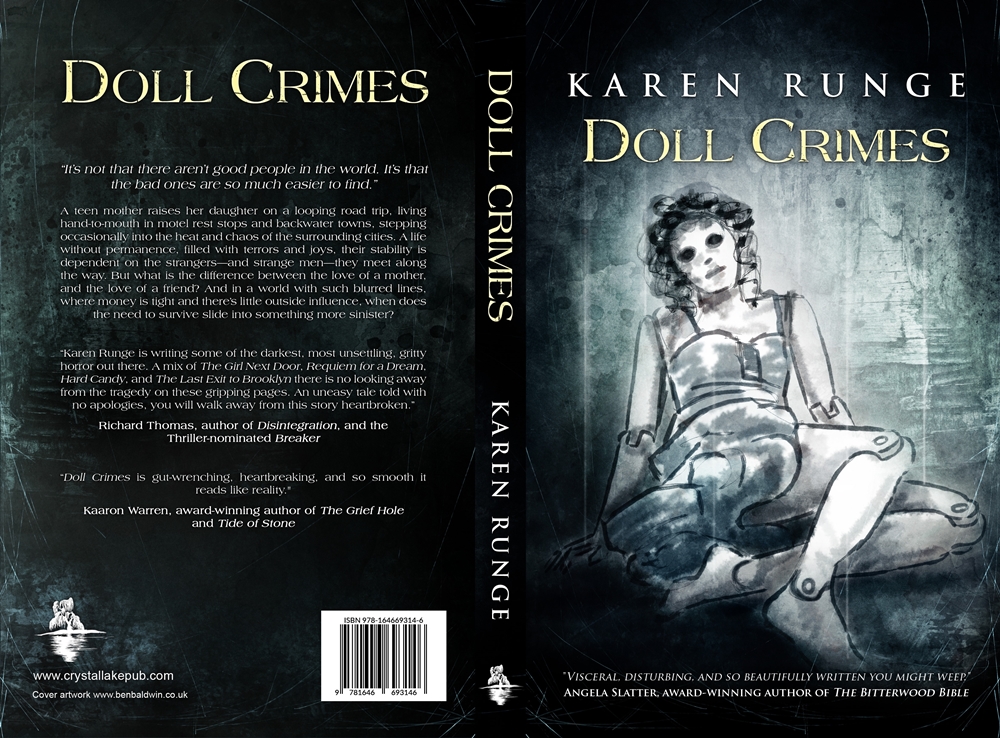
Doll Crimes

‘It’s not that there aren’t good people in the world. It’s that the bad ones are so much easier to find.’

A teen mother raises her daughter on a looping road trip, living hand-to-mouth in motel rest stops and backwater towns, stepping occasionally into the heat and chaos of the surrounding cities. A life without permanence, filled with terrors and joys, their stability is dependent on the strangers—and strange men—they meet along the way. But what is the difference between the love of a mother, and the love of a friend? And in a world with such blurred lines, where money is tight and there’s little outside influence, when does the need to survive slide into something more sinister?

Seeing Double

A trio of expats living in Asia form a tenuous bond based on mutual attraction, sexual obsession and the insatiable desire to experience the deadliest of thrills.

As their relationship matures, the dangerous love triangle in which they’ve become entwined quickly escalates into a series of brutal sexual conquests as they struggle to deal with lives spinning out of control and the debilitating psychological effects of mental and physical abuse.

Known for her distinctive brand of unsettling fiction, author Karen Runge is at the top of the modern horror game in this, her premiere novel. Seeing Double is a beautifully evocative and stunningly dark coming-of-age exploration of human sexuality and the roles of masculinity and feminism, polyamorous relationships, social and psychological isolation, and the humiliation of ultimate betrayal.

Seven Sins: Stories

A mesmerizingly dark imagination fills this collection of seven stories that explore a multitude of sins, both familiar and deadly. Love turns to lust. Crimes escape punishment. The ordinary turns strange. Women take control – or lose it. Blood flows, flesh ripens. And throughout, people, good and bad, find themselves in the inescapable grip of desire. 

Karen Runge’s fresh voice resonates with those of the masters – Atwood, Oates, Mantel, King, and other writers who look bravely into the darkness and write unflinchingly about what they see there. With these disturbing but undeniable stories, Runge makes her dazzling first mark as a writer – one with a brilliant future ahead.

Halloween Extravaganza: INTERVIEW: Karen Runge

Meghan: Hi, Karen. Welcome, welcome. Tell us a little bit about yourself.

Karen Runge: I’m a dark fiction author and occasional visual artist, based in South Africa. While my own brand of horror is more on the psychological side of things, I adore every inch of the genre and devour it in all its forms and formats. Art is my alpha and omega: books, film, music, visuals—all of it. I’m lucky to have grown up in a family full of art-inclined people, where I was free to explore these interests well beyond genre and specific tastes. My parents both hate horror, but they never stopped me from reading it. I find humanity fascinating—the wheres and whys of the things we do—and this is the major lynchpin in all my work. We’re all such a hot mess: terrible and beautiful and complex as the world is wide. I could live a thousand years and never run out of stuff to write about.

Meghan: What are five things most people don’t know about you?

Karen Runge:

  • I’m a huge nature lover. I volunteer for a local wildlife rehabilitation centre (we’re out in the sticks) and hike at every opportunity.
  • I have a phobia of pork. I mean, as food. Not just I-don’t-eat-it pickiness, but a full-on nauseous reaction at the very thought. I’d go into why, but talking about it… yeah. Phobias are phobias. Anyway. If you see me reference pork in any of my stories, be sure to strap in. There’s a reason.
  • This one often surprises me: I’m actually quite domesticated. I love cooking and baking and sewing: they’re interests I’ve avidly pursued from childhood. It’s great because if I can’t find something I want or like – from clothing to cakes – I can usually make it myself. Or try to, anyway. I also get a real kick out of making stuff for family and friends.
  • I speak three languages competently, and while Russian is a very weak fourth, I can read and write Cyrillic – which I put to regular use. Cyrillic is my go-to code. Lists, concepts, thoughts, poems… whatever I wouldn’t want people to see over my shoulder. So, my family might have some fun with that when I die.
  • Major confession: I have never seen Eraserhead. Yes, I know.

Meghan: What is the first book you remember reading?

Karen Runge: First actual book? Anna Sewell’s Black Beauty. I was about six or seven, barely out of school readers, but I was determined to get through it. I won the school’s annual reading trophy over that—I remember feeling so proud. I thought this was a major life achievement. Of course I had to read it again a few years later, because for all my enthusiasm much of it went way over my head. Well, I was six. There was a pretty black horse on the cover. I tried.

Meghan: What are you reading now?

Karen Runge: I’m finally about to start The Satanic Verses by Salman Rushdie, having just finished Nikos KazantzakisThe Last Temptation of Christ. Not sure why I’m on such a high-brow, world-religions kick at the moment, but this is where I’m being lead so I’ll just go with it.

Meghan: What’s a book you really enjoyed that others wouldn’t expect you to have liked?

Karen Runge: I love the Narnia series. I still read those books once every few years. They’re like my literary comfort food. It’s surprising because I’m not much into Fantasy, not one for kids’ fiction, and just in general that type of book doesn’t exist on my shelves. But I grew up reading them, and have always returned to them. They’re so vivid and wholesome and beautiful.

Meghan: What made you decide you want to write? When did you begin writing?

Karen Runge: Honestly, I don’t recall a moment when this was a decision, or even a thought. It was always something I knew I wanted. My father was probably the initial spark: from a very young age he would tell me about how amazing books are and how wonderful it is to be in a world someone else has created. He inspired me to love books before I could read, so wanting to write was probably a natural next step in my little mind. I tried to write a ‘book’ when I was about eight or so—loose papers scribbled with crayon, stashed in an old suitcase and hidden in the back of my wardrobe. Since then I’ve attempted one just about every year of my life, all through school and beyond. I wish I knew where those early manuscripts were now. I probably burned them all years ago in a dramatic fit of teen despair. Seems likely.

Meghan: Do you have a special place you like to write?

Karen Runge: Not particularly, though my desk is usually best because all my stuff is in reach and I don’t have to wear pants to sit there. Ha. Otherwise I’m pretty good at blocking out external chaos. I can write in the back of a nightclub with pounding music and drunk people yelling all around me. No kidding, I have actually done this—hunkered down against a wall with a notebook on my knees, desperate to catch some line of prose before it slipped away. No matter where I am, I seldom struggle to zone out of this world and zoom into my own. Call it a natural talent.

Meghan: Do you have any quirks or processes that you go through when you write?

Karen Runge: If I’m at home and this is serious, the place needs to be clean and tidy before I sit down. Desk organised, Thesaurus out, notebooks open. Music is essential. I go for Dark Ambient these days: my Seeing Double editor, Anthony Rivera, introduced me to Lustmord and my writing hours at home have been blissful ever since. If I’m afraid, I’ll read something good before I start; even just a page or two. I find it really helps me hook in and trust the tone and flow without second-guessing myself too much.

Meghan: Is there anything about writing you find most challenging?

Karen Runge: Much of it—particularly the mental gymnastics of smoothing out how Character A ends up doing Horrific X. But with what I do, this challenge is honestly the point. In Seven Sins I wanted to find empathetic frames for seven heinous acts. In Seeing Double, I wanted to write through the eyes of psychopathic sadists. None of that is easy, but I’m there because I want to see if I can do it, and if I can, how effectively. It’s always a helluva growth process, every time. I love the challenge. That’s what gets me up in the morning, and when it’s going well, that’s what keeps me going. No matter how tough the subject matter.

Meghan: What’s the most satisfying thing you’ve written so far?

Karen Runge: I drafted my short story Sweet Old Men in an hour, while on break at work. I crashed into a corner table with an Americano and a ticking clock, and presto. Story. The final version underwent very little in the way of editing from that barely legible first draft. It came out so complete, and it’s one of my favourite things I’ve ever done. Sweet Old Men made it into Structo, a UK litmag, and later reappeared as the opening tale in my collection, Seven Sins. So that was pretty satisfying.

Meghan: What books have most inspired you? Who are some authors that have inspired your writing style?

Karen Runge: Joyce Carol Oates and Margaret Atwood are top hitters for me. Toni Morrison, some Ian McEwan, some Cormac McCarthy. King goes without saying: I think many modern dark fiction authors first began by reading him. Specific books that did something permanent would be Lost Souls by Poppy Z Brite, Atwood’s The Handmaid’s Tale, and Senseless by Stona Fitch. I’m just as easily inspired by music or movies, though.

Meghan: What do you think makes a good story?

Karen Runge: A good story is like watching a great actor. Even if the genre or the theme don’t do much for you, you’ll be mesmerised by the skill, and you’ll keep watching despite yourself. I’m turned off immediately when I spot shallow emotional reactions: stuff that betrays the artist has no idea what they’re really tapping at. The discovery of a dead body does not make people go “Oh no” and then drop a cool quip about vengefully kicking ass. A good story will catch at the nuances, will convey something real. Even if we’re going wild, there are ways to craft the unconventional and the crazy so it presents credibly and compellingly to your reader. Ask Chuck Palahniuk. Ask the masters of Magic Realism. Basically, as in most things, it’s not so much what is done so much as how it’s done. The how, for me, is often what makes it.

Meghan: What does it take for you to love a character? How do you utilize that when creating your characters?

Karen Runge: Some of the most popular and captivating characters in fiction have been the bad guys—actually, the worst guys. Patrick Bateman, Mr Hyde, Count Dracula himself. Maybe it’s not them we love, but their complexity? That definitely echoes back at me when I’m creating my own characters. If I’m getting it right I can’t not love them, no matter how vile they are. The deeper I delve, the better I understand them. Which isn’t always the greatest feeling when they’re about to do something hideous, and I have to describe it. I think without that bond, though, these types of characters tend to fall flat? So… yay for my artistic torment?

Meghan: Which, of all your characters, do you think is the most like you?

Karen Runge: Dear god, none of them I hope! Not to get stuffy, but the trick here of course is that every character an author creates is in a way a part of themselves. Even if the character is an antithesis of their own core values and beliefs, in the act of conveying that personality you’re still the one doing the filtering. So in a way, that’s an expression of you, too, only this time cast in the negative space. So my characters are all like me, and they’re not at all like me, but they’re all a part of me. If that makes sense.

Meghan: Are you turned off by a bad cover? To what degree were you involved in creating your book covers?

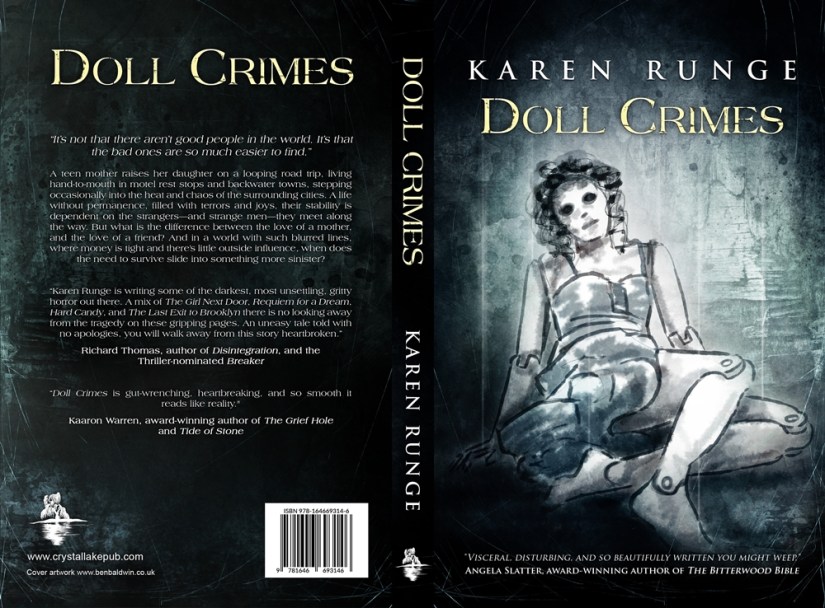
Karen Runge: I try not to be, but yes I am. If it’s pink and has bunny rabbits on it, I won’t want it on my shelves. If it’s tacky digital art with bad texturing, I’m not going to feel too solid about the quality of the content. Unless I already know the author, it’s hard not to judge a book by the art. After all, the cover is literally the first thing you see when you pick up a book. I’ve been extremely lucky with my own covers; my publishers have made fantastic choices. Seven Sins was done by Stephen Fredette, former Scruffy the Cat bandmate of editor Stona Fitch. So that cover is special in a few ways. Seeing Double was done by the gob-smackingly talented Dean Samed, whose career has since seriously taken off. As of this interview, the Doll Crimes cover is in the capable hands of Ben Baldwin. I just saw his concept sketch a few days ago and had to go scream into a pillow I loved it so much. Cover artists are a different kind of genius: it’s incredible how they manage to incorporate so much of a story’s tones and themes into one single image.

Meghan: What have you learned creating your books?

Karen Runge: That even as I’m raging at myself that I JUST CANNOT DO THIS, I can, in fact, Do This. And am busy doing it even as I’m raging about how I can’t. Looking back on these moments, they become a great practical illustration of how your own mind can be your enemy, sometimes for no real reason at all. So if I’ve learned anything from that, it’s that my negative voices are often full of shit and the best thing to do is just block them out and carry on. Save judgement for the end, and shut up about it until we get there. This mindset really helps.

Meghan: What has been the hardest scene for you to write so far?

Karen Runge: There were a couple scenes in Seeing Double that took some serious mental work, and caused me a lot of emotional strain. I know cruelty, but I am not cruel, so writing first-person from the POV of someone doing something so vicious—and write it convincingly—meant draft after draft, each time in serious psychic distress. It took a massive amount of energy, so I’m always relieved when readers tell me those scenes affected them. It means they worked. And as the creator, I definitely paid for them.

Meghan: What makes your books different from others out there in this genre?

Karen Runge: There’s a bit of a gap between literary horror and extreme horror. Actually, it’s more of a chasm with a few frazzled monkey ropes dangling in-between. I was chatting with Nikki Noir about this recently: how hard it is to find hardcore horror that doesn’t lean so deep into Schlock territory all depth is gone. Schlock is fantastic, don’t get me wrong, but there’s still a step missing here. Filmmakers got it right with New French Extremism: why isn’t the literary equivalent keeping pace? And this is really what I try to do. When I wrote Seeing Double, I aimed for a body horror that would present in a literary style. I wanted it as far from Schlock as I could get it, without diminishing the gore. I had to make the gore… well, deep. And keep it real, so nobody would mistake it for Absurdo, either. With Doll Crimes, I’m stepping away from body horror and towards its psychological equivalent: mental and emotional trauma. My stories concern themselves with the raw realities of evil in the really-real world. Inescapable, sometimes inevitable, knocking-on-your-door-right-now type subjects. But even within that, my focus is on empathy, on exploring the extreme and the unthinkable as honestly as I can, with as much insight and sensitivity as I can. Literary horror? Trauma horror? My territory lies somewhere in the space between.

Meghan: How important is the book title, how hard is it to choose the best one, and how did you choose yours (of course, with no spoilers)?

Karen Runge: For some reason I’ve never had a problem with titles? They just arrive in my head at some point and make perfect sense to me, no argument. I wish I had a more exciting answer, but I really don’t. As for importance: yes, there needs to be something different there, something that represents the key component(s) of the tale, isn’t too common/hasn’t been used, and still sounds pretty when rolling off the tongue. Tricky balances, here.

Meghan: What makes you feel more fulfilled: Writing a novel or writing a short story?

Karen Runge: They’re different, but on balance a novel probably offers me more, just with a longer wait to reach the pay-off. A short story can arrive fully-formed in a day, or work its way out over a few weeks, or get itself binned in the early stages because it’s proving to be a little nightmare you really don’t need to be dealing with. Your call. Whatever happens, they’re usually easier to get through (or at least, get them to the edits stage), purely because you’re only working with a max of roughly 8000 words? That’s much easier to thread and stitch than 50K plus. Novels take an insane amount of work, an incredible amount of mental energy. And you’re on your own in there for like a year. There’s a point of no return where even if you hate where it’s going and Every Day Is Pain, you cannot abandon it. You’re locked in, like it or not, and sometimes just about kills you. Successfully selling a short story makes me feel like I just got given a very, very pretty crown. Getting through a novel—and then successfully pitching it to a publisher—makes me feel like I just got the whole throne.

Meghan: Tell us a little bit about your books, your target audience, and what you would like readers to take away from your stories.

Karen Runge: My books and stories are about humanity—and inhumanity—first. As much as we find beauty, there is also real evil in the world. Sometimes life lines up to make the most wonderful things happen. But sometimes it does it for the opposite result, too. I find this fascinating, and in each of my works I try to represent reality and the nuanced complexities that go with each set of circumstances I create. If you prefer escapism, my books probably aren’t for you. People who enjoy my work are usually fans of people like Bloch and Ketchum and Ellis; the authors who take their souls with them when they dive into the dark. If there’s a takeaway in my work, I hope it’s the understanding that there’s more to learn from looking than by sweeping things under the carpet. There’s a reason why understanding and empathy have such a symbiotic link. Your life can change forever in just one second. Seriously. Anything can happen. As an individual, I think we do better if we stay real about that. And as a psych horror author, this is what I’m all about exploring.

Meghan: Can you tell us about some of the deleted scenes/stuff that got left out of your work?

Karen Runge: There were one or two scenes in Doll Crimes where I tried to unpin the veil for a moment and offer a more direct view of what was going on. I didn’t continue with them for a few reasons. One: this story is in a first-person POV, and lifting the veil goes against the shadowed mindset of someone who is actively being traumatised—which is what I really wanted to convey. Second: It just wasn’t necessary. What I had down was hard enough to confront without bludgeoning myself—or my readers—with it. And third: Sometimes less is more. And sometimes it’s not. But sometimes, it really is.

Meghan: What is in your “trunk”? (Everyone has a book or project, which doesn’t necessarily have to be book related, that they have put aside for a ‘rainy day’ or for when they have extra time. Do you have one?)

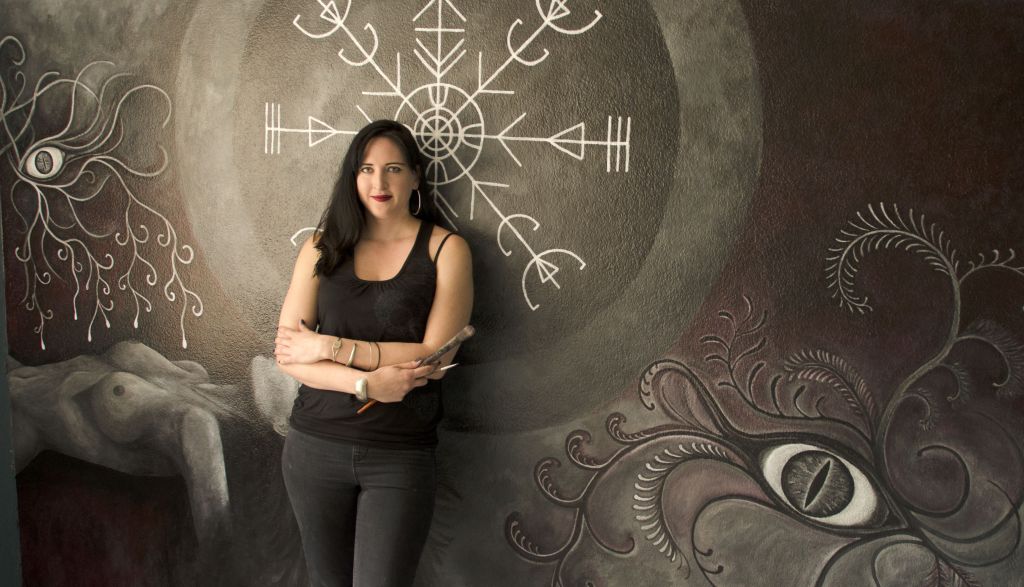
Karen Runge: Painting. Murals, specifically. I moved recently, and the walls here are very blank. I’m not used to it. In my last apartment, I risked the wrath of my landlord by painting a massive mural on my studio wall. (It’s okay, he’s a good dude and very kindly let me off the hook.) I like the things around me to be beautiful, or interesting, or unusual in some way. Every time I look up in this new place, I cringe at all the beige, all that emptiness. There’s only so much random stuff I can tack to the walls without looking like a hysterical teenager—and I love to personalise. For now I’m telling myself to see these walls as blank canvases. So, painting. Please.

Meghan: What can we expect from you in the future?

Karen Runge: I’m gearing up for a new short story collection. I still have a few more stories to write for it before I pitch a publisher, but hopefully this ball will start rolling sometime in the next few months. Short stories are my first love, and I’ve been so crazy with Doll Crimes for so long that I’d love to take a few deeper breaths. Plus I’m really excited about what I want to include in there. I also have a poetry collection boiling in the background. I write poetry all the time, but getting it published would be new for me. I’m still waiting to hear back from my beta reader on that before I do anything drastic, though.

Meghan: Where can we find you?

Karen Runge: You can find me on Twitter and on Facebook. I also have a kind of landing site (though I don’t blog).

Meghan: Do you have any closing words for your fans or anything you’d like to say that we didn’t get to cover in this interview?

Karen Runge: My huge, heartfelt thanks to everyone who’s followed and supported me over the years. It’s a brutal joke that writers (and artists in general) are often among the more sensitive, introverted types—where the only path to success requires we put ourselves out there in ways that just about strip the skin. It can be exceptionally hard. I’d be a mess in this if it weren’t for the beauty of some of the souls I’ve come across over the years in my career. Editors, reviewers, collaborators, fans. Friends. Random folks who say something nice. Thank you. You don’t know how deep it sometimes counts.

Karen Runge is an author and visual artist in South Africa. She is the author of Seven Sins: Stories from Concord Free Press, Seeing Double from Grey Matter Press, and Doll Crimes from Crystal Lake Publishing. Never shy of darker themes in horror fiction, she has been dubbed ‘The Queen of Extreme’ and ‘Princess of Pain’ by various bloggers and book reviewers. Jack Ketchum once said in response to one of her stories, “Karen, you scare me.”

Doll Crimes

‘It’s not that there aren’t good people in the world. It’s that the bad ones are so much easier to find.’

A teen mother raises her daughter on a looping road trip, living hand-to-mouth in motel rest stops and backwater towns, stepping occasionally into the heat and chaos of the surrounding cities. A life without permanence, filled with terrors and joys, their stability is dependent on the strangers—and strange men—they meet along the way. But what is the difference between the love of a mother, and the love of a friend? And in a world with such blurred lines, where money is tight and there’s little outside influence, when does the need to survive slide into something more sinister?

Seeing Double

A trio of expats living in Asia form a tenuous bond based on mutual attraction, sexual obsession and the insatiable desire to experience the deadliest of thrills.

As their relationship matures, the dangerous love triangle in which they’ve become entwined quickly escalates into a series of brutal sexual conquests as they struggle to deal with lives spinning out of control and the debilitating psychological effects of mental and physical abuse.

Known for her distinctive brand of unsettling fiction, author Karen Runge is at the top of the modern horror game in this, her premiere novel. Seeing Double is a beautifully evocative and stunningly dark coming-of-age exploration of human sexuality and the roles of masculinity and feminism, polyamorous relationships, social and psychological isolation, and the humiliation of ultimate betrayal.

Seven Sins: Stories

A mesmerizingly dark imagination fills this collection of seven stories that explore a multitude of sins, both familiar and deadly. Love turns to lust. Crimes escape punishment. The ordinary turns strange. Women take control – or lose it. Blood flows, flesh ripens. And throughout, people, good and bad, find themselves in the inescapable grip of desire. 

Karen Runge’s fresh voice resonates with those of the masters – Atwood, Oates, Mantel, King, and other writers who look bravely into the darkness and write unflinchingly about what they see there. With these disturbing but undeniable stories, Runge makes her dazzling first mark as a writer – one with a brilliant future ahead.