Halloween: INTERVIEW: Michaelbrent Collings

Meghan: Hi, Michaelbrent. It is an absolute pleasure having you here today. Tell us a little bit about yourself.

Michaelbrent Collings: Billionaire playboy by day, dark vigilante by night. Or maybe that’s Batman. Shoot.

As for me, much less cool.* I’m a writer. I am best known for horror, in which genre I’m an international bestseller, multiple Bram Stoker Award finalist, and one of the top indie authors in the US, but I have also written bestsellers in sci-fi, fantasy, thriller, suspense, urban fantasy, and even Western romance. So though I’m not Batman*, I do apparently have a multiple personality thing going that even he would be proud of.

*I SAY I’m not Batman, but have you ever seen me and him in the same room together? So there you go.

Meghan: What are five things most people don’t know about you?

Michaelbrent Collings: Hmmm… tough one. I’m a pretty open book, so that’s a great question! Here goes:

1) I abhor coconut, which I can only assume was created as a practical joke.
2) My favorite movie is Harvey.
3) My favorite movie STARS are Cary Grant and Bob Hope.
4) I asked my wife to marry me 10 days after our first date.
5) I am typing this in my in-laws’ house. And if you already KNEW about this one, then GET OUTTA MY IN-LAWS’ HOUSE, YA CREEPY STALKER!

Meghan: What is the first book you remember reading?

Michaelbrent Collings: This one is IMPOSSIBLE. Because I grew up in a house of books – my dad was the head of Creative Writing in a major university when I was a kid – I have no memory of life without books. I do remember my mom reading the Narnia books to us on the front lawn, and being bored of the whole Dick & Jane thing in kindergarten because I already knew how to read. But first book? That’s like asking about my memories of a first breath.

Meghan: What are you reading now?

Michaelbrent Collings: I read tons of different thing. I tell people that the depth and breadth of my reading habits are limited only by the square footage of the tops of my toilet tanks. Because I’m a dad, so my best reading is typically done in the one room my kids have not claimed as a “team sports” kinda space.

Meghan: What’s a book you really enjoyed that others wouldn’t expect you to have liked?

Michaelbrent Collings: Probably Les Miserables or Winnie the Pooh. Since I’m best known as a horror guy, that kind of thing surprises a lot of people. But both are masterfully written, full of lyricism, and are built around themes that wove themselves into my mental DNA when I read them for the first time.

Meghan: What made you decide you want to write? When did you begin writing?

Michaelbrent Collings: See above re house of books and Dad’s job. My earliest memory of writing is taking a red crayon to unlined paper and writing a one-page “story” about a bird. My dad then very kindly took it and helped me with some great critiques about the story, and how I could make it even better. He was and is my best writing teacher.

Meghan: Do you have a special place you like to write?

Michaelbrent Collings: Pretty much anywhere with wifi access and a refillable Diet Coke policy. ;o)

Meghan: Do you have any quirks or processes that you go through when you write?

Michaelbrent Collings: Mostly it’s pretty drudge-like. I tell people who yearn to be full-time writers that as soon as you GET that job, you realize how much like OTHER jobs it really is. It’s a great job, don’t get me wrong, but it is work, and most work is by nature boring and banal.

My one quirk would probably be in the “coming up with idea” stage I do a lot of walking in tight circles and mumbling to myself. My wife and kids are used to it, and say nary a word when I will suddenly sit up straight at dinner, blurt a phrase that means nothing to anyone other than me, and then rush away to write whatever the idea was on a note card or something.

Meghan: Is there anything about writing you find most challenging?

Michaelbrent Collings: Almost all of it. But it’s a challenge that I love; that stretches me and forces me to always try to be better than I was the last time.

Meghan: What’s the most satisfying thing you’ve written so far?

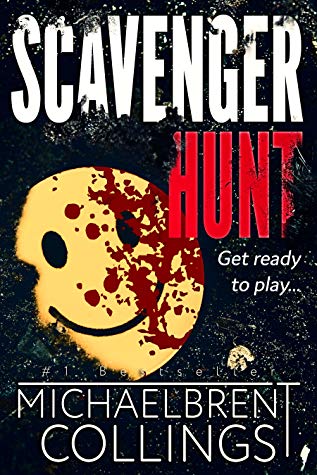
Michaelbrent Collings: The most satisfying thing I’ve written – now and forever – is whatever book I just finished. So right now it’s Scavenger Hunt. In a few months it’ll be something different. Each book is terrifying in its own way – not just story-wise, but to me as an author – and so finishing each one is like discovering and then conquering a brand new mountain.

Meghan: What books have most inspired you? Who are some authors that have inspired your writing style?

Michaelbrent Collings: Books that inspire me:

1) The Bible – regardless of theology, it’s the single most influential book in the English language, and has some of the most stunning imagery and language.
2) Winnie the Pooh and Peter & Wendy – both are beautiful mixes of laughter, whimsy, and adventure.
3) Les Miserables
4) Too many others to list

Meghan: What do you think makes a good story?

Michaelbrent Collings: I can only answer that one for myself. And for myself I’d say: a plot that is fun on its face, filled with interesting characters who do NOT make stupid or irrational decisions for no good reason other than authorial laziness, and themes I can unpack on later readings.

I read a lot of different genres, and any book that has those things in it will definitely get a second look from me.

Meghan: What does it take for you to love a character? How do you utilize that when creating your characters?

Michaelbrent Collings: Two different kinds of love here:
1) admiration
2) envy

For the first, I love characters who are good. Who desperately try to do what is right, and whose passions and decisions are all channeled through a moral lens that helps them find truth – both for themselves and for the reader.

For the second, I love villains that do and say things that I would love to do or say were I to give into my most awful moments. The ones who would slaughter the person who goes through the 15-items-or-less line with 16-items-or-more.

Meghan: Which, of all your characters, do you think is the most like you?

Michaelbrent Collings: That one’s easy: Ken Strickland from my series The Colony Saga. He and his family are explicitly modeled on me and mine. It’s a zombie apocalypse series, and I wanted to really ground it in reality – no supermen, no cops who have access to caches of weapons. Just normal folks. So I made the story a seven-book “what would I do in that situation?” story.

Meghan: Are you turned off by a bad cover? To what degree were you involved in creating your book covers?

Michaelbrent Collings: I am definitely turned off by a bad cover – more in indie works than in traditionally published stuff. In trad-pub, the author has little or no say over the cover, so I won’t judge the words by some outside factor he or she did not control. In indie stuff, a bad cover just says to me that the person involved either a) doesn’t care or b) isn’t competent. Neither of those encourages me to hand over my money.

I do my own covers, so I’m always watching for good and bad covers so that I can mimic the traits of the former and avoid the pitfalls of the latter.

Meghan: What have you learned creating your books?

Michaelbrent Collings: Mostly that it’s work. Always and forever. When I started out, I remember sitting on a panel at a writing con with James Dashner and Brandon Mull and feeling like a fraud. Now I sit on panels as someone who’s sold many many books and has been up for awards and even written movies… and I still feel like a fraud as often as not. I never feel like I’ve learned enough or done enough, and I suppose that in the final analysis that’s a good thing, because it keeps me growing as a writer and a person.

Meghan: What has been the hardest scene for you to write so far?

Michaelbrent Collings: Definitely the one in The Colony Saga where one of Ken’s children dies. No spoilers, but since that family was modeled on mine, the moment I realized that one of the kids was going to die – as a hero, but dead at the end just the same – writing that was incredibly draining emotionally. I came home a wreck, and when my wife asked what was wrong I told her I’d had to imagine how our child would die in that situation. She understood – bless her heart! – and helped me through a pretty dark moment or two in the coming days.

Meghan: What makes your books different from others out there in this genre?

Michaelbrent Collings: I think that one of the things is that because I DO write in so many genres, my books are able to draw on a lot of different genre elements to enrich whatever book I’m writing. My YA fantasy has dashes of horror, my science fiction exists in a thriller world, my romance understands that high stakes make ultimate triumph more valuable. Also, I genuinely like people, and I think that shows through in how I treat characters. All of them – even the villains – are folks who have made rational decisions given their life experiences, and I think that recognition allows me to write characters who have more verisimilitude and definitely are more capable of being sympathetic to the audience.

Meghan: How important is the book title, how hard is it to choose the best one, and how did you choose yours (of course, with no spoilers)?

Michaelbrent Collings: Ugh. Titles are SO HARD and SO IMPORTANT. I think I’m getting better at them, but they still cause me misery.

Most of the time I will try to put multiple layers in the title. Predators is about a safari that goes wrong and its survivors are tracked by a pack of hungry hyenas… and also about a group of women scarred by emotional predators. Terminal is about a group of people in a bus terminal who are made to choose one of their number to survive the night… and so the decisions the make are final, terminal ones in the truest sense. Scavenger Hunt is about a group of people who find themselves in a horrific scavenger hunt where the tasks or horrible and cruel… and then they find out that they have already been involved in a different – and much more cruel – kind of scavenger hunt in their own lives.

Titles should tell the audience what they’re in for at the very least – give them a sense of the genre, the “feel” of the book. But it’s nice to make one that they read before starting the book and say, “Sounds cool!” and then they read it after they’ve finished and go, “Ohhhh! NOW I get it!”

Meghan: What makes you feel more fulfilled: Writing a novel or writing a short story?

Michaelbrent Collings: Novel, definitely. I feel like they’re less ephemeral, and because of the length I can certainly take up more real estate in the readers’ brains. I get to settle in and move things around over a longer period of time and – hopefully – make that much more of a difference in their lives at the end.

Meghan: Tell us a little bit about your books, your target audience, and what you would like readers to take away from your stories.

Michaelbrent Collings: My target audience is anyone who likes a good yarn. Simply that. I try to make my books entertaining on their face, and hope that the first thing readers take away is a bit of escapism and fun. I also hope that they can go back and re-read them, see foreshadowing and clues I layer into all my books, and pick out the themes I try to use to shore up the walls of my plots.

Meghan: Can you tell us about some of the deleted scenes/stuff that got left out of your work?

Michaelbrent Collings: There aren’t really that many. I have an editing process that really works, and most of my books end up in final draft pretty close to how they finished out as first drafts.

Meghan: What can we expect from you in the future?

Michaelbrent Collings: Hopefully years of writing. Like I said, Scavenger Hunt hit on October 31, and in the future I’ll probably be releasing a middle grade fantasy called THE DYING IMMORTALS, then a prequel to my apocalyptic thriller THIS DARKNESS LIGHT.

Meghan: Where can we find you?

Michaelbrent Collings: I’m pretty easy to find. First of all, I’m the only “Michaelbrent” in the world, so just google that and I pop up right away. Failing that:

Website (Written Insomnia: “Stories that keep you up all night”) ** Facebook ** Twitter

You can also sign up for my email list (and get some free books).

Meghan: Do you have any closing words for your fans or anything you’d like to say that we didn’t get to cover in this interview?

Michaelbrent Collings: Only this: thanks for letting me chat with you!
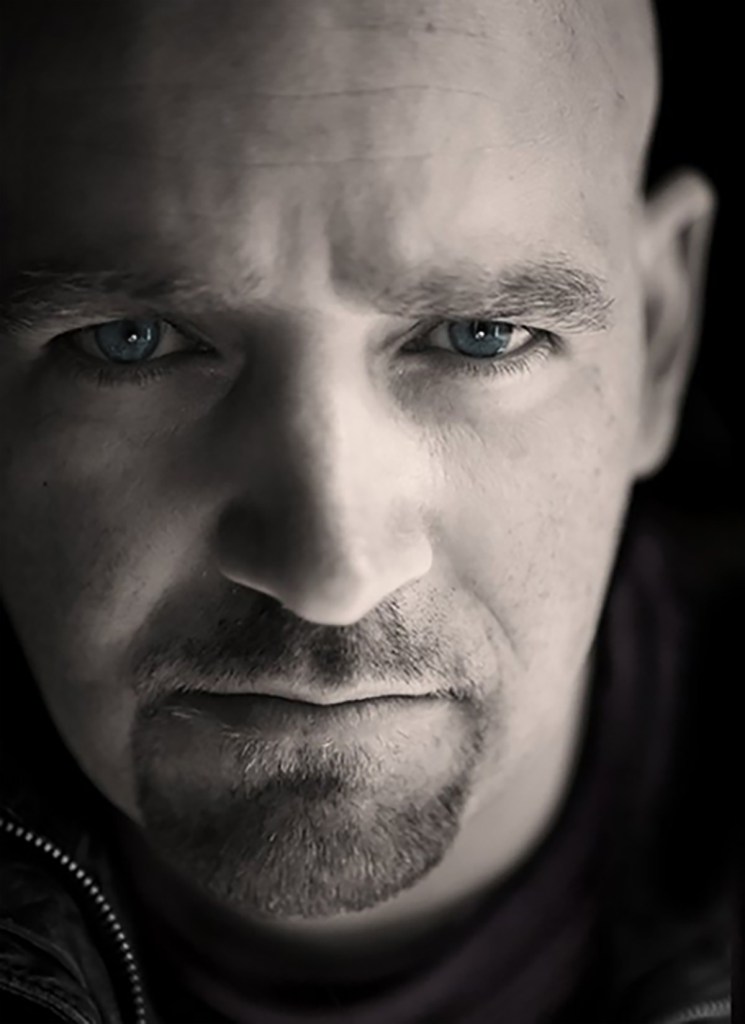
One of the most versatile writers around, Michaelbrent Collings is an internationally bestselling novelist, produced screenwriter, and multiple Bram Stoker Award finalist. While he is best known for horror (and is one of the most successful indie horror authors in the United States), he has also written bestselling thriller, fantasy, science fiction, mystery, humor, young adult, and middle grade works, and Western Romance.

As a novelist, Michaelbrent has written dozens of bestsellers that have also received critical acclaim, and he and his work have been featured on everything from mom-and-pop podcasts to Publishers Weekly, The San Francisco Book Review, and NPR.

Find more about him at his website or sign up for his mailing list (and get a free book!).

Scavenger Hunt

“I already know all your names. As for me… you can call me Mr. Do-Good.”

Five strangers have woken up in a white room. A room with no doors, no windows. 

A room with no hope.

Because these strangers have been kidnapped, drugged… and brought here as the newest contestants in the world’s most high-stakes scavenger hunt. Run by a madman named Mr. Do-Good, the game offers only two options: win or die. 

All they have to do to survive is… complete every task… on time… and not break any of Do-Good’s rules.

Playing the game will bring the players to their breaking point and beyond. But play they will, because Do-Good has plans for these strangers, and their only chance to live through the night is to discover what’s really behind his Scavenger Hunt.

Halloween Extravaganza: Carlos Colon: Old Man Jack

Old Man Jack

One of the advantages of living in a high-rise apartment building during Halloween was efficiency. Growing up in the Bronx in the late sixties and early seventies, my family lived in one that had16 apartments on each floor. The tenement itself had 18 floors, which meant that before we trick-or-treaters would even step out into the crisp October air, we would have already visited close to 300 neighboring households offering generous amounts of sugar-loaded goodies.

The convenience of having our apartments in the same building also enabled us to go to our rooms and empty out our pillow cases before we ran back out to reload. And being that we lived near other apartment buildings, more opportunities awaited outside to add to the following day’s tummy ache.

For me, the building was enough. October days seemed colder back then and the material from those cheap costumes we used to get at Woolworth’s were about as thick as toilet paper. And let us not forget the thin elastic band that was stapled to the plastic mask that had cut-out holes for your eyes, nose, and mouth. They always broke off upon the slightest stretch which meant you’d have to walk around holding your mask up. Another thing was, that if the cold weather gave you a runny nose, that mask would collect all of your sticky muck and press it right back against your face. That’s why I didn’t mind if Halloween landed on a bad-weather day. I usually did all my one-stop trick-or-treating right there in the building where I lived. I mean, really, was there any need to go anywhere else after raiding close to 300 apartments?

Most of the tenants were tolerant of the hyped-up kids running the halls and many were generous with all the M&M’s, Sugar Babies, Tootsie Rolls and, of course, my personal favorites, the candy corn. (Man, I loved those things. Even now in my older years, if I see a dish or a bowl full of those, I leave nothing for the unfortunate person who might have wanted some after me). Of course, some tenants gave more than others. Mrs. Jack, an elderly lady on the twelfth floor, was everyone’s favorite. She would give out a bag with a variety of candies and toys that made us feel like we visited Mrs. Claus before Christmas – much better than the other lady a few floors below that only gave out a single lollipop. But Mrs. Jack, she was a must stop for every trick-or-treater in our building. We all knew that we would never be disappointed after ringing her bell, and that she never seemed to run out of goodies.

Her real name wasn’t Mrs. Jack. We actually didn’t know what her real name was. Truthfully, outside of the fact that her apartment was the go-to place for Halloween, kids our age didn’t care very much for any other details. We gave her that name because of her scary husband, who we used to call Old Man Jack. Reflecting back now as an adult, he was just a harmless, older man who was unfairly labeled by us kids, who were intimidated by his slow, hunched-over walk and the out-of-sync limp that accompanied it. He also had a unibrow that resembled a five-inch, overfed caterpillar crawling across his forehead. Jack’s head also shook continuously. The cause could have been a variety of medical conditions, but to us it resembled someone who was about to erupt in a fit of anger. But Mrs. Jack had a kind, cherub-like face under a short, silver hairdo that we always found approachable, even though we often wondered about how she paired up with the ogre that shared the apartment with her.

By the time I reached my pre-teens, I, like other kids my age, started getting lazy with the costumes; maybe a cowboy hat with a neckerchief, or perhaps a drawn-on mustache with a pair of glasses. The last year, before I finally decided I was too old to be soliciting candy with kids half my size, word got out that Mrs. Jack passed away shortly after Labor Day weekend. I would like to say that we were saddened by the loss of our kind neighbor, but the truth is that the sensitivity gene still hadn’t blossomed in me or any of my fellow apartment raiders. We were more mournful about not receiving Mrs. Jack’s treat bag that year.

Buffoons that my pack of acne-challenged delinquents were, we dared each other to knock on Old Man Jack’s door to see if he would answer. Who knows, we figured. Maybe he’d keep up the tradition. Like I said, that sensitivity gene… When none of us volunteered, we played a game of odds and evens and once-twice-three, guess who lost.

Unlike the rest of the group, I didn’t really find it to be a big deal to ring Old Man Jack’s doorbell. I figured he either wouldn’t answer the door, or if he did, he would just say he had no candy. The other kids were more skittish about it and huddled by the hallway exit a few yards away. When the first clicks and drags of his unlocking deadbolt echoed in the hall, my giggling cohorts edged the exit door open preparing for a quick escape.

When the apartment door slowly opened, Jack looked up and down at the silly, middle-schooler out in the hall wearing a Superman t-shirt (I went all out that year). Internally, I felt ridiculous and made the decision right there that this would be the last year I would roam the halls for Halloween. Externally, I held out my almost-full pillow case and muttered a barely audible, “Trick or treat”.

Jack studied me for what was probably only a few seconds. Yet it felt like an eternity. “You want candy,” he finally said, not like he was asking, but more like he was acknowledging. I suddenly felt like an unseemly intruder (which I was), but rather than send me away, he opened the door wider and pointed to an upright piano where about two dozen of Mrs. Jack’s treat bags were placed on the bench. Beside the bench where shopping bags full of unopened packages of candy that she never got a chance to sort out.

“We never had any children,” said Jack, his head shaking as his unibrow took an upward turn. “She always liked when they came this time of year.” I stared at all the lollipops, chocolates, and jelly candies (Chuckles! Another one of my favorites! I even liked the black ones!). There was so much! She must have cleared out the supermarket shelves! “Go ahead, take it all. Share it with your friends,” he said, explaining that I was the only one to come to his door. No one else dared, or more likely, the other kids were respectful enough not to bother this man who was in mourning.

Above the piano, on the wall, were some black and white photos that appeared to be over fifty years old. There was a wedding photo of him and Mrs. Jack. They looked like they were in their teens. In the photo, since he was not hunched over, he appeared much taller than I ever pictured him to be. And since Mrs. Jack was very petite, it made him even more imposing.

My attention then shifted to a series of pictures of Jack in military uniform. “You were in the army?” Jack nodded and explained that he was a fighter pilot in the U.S. Army during World War I. His hunched over back, his limp and even the constant shaking of his head were the results of a spinal injury he suffered when his plane was shot down.

The piano against the wall also seemed from another era, though it was well maintained. “You play the piano?” I asked.

Mr. Jack smiled, the first time I ever saw him do so. “A little bit. But she played much better,” he said, pointing to a youthful picture of Mrs. Jack that looked like it was taken in a studio. She couldn’t have been more than twenty years old, was my guess.

The old man was hurting, even at my dense young age, I was able to see it.

The doorbell rang. “Trick or treat!” It was my friends; I recognized their voices. They were probably worried, or just curious.

Jack gestured to the door. “Let them in. They can help you with the candy.”

To my friends’ surprise, I was still in one piece and not devoured by the boogie man we laughed about all those years. When I explained to them that Jack was letting us all have the candy. They joyously dashed to the piano hauled them away. As my buddies relieved Jack’s apartment of all the sweets, Jack looked longingly at his wedding photo.

In just the few minutes I was there, I learned that this man was not a caricature like we’d been making him out to be all these years. He was a man who’d had a colorful life. A man that suffered a devastating loss. A man that deserved respect. Suddenly, I recognized myself as the snot-nosed little shit that I was.

Candy? It just didn’t seem that important any more. Somehow, the excitement was gone.

Just five weeks later, with Christmas rapidly approaching, Jack followed his Mrs. into the world that comes after this one. They say it happens that way with older married couples. When one passes, the other one quickly follows. “Natural causes” is what they said, but I believe he was unable to face another holiday without his wife and just willed his body to die.

Less than a year later, puberty would arrive and my body would start the conversion process of me physically becoming a man. But there are more components to becoming a man than growing hair in new places and having your voice change. It’s also about seeing the world differently. I would like to think that I took my first step that Halloween night.

“You’re Carlos, right?” he said to me, as I left with my sack full of candy. It was unexpected. I had never imagined that he would know my name. I nodded, and then he surprised me again. “Habla español, Carlos?” The words were pronounced effortlessly without any hint of an accent.

I don’t know why I stuttered, but I did. “Uh, yeah, uh, do you?”

He smiled, “German, Italian and a little bit of French, too.”

These days they call some guy in a beer commercial the most interesting man in the world. Back then, I would have made a case for the piano-playing, fighter pilot that spoke five different languages that was standing before me. It then occurred to me that none of us ever bothered to learn what his real name was, so I asked. “Excuse me, sir, but what is your name.”

The unibrow rose for a moment and then he smiled again. “Jack,” he said with a wink, before slowly closing the door.

After receiving extraordinary praise from literary critics and the unexpected devotion of readers to his sullen, but oddly endearing, foul-mouthed anti-hero Nicky Negrón, Carlos Colón knew he had little choice but to begin working on a follow-up to his debut novel Sangre: The Color of Dying. Since then Carlos has been dividing time between work on the sequel, Sangre: The Wrong Side of Tomorrow, while also adapting the first book into a graphic novel for a limited-edition series. And since there has also been interest in adapting “Sangre” into a television series, Carlos has also been writing scripts for a proposed first season. Having dipped his toes into the new media, Carlos also formed Ventana Luz Productions, LLC and co-executive produced “Bite”, which won the Best Comedy Short award at the 2018 Culver City Film Festival.

Born in Spanish Harlem and raised by Puerto Rican parents in the South Bronx, Carlos began writing comic strips in his pre-teens and drew attention in school by writing dramatic short stories. His teachers quickly noticed and nicknamed him Hemingway. After graduating from Herbert H. Lehman College, CUNY in the Bronx, Carlos dabbled in screenwriting for a few years before settling into the insurance business. Several decades later, Carlos returned to the entertainment business when he formed the retro rock ‘n’ roll band, the Jersey Shore Roustabouts which produced two albums. After performing their farewell concert in July of 2018, Carlos then took a short break before returning with a new rockabilly group called the Blue Suede Quartet.

When not busy with his multiple projects, Carlos enjoys time enjoying the Jersey Shore area where he resides with his Maria, his wife of 39 years and their cat, Tuco.

Sangre: The Color of Dying

Introducing Nicky Negron, a Bronx-born, Puerto Rican salesman who has suffered enough tragedy for multiple lifetimes.After a business dinner in New York City, Nicky’s life is cut shortat the hands of a ravishing undead woman at the Ritz-Carlton, resulting in a public sex scandal that leaves a legacy of humiliation for his surviving wife and children. When herises from the dead, he becomes a night predatorthat feeds on human bloodas well. The difference is, Nicky has agenetic resistance that retains his humanity – a trait that makes him reluctant to victimize innocents. Hampered by conscience, he instead decides to feed on what he deems are the undesirables of society-prisoners, sexual predators, domestic abusers and others that lower the quality of life around him.

Sangre: The Color of Dying features rough language, jaw-dropping sex, and abhorrent acts of violence, but its real emphasis is on the human being living inside the undead night stalker. Nicky values his family, his ethnicity, and is determined to hold on to his humanity, even if it’s just by rooting for the Mets, watching old Seinfeld episodes or reminiscing about the love he once shared with his wife. Readers are already falling in love with Nicky and this thrilling tale that takes supernatural horror in a completely new direction!”

Sangre: The Wrong Side of Tomorrow

The harrowing saga of Nicky Negron’s tortured soul continues as the inner and outer demons shadowing Newark, New Jersey’s undead vigilante have no intention of letting him rest in peace. Knowing his paranormal existence can only lead to complications, Nicky tries not to draw too much attention to himself. This becomes difficult as he learns that he has captured the interest of an unrelenting federal agent. Suspected of being an assassin for a South American drug cartel, Nicky finds himself dealing with the exact kind of scrutiny he’s been trying to avoid since he was turned almost thirty years ago. It complicates matters even more when Nicky is confronted with another undead presence that is threatening to commit atrocities to the children of a friend Nicky had sworn to protect. This pits the foul-mouthed night stalker, Nicky Negron, against the most horrifying monsters – both the human and non-human variety. An absolute rollercoaster of a novel, Sangre: The Wrong Side of Tomorrow delivers even more suspense, insight, laughs, and emotional wallop than its predecessor. Nicky is back! See you on the other side…

Halloween Extravaganza: INTERVIEW: Carlos Colon

Meghan: Hi, Carlos. Before we get started, I want to wish you a HAPPY BIRTHDAY!! Thanks so much for agreeing to meet with me on your special day. Tell us a little bit about yourself.

Carlos Colon: I am the son of two working class Puerto Rican parents born in New York City. That makes me a Nuyorican. I was raised in the South Bronx during the 1960’s and am currently living out on the Jersey Shore. Throughout most of my life, I worked in the insurance industry while dabbling in screenwriting and playing in a rock ‘n’ roll band. My first published novel, Sangre: The Color of Dying came out in 2016 and it is about an undead vigilante that was raised in the South Bronx and now resides in New Jersey. Any resemblance to actual persons, living, dead or undead, is entirely coincidental.

Meghan: What are five things most people don’t know about you?

Carlos Colon: For the most part, I am an open book. There is not too much that the people in my circle don’t know about me. If there is something that they don’t know about me, it’s probably because I don’t want them to. For example, currently, I am recovering from a very recent stroke that sprung upon me shortly after the birth of my first grandchild, a beautiful baby girl named Cecilia. Not wanting to draw attention away from the happy occasion, I kept that information to myself, which upset my son. My daughter had bought tickets to a Broadway show that we were supposed to see that week, so I had to tell her. But she, in turn, divulged my current situation to my son, so there went my intentions. I have a wonderful, loving family. My wife was on top of things while my brain was in La-la Land, and outside of some vision problems and minor brain damage, I am doing well and living la vida loca.

Meghan: What is the first book you remember reading?

Carlos Colon: Nice segue! In his armoire, my father had a softcover book with a dimly lit photograph of a naked woman sitting on a chair. It was called “The Pearl”. Well, damn, you just know I had to read that. It turns out that it was a collection of erotic stories written in England during the Victorian era. And let me tell you, for a horny little pre-teen, that book was hot!

After that, I believe it was either The Hound of the Baskervilles by Sir Arthur Conan Doyle or The Murders in the Rue Morgue by Edgar Allan Poe. I was fascinated by how Doyle presented Sherlock Holmes’ deductive capabilities and by Poe’s methods in building suspense. Unfortunately, there were no nude women on the covers.

Meghan: What are you reading now?

Carlos Colon: I’m focusing on independent writers, right now. I just finished The Amnesia Girl by Gerri R. Gray, which was an absolute blast, and am now in the middle of The Cabin Sessions by Isobel Blackthorn. She originally got my attention with a book of hers called Twerk, which was about Las Vegas strippers. And yes, there was a semi-nude woman on the cover. Some things just never change.

On the lighter side, I’m reading Howard Stern Comes Again, which is an interesting collection of interviews from his radio show.

Meghan: What’s a book you really enjoyed that others wouldn’t expect you to have liked?

Carlos Colon: I recently read a collection of short stories called Single Chicas by a talented, young Hispanic writer named Sandra Lopez. One probably wouldn’t have expected a book about the urban lives of young Latina women to have held my attention, but it did. It was funny, poignant and insightful, all at once. And the women were all fully clothed. I think I’m growing up.

Meghan: What made you decide you want to write? When did you begin writing?

Carlos Colon: I was a storyteller from the start. As a child, I wrote little comic strips for my parents. Then, in elementary school, I began writing short stories and little novellas. By the time I was in junior high school, one of my English teachers nicknamed me Hemingway.

Meghan: Do you have a special place you like to write?

Carlos Colon: I have an office in my house where I can close the door and let all the characters from my stories come to life. There was a recent movie called The Man Who Invented Christmas. It was about Charles Dickens when he was writing A Christmas Carol. There was a scene in that film that beautifully explained the mindset I’m talking about. He was alone in his room writing and all of the characters, Tiny Tim, Scrooge, Bob Cratchit, and whoever else, were in the room with him. Then his wife opens the door and comes in and “Poof!”, the characters immediately disappeared. I go through the same exact thing. I would not only have the characters in my room, but my room would convert into the location where the scene is taking place. I could be on a New York street, a dark alley, or in an abandoned hospital with Nicky, Travis, Dominic or one of my other characters. I’m smelling the scents, hearing the sounds, feeling the air, and then my wife would yell out from the kitchen, “CARLOS, DID YOU PAY THE ELECTRIC BILL???” Again, “Poof!”, I’m back in my office where my cat is licking himself after stepping out of the litter box. And let me tell you, it is so hard to get back in that scene once you are taken out.

Meghan: Do you have any quirks or processes that you go through when you write?

Carlos Colon: That’s the quirk! I need to be in that scene! If it’s a romantic scene on a park bench, I need to be sitting there and I need to be in love. I need to feel that love for that other person. If it’s a character that is in mourning, I need to feel that loss; the pain, the sadness. It’s like method acting. It can be grueling, but if I am going to take my reader somewhere, I have to get there first.

Another process I go through is that I envision my book as a movie and then pick out the songs that would be on the soundtrack. When I’m driving around, I listen the soundtrack from my book. This helps set the mood for me. I envision certain songs playing during certain scenes. So, if any of my books ever get adapted for the big screen, hey, don’t worry producers, I got that soundtrack thing covered for you.

Meghan: Is there anything about writing you find most challenging?

Carlos Colon: Getting the damn thing published and read! Writing is the easy part.

In the “Sangre” novels, I wrote in a genre that had been so oversaturated in the past decade or so, that many readers jumped to the conclusion that, as a first-time writer, what I wrote was just another amateurish effort in creating another “Twilight” or LeStat world. Or maybe one of those vampire romances, which, there are literally thousands of those out there. And I’m not putting those down, by the way. Hey, if you like that, cool. There’s nothing wrong with that at all. I get it. They’re fun. But it’s not what I set out to do. To anyone, that thinks that’s what I did, I say, go on Amazon or Google and read the first ten pages or so. I believe they let you read a certain amount before you have to pay for it. If one does so, I am very confident that anyone that reads the first few pages of any of the “Sangre” novels, will realize that they are reading something unique.

Meghan: What’s the most satisfying thing you’ve written so far?

Carlos Colon: Outside of a nasty email I just sent to my cable provider, I would have to say that the sequel, Sangre: The Wrong Side of Tomorrow was even more satisfying than the original, Sangre: The Color of Dying. Mainly, because I never envisioned a sequel to the first. The original did have an open ending but it was never my intention to continue the story. Besides, I normally hate sequels. But readers fell in love with Nicky Negrón. He is funny, badass, scary, and tragic all at once. Readers wanted more so I gave them more. When an idea came to mind as to where I could take the next story, I went with it. And I have to say, I felt both surprised and extremely satisfied with the result. It not only kept the story in the same spirit as the first, but it also went deeper into Nicky’s psych and expanded the world of “Sangre” without being a by-the-numbers repeat of the first tale – which many sequels are.

I never thought I could write a sequel but, damn it, I did, and it’s a good one.

Meghan: What books have most inspired you? Who are some authors that have inspired your writing style?

Carlos Colon: This kind of goes back to your question about things that people don’t know about me. I would say that The World According to Garp by John Irving was probably the book that most inspired me to keep writing. His style was so flowing and easy to read it made me feel like, hey, you don’t need to be so showy with the words, just tell the damn tale! I don’t think anyone has been more of an influence in my writing style than he has.

Meghan: What do you think makes a good story?

Carlos Colon: Even if you have the most interesting your concept in the world, what will hold the story together in the end is the characters. Your characters need to capture that reader. The reader has to be invested. That’s what makes a good story.

Meghan: What does it take for you to love a character?

Carlos Colon: Well, I immediately loved that lady on the cover of The Pearl. I know, I need to stop.

A good backstory is essential in making the reader invested; an understanding of his or her mindset. It makes the difference between character and caricature. And you don’t need to spill that history all out at once. It’s always fun learning something new about the character as the story moves along. But that is the key; the better the characters, the better the story.

Meghan: How do you utilize that when creating your characters?

Carlos Colon: The “Sangre” novels are very heavy in backstory. For some readers, it took a little getting used to because a lot of the flashbacks didn’t seem to be related to the present-day undead vigilante tale. But then, slowly, the readers started realizing that they weren’t reading a Gothic, slash and gore vampire novel. They were reading a grounded, adult novel about real situations like adultery, domestic abuse, and mourning the loss of a loved one, with real emotions like guilt, remorse, and longing. I believe I succeeded in creating a new type of genre, the horror tearjerker. In my stories you have the same characters involved in both normal and paranormal storylines within the same tale. Both mature readers looking for an adult novel with deep character studies and readers looking for dark, paranormal tales will find either “Sangre” novel to be an exceedingly satisfying read.

Meghan: Which, of all your characters, do you think is the most like you?

Carlos Colon: Ugh, I hate saying this, but since I used elements of my life in creating Nicky Negrón, it’s obviously him. It often makes for awkward dinner conversations as friends and family speculate, how much of myself I wrote into Nicky, and how much of my wife I wrote into Stefanie. Some of our friends and family have even had trouble reading the books because of the graphic sex, violence, and use of profane language – things they’d rather not picture us doing. I strongly recommended to our kids that they do not read the novels. If they were written by anyone else, they would probably love them. But since I wrote it, they would probably come back to me and say, “Eww, Dad!”

Meghan: Are you turned off by a bad cover?

Carlos Colon: Well, I hated Kanye West’s version of “Bohemian Rhapsody”.

Oh, you mean book cover. I don’t know that I would be so much turned off by a bad cover, but I can definitely be drawn in by a good cover. Let us not forget my experience with “The Pearl”. John Steinbeck probably would have sold a lot more copies if his version of “The Pearl” had the cover I came across.

Meghan: To what degree were you involved in creating your book covers?

Carlos Colon: I was 100% involved. I worked with a super-talented graphic artist called Keith Whalen. I told him exactly what I wanted and he came through beautifully – especially on Sangre: The Wrong Side of Tomorrow. The work he did on that one is some of the best I’ve ever seen.

Meghan: What have you learned creating your books?

Carlos Colon: Probably that the work begins after the book is finished; getting it published, sales, marketing, etc. Writing a good book is no guarantee that it’s going to be read.

Meghan: What has been the hardest scene for you to write so far?

Carlos Colon: Great question! Unfortunately, I can’t give you a great answer because it would include spoilers.

I think what has made the Nicky character so fascinating is that he has drawn a deep love from the readers despite some of the appalling acts he commits. Readers love that his heart is usually in the right place, even if some of his actions reveal the monster inside.

Meghan: What makes your books different from others out there in this genre?

Carlos Colon: I want you to try and imagine a book about a mournful family like Judith Guest’s Ordinary People, the one that was made into a movie starring Mary Tyler Moore. Now mix in a somber, serious vampire tale like the Swedish novel Let the Right One In by John Ajvide Lindqvist. Then throw in some Chris Rock-like observations, complete with the foul language. That’s what you get with the “Sangre” novels. Can you think of any book out there that would fall into this category?

Meghan: How important is the book title, how hard is it to choose the best one, and how did you choose yours (of course, with no spoilers)?

Carlos Colon: The title is crucial. And the process is torturous for me. Insecurity sets in. Did I get it right? Does it truly capture what the novel is about? With the first book, I wanted there to be an awareness that the novel will have a little Latin flavor. And since the lead character is a vampire, what better title than the Spanish word for blood “Sangre”. But it wasn’t enough. I wanted to draw attention to how colors describe the moods in our lives; blue being sad, green being envious, yellow being scared. And that’s where I came up with the subtitle describing “Sangre” as The Color of Dying.

With Sangre: The Wrong Side of Tomorrow I wanted to convey the bleak future Nicky faced after tragedy struck his family. Nicky’s tomorrows are always going to be filled with sorrow. That being said, readers enjoy how, somehow, he manages to hold on to his sense of humor, which carries him into the next day, or more precisely, night.

Meghan: What makes you feel more fulfilled: Writing a novel or writing a short story?

Carlos Colon: Novels and short stories serve different purposes. And both can be equally effective. One of the best short stories I ever read was Duel by Richard Matheson, which Steven Speilberg later adapted into a TV movie. Edgar Allan Poe’s The Tell Tale Heart and The Black Cat still give me goose bumps.

I haven’t written a short story in a very long time so I’m not sure if one will ever come out of me again. It appears that novels work better for me because I’m a big picture type of guy. They allow me to explore each character thoroughly and take the reader through more of a journey.

Meghan: Tell us a little bit about your books, your target audience, and what you would like readers to take away from your stories.

Carlos Colon: The “Sangre” novels are adult novels. These are not YA. They are they are thought-provoking, reflective stories that take a fantasy concept and treat it as a reality. How would real people behave if something like the events in these novels ever really happened? In all my years, when reading something that takes place in this world outside of our reality, I rarely felt invested because it was rare that the characters felt like authentic people. Writers like Stephen King are good at making the characters in their paranormal world feel real, but I think the first time I ever got truly invested was when I read William Peter Blatty’s The Exorcist. Those characters felt real and it made the book that much scarier. I believe that’s what readers enjoy about my stories. That they feel real.

Meghan: Can you tell us about some of the deleted scenes/stuff that got left out of your work?

Carlos Colon: I came up with the concept of what would eventually be Sangre: The Color of Dying over twenty years ago. It was called “Vampiritis” and it was based on homeless, mole people living below the subway tunnels in New York City, that were infected with this disease that made them act like vampires. The lead character was a police detective who later became Dominic in the “Sangre” novels. Working with him was an epidemiologist who in the current novels is divided into two characters, Dr. Gunder and Federal Agent Janet Howard. I scrapped “Vampiritis” when I decided to focus on one of the infected and create a less sci-fi oriented story. That’s when I came up with Nicky and dropped the whole subway tunnel, mole people idea.

Meghan: What is in your “trunk”?

Carlos Colon: Whoa, whoa! Hey! Back up, there, Miss! I’m a married man!

Meghan: Everyone has a book or project, which doesn’t necessarily have to be book related, that they have put aside for a ‘rainy day’ or for when they have extra time. Do you have one?

Carlos Colon: Oh, that’s what you mean by, “ trunk”.

Okay, for about two years, now, we’ve been working on adapting “Sangre” into a premium channel or streaming network television series. There are a couple of teaser/trailers online. The problem has been, raising the money. Talk about rejection. I feel like I did back in high school whenever I asked out a cheerleader.

Meghan: What can we expect from you in the future?

Carlos Colon: You have an exclusive! I have already come up with the beginning, middle and end of the third story in the Nicky saga, and it’s a doozy. It’s called Sangre: A Relative Darkness. I am waiting to decide whether I’m going to go through this grueling writing process again. Truthfully, I’m not satisfied with the amount of feedback I’m getting from the current novel, so I’m looking for a little more “Nicky love” before I put myself through this again.

Meghan: Where can we find you?

Carlos Colon: Well, after that whole trunk thing, I’m not sure I want you to find me.

Meghan: Anywhere you’re okay with fans connecting with you.

Carlos Colon: I can be found on Facebook. There is a Sangre page as well.

Meghan: Do you have any closing words for your fans or anything you’d like to say that we didn’t get to cover in this interview?

Carlos Colon: If anyone has the name and contact information for the woman on the cover of “The Pearl”, please pass it on to me. It would be very much appreciated.

After receiving extraordinary praise from literary critics and the unexpected devotion of readers to his sullen, but oddly endearing, foul-mouthed anti-hero Nicky Negrón, Carlos Colón knew he had little choice but to begin working on a follow-up to his debut novel Sangre: The Color of Dying. Since then Carlos has been dividing time between work on the sequel, Sangre: The Wrong Side of Tomorrow, while also adapting the first book into a graphic novel for a limited-edition series. And since there has also been interest in adapting “Sangre” into a television series, Carlos has also been writing scripts for a proposed first season. Having dipped his toes into the new media, Carlos also formed Ventana Luz Productions, LLC and co-executive produced “Bite”, which won the Best Comedy Short award at the 2018 Culver City Film Festival.

Born in Spanish Harlem and raised by Puerto Rican parents in the South Bronx, Carlos began writing comic strips in his pre-teens and drew attention in school by writing dramatic short stories. His teachers quickly noticed and nicknamed him Hemingway. After graduating from Herbert H. Lehman College, CUNY in the Bronx, Carlos dabbled in screenwriting for a few years before settling into the insurance business. Several decades later, Carlos returned to the entertainment business when he formed the retro rock ‘n’ roll band, the Jersey Shore Roustabouts which produced two albums. After performing their farewell concert in July of 2018, Carlos then took a short break before returning with a new rockabilly group called the Blue Suede Quartet.

When not busy with his multiple projects, Carlos enjoys time enjoying the Jersey Shore area where he resides with his Maria, his wife of 39 years and their cat, Tuco.

Sangre: The Color of Dying

Introducing Nicky Negron, a Bronx-born, Puerto Rican salesman who has suffered enough tragedy for multiple lifetimes.After a business dinner in New York City, Nicky’s life is cut shortat the hands of a ravishing undead woman at the Ritz-Carlton, resulting in a public sex scandal that leaves a legacy of humiliation for his surviving wife and children. When herises from the dead, he becomes a night predatorthat feeds on human bloodas well. The difference is, Nicky has agenetic resistance that retains his humanity – a trait that makes him reluctant to victimize innocents. Hampered by conscience, he instead decides to feed on what he deems are the undesirables of society-prisoners, sexual predators, domestic abusers and others that lower the quality of life around him.

Sangre: The Color of Dying features rough language, jaw-dropping sex, and abhorrent acts of violence, but its real emphasis is on the human being living inside the undead night stalker. Nicky values his family, his ethnicity, and is determined to hold on to his humanity, even if it’s just by rooting for the Mets, watching old Seinfeld episodes or reminiscing about the love he once shared with his wife. Readers are already falling in love with Nicky and this thrilling tale that takes supernatural horror in a completely new direction!”

Sangre: The Wrong Side of Tomorrow

The harrowing saga of Nicky Negron’s tortured soul continues as the inner and outer demons shadowing Newark, New Jersey’s undead vigilante have no intention of letting him rest in peace. Knowing his paranormal existence can only lead to complications, Nicky tries not to draw too much attention to himself. This becomes difficult as he learns that he has captured the interest of an unrelenting federal agent. Suspected of being an assassin for a South American drug cartel, Nicky finds himself dealing with the exact kind of scrutiny he’s been trying to avoid since he was turned almost thirty years ago. It complicates matters even more when Nicky is confronted with another undead presence that is threatening to commit atrocities to the children of a friend Nicky had sworn to protect. This pits the foul-mouthed night stalker, Nicky Negron, against the most horrifying monsters – both the human and non-human variety. An absolute rollercoaster of a novel, Sangre: The Wrong Side of Tomorrow delivers even more suspense, insight, laughs, and emotional wallop than its predecessor. Nicky is back! See you on the other side…

Halloween Extravaganza: Ronald Kelly: My Top 10 Favorite Halloween Stuff of the 60s and 70s!

My Top 10 Favorite Halloween Stuff of the 60s & 70s

Having grown up in the mid-1960s and early 1970s, Halloween seemed distinctly different than it does now. First, it was much more carefree and simplistic. Now days Mom and Dad have to follow you from street to street in the mini-van or even accompany you to the door of the neighbor’s house to insure that no creepy pedophile nabs you, locks the door, and whisks you away to the basement. Either that, or you simply do Trunk or Treat at the local church parking lot or do the candy thing, store-to-store, at some safe outlet mall. When I was a kid, we’d don our costumes, grab our T&T bags, and plunge headlong into the darkness, while our folks stayed behind to pass out treats to equally adventurous young’uns. And there was no day-glow orange, glow-sticks, or flashlights to distinguish us from the darkness. We were creatures of the night! We didn’t want anyone to see us until we appeared at the glass of the storm door and heralded our arrival with a hearty “Trick r’ Treat!”

Also, kids these days don’t seem to give Halloween a second thought until a day or two before the grand event. When I was a kid, we planned weeks… maybe months – ahead; indulging, scheming, soaking it all in in. Anticipating the coming of dusk on All-Hallows Eve and the delightfully spooky festivities that night would bring. In celebration of those bygone days of childhoods past, I present to you my Top 10 Halloween Stuff of the 60s and 70s

Halloween Decorations

Back when I was a kid, we didn’t have seven-foot blow-ups in the yard, synthetic spiderwebs, or zombie arms sprouting out of the autumn leaves (although that would have been cool!). Halloween decorations were much simpler. Of course, there was the traditional jack-o-lantern to sit on the front porch. As for other decorations to embellish your “haunted house” you would usually go to your local Woolworth’s or five-and-dime store and get cardboard decorations to hang in your windows or on your walls. Witches, black cats, leering pumpkins, bats… the theme was pretty much set in stone (and there was the occasional Devil every now and then). But it was what graced your front door, to welcome hordes of trick-or-treaters, that mattered most. For our family it was the “Life-Sized Articulated Glow-in-the-Dark Skeleton”. To tell the truth, it wasn’t exactly “life-sized”. It was usually only five feet tall… but if it had been anatomically scaled to my mother, who was four foot, eleven and a half, then it would have been right on the money. The Glow Skeleton came in two different hues; bone yellow and ghoulish fluorescent green (my personal preference). My brother and I would usually pressure Dad into buying two skeletons; one for the front door and one for our bedroom door. Incidentally, my love of the Glow Skeleton later inspired me to write my Halloween short story, Mister Glow-Bones in my collection of Halloween stories and essays, Mister Glow-Bones & Other Halloween Tales.

Halloween Costumes in a Box

When you were a little kid in the 60s and 70s, more than likely the folks would buy you the tried-and-true Halloween Costume in a Box. This consisted of a hard-shell mask (with retaining elastic string) and a silk-screened jumpsuit of flame-retardant polyester. These costumes came in colorful boxes with a window in the front, usually with the hollow-eyed masks staring creepily at you from the other side. You could be anyone wanted to be; cartoon characters, astronauts, superheroes, ballerinas, or your favorite monsters, be they generic (witches, ghosts, black cats) or of the Universal kind (Frankenstein’s Monster, the Wolfman, the Creature). The majority of them were released by Ben Cooper, Inc., an American corporation based in Brooklyn, NY which manufactured Halloween costumes from the late 1930s to the late 1980s. I remember my favorite Costume in a Box at age 6 was Batman. The funny thing was, because of the wild success of the Batman TV series, the stores were selling Caped Crusader costumes to Batman-crazy boys months in advance. So, mine was well worn by the time Halloween rolled around (and to emulate Adam West – and to breathe a little easier – I had Mom cut away the lower half of the mask with her sewing scissors, leaving only the upper cowl to cover my youthful face.

Halloween Music

If you grew up in the 60s and 70s, more than likely you listened to 78 rpm vinyl albums or 45 rpm singles on a little portable record player or your Dad’s grown-up stereo in the living room. Our source of musical entertainment was the latter – a Sears Silvertone Console Stereo of Spanish design with burgundy-walled speakers on each side. Customarily, Dad played Merle Haggard, George Jones, or Buck Owens (as a child I remember lying in my bunkbed and hearing Johnny Cash walk the line on the opposite side of the bedroom wall). But around Halloween, Dad let us listen to our Halloween albums. Some were old classic radio show broadcasts like The Shadow or Orson Welles’ The War of the Worlds, while others were spooky sound effects and goofy monster-themed songs like The Monster Mash and Purple People Eater. Our personal favorite was Disney’s The Haunted Mansion album (sporting the fold-out dust jacket with the full-color story booklet stapled inside). I recall me, my brother, and my cousins lying in pitch darkness on the shag carpeting of the living room floor, giggling and shivering to the story of two children trapped within the mansion inhabited by 999 Happy Haunts (incidentally, one of the kids was voiced by a pre-teen Ronnie Howard).

Monster Movies

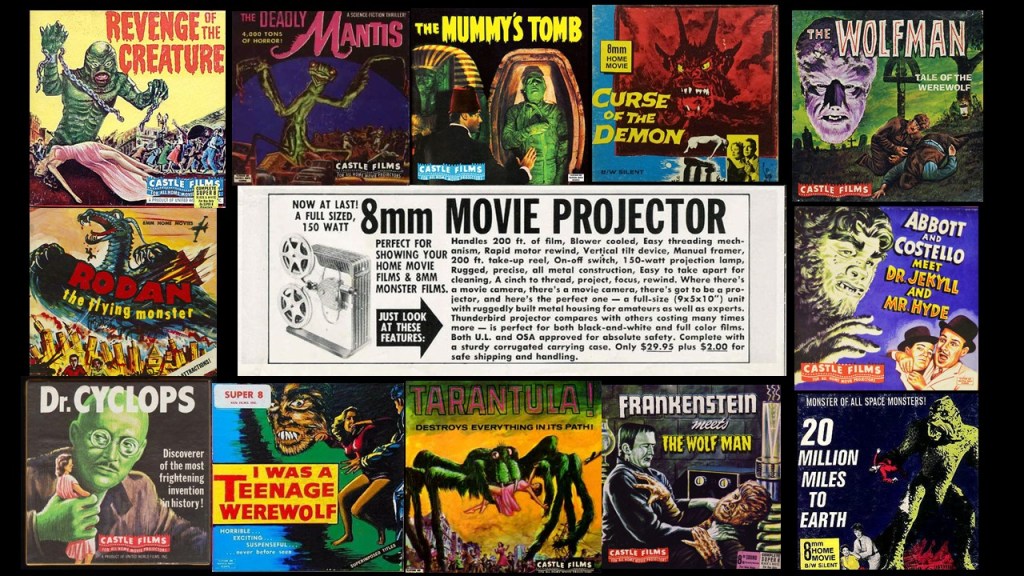
When I was a kid, we didn’t have DVDs or digital streaming like Netflix or Hulu. If you wanted to watch a monster movie – outside of going to the movie theater – you had two ways of doing it. You either stayed up late and watched the local creature feature (in the area I grew up in it was Sir Cecil Creepe on Nashville’s Channel 4) or you begged your folks to buy you a cheap 8mm or Super 8 movie projector. I indulged in both, but buying your own little slices of horror cinema and manually threading them through the spools from reel to reel made it feel like big deal to a kid of nine or ten. You pretty much had two ways to watch them; the small reels (3 and a half minutes) and big reels (15 minutes). Never mind that they were only snippets of the best scenes and had no sound whatsoever, they were just fun to own and watch. When we wanted our monster fix, we’d throw a blanket over the bedroom window and watch Godzilla stomp Tokyo or Frankenstein’s Monster and the Wolfman battle it out on the bedroom wall.

Rubber Monster Masks

When you reached your preteen years, you normally wanted to ditch the Costumes in a Box and enter the big leagues. And that meant over-the-head rubber monster masks. There was just something about slipping the gaudy, gruesome second skins over your youthful head and breathing in that heady odor of latex rubber that told you that you had entered a higher realm of Halloween indulgence. Yes, you couldn’t half see through the off-kilter eyeholes and you sweated like a sinner in church after only a few minutes, but to wear the leering visage of a hairy werewolf or a rotting zombie gave you a thrill that the children’s hard-shell masks never could. Most of us hardcore monster enthusiasts yearned to own the big daddy of all horror disguises; the Don Post latex monster masks. We would gawk at that full-page advertisement in the back of Famous Monsters magazine and dream of owning a full-head mask of the Creature of the Black Lagoon or the Wolfman or Mr. Hyde. And, of course, if we ever managed to get the face masks, we would have to have the matching hands as well. Sadly, very few of us ever reached that level of monster mask ownership. At $39.99 per mask, it was a bit steep for a twelve-year-old’s piddling allowance.

Horror Comics

When I was around ten or eleven, I started collecting comics. I always had a thing for Batman and the Flash and, when I got into Marvel, the Hulk and Spiderman was my favs. But from the beginning, I always bought the horror comics. I reckon it was my natural inclination toward the weird and macabre that drew me to comic books like DC’s House of Mystery, The Unexpected, and Swamp Thing, as well as Marvel’s Werewolf by Night, Tomb of Dracula, and Man Thing. I was too young to have enjoyed the ultra-bizarre (and “gasp” potentially immoral) tales of the EC Comics of the 50s, but, in a strange way, I still did. While my mom was pregnant with me in 1959, she came across a large stack of EC comics in the dusty attic of a house she was renting (while my Dad was serving in Korea and Germany). Throughout her pregnancy, she read horrifying tales of decaying corpses and flesh-eating monsters from such comics as Tales from the Crypt and Vault of Horror; feeding me a steady diet of tantalizing terror as I floated in the darkness of the womb. You may say that had nothing to do with my inherent love of horror, but I beg to differ.

Aurora Monster Models

One of my favorite hobbies (around Halloween or otherwise) was assembling and painting Aurora monster models. It was always fun to head to the toy section of Sears (we bought everything at Sears back then), find your favorite monster in a box, then head back home and start bringing that plastic kit to life with airplane glue and those little glass jars of Testors model paint. I started my model-building in the early 70s, around the time Aurora released their glow-in-the dark line. I was always a stickler for detail, so I never used the glow heads or hands for the actual models, saving them for those little midget monsters you could build with the surplus parts you had left over. My favorites of the Aurora models were the Creature, King Kong, and Dr. Jekyll and Mr. Hyde (although the latter was of a much smaller scale than the others, along with the Witch). Aurora also put out Monster Scenes, which you could use to build your own mad scientist lab and torture chamber, featuring Dr. Deadly, the Frankenstein Monster, the Victim, and the scantily clad Vampirella.

Glow Fangs, Vampire Blood, & Scar Stuff

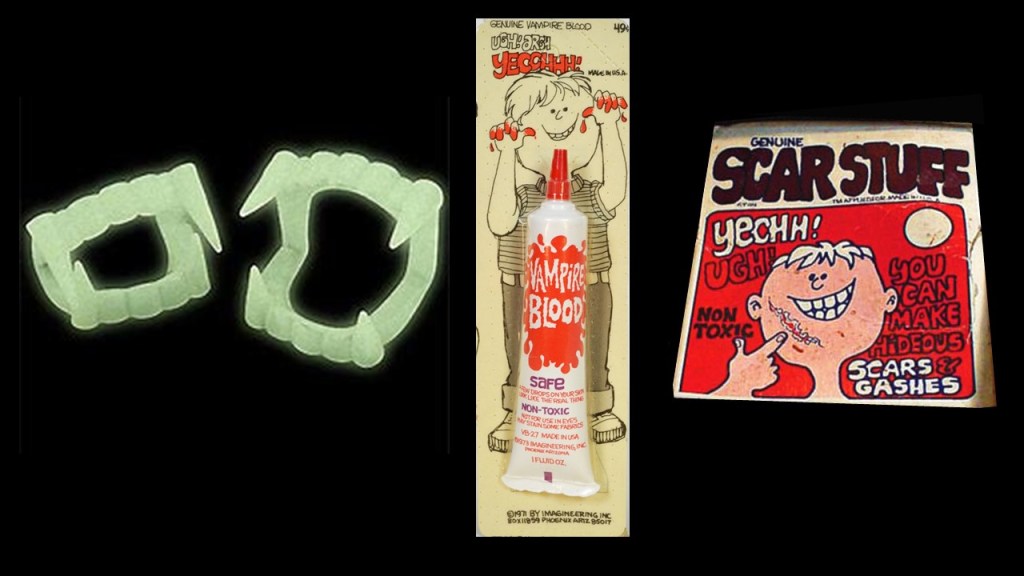
Eventually, there would come the Halloween when you wanted to do some experimentation with your costume for that year. With me it was Count Dracula (I read the novel while in middle school and was completely obsessed with it!). Mirroring the dread Count (pun intended!) required some improvisation that a mere rubber mask couldn’t pull off. So, I sojourned to the local Walgreens and acquired the traditional pair of glow-in-the-dark vampire fangs, as well as a tube of Vampire Blood and, for good measure, a tiny jar of Scar Stuff. Vampire Blood and Scar Stuff came out in the early 70s and, although they produced authentic appearing trickles of blood from the corners of your mouth and ghoulish scars and abrasions, they were a Mom’s nightmare around the Halloween season. It was nearly impossible to get Vampire Blood out of clothing and Scar Stuff (which basically had the consistency of flesh-colored snot) contained enough grease to stain clothes and furniture upholstery equally well. I didn’t have a proper Dracula cape for my Halloween ensemble, but my Dad have an old black overcoat that worked quite nicely. I also wore my Sunday go-to-church shirt and tie to give my Count a little class, although my clip-on did bear a weirdly-colored burgundy & olive green paisley pattern in the 1970s mod style of that period.

Monster Magazines

My #1 source for a solid monster fix was undoubtedly Famous Monsters of Filmland magazine, edited by Forrest J. Ackerman (or simply “Uncle Forry” to us creature-loving kids). Uncle Forry possessed a tremendous love and appreciation for horror and science fiction cinema; one that extended from the silent era of The Phantom of the Opera and Metropolis, through the 30s, 40s, and 50s heyday of the Universal Monster movies, and on into the 60s and 70s era of the Hammer horror films, the Planet of the Apes phenomena , and even Star Wars. I had the pleasure of actually meeting Uncle Forry at the first World Horror Convention (he was hanging out in the monster model room with none other than Robert “Psycho” Bloch) and found my childhood hero to be both congenial and humble. Other Warren Publishing magazines like Creepy, Eerie, and Vampirella where on the newsstands for the taking, but unfortunately my Mom prohibited me from partaking of them, claiming that they were much too “adult” compared to my monthly purchase of the latest Famous Monsters.

Halloween Candy

And last – but certainly not least – there was the candy! The decorations, costumes, and activities may have embellished All Hallows Eve, but the hunting and procuring of sugary delights was always the main objective. Whether we took a brown grocery bag Mom brought home from Kroger’s or A&P, or the seasonal Brach’s Candy trick-or-treat bags given away at the big candy counter at – you guessed it – Sears, it was a requirement to have a sturdy-enough receptacle to haul at least five pounds of candy home in. Some kids toted those plastic pumpkins around, but they filled up quickly and, by the time you’d done two or three streets, it was like toting a heavy, orange bowling ball around. When you got home, you would slip into your pajamas and dump that night’s Halloween haul onto the kitchen table or the living room carpet and begin the sorting process. Miniature candy bars went into one pile (Snickers, Baby Ruth, Almond Joys, Reeces’ cups, etc), suckers and hard candy into another, and the novelty items in a third (Razzles, Bottle Caps, and the now politically incorrect candy cigarettes and bubble gum cigars). Oh, and there was always a fourth pile of odd and questionable treats that Mom had to inspect before giving the okay or tossing them in the trash; things like popcorn balls, apples, religious tracts, and even little tubes of toothpaste and tooth brushes. Every now and then, we would be delighted to find some pennies, dimes, or quarters in our bags; tossed there by some unprepared homeowner who had either run out of candy early or completely forgotten it was Halloween in the first place. But, sadly, those monetary treats were few and far between.

So, there you have it: Ol’ Ron’s top Halloween things of the 1960s and 70s. These days I enjoy Halloween and trick-or-treating through my own kids, but I still cherish those fun, carefree days of preparing for and indulging in the most ghoulish holiday of the year.

Born and bred in Tennessee, Ronald Kelly is an author of Southern-fried horror fiction with fifteen novels, eight short story collections, and a Grammy-nominated audio collection to his credit. Influenced by such writers as Stephen King, Robert McCammon, Joe R. Lansdale, and Manly Wade Wellman, Kelly sets his tales of rural darkness in the hills and hollows of his native state. His published works include Undertaker’s Moon, Fear, Blood Kin, Hell Hollow, The Dark’Un, Hindsight, Restless Shadows, After the Burn, Timber Gray, Mr. Glow-Bones & Other Halloween Tales, Dark Dixie, Midnight Grinding & Other Twilight Terrors, The Sick Stuff, More Sick Stuff, and The Buzzard Zone. He lives in a backwoods hollow in Brush Creek, Tennessee with his wife and young’uns.

Fear

It was a legend in Fear County… a hideous, flesh-eating creature – part snake, part earthbound demon – that feasted on the blood of innocent children in the cold black heart of the Tennessee backwoods.

But ten-year-old Jeb Sweeny knows the horrible stories are true. His best friend Mandy just up and disappeared. He also knows that no one has ever had the courage to go after the monster and put an end to its raging, bestial hunger. Until now.

But Evil is well guarded. And for young Jeb Sweeny, who is about to cross over into the forbidden land of Fear County and the lair of the unknown, passage through the gates of Hell comes with a terrible price. Everlasting… FEAR!

Mister Glow-Bones & Other Halloween Tales

Halloween is more than a holiday; more than a fun time of candy and costumes for the young. It is inoculated into our very being at an early age and there it remains. As we grow old, it grows dormant… but it is still there. For the lucky ones, such as us, it emerges every year, like a reanimated corpse digging its way out of graveyard earth to shamble across our souls. And we rejoice… oh, if we are the fortunate ones, we most certainly rejoice.

So turn these pages and celebrate our heritage. Blow the dust off the rubber mask in the attic and hang the glow-in-the-dark skeleton upon the door. Light the hollowed head of the butchered pumpkin and string the faux cobweb from every corner and eave.

It’s Halloween once again. Shed your adult skin with serpentine glee and walk the blustery, October streets of long years past. And, most of all, watch out for misplaced steps in the darkness and the things that lurk, unseen, in the shadows in-between.

Stories included in this collection:
Mister Glow-Bones
The Outhouse
Billy’s Mask
Pins & Needles
Black Harvest
Pelingrad’s Pit
Mister Mack & the Monster Mobile
The Halloween Train
The Candy in the Ditch Gang
Halloweens: Past & Present
Monsters in a Box

The Buzzard Zone

When the buzzards took flight, Levi Hobbs knew his family’s only hope of survival was to escape. They were coming, the Biters, the dead, risen as zombies, infested by parasites and transformed into shambling, ravenous monsters. As the family flees their home in the Smoky Mountains, they head eastward to the Carolinas in search of refuge. As the buzzards on their trail grow thicker, the Zone widens, and the Biters become hungrier and more hostile. The Hobbs family realizes there is only one place left to go, one place to make a final stand… and time is running out.

Undertaker’s Moon

As the residents of Old Hickory, as well as the local police, begin to fall victim to an unknown evil, four individuals—the town nerd, a high school jock, a widowed gunsith, and a mysterious transient from a distant shore—find themselves facing what could possibly be a hellish lycanthrope from ancient Ireland… the legendary Arget Bethir… the Silver Beast.

Halloween Extravaganza: INTERVIEW: Ronald Kelly

Meghan: Hi, Ronald! Welcome back! And welcome to our new home, Meghan’s House of Books. It’s been awhile since we sat down together. What’s been going on since we last spoke?

Ronald Kelly: I’ve been busy with one writing project or another. I finally finished my Southern-fried zombie novel, The Buzzard Zone, after a long bout of writer’s block. I’ve been working with various publishers, mostly Thunderstorm Books, Sinister Grin Press, and Crossroad Press. Thunderstorm put out a hardcover edition of More Sick Stuff a few months ago, the follow-up to my extreme horror collection, The Sick Stuff. More Sick Stuff is sort of like the bigger, nastier sibling of the original Sick Stuff.

Meghan: Who are you outside of writing?

Ronald Kelly: I reckon you could say that I wear a lot of hats outside of the horror genre. I’m a faithful husband (going on 29 years now) and papa to three wonderful young’uns. I work in the quality department for PPG; one of the biggest paint companies on the globe. And I’m a devout Christian – the proverbial Southern Baptist – which seems downright odd, considering the sort of stuff I write.

Meghan: How do you feel about friends and close relatives reading your work?

Ronald Kelly: Well, to tell the truth, they don’t. The folks I grew up with, those I live around now and work with, they know that I’m a writer and know the kind of genre I write in, but they don’t make a big deal about it… and neither do I. My wife has read a few of my less intense books in the past, but she’s more of an Amish Romance fan than the blood and gore type. My youngest, Bubba, desperately wants to read my books, but I won’t let him until he gets on into his teens (he’s eleven now). So, basically, my writing life and personal life are two separate sides of the same coin.

Meghan: Is being a writer a gift or a curse?

Ronald Kelly: I consider it a gift. If you have a natural ability to take words and create memorable characters and build entire words from nothing more than your imagination, I believe you should embrace it and share it with others. I come from a long line of Southern storytellers, so it sort of came to me naturally. I never had any formal training – heck, I never even went to college – but listening to my mother and grandmother tell ghost stories and pass on family history during my childhood instilled in me a desire to carry on the tradition, albeit in the written form. So, yes, I’d definitely say the ability to write is a blessing. The only time it seems like a curse is when you’re facing a deadline and you feel forced to write. That’s when it feels like walking a rocky road in your bare feet.

Meghan: How has your environment and upbringing colored your writing?

Ronald Kelly: I was born and raised in the South – in central Tennessee – so my love of that region has always carried over into my novels and short stories. The South has a particular aura to it; partly welcoming, partly threatening. It can be the friendliest and most inviting place on the face of the earth, but there has also been a lot of darkness and depravity committed in its hills and hollows. Racism in the region is not nearly as prevalent as it was thirty or forty years ago, but when it was, that was the stuff of horror tales. Folks have this idea of the South being backwards and ignorant, with an underlying meanness to it. For the most part, that’s not the way it is at all. But I’d be lying if I said I didn’t know at least a few folks down here that make the raping hillbillies in Deliverance look like Sunday School teachers.

Meghan: What’s the strangest thing you have ever had to research for your books?

Ronald Kelly: Just the nature of this genre gives you the opportunity to Google stuff that everyday folks simply don’t consider on a day-to-day basis. When I wrote Father’s Little Helper (Twelve Gauge) I did a lot of research on mass murderers and serial killers, which is why the book probably went in a dark and violent direction I didn’t originally intend for it to. It was interesting to research Tasmanian Devils for my second novel, Pitfall. They are vicious little critters, but I sort of expounded on their temperament for the sake of the storyline and turned them into a ravenous pack of land piranhas. And I’m always delving into Southern folklore for one story or another. I grew up with a lot of backwoods superstition, but there is always some that I come across that I never heard of before.

Meghan: Which do you find the hardest to write: the beginning, the middle, or the end?

Ronald Kelly: Definitely the middle. I always have a very clear image of how a novel or story will begin and end, but the middle is usually unknown territory. Sometimes I go in with a certain chain of events firmly in mind, but I find out that absolutely nothing is written in stone. Sometimes directions change when it comes to plot and characters. If you force your will on a storyline, it usually shows. It’s best to go with the flow when a story evolves into something that you didn’t originally intend it to be.

Meghan: Do you outline? Do you start with characters or plot? Do you just sit down and start writing? What works best for you?

Ronald Kelly: In my earlier years, when I wrote for Zebra Books, I did adhere to a strict outline, mainly because the publisher required it, for approval and marketing purposes. But now I simply sit down and start writing and let my imagination take the reins. Oh, I have an idea of where I want to go and I generally map out my characters and their personalities beforehand, but that doesn’t mean the story is going to turn out, word for word, like I imagined from the starting gate.

Meghan: What do you do when characters don’t follow the outline/plan?

Ronald Kelly: Characters can turn out to be downright stubborn folks; contrary with minds of their own. I think that’s a good thing. If a character is not multi-dimensional it’s apparent; they’re like puppets and they come across as unconvincing and lacking of humanity and natural motivation. If a character really has heart and soul, they act accordingly and react to literary situations in their own personal ways. The same goes for the antagonists. Their utter lack of heart and soul is what puts the horror into a storyline and gives the protagonist his or her fire and determination to do what is necessary to bring the conflict or evil to its just end.

Meghan: What do you do to motivate yourself to sit down and write?

Ronald Kelly: When I was a younger man and fighting tooth and nail to get published and stay published, the motivation was a natural thing. I knew to become a legitimate author I had to write. Now that I’m older, the motivation and discipline to sit down on a regular basis isn’t quite as strong and I’m okay with that. When I started out thirty years ago, I was a single man and there was only eating and sleeping and writing. Getting published was my sole objective. Now that I have my family and my faith, writing has sort of taken a backseat to a lot of other things. I still like to write and enjoy it, but on the list of things that I consider myself to be, being a writer is four or five notches down from where it once was.

Meghan: Are you an avid reader?

Ronald Kelly: I used to be a voracious reader. I read obsessively during my teenage and young adult years, even into middle age. I don’t read nearly as much as I once did. Some of that had to do with my eyes; I just recently had cataract surgery in both eyes, but before then it was simply uncomfortable to sit down and try to read the printed page, and it sort of extinguished my desire to read for a while. Now that my vision has been corrected, I’m hoping to sit back down and learn to enjoy reading again.

Meghan: What kind of books do you absolutely love to read?

Ronald Kelly: Horror, of course, and I like science fiction if it’s down-to-earth (is that an oxymoron?). You know, like Ray Bradbury and some of Asimov’s work. I’m a big western fan and have done three novels in that genre, although two were ghost-written for the Jake Logan series in the early 90s. I’ve always been a big history buff, so I read a lot of non-fiction about American history, mostly the Civil War and the Old West.

Meghan: How do you feel about movies based on books?

Ronald Kelly: I believe more movies should be made from literary works and that studios shouldn’t just remake or reinvent films that have already been done. That’s just pure laziness on their part. I’m seeing a lot of encouraging book-to-movie works come from Netflix lately, with Malerman’s Bird Box and Lebbon’s The Silence, and they’re making some faithful King adaptations, too.

Several months ago, I received interest from a director about doing a movie of one of my novels, so hopefully there could be a movie adaptation of one my works sometime in the future. I’m keeping my fingers crossed!

Meghan: Have you ever killed a main character?

Ronald Kelly: Lordy Mercy, yes! I’d say, by the last chapter of an Ronald Kelly novel, at least one or two of my main characters meet an emotional and tragic end… sometimes more. I believe four or five bit the dust in The Buzzard Zone. When you watch a show like The Walking Dead and a main character dies or gets turned into a zombie, I think it really grabs the viewer and affects them in a very emotional way. The same goes for characters in books and short stories. The reader becomes invested in a character they like – or even love – and when they die, it’s like a death in the family. That doesn’t particularly make it feel-good fiction, but then horror never promises to offer a happy ending.

Meghan: Do you enjoy making your characters suffer?

Ronald Kelly: No, not necessarily. Maybe on an emotional level… to motivate a character to move past the paralysis of horror and fear and fight the evil that has brought them to that point. I don’t like to depict my characters being tortured, raped, or humiliated (although I can’t say that I’ve never done that before in a story). I think emotional suffering is much more potent.

Meghan: What’s the weirdest character concept that you’ve ever come up with?

Ronald Kelly: I would have to say The Dark’Un. The concept of a changeling creature that could physically morph into any person or animal it observes, be it face-to-face, or through literature or television, was extremely intriguing to me. During the course of the novel (which was initially titled The Dark’Un, but retitled Something Out There during my stint at Zebra) the creature turns into everything from the Frankenstein Monster to a ninja to a gun-blazing sheriff to several different types of dinosaurs. The book melds horror, science-fiction, and a healthy dose of fantasy, which gave Zebra fits, because they didn’t quite know how to classify it, genre-wise.

Meghan: What’s the best piece of feedback you’ve ever received? What’s the worst?

Ronald Kelly: I was fortunate enough to receive some very sound advice from Joe Lansdale when I was first starting out in the business. A couple of wise suggestions from Joe: 1) During dialogue, make a habit of using plain old “said” when a character speaks. Don’t try to embellish too much with words like “exclaimed” or “ruminated”. Also 2) don’t drive yourself crazy worrying about becoming a full-time writer. If you’re writing full time and you have overdue bills and no health insurance, your anxiety will get in the way and it will show in your prose. So, if you must depend on steady employment while you write and publish, that’s an okay thing.

The worst bit of advice I ever received was from a former agent. When Kensington shut down the Zebra horror line and put me out of a job, my agent told me to write anything except horror fiction. I tried several other genres and, when I didn’t have any luck, I quit writing completely for ten years. If I’d just stuck with it, there would be a decade worth of RK horror books for the fans to read.

Meghan: What do your fans mean to you?

Ronald Kelly: My fans have always meant a great deal to me. Of course, back in my mass market paperback days, you wondered whether you actual had any fans or not. Zebra was always very slow about forwarding fan mail to their writers and I think maybe I got five letter the entire six years I wrote for them. That’s mainly what drives a writer and gives him or her the incentive to continue; knowing that folks are reading your work and enjoying it. Now days, social media puts you in direct contact with your fanbase and that’s wonderful. So many of my fans have become genuine friends through social meeting places like Facebook, Twitter, and Goodreads.

Meghan: If you could steal one character from another author and make them yours, who would it be and why?

RK: That’s an interesting question. For a protagonist, I’d say Atticus Finch from Harper Lee’s To Kill a Mockingbird. That was the novel that first made me want to become a writer, when I read it at age fourteen. As for a truly evil antagonist, it would have to be Pennywise from Stephen King’s IT. He – or it – is a truly classic villain. Just mention the name and everyone knows who you’re talking about, including those who have never read the book or watched any of the movies.

Meghan: If you could write the next book in a series, which one would it be, and what would you make the book about?

Ronald Kelly: If you’re talking about a series created by someone other than myself, I’d say it would be a continuation of L. Frank Baum’s The Wizard of Oz. Maybe do a truly dark and disturbing version with the original characters; a truly nightmarish journey through the blacker heart of Oz. As for a series of my own making, I’ve always wanted to do a weird horror western series in which the protagonist battles a different monster in each segment. I actual pitched such a series to Berkley in the mid-90s, but it never materialized. I’m seriously thinking about tackling a series like that in a year or two.

Meghan: If you could write a collaboration with another author, who would it be and what would you write about?

Ronald Kelly: I’ve never been very big on collaborating. I tried it once and lost a spot in a very prestigious anthology because my writing style and that of the other author simply didn’t gel. I prefer to be a one-man show. That might sound a little selfish, but I work better working with my own ideas and characters. If I could collaborate with someone successfully, it would probably be folks like Brian Keene, Joe Lansdale, or Robert McCammon. I think it would be a blast to work with any one of them.

Meghan: What can we expect from you in the future?

Robert Kelly: I’ve got a couple of new short story collections in the works, and I’d like to do a sequel to my epic novel, Fear, sometime in the future. I owe a book to Cemetery Dance that got lost in a hard drive crash several years, so I’ll finally be rewriting that soon. And I’d like to do that weird western series I mentioned before.

Meghan: Where can we find you?

Ronald Kelly: You can check out my website and my blog, Southern-Fried and Horrified. And, of course, my author pages at Amazon and Goodreads.

Meghan: Do you have any closing words for your fans or anything you’d like to say that we didn’t get to cover in this interview or the last?

Ronald Kelly: I’d just like to let my loyal fans know that I appreciate and cherish them very much. Thanks for sticking with me through thick and thin; both during the Zebra years and when I came back to the horror genre in 2006. It really meant a lot. And I’d like to thank my future readers, as well. I hope you give Ol Ron’s brand of Southern-fried fiction a chance and that you enjoy the down-home storytelling it offers. And, of course, to all, I wish Very Happy Nightmares!

Born and bred in Tennessee, Ronald Kelly is an author of Southern-fried horror fiction with fifteen novels, eight short story collections, and a Grammy-nominated audio collection to his credit. Influenced by such writers as Stephen King, Robert McCammon, Joe R. Lansdale, and Manly Wade Wellman, Kelly sets his tales of rural darkness in the hills and hollows of his native state. His published works include Undertaker’s Moon, Fear, Blood Kin, Hell Hollow, The Dark’Un, Hindsight, Restless Shadows, After the Burn, Timber Gray, Mr. Glow-Bones & Other Halloween Tales, Dark Dixie, Midnight Grinding & Other Twilight Terrors, The Sick Stuff, More Sick Stuff, and The Buzzard Zone. He lives in a backwoods hollow in Brush Creek, Tennessee with his wife and young’uns.

Fear

It was a legend in Fear County… a hideous, flesh-eating creature – part snake, part earthbound demon – that feasted on the blood of innocent children in the cold black heart of the Tennessee backwoods.

But ten-year-old Jeb Sweeny knows the horrible stories are true. His best friend Mandy just up and disappeared. He also knows that no one has ever had the courage to go after the monster and put an end to its raging, bestial hunger. Until now.

But Evil is well guarded. And for young Jeb Sweeny, who is about to cross over into the forbidden land of Fear County and the lair of the unknown, passage through the gates of Hell comes with a terrible price. Everlasting… FEAR!

Mister Glow-Bones & Other Halloween Tales

Halloween is more than a holiday; more than a fun time of candy and costumes for the young. It is inoculated into our very being at an early age and there it remains. As we grow old, it grows dormant… but it is still there. For the lucky ones, such as us, it emerges every year, like a reanimated corpse digging its way out of graveyard earth to shamble across our souls. And we rejoice… oh, if we are the fortunate ones, we most certainly rejoice.

So turn these pages and celebrate our heritage. Blow the dust off the rubber mask in the attic and hang the glow-in-the-dark skeleton upon the door. Light the hollowed head of the butchered pumpkin and string the faux cobweb from every corner and eave.

It’s Halloween once again. Shed your adult skin with serpentine glee and walk the blustery, October streets of long years past. And, most of all, watch out for misplaced steps in the darkness and the things that lurk, unseen, in the shadows in-between.

Stories included in this collection:
Mister Glow-Bones
The Outhouse
Billy’s Mask
Pins & Needles
Black Harvest
Pelingrad’s Pit
Mister Mack & the Monster Mobile
The Halloween Train
The Candy in the Ditch Gang
Halloweens: Past & Present
Monsters in a Box

The Buzzard Zone

When the buzzards took flight, Levi Hobbs knew his family’s only hope of survival was to escape. They were coming, the Biters, the dead, risen as zombies, infested by parasites and transformed into shambling, ravenous monsters. As the family flees their home in the Smoky Mountains, they head eastward to the Carolinas in search of refuge. As the buzzards on their trail grow thicker, the Zone widens, and the Biters become hungrier and more hostile. The Hobbs family realizes there is only one place left to go, one place to make a final stand… and time is running out.

Undertaker’s Moon

As the residents of Old Hickory, as well as the local police, begin to fall victim to an unknown evil, four individuals—the town nerd, a high school jock, a widowed gunsith, and a mysterious transient from a distant shore—find themselves facing what could possibly be a hellish lycanthrope from ancient Ireland… the legendary Arget Bethir… the Silver Beast.