Meghan: Hi Lucy! Welcome to this year’s Halloween Extravaganza. What is your favorite part of Halloween?
Lucy: Right now, it’s baking. Every Sunday, my mom and I bake together over FaceTime. From mid-September to the end of October, we’re baking exclusively Halloween-themed treats. I get a lot of inspiration from the baking shows on the Food Network.
Meghan: What is your favorite Halloween tradition?
Lucy: When I was a kid, we’d have huge Halloween parties. It would start in September when the Oriental Trading Company catalog arrived. My brother and two sisters and I would sit down with our mom and create an order for party favors and decorations. Weeks in advance, we’d start planning all the attractions. Putting macabre labels on spice mixes for the witches brew in the shed. Collecting supplies for fortune-telling in my sister’s room. I remember scouring DC-area magic stores one year trying to find an appropriate crystal ball. We never did, and my dad wound up mounting a glass orb onto a stocky cylinder. My mom had new ideas for the party every year, but some of the staples were the kids wrapping each other in toilet paper as mummies and eating small, powdered donuts hanging from a tree branch without using our hands. My dad hooked up a trailer to his lawn tractor, filled it with hay, and towed us around the backyard. The trailer would frequently detach, leaving kids at an odd angle in the yard, and my dad would just keep driving as he couldn’t hear the screams over the sound of the lawn mower.
But the best part was the haunted house. Since I’m the oldest, I was in charge of transforming the garage into a room of terrors and leading age-appropriate tours for the younger kids. My parents used the garage for storage, so we used whatever we found in there. A recurring character was Harold, my dad’s jeans and flannel shirt stuffed with pillows and newspaper that sat in an old rocking chair. Two female salsa dancer pinatas, a relic from my third birthday party, hung from the ceiling by their necks. Someone would always be waiting outside, sticking a foot through the cat door, then brandishing a leaf blower to terrify the kids who thought the nightmare was over when they had left the garage.
A couple of Halloweens ago, I carved an Ace Frehley pumpkin. It’ll be Gene Simmons this year.
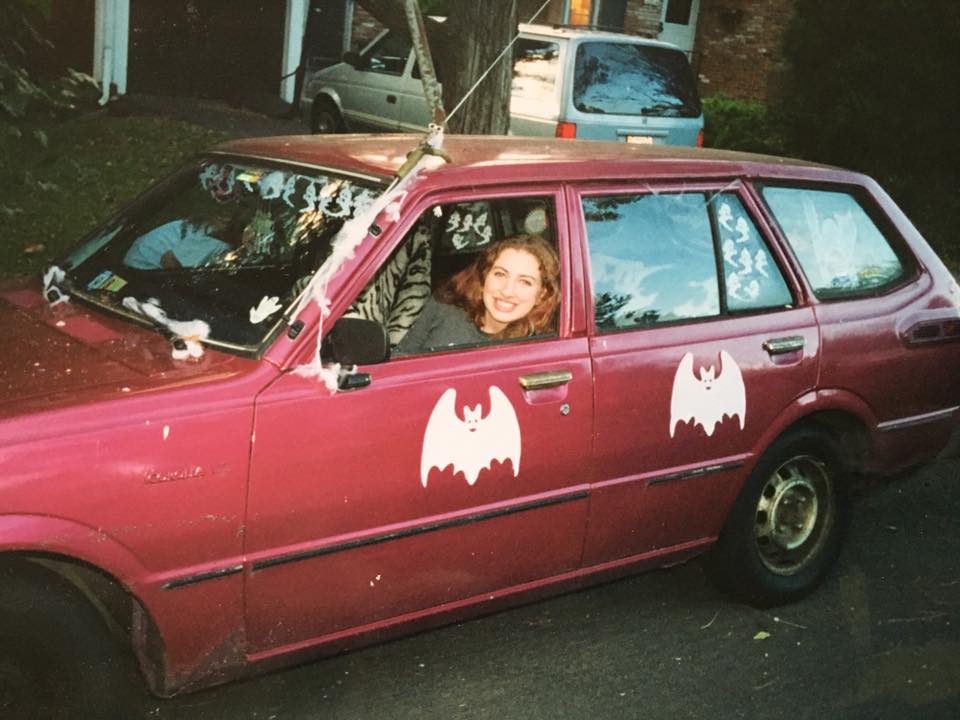
My first car, decorated for Halloween 2000, my senior year of high school. It was always magenta.
Meghan: If Halloween is your favorite holiday (or even second favorite holiday), why?
Lucy: The memories. Halloween was a big deal to my family when I was growing up. We’d take long drives through the changing leaves to far-off farms in search of pumpkins. We never had packaged costumes, always ones that we’d construct from seemingly disparate items around the house. When I was in kindergarten, my mom turned dining room chair cushions into turtle shells so my brother and I could dress as our favorite Teenage Mutant Ninja Turtles. One year, we put stuffing in long underwear to turn my little sister into the Stay Puft Marshmallow Man.
Two years ago, my mom and I went up to Salem for the weekend a couple weeks before Halloween. We did a ghost tour, an interactive Rocky Horror, and a bunch of of witch stuff. It was so much fun. We keep talking about how we need to go back. It’s my most recent wonderful Halloween memory.
Meghan: What are you superstitious about?
Lucy: Five years ago, I broke my face after flying off a set of gymnastics rings at the gym. I will not use that particular set of rings again. Unfortunately, the owners just rearranged the gym so I don’t know where that set is. I have to accept that it was not the rings’ fault…
Meghan: What/who is your favorite horror monster or villain?
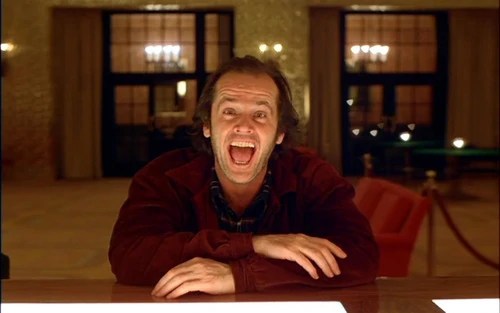
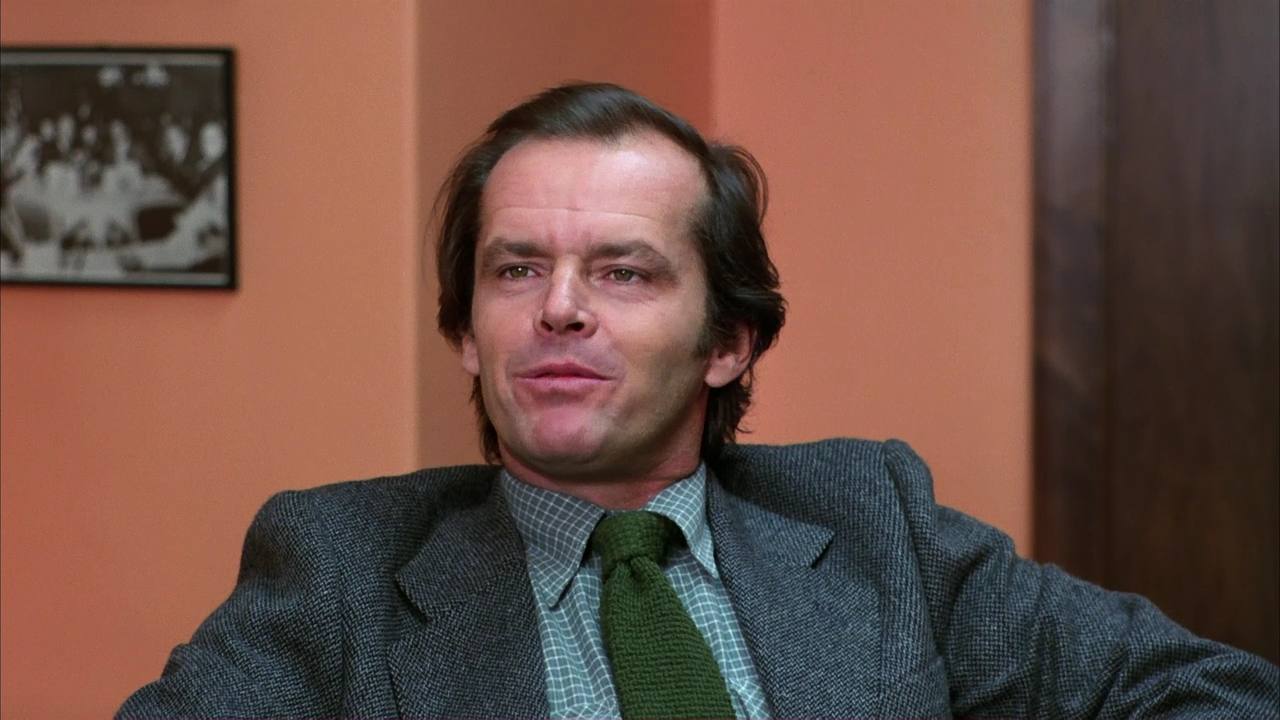
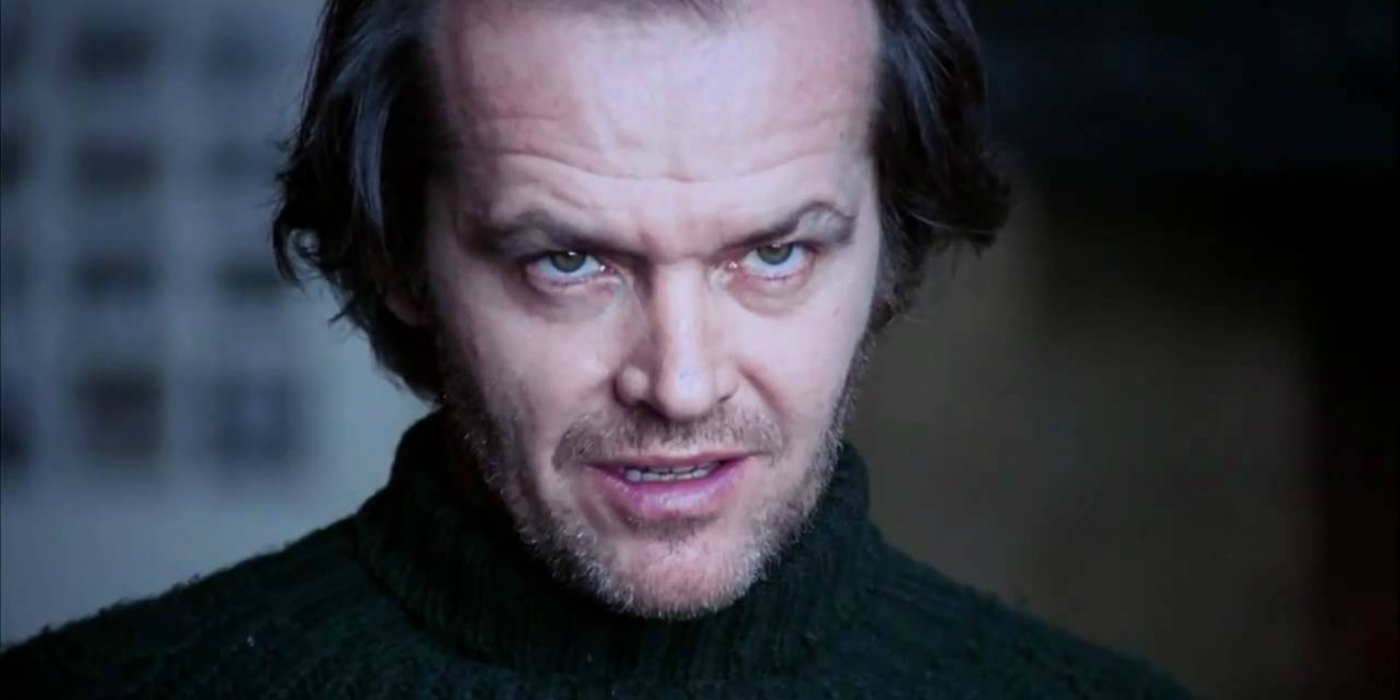
Lucy: Jack Torrance. Several years ago, I was the only copywriter at a busy ad agency and was assigned about 17 hours of work in each eight-hour day. In a meeting with the agency president and the project managers who were constantly haranguing me about status updates, I told them how every time they interrupted me, they broke my concentration. It’s like at the gym. I was cooled down and needed to warm back up again to get back in the creative zone. So, their constant interruptions were slowing me down. Nearly a year after I was fired, I was watching The Shining (as I do every Halloween) and realized Jack gave almost the identical speech/rant to Wendy — with a lot more profanity. The Shining has always been my favorite horror movie, but I got a whole new appreciation for the horror of stress-induced psychosis.
Meghan: Which unsolved murder fascinates you the most?
Lucy: Jack the Ripper. I like all the theories and find it interesting how many Ripperologists seem convinced that it has to be a notable person who committed the murders when the vast majority of known serial killers were losers.
Meghan: Which urban legend scares you the most?
Lucy: The ones with the spiders and bugs burrowing under skin. That sounds like it could actually happen.
Meghan: Who is your favorite serial killer and why?
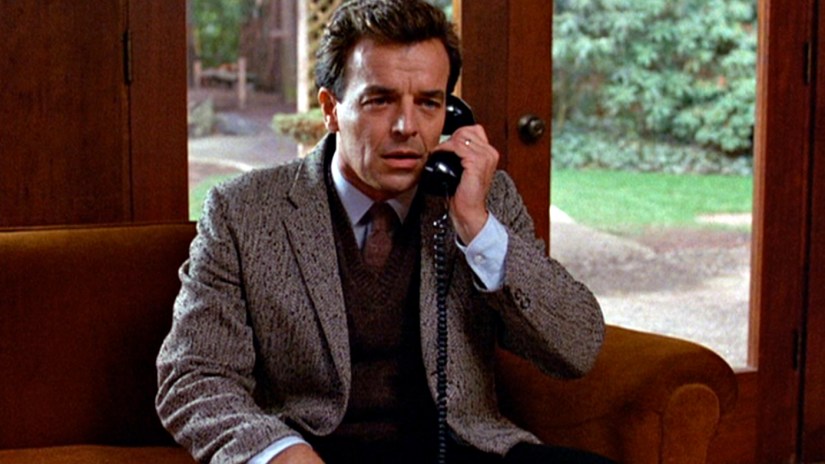
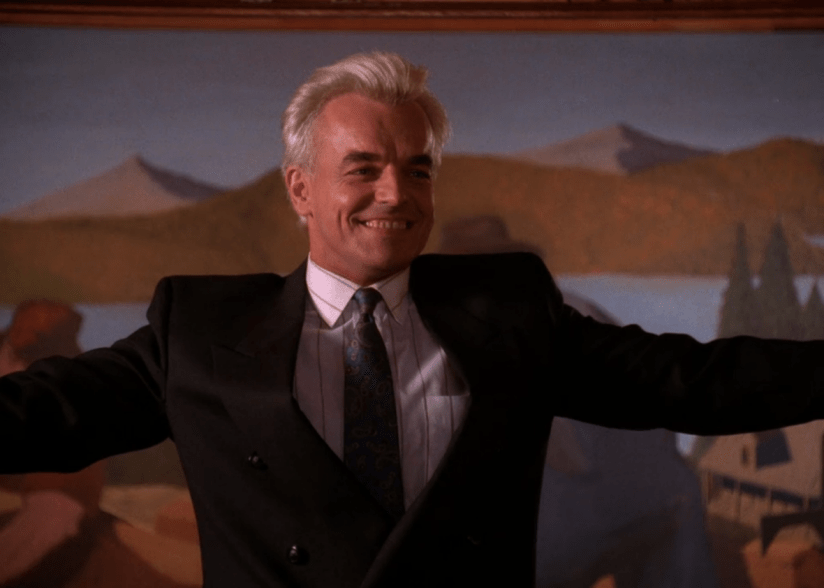
Lucy: SPOILER ALERT. Leland Palmer. The singing, the crying, the dancing, and the emergence of BOB when he gets locked in the cell. And the scene where it’s revealed that Leland is the killer — one of the best things ever on TV. I was too young to watch Twin Peaks when it aired, but I can’t imagine many people saw that one coming.
Meghan: How old were you when you saw your first horror movie? How old were you when you read your first horror book?
Lucy: I remember reading Lois Duncan’s Stranger with My Face when I was 10 or 11. I loved it and was hooked on her books after that. My first horror movie was Psycho, but I can’t remember how old I was. I saw Scream as soon as it came out on VHS when I was 13. That was my first modern slasher flick. I memorized it. A few years later I won a tickets to a premiere screening of Scary Movie for calling into a local rock radio station and completing a line from it.
Meghan: Which horror novel unsettled you the most?
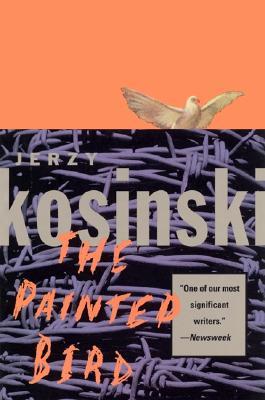
Lucy: The Painted Bird is more disturbing than any horror book I’ve ever read.
Meghan: Which horror movie scarred you for life?
Lucy: For some reason in 6th grade band class we watched the Twilight Zone movie. I remember getting all freaked out by the sister with no mouth. That gave me nightmares for a couple days. We also watched the original It in that class. That one left no impression…
Meghan: What is your favorite Halloween costume?
Lucy: Sharon Tate. Halloween 2007 when I was 24. I wore a blood-soaked nightgown over a fake pregnant belly though which I stuck a plastic knife.
Meghan: What is your favorite Halloween-themed song?
Lucy: “Song of Joy” by Nick Cave. Spooky, dark, and uses one of my favorite literary devices, the unreliable narrator.
Meghan: What is your favorite Halloween candy or treat? What is your most disappointing?
Lucy: I’m one of those crazy people who love candy corn and mellowcreme pumpkins. But Indian corn is disappointing. Something about that fake chocolate flavor just does not do it for me.
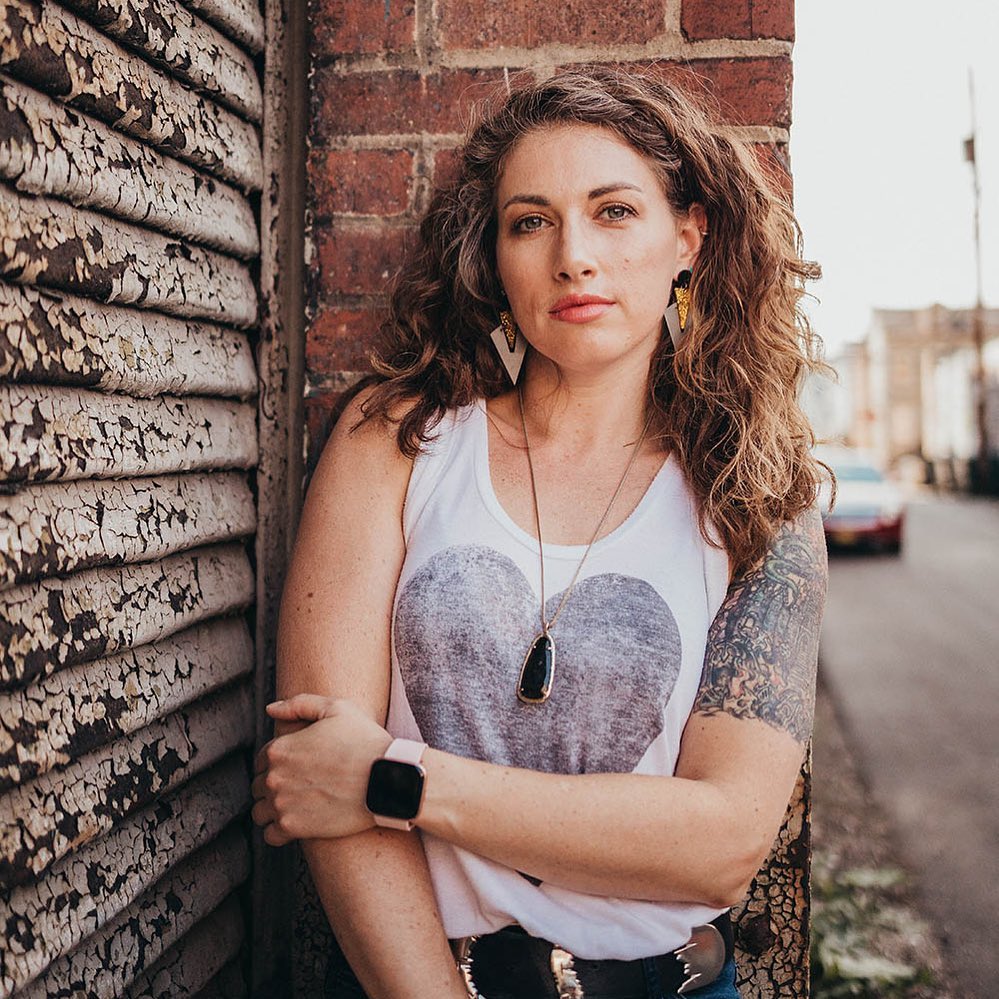
Boo-graphy: Lucy Leitner is the author of horror-comedy novels Working Stiffs (2012) and Outrage: Level 10 (2021). From Arlington, VA (where the joke says people are dying to go), she lives in Pittsburgh, PA (where the movies say the dead live). She’s been making up scary stories since frightening her little sister out of sharing a room at age 10. In 2010, she earned a master’s in journalism, won an award for a piece in Justice Magazine, and promptly retired from journalism. Now she’s the writer, spokesperson, and sometimes hand model for a global vitamin company that tends to post more zombie content on social media than all its competitors… When not scaring customers into taking their vitamins, she’s working on her next horror novel.
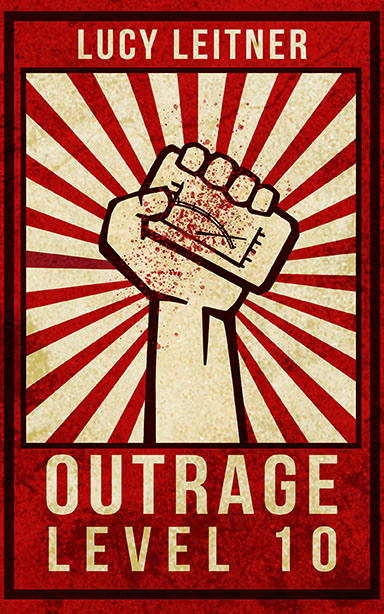
Outrage: Level 10 was originally released through Necro, but sadly Dave Barnett died right after the book was released. It will be re-released through Blood Bound Books on November 26th.
Outrage: Level 10 — Alex Malone is brain damaged from a career as a legendary goon in the outlawed sport of hockey. Now he’s a cop because that’s the only job that’ll take him. His presence is enough to raise a citizen’s outrage level, putting him at constant risk of being banished—or worse, sent to the mysterious Maze.
His headaches bring the type of pain that makes plunging off one of Pittsburgh’s bridges a viable option. The bouts of unfettered rage interfere with his ability to complete even the simplest task of rounding up the centenarians with the dying brains and bionic bodies who terrorize other citizens.
Since The People assumed control of the Republic of America, death before 130 has become a thing of the pre-Revolutionary past. Cancer, heart disease, spinal cord injury—all eradicated thanks to tax dollars funding medical research instead of wars and unjust justice. If only they could figure out the brain…
So an experimental treatment sounds good to Malone. It feels good, too. The blackouts that would end with bleeding knuckles and a citizen unconscious on a sidewalk are replaced by vivid memories. The only problem is that the memories aren’t his. They’re filled with torture and more violence than even the undefeated champion of ice boxing could imagine.
With a sense of purpose not felt since his days as hockey’s premier fighter, Malone is determined to find out what’s going on in his head, even if it makes him a target of the outraged mob and the powerful sadists that manipulate it, and leads him to horrifying truths that should have remained lies.
Outrage: Level 10 is an anti-hero’s journey through the inner workings of a violent, near-future dystopia.
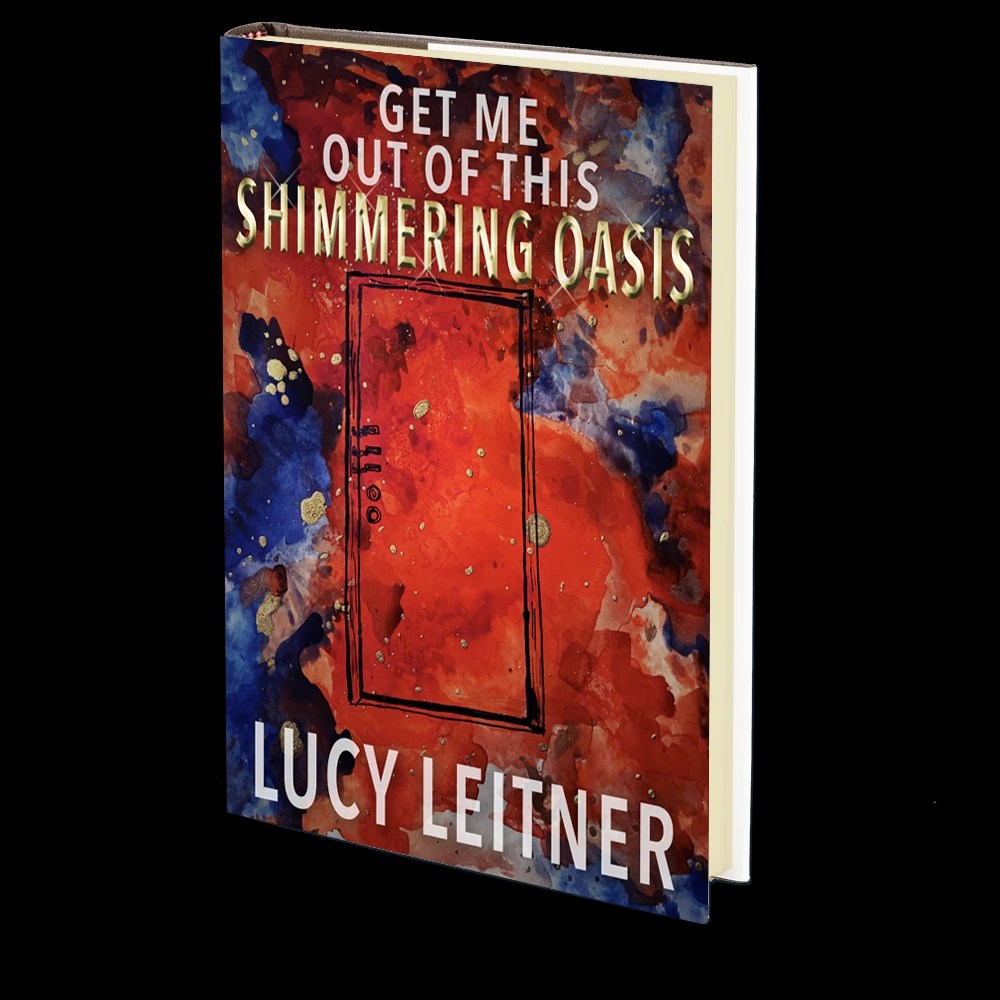
Get Me Out of This Shimmering Oasis — OMG this place is amazing. I can feel all the remnants of my leaky gut clearing right up. A few more days and I may even be able to tolerate dairy again. These innovative treatments are truly elevating my wellness. They are literally scaring me to death, but doing good for yourself never feels good, right? Right?
Sadly, this is my last interview with some of the authors from Blood Bound Books’ latest anthology, Burnt Fur. It’s been great fun getting to know some authors I had never met before, and I hope that you have enjoyed these as much as I have.
Meghan: Hi, Troy. Welcome! Tell us a little bit about yourself.
Troy Gardner: I’m a New Englander transplanted to Florida who writes, watches, and talks about horror. It’s the most expansive genre out there. I’m a cat dad and garage enthusiast.
Meghan: What are five things most people don’t know about you?
Troy Gardner: Hmmmm, let’s see. 1- I’m color slow, 2- I never learned to drive, 3- I don’t have a sweet tooth, but I can’t turn down trail mix, 4- I don’t understand electricity, 5- I love music but I’m basically tone deaf.
Meghan: What is the first book you remember reading?
Troy Gardner: The first novel was Jurassic Park. The movie came out when I was nine and I loved it so I read it.
Meghan: What are you reading now?
Troy Gardner: Shit Politicians Say by Governor Jesse Ventura. It was a Christmas gift. I enjoy outsider perspectives that poke fun at both parties.
Meghan: What’s a book you really enjoyed that others wouldn’t expect you to have liked?
Troy Gardner: Since most of what I talk about is horror-related, I’ll say Michael Cunningham’s The Hours. Such a beautiful book. I have a soft spot for Virginia Woolf so his fictionalization of her hits deep.
Meghan: What made you decide you want to write? When did you begin writing?
Troy Gardner: I’ve always been a writer. We got this Tandy-900 when I was a kid and I filled floppy disks with fiction stories when I was nine or ten.
Meghan: Do you have a special place you like to write?
Troy Gardner: I cleaned out my garage and put in my uncle’s old futon and built a four foot by four foot screen I hooked a projector to. It’s a great place to be isolated and write in the dark with some movie playing. Downside is it’s unusable during the peak summer.
Meghan: Do you have any quirks or processes that you go through when you write?
Troy Gardner: I almost always have the TV on when I’m writing first or second drafts. Occasionally, if I need to focus, I listen to music. It’s extremely rare that I write in a quiet space.
Meghan: Is there anything about writing you find most challenging?
Troy Gardner: Editing, in a good way. Revisions make the story stronger, but it’s far easier to say, “Act two needs to be strengthened” than to actually strengthen the act.
Meghan: What’s the most satisfying thing you’ve written so far?
Troy Gardner: I lost someone very important to me to drugs and I wrote this long YA supernatural book about grief and magic and time travel and it’s all over the place and maybe some day it’ll find publication, but I didn’t write it to be published, I wrote it to process. And it did help.
Meghan: What books have most inspired you? Who are some authors that have inspired your writing style?
Troy Gardner: Every single book I read inspires me. Everything. I’m the type of guy who watches a documentary, then wants to write a book about that topic. I read a murder mystery and it makes me want to write a murder mystery. Specific books, I’d say The Picture of Dorian Gray was a big influence. David Sedaris is up there. Christopher Rice.
Meghan: What do you think makes a good story?
Troy Gardner: Characters. There’s a famous quote (that’s been attributed to different people) that says there’s two types of stories: a man goes on a journey, or a stranger comes to town. Characters are what makes narratives distinct and memorable.
Meghan: What does it take for you to love a character? How do you utilize that when creating your characters?
Troy Gardner: I’d say relatability is pretty high on the scale. If a reader connects to a character, not necessarily even the protagonist, then the story becomes so much more than words on pages.
Meghan: Which, of all your characters, do you think is the most like you?
Troy Gardner: I have a project that my agent is currently querying that I can’t say too much about, but it’s about a young filmmaker who is a little too enthusiastic about movies. It’s a comedy/drama with a pinch of romance, and he’s me in many regards. I just tapped into my life when I built his backstory for how he fell in love with movies and the horror genre and gave him all my insecurities.
Meghan: Are you turned off by a bad cover? To what degree were you involved in creating your book covers?
Troy Gardner: “Don’t judge a book by its cover” is one of the oldest sayings we’ve all heard, and it’s true, we can’t help it. If a cover looks cheap, there’s that gut instinct of “oh, the story is bad,” but logically I know that’s not true. I’ve had a lot of say with all the small publishers I’ve worked with, and none with the anthologies because usually an anthology cover is done before they even choose which stories will go in it. No complaints there.
Meghan: What have you learned throughout the process of creating your books?
Troy Gardner: I’m constantly learning as I write, edit, and publish work and beta read and edit other writers’ works, and read for pleasure and watch movies as a habit.
Characterizations, dialogue, plots, what to avoid, what techniques work. I have an obsessive personality, so I’m fairly good at deconstructing elements. You analyze art, you learn from it.
Meghan: What has been the hardest scene for you to write so far?
Troy Gardner: I can’t think of a specific scene, but generally the hardest parts of a manuscript to write are in revisions. When you realize a sub-plot is weak and needs something, but you’re not entirely sure what, and you spot a great place to hone in on it. So you sit there with the cursor blinking thinking, “Right here, this is the spot where I’ll make the whole sub-plot and side character worth it. Okay, so… what now?”
Meghan: What makes your books different from others out there in this genre?
Troy Gardner: One thing is I can’t stick to one genre and I love blending them. And it’s rare that I don’t throw humor into even tense and frightening scenes.
Meghan: How important is the book title, how hard is it to choose the best one, and how did you choose yours?
Troy Gardner: Oh, my God, I HATE coming up with titles! That’s the absolute worst. I’ve written a few things and worked with my friend Josh Winning (check out his YA fantasy action SENTINEL series) and he’s blessed with the ability to create titles. I am not. I slave over them. With the Burnt Fur anthology, I just named the story after the central figure, “Randall Rabbit,” because alliteration is fun.
Meghan: What makes you feel more fulfilled: Writing a novel or writing a short story?
Troy Gardner: Oh, tough one. I’d say short story only because I can write ten shorts in the time it would take me to write one novel, so that feels like I’ve done more. But that one novel might be greater than all the shorts, so it’s a tough call. I do think that shorts don’t get the respect they should in some literary circles (or all film circles).
Meghan: Tell us a little bit about your books, your target audience, and what you would like readers to take away from your stories.
Troy Gardner: My target audience is me. I write stories I’d like to read. And hopefully, other people, too. I don’t read one genre, so I don’t write in one genre, and I often blend them. I like quirky, out there, queer stories. I like to be surprised. These are the things I strive to write.
Meghan: I am always excited to get my hands on anthologies, especially ones from publishers that I have grown to trust. Tell us about Burnt Fur and your story in it.
Troy Gardner: I love anthologies, too. Ever since I was a kid watching Are You Afraid of the Dark? on Saturday nights. A fur-themed, extreme horror anthology just sounded fun, so I came up with this story about a young hustler with a client dressed up in a rabbit costume that reminds him of a stuffed animal that crossed his path a few years back. I’d been writing a lot of YA, and Middle Grade, so it’s always fun to change tracks and write something more extreme once in a while.
Meghan: Can you tell us about some of the deleted scenes/stuff that got left out of your work?
Troy Gardner: That’s funny you ask that, because this is the first short I’ve published in which I ended up totally changing the ending. There’s always an editing phase to make the story stronger. I cut quite a bit of fat out of “Randall Rabbit” which I’m happy to do to make it a leaner, more effective read. I’m happy to trim stories to make them stronger. I’ve had publishers and editors compliment me on being enthusiastic to edit and rework pieces, and this was the most major change I’ve made. My original idea was to focus on psychological terror, but we ended up going with a shorter, more physical ending. The Burnt Fur team’s been wonderful to work with and I’m very happy with the changes we made.
Meghan: What is in your “trunk”?
Troy Gardner: Not sure if you’d call it my trunk because I devote a LOT of free time to it, but I’m working on making a no-budget horror movie anthology. I had the idea last June and I already have seven segments done totalling eighty minutes. I don’t know what shape the final project’s going to take, but it’s been fun, it’s been challenging, and I’m looking forward to sharing it with an audience in the next year.
Meghan: What can we expect from you in the future?
Troy Gardner: Besides my film opus 🙂 , I’d love to write some more extreme horror. I’ve got a short coming out on the Monsters Out of the Closet podcast and I write reviews and random articles for Gayly Dreadful.
Meghan: Where can we find you?
Troy Gardner: I wrote “Randall Rabbit” for Burnt Fur with my Elliot Arthur Cross pseudonym, but I’m on Twitter under my real name and I post Are You Afraid of the Dark? fan art every week on Instagram.
Meghan: Do you have any closing words for your fans or anything you’d like to say that we didn’t get to cover in this interview?
Troy Gardner: Thank you for reading. As a writer, I sit alone in a room typing on a laptop and it always amazes me that someone somewhere will read that story and (hopefully) enjoy it.
About the Book: Sit. Roll over. Who’s a Good Boy?
There are no good boys in in this anthology, only twisted, deviant, and burnt encounters with pets, people in costume, animals who behave like humans, and creatures who blur the line between the three. Violent pigs, killer ducks, horny bees, a naughty rabbit, and many more fill these pages with tale after tail of hair-raising horror.
Don your Fursuit, slip into your Fursona, and ride the dark wave of horror that is Burnt Fur. You may never go back to wearing your normal skin again.
The Moon in Her Eyes by Sarah Hans Mallard’s Maze by Joseph Sale Salivation by Theodore Deadrat The Hamford Pigs by N. Rose The Willingness of Prey by Paul Allih 6 Dicks by Rachel Lee Weist The Others by C.M. Saunders Randall Rabbit by Elliot Arthur Cross A Concubine for the Hive by Rue K. Poe Five Nights with Teddy by Thurston Howl Oh Piggy, My Piggy by Matt Scott Ware the Deep by Stephanie Park The Molt of a Diminishing Light by Michelle F. Goddard The Victims by James L. Steele
About the Author: Troy H. Gardner was born in Florida but left at the ripe age of six months. He grew up and earned his Bachelor’s Degree in New England before returning to the Sunshine State just in time for Hurricane Irma.
He started writing stories on his Tandy Personal Computer as a child in the ’90s after devouring the works of Stephen King in elementary school.
Red is his favorite color, but blue hasn’t gotten the memo yet. He doesn’t understand why fans can’t equally love Star Wars and Star Trek (they’re different genres, people!). When Troy isn’t writing, or talking about writing, he enjoys killing hours on his PlayStation or watching horror movies (both really great and incredibly bad are his jam).
Jonathan W. Thurston Howl is another author from Blood Bound Books‘ latest anthology, Burnt Fur, edited by Ken MacGregor. I learned a lot about this interview, including some interesting facts about HIV, the difference between sexual and erotic, and sex trafficking.
Meghan: Hi, Jonathan. Welcome to Meghan’s House of Books. Tell us a little bit about yourself.
Jonathan W. Thurston Howl: I am a PhD student in English at Michigan State University, an activist for HIV destigmatization, and an editor for Thurston Howl Publications and Weasel Press.
Meghan: What are five things most people don’t know about you?
Jonathan W. Thurston Howl: 1) I got HIV through a partner who lied about his status. 2) I identify as a furry. 3) I have a very sex-positive household with lots of toys and art everywhere. 4) My fiance and I met through publishing. 5) I have a TED Talk out!
Meghan: What is the first book you remember reading?
Meghan: What’s a book you really enjoyed that others wouldn’t expect you to have liked?
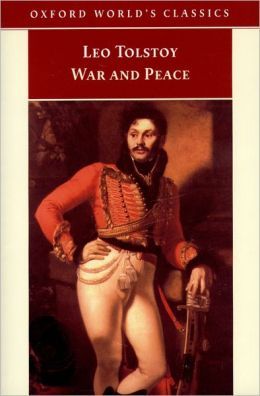
Jonathan W. Thurston Howl: War & Peace. It’s infamous as such a large book that is incredibly dry, but I actually have loved the book each of the three times I read it. Its social critiques are often still relevant, and I love the characters.
Meghan: What made you decide you want to write? When did you begin writing?
Jonathan W. Thurston Howl: I decided I wanted to write after realizing my writing could make people feel something. It made me feel like a magician, tricking the audience. I first started writing in eighth grade, when I wrote my first novel.
Meghan: Do you have a special place you like to write?
Jonathan W. Thurston Howl: Usually just any cafe.
Meghan: Do you have any quirks or processes that you go through when you write?
Jonathan W. Thurston Howl: I often write via the Snowflake Method. I write the whole story as one sentence, then one paragraph, then one page, so on and so forth, until it’s done.
Meghan: Is there anything about writing you find most challenging?
Jonathan W. Thurston Howl: Descriptive prose. My writing style is very fast and animated. It’s hard to just slow it down to let the setting tell a story by itself.
Meghan: What’s the most satisfying thing you’ve written so far?
Jonathan W. Thurston Howl: One of two works. Either my experimental horror book The Devil Has a Black Dog or my nonfiction exposé Blood Criminals.
Meghan: What books have most inspired you? Who are some authors that have inspired your writing style?
Jonathan W. Thurston Howl: One that makes its reader feel what the author intended.
Meghan: What does it take for you to love a character? How do you utilize that when creating your characters?
Jonathan W. Thurston Howl: It takes quirks and active personality. However, as a horror writer, it means I’ll make my most fleshed out character the one who gets their flesh outed.
Meghan: Which, of all your characters, do you think is the most like you?
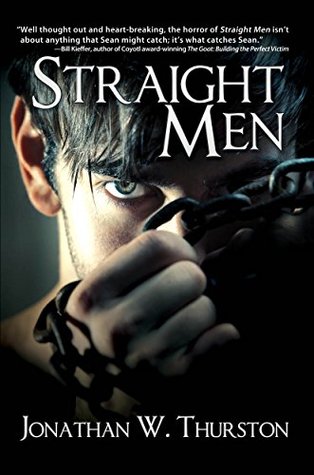
Jonathan W. Thurston Howl: Probably the protagonist of my award-nominated book Straight Men.
Meghan: Are you turned off by a bad cover? To what degree were you involved in creating your book covers?
Jonathan W. Thurston Howl: Yes, I can’t stand bad covers. I often work as a cover advisor for a few different publishing houses because I’m so nitpicky.
Meghan: What have you learned throughout the process of creating your books?
Jonathan W. Thurston Howl: Formatting experimental fiction sucks.
Meghan: What has been the hardest scene for you to write so far?
Jonathan W. Thurston Howl: Some of the explicit scenes of Straight Men definitely. Doing bad things to good people is hard.
Meghan: What makes your books different from others out there in this genre?
Jonathan W. Thurston Howl: They take popular narratives and queer them. There’s just not enough solid gay fiction out there, not that isn’t a coming-out story.
Meghan: How important is the book title, how hard is it to choose the best one, and how did you choose yours?
Jonathan W. Thurston Howl: I usually choose my titles fairly fast. I think for me they are usually simple but have multiple layers of meaning.
Meghan: What makes you feel more fulfilled: Writing a novel or writing a short story?
Jonathan W. Thurston Howl: Usually a novel. It just takes more time, and you get to hold it in your hands with its own cover.
Meghan: Tell us a little bit about your books, your target audience, and what you would like readers to take away from your stories.
Jonathan W. Thurston Howl: Usually, my target audience is erotic horror readers. I like them to be aroused but then made uncomfortable for their arousal: they feel complicit in the consequences of the intercourse scenes.
Meghan: I am always excited to get my hands on anthologies, especially ones from publishers that I have grown to trust. Tell us about Burnt Fur and your story in it.
Jonathan W. Thurston Howl: So, my story in Burnt Fur twists a couple of narratives: Tusk (an old body horror film) and the video game Five Nights at Freddy’s. Furries are all about wish fulfillment. They buy art of their fictional character. They get fursuits of them. They imagine themselves as that character sometimes. So, my story tackles the question of, “What if you got your wish and could be plastic surgeried into being your character?” But as is usual with wish fulfillment horror stories, you really should have been more careful of what you wish for.
Meghan: You wrote a book called Straight Men, published by Black Rose Writing. Explain to us what a gay sexual thriller is.
Jonathan W. Thurston Howl: (Content warning: all kinds of sexual abuse) So, first off, there is a difference between sexual and erotic. Erotic implies that the author hopes the reader is aroused. An erotic thriller could involve, for example, a very Stockholm syndrome case of a person falling for their kidnapper and having lots of sex and then later regret when they escape, masturbating to fantasies back in the safety of their home. Sexual thriller takes out the arousal but keeps the sex. Straight Men does not make me aroused. It didn’t at any portion of writing it. Unfortunately, sex is not always beautiful. There is sex trafficking in this country. There is sexual abuse. There is rape. There are bestiality shows in almost every state, and people live their lives as if these things could only happen on the news, not in real life. Straight Men follows a young man who goes on a hookup without telling anyone and is entered into the sex traffic market, drugged, shock collared, and unable to escape for months. It might sound crazy and extreme, but it almost happened to me. I once had a hookup where I was raped and told that if I didn’t do as I was told, the man’s dog was going to rape me, and I wouldn’t be allowed to leave. This novel came from a very real place for me.
Meghan: I’ve never met someone who has done a TED Talk and this has intrigued me. Tell us more about your nonfiction expose called Blood Criminals and that talk.
Jonathan W. Thurston Howl: Sure! So, I was diagnosed with HIV on January 7, 2015. It was from a partner who had lied to me about their status. And since then, I’ve had some interesting things learned. Did you know, if you have HIV, you take one pill a day, and you both don’t have symptoms and can’t actually spread it to anyone else? You could literally drink my blood, and you wouldn’t catch HIV from me. Because of my meds. The hardest part of HIV is people telling you once a week to go kill yourself. That’s kind of what my TED Talk and book are about. They’re not focused on my experiences. They’re focused on what having HIV in the 21st century is like. It’s not the death threat it used to be in the 80s, but it has wholly new problems that people don’t think about, and it needs to be addressed.
Meghan: Can you tell us about some of the deleted scenes/stuff that got left out of your work?
Jonathan W. Thurston Howl: Not really. I can’t think of anything notable that was deleted.
Meghan: What is in your “trunk”?
Jonathan W. Thurston Howl: Well, the third book in the Straight Men series is the next book I will probably write. Also, I have a book coming out this year called Spiders in Our Bed, a collection of a few erotic horror stories centered on the troubles that can happen if a spider interferes with your sex life.
Meghan: What can we expect from you in the future?
Jonathan W. Thurston Howl: Spiders in Our Bed soon! Plus an erotic horror monster anthology I’m writing with my loving fiance, Weasel.
Meghan: Where can we find you?
Jonathan W. Thurston Howl: My Twitter account (18+ only), and my publisher’s webpage. And if you’ve read this far, you can always feel free to reach me through any of those places or email me at: jonathan.thurstonhowlpub@gmail.com. I am always willing to answer questions, provide recommendations, give tips, etc.
Meghan: Do you have any closing words for your fans or anything you’d like to say that we didn’t get to cover in this interview?
Jonathan W. Thurston Howl: If any of this sounds interesting, just hit me up, and I can possibly get you a discount on any of my books. Just mention the interview! I’d love to just have more readers of my work honestly.
About the Book: Sit. Roll over. Who’s a Good Boy?
There are no good boys in in this anthology, only twisted, deviant, and burnt encounters with pets, people in costume, animals who behave like humans, and creatures who blur the line between the three. Violent pigs, killer ducks, horny bees, a naughty rabbit, and many more fill these pages with tale after tail of hair-raising horror.
Don your Fursuit, slip into your Fursona, and ride the dark wave of horror that is Burnt Fur. You may never go back to wearing your normal skin again.
The Moon in Her Eyes by Sarah Hans Mallard’s Maze by Joseph Sale Salivation by Theodore Deadrat The Hamford Pigs by N. Rose The Willingness of Prey by Paul Allih 6 Dicks by Rachel Lee Weist The Others by C.M. Saunders Randall Rabbit by Elliot Arthur Cross A Concubine for the Hive by Rue K. Poe Five Nights with Teddy by Thurston Howl Oh Piggy, My Piggy by Matt Scott Ware the Deep by Stephanie Park The Molt of a Diminishing Light by Michelle F. Goddard The Victims by James L. Steele
About the Author: Jonathan W. Thurston Howl is a PhD student in English at Michigan State University. Aside from working on their dissertation, they are an editor of two publishing houses and an activist for HIV destigmatization. They are an avid horror writer, particularly when it comes to erotic horror.
We have a second interview today, from those good folks at Blood Bound Books and their Burnt Fur anthology, author Joseph Sale. This interview is, in all honesty, in my top five favorite interviews of the year. He was so thorough and engaging, and I hope you enjoy his responses as much as I did.
Meghan: Hi, Joseph. Welcome to Meghan’s House of Books. It’s a pleasure to have you here today. Tell us a little bit about yourself.
Joseph Sale: I’m an author based in the UK, south of England. I grew up in a Lovecraftian seaside town that truly is the British Innsmouth! Full of existential dread, fish people, and drug trafficking. I’ve published probably over 30 books now, including books written under different names or ghost-written. I love fantasy, science fiction, and of course horror. I edit and write full time, but it has been an uphill battle to get to that stage! I’m also part of The Writing Collective, along with my partner in crime Ross Jeffery, so I also publish indie-fiction. Like yourself, I’m also really big on promoting writers. I feel there are so many real talents out there who’ve been neglected and I feel a duty to bring attention to them. I’m a gamer at heart, drunk on Warhammer, Dungeons & Dragons, and Dark Souls.
Meghan: What are five things most people don’t know about you?
Joseph Sale: This is a deliciously challenging question!
(1) I spent thirteen years in a tang shao tao temple learning a grueling form of Kung Fu that has left an indelible mark on me. This is 100% real. And of course I’ve written a book about it! I’d like to thank the neo-noir master and insanely good editor Richard Thomas for helping me get that book onto paper.
(2) I also spent sixteen or more years competing in fencing – or swordfighting. That was also a life-changing experience. I got to train with Hungarian masters and ex-army coaches; it was pretty wild, and, as someone who writes the odd sword and sorcery story, very useful for the combat scenes!
(3) To move away from physical stuff, not many people know I’m a hard anime and manga fan. I am obsessed with Attack on Titan, which I think I admit on my website, but it doesn’t stop there. Seven Deadly Sins, or Nanatsu no taizai, is another brilliant anime I watch religiously. The storytelling is just incredible. Most TV shows can barely do one character arc, and Seven Deadly Sins is out doing seven – more if you count the B-characters and villains. And each one hits with resonance and depth. DeathNote is another brilliant story, of course (I own the complete special edition black-manga collection). And anything by Junji Ito, Uzumaki probably being my favourite. A few years ago I took up learning Japanese and it’s been incredibly challenging, but I hope one day to read a Kobo Abe or Haruki Murakami novel in the original language.
(4) I write music and play piano and guitar. There are some truly terrible early tracks I did that are still lurking on YouTube somewhere. They are unbelievably bad. But, more recently, I’ve been scoring short films and musicals, and that has been an awesome and rewarding experience. I think it marks a transition from trying to be a rockstar as a teenager and not having even an ounce of the star quality needed, to, well, writing. Writing the music and being more in the background but still playing that key role (pardon the pun). My wife is a huge inspiration to me musically.
(5) I am a really big heavy metal fan. Avenged Sevenfold, Coheed and Cambria, Slipknot, and on a rainy day, Ankor, Breaking Benjamin, Starset. I do listen to other styles and genres. I’m a sucker for a really good ballad or a killer rap track. But I keep coming back to metal. Most people view it as “depressing” but I think the reverse: there’s something joyous and uplifting about that music. And metal artists never get enough credit for the complexity of their sound.
Meghan: What is the first book you remember reading?
Joseph Sale: Wow, that’s a tough one. I’m a bit peculiar because I kind of largely skipped children’s books and went straight into heavy duty literature; the perks of having an awesome dad, who used to be an English teacher and who writes poetry. So, he got me reading Milton’s Paradise Lost, and Macbeth when I was about eight years old! We’d read them together, and I’d stop him every five seconds to ask what a word meant, but together we’d work through these epics and, of course, there was such a sense of achievement and understanding when we reached the end together. My mother contributed huge amounts to my reading as well, and is responsible for introducing me to 2000AD, David Gemmell, Terry Pratchett, Margaret Weis and Tracy Hickman, David Eddings, the kind of “fantasy OG” if I may be permitted such a phrase. And the book my mother and father overlapped on was, of course, The Lord of the Rings. That’s probably the first book I remember reading. I’ve read it three or four times now. Once as a very young kid, I mean five or six. I barely understood it, but was just awed by the majesty, the heroism, and remember my hair standing up on end so many times, not even sure why. I think it changed me forever. The book became a part of who I was. Then I read it again, a little older, more twelve or thirteen. And the third time, at university, eighteen or nineteen. I think I read it one time after that as well. But the third time was actually the charm, the best reading of it. I was finally ready for it, if that makes sense. And the metaphor for addiction was so powerful.
Meghan: What are you reading now?
Joseph Sale: I used to be a “read one book at a time” kind of guy, but now I haven’t got time for the luxury of that, so I tend to have several books on the go at once. I’m currently reading and as yet unreleased book by Christa Wojciechowski. She is one of my favourite authors, and an absolute genius at creating psychologically rich and compelling characters. I’m in awe of her writing. If you haven’t heard of her, definitely check out her Sick trilogy.
I’m also reading another unreleased horror novel by Dan Soule (the perks of being an editor). He is another great indie-author, and his first book, Neolithica, I edited. It’s a really strong horror title that is more than it appears and kind of revives old-school King-style horror but also puts a new spin on it.
Lastly, I’ve just started re-reading Grady Hendrix’s My Best Friend’s Exorcism. I know with The Lord of the Rings example it sounds like I re-read books all the time, but it’s actually super rare. For me, only the very best books justify the time to read them twice or more. And my God, is My Best Friend’s Exorcism one of the best books I’ve ever read. Hendrix’s prose is unbelievable. The two principle characters, Abby and Gretchen, are so well fleshed out, and you care so much about them. Hendrix is at that level where you feel magic in the writing. So, I can’t wait to re-read it. I feel it’s an important benchmark for me as a horror writer.
Meghan: What’s a book you really enjoyed that others wouldn’t expect you to have liked?
Joseph Sale: Good question. I think because I kind of purport to be quite a stylist, and talk a lot about beauty in prose, most people don’t expect me to be a fan of, for example, bizarro novels. But I really am! I love Carlton Mellick III’s work, particularly Biomelt. That novel is batshit insane but totally full of heart. The way he shifts perspective in it is genius. And, it has one of the greatest names for a serial killer of all time: Porn Eyes. The character is called that because he’s watched so much holographic pornography that flickering lewd images have been scored onto his irises. I mean… what more do you need to hear? Buy the book now!
Meghan: What made you decide you want to write? When did you begin writing?
Joseph Sale: This is always a tough question to answer, in some respects. Life doesn’t always throw you the epiphany moments that fiction deals with! The revelation can be more gradual. However, I used to want to be an actor. I did a lot of theatre and drama, and my Sixth Form studies (High School to my American friends) almost entirely consisted of drama-related studies. I did really enjoy being on stage, playing characters, the drama and life and vitality of it, but something felt like it was missing. I began to realise that I was more interested in the words being said than how I was saying them, if that makes sense. And this eventually led me to realise I wanted to tell stories, write the scripts, rather than necessarily be the mechanism by which the stories were interpreted or passed on. It was a subtle shift. Both are creative, but the acting in the end wasn’t for me long term. Although, having said that, a few things have come up, projects that have not yet seen the light of day, in which I may be “treading the boards” again (or in this case getting in front of a camera). You may have noticed I like to do lots of different things. I think the diversity is what’s kept me alive these last few years!
Meghan: Do you have a special place you like to write?
Joseph Sale: I recently moved out of a tiny, one-room flat with my wife and we’re now finally enjoying a bit more space; I even have my own office! So, that office is now where I love to write. But I’m easy. Once I get into the flow, it’s hard to get me out; like I’m plugged into The Matrix.
Meghan: Do you have any quirks or processes that you go through when you write?
Joseph Sale: Good question! Two things I often do. I start the session by re-reading and editing the last couple of paragraphs I wrote the session before. This eases me into the writing process so I’m not staring at a blank screen. Then, at the end of the session, I always write the first sentence of a new chapter. This means that when you come to sit down next time, you have the first line to kick you off! Apart from that, I have no unusual rituals. Lots of tea, sometimes music!
Meghan: Is there anything about writing you find most challenging?
Joseph Sale: Slowing it down. I have a tendency to write in a frenzy when I’m full of ideas, and sometimes this means I rattle through scenes and they don’t get the development they need, which I then have to laboriously fix in editing! But, if I’m able to “centre myself” a little bit, and slow down, it often produces better results. It’s hard, because riding the wave of excitement is good and means productivity, but I definitely have a tendency for economy rather than depth and whilst concision is important sometimes the reader needs that richness to fully feel a scene. I recently read China Mieville’s Perdido Street Station for the first time and it totally blew me away. I learned a lot about slowing down to take in the scenery and senses from that book. Of course, scenery is not just scenery, it can itself be a character or a way to reveal character!
Meghan: What’s the most satisfying thing you’ve written so far?
Joseph Sale: That is an interestingly worded question. I like it. This might sound a bit promotional, but it is genuinely my latest book, Return to the Black Gate. The reason being it’s the final entry in a trilogy, but not only that, it also draws together a kind of hidden (not-so-hidden anymore) inter-connected multiverse that spans throughout many of my books. I call it “The Sevenverse Saga”. This book ends that, as well, and says goodbye to some characters that have been with me for seven years or more and have cropped up in numerous books. It was immensely satisfying as well as sad. It’s the first time I’ve finished a novel and not immediately needed to start writing something else. I was actually at peace with myself for a long time afterward. It was eerie and strange, but kind of welcome.
Meghan: What books have most inspired you? Who are some authors that have inspired your writing style?
Joseph Sale: Actually Christa Wojciechowski’s books inspired me a great deal. I bought the first Sick novel thinking it would be one type of story, a kind of sleazy body-horror, and it blew my away with its psychological depth, insight, and with how compelling the narrative was. I couldn’t stop reading. And I realised I had to up my game in terms of character development. She showed me the way with that really.
Eric Van Lustbader’s The Ninja and Black Heart are two really important books in terms of informing my writing stye. What I love about Lustbader’s work is he is so counter-cultural in terms of the trend towards “stark”, “stripped” prose. The kind of Cormac McCarthy / Lee Child effect of this hard-boiled narrative without any ornamentation. Lustbader is a poet, however. And he fearlessly writes about horror, sex, and taboos in a way I’ve never seen anyone else tackle. The Ninja and Black Heart will both haunt me forever, I think. There are some passages in there that are transcendental in their beauty but also terror. It’s a shame that people view him as pulp, or know him as the successor to Robert Ludlum (he continued the Bourne series), he’s so much more.
I won’t bore you with more gushing praise, as I mentioned them before, but The Lord of the Rings and My Best Friend’s Exorcism are both big influences too.
Meghan: What do you think makes a good story?
Joseph Sale: I think that’s an interesting question, because there is no definitive answer. For me, however, a good story is something that moves me emotionally. It has to land the final “catharsis” or emotional punch. If I don’t weep or feel my heart swell with joy, there was no purpose. For me, there’s nothing worse than a film that leaves me cold. Boring is worse than bad, in my view, because sometimes bad books or bad films have something underneath they’re trying to express that still gets you in some way.
And I think this draws out another point: the ending is so important. In a way, the ending is the story. Otherwise, why did we come all this way? There’s a shocking trend of botched endings right now (not to mention any particular TV series… cough cough) but I’m actually seeing it in a lot of books, too. People just don’t seem to know how to end their stories. It’s weird. There’s probably some sociopolitical or cultural psychological factor that is influencing this. Someone with more brains than me could do a study!
So, I would urge authors to really sweat the emotional resonance of their ending. Go for bittersweet, go for heartbreak, go for redemption, don’t be afraid of these big emotions. It’s better to try and fail, in my view. There’s nothing worse than the clever-dick “Character looks directly at the audience / camera and says, ‘Oh, you thought this story had meaning? Well, tough shit.’”
In the same way it’s harder to be emotionally real and sincere with people in real life without sounding corny (we Brits are terrible at sincerity, we’re too stuffy), it’s harder to be sincere in your writing, but the harder path is better in the long run.
Meghan: What does it take for you to love a character? How do you utilize that when creating your characters?
Joseph Sale: I think the truthful answer to this is sin. I need them to be sinful in some way, or I don’t believe them. There’s also a trend at the moment for squeaky clean characters. We need characters with flaws! Only then can we be engaged in the journey to them perhaps overcoming their flaw, which is what character arcs are all about.
In terms of creating my own characters, a “tragic flaw” – or “hamartia” to use the ancient Greek term – is definitely up there as possibly the most important thing to consider. You might also want to consider the inverse: what are their strengths? And things get really interesting when you start to make the character’s weakness also the source of their strength.
So, for example, Craig Smiley is one of the key antagonists and sometimes protagonist of my Black Gate series. He is a killer and it’s his zealous belief that makes him so unstoppable. Truly, his belief creates the reality he wants and means he can overcome almost any obstacle. But it’s also his belief which blinds him to the true horror of who he is and what he’s done. And, at a plot level, blinds him to what the gods he’s serving are really doing. So, here we have an interesting conundrum. What happens when that weakness is “lanced” and he loses faith – therefore also losing his greatest strength? There is a lot more narrative room to play here.
Meghan: Which, of all your characters, do you think is the most like you?
Joseph Sale: This is a positively naughty question! I feel compelled to answer it honestly. Craig Smiley is almost certainly the character most like me. The serial killer… My dad has this brilliant phrase “monomaniac with a mission” and it’s so true. I am that monomaniac who never takes his eyes off the future. Often when people ask me what I’m doing, I quote the Blues Brothers “I’m on a mission from God”.
I’m very aware there’s a thin line that stops someone like me becoming someone like him. Smiley was an expression of my own madness and despair when I was trapped working at a call centre, answering 150 phone calls a day. I started to experience auditory hallucinations (waking up hearing a phone ringing where there was none, for example), and a general deterioration in my health and psyche. We start with Smiley in Gods of the Black Gate imprisoned in a high-security facility on Mars. Smiley then enacts an escape (this is on the back cover, so no spoilers). I think Smiley’s journey was a bit of a way for me to explore how angry and trapped and insane I was feeling. I wanted to escape that call centre, and eventually I did. The thing about Smiley is as evil as he certainly is, he genuinely believes what he’d doing is right, and as a result is strong and he is a survivor. And those qualities were what I needed. He taught me how to endure, in a way.
When I came to writing the final book about him, Return to the Black Gate, I had to end his story, and that was the hardest part, because in a way it felt like making a prophecy about myself.
Meghan: Are you turned off by a bad cover? To what degree were you involved in creating your book covers?
Joseph Sale: I’ve created probably 90% of my own covers. That’s generally the way it goes in indie-publishing these days. Even in bigger publishing, actually. I know people with deals with the big five who have had a partner or friend create the cover for their book. Sounds insane, but publishers are cost-cutting wherever they can to survive.
I have created some really, really bad covers… But I’ve learned a lot from graphic designer friends and other professionals in this industry and now I’m quite proud of some of my efforts. I definitely get turned off by a bad cover. But worse, I get turned of by a bland cover. So many thrillers with bloody open windows on the front! I much prefer illustrative rather than photographic covers (I was in heaven reading Grady Hendrix’s non-fiction book Paperbacks From Hell, which showcased all the classic 60s, 70s, 80s, and 90s horror covers!).
Meghan: What have you learned throughout the process of creating your books?
Joseph Sale: Wow, this question is almost too big to answer fully. I’ve learned so much. The learning is also far more universal than simply craft-related. It’s taught me how to be a better person. It’s taught me how to see things from other people’s point of view. You know, when you’re writing a character, and you’re really trying to inhabit their shoes (a little bit of the actor in me that hasn’t worn off I guess) you find yourself writing lines that then surprise you: Jesus, I never realised they would see it like this. I confess that when I was at university, that kind of age, I was not a very tolerant person. But writing has changed that. It’s helped me to see weakness and vulnerability and how it can be healed. Most of all, in myself.
Meghan: What has been the hardest scene for you to write so far?
Joseph Sale: The hardest scene I’ve ever had to write is in a book that I will probably never release called Against Such Reckless Hate. The whole thing is a metaphor for my journey out of depression in 2017. I am a character in the story who is kidnapped and taken to a warped world in which I’m being tortured by a Satanic doppelganger of myself. The fictional characters I’ve created and friends and family have to come to my rescue and daringly enter this world. Man, some of the scenes in that felt like neurolinguistic programming, like I was actually re-wiring my brain, but that’s what I intended, I guess. I had to shake myself out of these false narratives: that I was alone, that nothing I did meant anything, etc. There is a scene where a psychologist, who is a key “grey” character in the book, is finally the one to heal my broken mind by entering a labyrinth. That was unbelievably hard, every word like drawing blood, and still makes me tear up thinking about it, but it’s also probably some of the best writing I’ve ever done. Maybe one day I’ll share the book. But not this day!!
Meghan: What makes your books different from others out there in this genre?
Joseph Sale: Ahh, a challenging question. Writers are always the worst authority on their own work! I will give it a go, however.
I think ultimately what’s different about my work is what I’d call the “mythical dimension”. Lots of writers use fantasy, and blend genres really well. But that fantasy is purely conscious effort and not resonating from somewhere deeper. Lots of writers write stylish prose like I do. Lots of writers write dark pull-no-punches fiction, like I do. There are a few writers who use mythical tropes (Norse gods show up, or dragons, or demigods). But they don’t use mythic storytelling itself. They don’t pull from that deeper well of the unconscious, that kind of inchoate place where the raw stuff of creation resides. You have to go into that abyss to create myth. I can always tell when a writer hasn’t, when they’ve written the book from their head, with thinking, with conscious effort. Real stories don’t come from there (they can be refined from that place), they issue from a darker realm.
Myths are the archetypes imbedded in us. Narrative is at the core of who we are. Myths and theology define us and help us understand ourselves. The real myths tell us something about human nature. I try as hard as I can to tap into these myths. I don’t always get there, but when I do succeed, I think it’s what gives my work a slightly differently feeling. When you’re reading Gods of the Black Gate, you’re not just reading about a killer and a detective, you’re reading about something altogether more primeval and Jungian. I think the readers who so kindly reviewed it sensed that. Beneath one story is another older and more potent one that partly explains why we kill, why we hate, why we destroy. When you venture into the virtual reality escapism of Save Game, again, there’s a myth there beneath the surface. It’s not just about video-games. It’s about a journey into hell to save a loved one. It’s Orpheus, in some ways. So, I’m just not just trying to tell stories, I’m trying to create myths. Whether that is hubris doomed to fail remains to be seen!
Meghan: How important is the book title, how hard is it to choose the best one, and how did you choose yours?
Joseph Sale: Book titles are like opening lines: they’re so, so important! However, I think for me an opening line is slightly more important. I can forgive a generic title, and I appreciate how hard it is to sum up a book from my own efforts. But a bad opening line is unforgiveable to me!
I think a book title is so difficult because it’s not only summing up your story for a reader, but also engaging with all those tricky and increasingly complex issues around what genre it is, how violent / graphic it might be, what audience it’s for. Stephen King famously said the original title for The Stand was The Second Coming, but his Tabitha King told him it sounded like a sex book so he changed it!
I must say, that unlike many writers, normally a title is one of the first things that comes to me, before or simultaneously with the story itself. Not always, but frequently. The title is then almost like a focal point for me, a kind of thematic lynchpin, that I can return to to stay grounded in what the story is really about.
I think the best way to come up with a title, and this is a big vague so I’m sorry, but is to consider what feels right. It can be super hard. But sometimes all the distractions of genre, audience, etc can make making a decision hell, and you can overanalyse it and end up with something that isn’t right at all. There’s something to be said for sticking to your gut.
Meghan: What makes you feel more fulfilled: Writing a novel or writing a short story?
Joseph Sale: Novels, all the way! I actually really struggle with short stories. They’re not as natural to me. I think I much prefer having the space to play with the characters and take them on these journeys. I’m obsessed by journeys in narrative, actually. People who have to go into some abyss to achieve something. It’s very difficult to do that in a short story.
The sense of achievement when finishing a novel is so much greater as well. It’s harder to do, of course, but there’s nothing like putting the final full-stop on a long novel and realising it’s done. It’s often an emotional experience for me. I’m a bit addicted to it if I’m honest.
Meghan: Tell us a little bit about your books, your target audience, and what you would like readers to take away from your stories.
Joseph Sale: I’ll try! So, my books are a mix of genres, what unites them is the feeling and mood and aesthetic, I guess. They’re very dark, but never without a ray of light, however small. I’ve experienced some disturbing and wonderful things, so there is always a supernatural dimension to my stories, because I have experienced the supernatural in a very real way, so I think ironically I am being truer to life’s weirdness. I write science fiction, fantasy, horror primarily. I am a sucker for a good redemption arc. My target audience are people who are open to exploring new genres, or genre crossovers, and perhaps fiction that is a little more on the literary and symbolic side of things. But having said that, I think story really is king, and I hope to deliver exciting tales regardless of whether you want to go deeper. You know, just because a book has symbolic metaphors and allegories, doesn’t mean it can’t also have massive robots destroying each other…
I think you’ll like my work if you’re into Philip K. Dick, China Mieville, Max Booth III, or Clive Barker. Barker I think is the most apt comparison in some ways because of the way he blends horror and fantasy (though I’m nowhere near as good as him, of course, not even on the same plane of existence!!!).
Meghan: I am always excited to get my hands on anthologies, especially ones from publishers that I have grown to trust. Tell us about Burnt Fur and your story in it.
Joseph Sale: I’m glad you like anthologies! I think they’re awesome. They’re a bit of a niche in terms of readership, or it can feel like that sometimes, but I think they’re necessary and vital to the craft. For Burnt Fur, I saw the open call, and knew immediately I wanted to participate! I really like the books Blood Bound put out, particularly Alistair Rennie’s BleakWarrior, a surreal masterpiece that reinvents sword & sorcery in my view. I also loved The City by S.C. Mendes.
The theme of the anthology was furries and anthropomorphism, which is a subject that deeply fascinates me and tends to crop up quite frequently in my fiction without much prompting. I knew, however, that I wanted to pick a very unusual animal, not the standard furry-fare of bunnies, dogs, and the like.
At the same time that I was contemplating Blood Bound’s open call for submissions, I was playing a video-game called Nightripper by the one and only indie-developer Puppet Combo which featured a duck-masked serial killer. I found this game particularly disturbing, not just because of its excellent design and shock-factor, but also because, as a child, I used to own a duck teddybear. The rest, as they say, is history! The story wrote itself from there.
Meghan: Can you tell us about some of the deleted scenes/stuff that got left out of your work?
Joseph Sale: This is such a cool question, because I was actually a part of an anthology called Lost Voices, which also features Ross Jeffery, Christa Wojciechowski, and Emily Harrison. We basically banded together to create it because we all had these stories that’d been considered “too dark” or disturbing for wider release. So, we thought, let’s make a thing of these forbidden tales. It’s an anthology of deleted scenes material, in some sense, a director’s cut!
I don’t have many deleted scenes, but I do have lots of alternate endings. I’m sometimes smacked in the face with a memory of how a story originally ended. The most dramatic example is Save Game, for sure. Ross Jeffery, who is a fantastic writer everyone should definitely check out, read an earlier draft of the book and he loved it all, except the ending. And he was bang on. I changed it, and the ending is one of the most talked about aspects because it’s a little ambiguous. I shudder to think what would have happened had the original ending seen the light of day! I’m very grateful to him for that feedback.
There are also “deleted novels”, haha. I have a lot of unreleased material that I am probably never going to release. A lot of people think that when you self publish (I do a mix of indie-publishing and self-publishing), there’s “no quality control”. But on the contrary, I am very selective. I’ve published over 30 books, but I’ve probably written more like 50 or 60. Some books are save-able in editing. Some aren’t. You have to let them go. I’ll give you a roll call of some of my favourite titles from these deleted works: Emerald Night, Way of Black, Crowbag Bastards, Killer in Asphodel, The Last Great-Walker, and most auspiciously: Dr Cocktopus and the Mutilator Man. Yep. You did not mishear that.
Meghan: What is in your “trunk”?
Joseph Sale: There are a few things in the trunk. The main thing is two screenplays. One for a TV pilot, one for a feature film. I don’t work on them as much as the novels, because the film industry is such a different path and I barely understand it, hence why they’re in the trunk. But there is a sense that one day they might be useful. I have a friend, a director and collaborator on a few projects, who really wants to get the TV series off the ground. At least to produce episode one to show people the vision we had for it. I really hope one day it’ll happen! He’s a brilliant filmmaker and almost scarily spellbinding actor.
Meghan: What can we expect from you in the future?
Joseph Sale: That is a kind question. Thank you! I have three big projects in the pipeline. Two are new novels yet to be announced, and one is an Omnibus of the Black Gate trilogy. The Omnibus is going to be a really special book, beautifully designed and of course full of 250,000 words plus of story! Stay tuned, as there’s a competition centered around the book that people can participate in.
You can expect other novels and collections that we’re publishing via The Writing Collective too. We have some awesome releases from new authors that we really think people are going to love. It’s a joy to bring new writers to readers. And some of these stories are so unique and different from what mainstream publishing is always churning out. Already, our releases like Lost Voices, Juniper (by Ross Jeffery), and most recently The Fabric of Tombstones (B. F. Jones) are really causing a splash because they’re not like everything else, so we want to continue that momentum and go deeper into that weirdness and uniqueness.
Finally, you can expect one or two left-field projects. I’ve been involved with a really cool board-game that I’m hoping can come to light soon (can’t say more than that right now I’m afraid). And, as I mentioned, perhaps a TV pilot, if we’re lucky!
Meghan: Where can we find you?
Joseph Sale: You can find me on social media at Twitter.
You can also check out my website, and there is a mailing list on there you can sign up to in order to get a free eBook from me, plus you get goodies every month in my newsletter (which I promise is not an annoying one and contains some actual content).
I am also co-host of a podcast, Monaghan & The Mindflayer, which is a nerdy place where we discuss everything from Warhammer lore to conspiracy theories. Don’t be shy about messaging us. We love questions about our show.
If you want to connect with The Writing Collective, you can check out our website.
Meghan: Do you have any closing words for your fans or anything you’d like to say that we didn’t get to cover in this interview?
Joseph Sale: I’d just like to say thanks. We live in a world where gratitude seems to be at a premium. I am so grateful to all my readers, to all the people that take the time to type out long and thorough and beautiful reviews of my work that are pieces of art in their own right. Dan Stubbings, Steve Stred, Matt Brandenburg, Ross Jeffery, Dan Soule, Christa Wojciechowski, Iseult Murphy, the list goes on and on. I’m so grateful to all the epic writers I’m friends with, in person and online, who give me the time of day and help me develop as a writer. I’m grateful to people like yourself, who take the time to ask thoughtful questions and spread the word about indie writers. Sincerely, and genuinely, thank you so much. I made a promise to myself that however far I go in this crazy world of publishing, writing, storytelling, I would never lose touch with the people that have gotten me here, and the community that makes it happen. I hope to remain grateful and in awe and to recognise that without readers, we writers are just talking to ourselves! Cheers.
About the Author: Joseph Sale is an editor, novelist, writing coach and co-host of Monaghan & The Mindflayer. His first novel, The Darkest Touch, was published by Dark Hall Press in 2014. He currently writes and is published with The Writing Collective. He has authored more than ten novels, including his Black Gate trilogy, and his love-letter to fantasy: Save Game. He grew up in the Lovecraftian seaside town of Bournemouth.
He edits non-fiction and fiction, helping fledgling authors to realise their potential. He has edited some of the best new voices in speculative fiction including Ross Jeffery, Emily Harrison, Christa Wojciechowski, and more. His short fiction has appeared in Tales from the Shadow Booth, edited by Dan Coxon, as well as in Idle Ink, Silver Blade, Fiction Vortex, Nonbinary Review, Edgar Allan Poet, and Storgy Magazine. His stories have also appeared in anthologies such as Lost Voices (The Writing Collective), Technological Horror (Dark Hall Press), Burnt Fur (Blood Bound Books) and Exit Earth (Storgy). In 2017, he was nominated for The Guardian’s ‘Not The Booker’ prize.
He is obsessed with Attack on Titan and Community.
There are no good boys in in this anthology, only twisted, deviant, and burnt encounters with pets, people in costume, animals who behave like humans, and creatures who blur the line between the three. Violent pigs, killer ducks, horny bees, a naughty rabbit, and many more fill these pages with tale after tail of hair-raising horror.
Don your Fursuit, slip into your Fursona, and ride the dark wave of horror that is Burnt Fur. You may never go back to wearing your normal skin again.
The Moon in Her Eyes by Sarah Hans Mallard’s Maze by Joseph Sale Salivation by Theodore Deadrat The Hamford Pigs by N. Rose The Willingness of Prey by Paul Allih 6 Dicks by Rachel Lee Weist The Others by C.M. Saunders Randall Rabbit by Elliot Arthur Cross A Concubine for the Hive by Rue K. Poe Five Nights with Teddy by Thurston Howl Oh Piggy, My Piggy by Matt Scott Ware the Deep by Stephanie Park The Molt of a Diminishing Light by Michelle F. Goddard The Victims by James L. Steele
Author interviews are one of my favorite things to read, and I hope you feel the same, especially with this week of Burnt Fur, the latest anthology from Blood Bound Books, authors. Today we have Sarah Hans.
Meghan: Hi, Sarah! Welcome. Tell us a little bit about yourself.
Sarah Hans: In my day job I’m a teacher (middle school, special education English). I write mostly horror. I have a novella and a short story collection out from Dragon’s Roost Press and in the Fall my first novel will be published by Omnium Gatherum. In my spare time I do a lot of crocheting, gardening, and playing horror video games.
Meghan: What are four things most people don’t know about you?
Sarah Hans: I got my septum pierced in Ireland while I was studying abroad (yes, it hurt). I love tattoos but don’t have any. I collect dolls with big heads and color-change eyes called Blythe dolls. I was diagnosed with ADHD at 34 years old!
Meghan: What is the first book you remember reading?
Sarah Hans: Maybe The Secret Garden? I have a soft spot in my heart for that book.
Meghan: What’s a book you really enjoyed that others wouldn’t expect you to have liked?
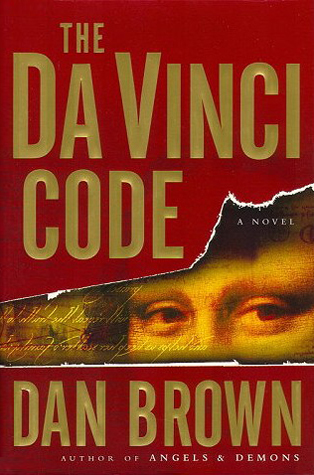
Sarah Hans: The DaVinci Code. It’s got problems, but the writing is like a master course in maintaining tension.
Meghan: What made you decide you want to write? When did you begin writing?
Sarah Hans: I’ve always been a storyteller. When I was a kid, before I could write proficiently, I would line up my stuffed animals and tell them stories. I filled notebooks with handwritten stories as soon as I knew my letters, but I didn’t really take off until I got my own personal computer for college. Finally, my writing speed could almost keep up with the speed of my thoughts!
Meghan: Do you have a special place you like to write?
Sarah Hans: My favorite spot is on my patio, but most of the time I’m in my recliner or on my sofa.
Meghan: Do you have any quirks or processes that you go through when you write?
Sarah Hans: My routine is to have no routine! I don’t want to be limited in where/when/how I write. My only consistent quirk is probably listening to middle eastern music while I write. It’s beautiful and energetic and since I can’t understand the words, it doesn’t distract me from my writing.
Meghan: Is there anything about writing you find most challenging?
Sarah Hans: Having the time/energy is pretty tough during the school year. Teaching is exhausting and it’s very hard to turn off “teacher brain” and turn on “writer brain.” Writing is very satisfying for me, but often it’s hard to start because I have an anxiety disorder, and it’s even harder to submit the finished piece!
Meghan: What’s the most satisfying thing you’ve written so far?
Sarah Hans: The stories that are based on my personal fears, traumas, and hopes are probably the most satisfying. I call that writing therapy.
Meghan: What books have most inspired you? Who are some authors that have inspired your writing style?
Sarah Hans: Three-dimensional characters in a unique and fascinating setting. A story that unfolds like a mystery, without telling me everything up front, so I have to figure it out as I read. I love cosmic horror, so any story with people finding themselves completely out of their depth is really satisfying for me.
Meghan: What does it take for you to love a character? How do you utilize that when creating your characters?
Sarah Hans: I like characters that have strengths and weaknesses. Your protagonist can’t be flawless. I like to root for an underdog.
Meghan: Which, of all your characters, do you think is the most like you?
Sarah Hans: There’s a piece of me in every character I write! In “The Moon in Her Eyes,” the teenage girl in the story is probably based on my young self. The werewolf is based on my old, blind dog who passed away several years ago. This story was a therapy story I wrote to work through her death. I never expected to sell it anywhere! So this anthology has been a nice surprise.
Meghan: What can we expect from you in the future?
Sarah Hans: I’m always putting out new short stories and the occasional poem on my Patreon, and I’m currently working on another novella about an evil knitting circle (they’re not really evil, just misunderstood!) and my first novel, Entomophobia, will be published in Fall 2020. The novel is about a woman going through a divorce who is terrified of bugs. She shoplifts from the wrong store and is cursed to turn into the thing she fears the most! (Don’t shoplift, kids!)
There are no good boys in in this anthology, only twisted, deviant, and burnt encounters with pets, people in costume, animals who behave like humans, and creatures who blur the line between the three. Violent pigs, killer ducks, horny bees, a naughty rabbit, and many more fill these pages with tale after tail of hair-raising horror.
Don your Fursuit, slip into your Fursona, and ride the dark wave of horror that is Burnt Fur. You may never go back to wearing your normal skin again.
The Moon in Her Eyes by Sarah Hans Mallard’s Maze by Joseph Sale Salivation by Theodore Deadrat The Hamford Pigs by N. Rose The Willingness of Prey by Paul Allih 6 Dicks by Rachel Lee Weist The Others by C.M. Saunders Randall Rabbit by Elliot Arthur Cross A Concubine for the Hive by Rue K. Poe Five Nights with Teddy by Thurston Howl Oh Piggy, My Piggy by Matt Scott Ware the Deep by Stephanie Park The Molt of a Diminishing Light by Michelle F. Goddard The Victims by James L. Steele
About the Author: Sarah Hans is an award-winning writer, editor, and teacher whose stories have appeared in more than 30 publications, including The Arcanist and Pseudopod. You can read more of Sarah’s short stories in the collection Dead Girls Don’t Love, published by Dragon’s Roost Press, or on her Patreon. You can also find her on Twitter.













 Meghan's House of Books