Clive Barker, Dark Dreamer: A Retrospective Part 2
1988 proved to be another busy year for Clive Barker, as another Hellraiser movie was needed and more books needed to be written. He gave up the director’s seat for Hellraiser 2, offering his friend, Peter Atkins, the opportunity to write it. Clive acted as executive producer for Hellbound, whilst pursuing another movie project in Nightbreed. He was also working on a new novel, eager to capitalise on the UK success of Weaveworld.
1988 was a year of creation, but he still managed to release another seminal work, the book that became the unintended blueprint for the movie that would become Nightbreed.
Barker had actually intended to release Cabal as part of another collection of short stories; in fact, it has been released along with other stories from Books of Blood Volume 6 in the US. In the UK, it was released as a novella, the intention being to release a series of connected stories outlining the mythology of the lost breed. That has never, up to now, materialised, but has given rise to graphic novels, unauthorised anthologies, and the aforementioned movie. What it has become in the intervening years is a cult classic, giving rise to TV programmes like Buffy The Vampire Slayer and movies like Twilight, where the monster can be the sympathetic character and the humans the true monsters. Here, Clive Barker was truly ahead of his time.
Aaron Boone is a man suffering with mental health issues which often lead to him having blackouts. In order to combat his illness, he has turned to psychiatrist, Phillip Decker. During a crisis Boone visits Decker, where the psychiatrist shows him a deck of photographs from crime scenes, crimes which Decker insists Boone committed. The good doctor promises to cover for Boone, just as long as he takes the medication that Decker prescribes. Confused, scared, feeling guilty, and high on the medication that Decker has given him, Boone attempts to commit suicide and throws himself under a truck… but he is not killed and wakes up in a hospital.
In his hospital room is a man named Narcisse, who mistakes Boone for an envoy of a place called Midian. Narcisse insists that he is worthy and begs Boone to take him there, and to prove his worth he is prepared to show Boone his true face. Narcisse sets to work slicing off his own face as an act of faith, and Boone flees in fear of being blamed for the man’s injuries. What Narcisse has given Boone is a destination: if he is a monster, then why not go where the monsters live?
Boone finds Midian, a huge graveyard and necropolis in the north of Canada. He approaches the gates and is met there by Peloquin, a half-man, half-reptile hybrid. Boone tells him of his crimes, and Peloquin laughs and tells him that he is innocent and natural… he is meat. Peloquin bites Boone, and the bite awakens something in Boone’s senses. He flees from Midian and hides in a ghost town, shunned by the monsters and fearful of humanity, he hunkers down. The police arrive, led by Decker, and corner Boone, shooting him at the order of the psychiatrist who has now blamed Boone for the murders in the photographs.
Lori is Boone’s girlfriend and soulmate, and she struggles to make sense of Boone’s crimes or his death. In an effort to find some closure, she sets out to Midian to lay her man to rest. She finds the necropolis in daylight and explores the place, wondering what could possibly have brought Boone to this place. On her exploration she finds a cat-like creature, burning in the sun. She picks up the creature and carries it to the shadows of a mausoleum, where the creature turns into a little girl. The girl’s mother, Rachel, appears and explains to Lori the nature of the Breed, and tells her that Boone is not dead. Lylesberg, the patriarch of Midian, appears and bids Lori to leave, “What is below must remain below,” he says, reciting the law of the Breed.
Devastated at her dismissal and the news that Boone still lives, Lori leaves and is found by Old Zipper Face, the alter ego of Decker. He tells her that it was him that committed the murders that Boone was accused of, that he liked it. He chases her through the necropolis, but is attacked by Boone. Decker escapes and Boone takes an unconscious Lori into the mausoleum, breaking the law of the Breed.
When Lori wakes, she finds Midian in controversy over Boone’s actions. Lylesberg insists that Boone must answer to Baphomet, the god of the Breed. Boone goes off to the god’s chamber to be judged for his crimes, and Lori follows. What she sees astounds her; a city underground peopled by every configuration of monster that her mind could conjure. She comes to Baphomet’s chamber and screams when she sees the divided god in its pillar of white fire.
Boone is banished from Midian by the god, and is about to leave when the city comes under attack from the cops and good old boys of the nearby town. In the tumult of the attack, Boone finds Decker and tears him to pieces as the battle rages around him. Lylesberg releases the Berserkers of the Breed, and the humans are defeated, but at the cost of Midian. Uncovered, the Breed must leave their haven and find new sanctuaries… and Boone must be their leader. He is Cabal.
With the success of Hellraiser, and the promise of more movies in that franchise, Barker realised that his distance from Hollywood would prove to be a stumbling block. In 1988, Barker decided that it was time to circulate in LA. His agents, CAA, introduced him to another of their clients, Mick Garris. The two men found a common ground with their love of horror and got along; Garris was fresh from success with Critters 2 and Barker has just released Hellraiser the year before, so it made sense that they might work together. Over the coming months and years, the pair would pitch a number of projects that would not see the light themselves, but would give rise to other projects that did. Spirit City USA, a series that Barker was developing for ABT, would become Lord of Illusion; there was early talk of adapting the Books of Blood Story, In The Flesh, into a movie as well as Cabal, but neither happened; and neither did their pitch for a movie entitled The Mummy, although that would surface in 1999 under a very different guise to the one that Barker and Garris intended.
Garris did work with Barker on screen, however, casting him in a cameo for Stephen King’s Sleepwalkers (one of the most iconic scenes for horror aficionados, involving Barker, King and Tobe Hooper). Garris also worked on the King/Barker collaboration, Quicksilver Highway, in 97.
With this meeting between Barker and Garris, and Clive’s attempts to work more often in LA, he was certainly signalling his intent and ambition in 1988. LA and the film industry would become influential for Barker in the coming years… but not quite yet.
1989 was dawning, and Barker still had business in England… and with the literary world.
1989 was the year that Barker stepped his literary craft up to another level, penning and releasing the book that would begin what I consider to be the triumvirate of masterpieces that he would create in the next few years: The Great and Secret Show. In fact, it was something of a risk, as Barker would eschew the horror genre completely and step into another realm entirely, and one not easily characterised at the time. With The Great and Secret Show, Barker would embrace his Tolkienesque quality and display his love of E.R. Eddison with great effect, re-writing the rulebook when it comes to fantasy writing and truly becoming the great imaginer of the dark fantastique.
The gamble would pay off, as The Great and Secret Show would earn him bestseller status in both the UK and US for the first time, and also a $2m advance for his next four books. It would place him in the pantheon of great authors of his time, offering him the freedom and cache to be the artist that he truly wanted to be.
The book begins with Randolph Jaffe, a true wastrel who struggles to hold down a job, feels no direction and is utterly hopeless. He is absolutely bitter about all of this, feeling that he is above the lot that the world had given him and being wasted in the dead-end world that he inhabits. He works in the post office in Omaha, the centre of America… and hates it. His mood isn’t made any better when he is sent to work in the dead letter office, opening envelopes that the service has failed to deliver. His job is to open up the letters and remove anything of value; consigning the worthless correspondence to the furnace. What he discovers in the dead mail will change his life. Not every letter, but one in every hundred or so envelopes, he sees whispers of a hidden world, a new theology which exists under the surface of humanity. Jaffe hears of the sea of Quiddity, which mankind swims in only three times in their life: the day they are born, the night they sleep beside their true love, and the day they die. He reads about the Ephemeris, the island which stands in Quiddity, and the power that might be derived from that strange place. He searches through the letters then in search of more information of this new religion. He finds it too, along with a strange medallion which piques his fascination even more. In these letters, Randolph Jaffe sees power and knowledge… he sees The Art.
Soon enough, his supervisor and colleagues become distrustful of Jaffe and suspect him of hoarding some of the banal treasures for himself. He hears that his superiors are about to remove him from the dead letter office, and so he kills his supervisor and burns down the dead letter office. He flees Omaha and goes on a quest across America in search of the Art, of the power that it might offer him.
His quest brings him to a strange place called The Loop, where he meets a man named Kissoon. Kissoon is a shaman, wielder of The Art, and member of a group of seventeen murdered adepts named The Shoal. Jaffe implores Kissoon to teach him, but he is refused and sent away.
Not to be denied, Jaffe soon finds another way to obtain power. He meets Richard Fletcher, a brilliant scientist who is addicted to mescaline. Fletcher is a dreamer, always asking “Will I be sky?” He has engineered a substance called the Nuncio, a force which speeds up evolution. With the Nuncio, Fletcher has already caused an ape to evolve into a boy and Jaffe sees the possibilities that the Nuncio presents. He imbibes it, feeling the power of the substance coursing through him. Unfortunately for Jaffe, Fletcher has also been exposed to the effects of the Nuncio, and pits himself against Jaffe. They battle each other for many years, all across America, until they are exhausted and come to rest, totally exhausted in a non-descript area of the States.
In Palomo Grove, four virgins go swimming in a lake which appears from nowhere during a summer storm. When they emerge, each one is filled with carnal urges which cover a basic need, that of fertility. Of the four, one is barren and kills herself. Three others conceive and deliver children, but one of them kills her child, which leaves three: Tommy-Ray and Jo-Beth Maguire, twins borne of Jaffe’s seed, and Harold Katz, borne of Fletcher’s. The scene has been set for an endgame, but it would take eighteen years for it to reach apotheosis.
Buddy Vance is a comedian who has made Palomo Grove his home. He falls down a fissure while out running, where he comes into contact with Jaffe and Fletcher. He is dying, and sees the pair, by turns, as wasted old men and spirits locked in grim combat. Through sly persuasion, Jaffe takes Vance’s worst fears and nightmares, turning them into creatures called terrata, which he uses to escape the chasm that has kept him trapped with Fletcher. On his part, Fletcher takes a dream from Vance, called hallucinogenia, gives chase, and both men go in search of their offspring.
Nathan Grillo arrives in Palomo Grove to investigate the disappearance of Buddy Vance. Grillo is a shamed journalist, feeding on the weird and horrific in American society for publications like National Enquirer. For Grillo, the disappearance of Vance is manna from heaven. Until Vance resurfaces and arranges a party at his house in the town, inviting the great and good from Hollywood to attend. His house is a shrine to carnival, a literal funhouse. Grillo sneaks into the party, and witnesses the strangeness that ensues.
Buddy Vance is not Buddy Vance at all, but is Jaffe disguised by a sway. Jaffe’s plan is to lure these people to the town and make them bear witness to his moment of glory, and make an army of their nightmares..
Meanwhile, Fletcher has realised that his hallucinogenia is no match for Jaffe’s terrata, and he has no time to raise more. He passes the secrets of the Nuncio to Tesla Bombeck, before he sets himself on fire in an act of self-sacrifice. There is a crowd of townspeople watching the scene unfold, and Fletcher’s spirit touches each of them, which in turn inspires their hallucinogenia.
Tesla sets out to find the remnants of Fletcher’s Nuncio to destroy it, but Tommy-Ray Maguire is inspired by his father by now and tries to take it from her. In the scuffle, Tommy-Ray is touched by the Nuncio and is transformed into the Death Boy and he flees back to Palomo Grove. Gravely wounded from the battle, Tesla also tastes the Nuncio, and is transported to New Mexico, to the town of Trinity, where she meets Kissoon and is utterly disgusted by him.
Meanwhile, Jaffe is slowly becoming drunk on his own power to deceive. In the rush, he goes beyond his intention to create terrata and decides to show his audience his true power, to rip away the screen of reality and show the gathered there what lies beneath the veneer of the world. He takes a handful of the wall in his hand and pulls, bending the substance of the house out of true and revealing the secret world that exists beyond the veil. He pulls, revealing more and more, and slowly becoming consumed by it. Harold Katz and Jo-Beth Maguire arrive with an army of hallucinogenia, intending to take on Jaffe and his terrata, and witness the downfall of Jo-Beth’s father… just as Tommy-Ray arrives, too late to save him.
The trio are sucked out of the real world and into Quiddity. They swim for a time, and the sea joins Jo-Beth and Harold together. They come onto the island of Ephemeris. Here, Tommy-Ray sees the Iad Uroboros, a seething mass of darkness which contains horrors beyond the imagining of man. The sight inspires him, and he takes that inspiration back into the real world.
Tesla and Grillo descend into the bowels of Palomo Grove, into the chasm that had claimed Buddy Vance, in search of whatever the experience in the house had left of Jaffe. They find him, bereft and bitter after his failure to wield the Art. What follows is a scene reminiscent of the game of riddles in The Hobbit, where Gollum and Bilbo Baggins trade riddles in return for Bilbo’s freedom. Jaffe leads Tesla as she tries to make sense of the things that she has seen, egging her on to the most profound discovery and explanation of the medallion that he first discovered all those years before Palomo Grove and the Nuncio.
Grillo and Tesla emerge from the chasm to the death of Palomo Grove, as the town destroys itself and sinks into the earth.
This is not the end though… not quite. Tesla returns to Trinity and The Loop, where she encounters Kissoon once again. This time, she knows the power that she wields and can control it. She uncovers the secret of the place, the pivotal moment of human history in the twentieth century, frozen in time and made a prison. She confronts Kissoon and discovers his crimes, and destroys the Loop… and a remnant of the Iad Uroboros. She has come into her power and revealed herself as a saving power in the human world.
1989 ended on a high and with triumph for Barker, as The Great and Secret Show gave him his first success, both critical and commercial. He moved forward with confidence into the New Year, with a new challenge before him… but 1990 would prove to be frustrating, and darken his view of the workings of Hollywood for the rest of his life.
Come back tomorrow for Part 3 of this fantastic retrospective on Clive Barker.
Paul Flewitt is a horror/dark fantasy author. He was born on the 24th April 1982 in the Yorkshire city of Sheffield.
Always an avid reader, Paul put pen to paper for the first time in 1999 and came very close to inking a deal with a small press. Due to circumstances unforeseen, this work has never been released, but it did give Paul a drive to achieve within the arts.
In the early 2000’s, Paul concentrated on music; writing song lyrics for his brother and his own bands. Paul was lead singer in a few rock bands during this time and still garners inspiration from music to this day. Paul gave up his musical aspirations in 2009.
In late 2012, Paul became unemployed and decided to make a serious attempt to make a name for himself as a writer. He went to work, penning several short stories and even dusting off the manuscript that had almost been published over a decade earlier. His efforts culminated in his first work being published in mid-2013, the flash fiction piece “Smoke” can be found in OzHorrorCon’s Book of the Tribes: A Tribute To Clive Barker’s Nightbreed.
In 2015 Paul contributed to two further anthologies: Demonology (Climbing Out) from Lycopolis Press and Behind Closed Doors (Apartment 16c) with fellow authors Matt Shaw, Michael Bray, Stuart Keane, and more.In 2016, Paul wrote the monologue, The Silent Invader, for a pitch TV series entitled Fragments of Fear. The resulting episode can be viewed now on YouTube, but the show was never aired. The text for the monologue was published in Matt Shaw’s Masters Of Horror anthology in 2017.
Paul continues to work on further material.
He remains in Sheffield, where he lives with his partner and two children. He consorts with his beta reading demons on a daily basis.
You can find more information on Paul Flewitt and his works here…
“Nobody expects anything really dramatic to happen at Christmas.”
“There was Ceausescu. He got toppled at Christmas. That was pretty dramatic.”
“And they shot him. Which was even more dramatic.”
“Along with his wife!”
“Then we had the Tsunami on Boxing Day.”
“I know that, I know. But – and it’s a big but – it’s still true that no one expects anything to happen at Christmas. When it does, it takes us by surprise.”
“But you could say that about any day of the year. You could say no one expects anything really dramatic to happen on the twenty-fifth of July. Now there’s a boring date for you.”
“And if you said this to the vicar he’d soon tell you that the most dramatic event in the history of mankind happened at Christmas.”
“Oh, put a sock in it! You’ll have us singing carols next. For God’s sake…”
“Anyway, Bob, what exactly are you getting at? Why does it matter whether, rightly or wrongly – depending on your point of view – you think no one expects anything really dramatic to happen at Christmas? Apart for the usual domestic break-ups and rows and everything else you might expect when most of the population over indulges in alcohol.”
“Never mind all that. Whose round is it next? I’m drinking without.” Arthur Renshaw banged his empty beer glass on the table between them, emphasising his point. The four old men, the Grudgers they called themselves (after the district of town they were all born in, Grudge End), burst out laughing, while Bob Beesley fished in his wallet for a ten-pound note.
“Barman,” he called out. “Another four of your best, please!”
They were a distinctive group, even in the Potter’s Wheel, one of the few unrefurbished, unremodernised pubs in the district. Its dark wallpaper first saw the light of day – such as ever penetrated this far – over thirty years ago, much about the same time the paint dried on its woodwork. There was a luxurious atmosphere of dilapidation about the place, with its damp beer mats that often stuck tenaciously to the scarred wooden tables and the old fashioned, barrel-shaped glasses.
Bob Beesley heaved himself up off his stool and waddled to the bar, where he picked up their next round of drinks and passed them, one by one, to eager hands held stretched from the nearby alcove that was literally their own reserve spot in the pub. “And a bag of pork scratchings,” Bob added. “I’m feelin’ a bit peckish.”
By the time he’d sat down again, panting from the effort, the others had taken at least two or three gulps of their beers and were busily arguing once more. Bob pushed his thick, horn-rimmed spectacles back up the broad bridge of his nose and glanced at the darkening sky outside the nearest window as he nimbly unfastened his pork scratchings. It looked as if there was a storm brewing, which probably meant he’d have to hurry home later to avoid getting soaked; he’d left his raincoat hung behind his front door, along with his brolly. Typical the weather should change like this, he thought. Just his luck.
“Anyway,” Tom Atkins said to him; his sallow cheeks had gained a faint, almost healthy flush from the two pints he’d drunk, “what’s all this about Christmas? It’s not November till tomorrow. It’s only friggin’ Halloween tonight. It’s bad enough all the shops start putting up their blasted decorations as soon as we’ve seen the back of Bonfire Night, without you going on about it.”
“You old humbug,” Arthur scolded him. “You get more miserable by the year.”
“So would you if you’d thirteen grandchilder to buy presents for – and none of ‘em cheap.”
“As if you didn’t really love it,” Bob told him. “I’ve seen you, hiking off to Eddison’s Toy Shop on Market Street. You’re like a child yourself when you get in there. And I’ll bet you make sure you help some of those grandchilder of yours to play with their toys!”
The others laughed, including Tom, who had to admit that he did, sometimes, have to help them out. “But only when they’re not sure how to play with them properly,” he added. “Some of these modern toys are very complicated to use, you know.”
Paddy Morgan, his brick-red cheeks like very old slabs of beef, shook his head sadly. “You never grew up, Tom. I’ve always said it.”
“Some of us grow up too fast,” Tom told him. “I envy my grandchilder. They’ve some wonderful toys these days. Far better than we’d to make do with when we were kiddies.”
There was a rumbled chorus of agreements to this. Then Tom said: “I’d better get in another round. I see Arthur’s about to be drinking without again.”
“Drinks too fast. Always has. Like a bottomless drain,” Bob grumbled good-naturedly. He glanced at the clock, hidden above the bar amidst a line of almost empty optics. Nine thirty and he felt tired already. Getting old, he thought. Getting far too old. Not like the old days when the four of them would paint the town red. A long, long time ago now, he added to himself, sadly.
“What’s going on out there?”
On his way to the bar, Tom glanced at the speaker, a terse old farmer who drove down to the pub at night in his battered Land Rover for a pint or two by himself before going home to bed.
“What is it, Jim?” Tom asked as he leant against the bar and nodded to the landlord for another four pints.
“Outside. Looks like some sort of commotion. Might be some damned idiots out celebrating Halloween.” Jim Bartlet slammed down his beer and sidled over to the frosted glass door. Frowning, he placed a hand on the doorknob to pull it open.
As he watched him, Tom felt a faint premonition that something was wrong, something worse than just a commotion outside. And for an instant he had an urge to tell Jim to ignore it, to let go of the door and go back to the bar. But it was an urge he ignored. Not only would Jim think he was being absurd, but he would take no notice of him. In fact, he’d be even more likely to go ahead with whatever he was going to do if he said anything to him. And quite rightly so. If someone told Tom something as ridiculous as that he’d ignore them as well. Tom shuddered, though, as the irascible old farmer pulled the door open and stepped outside. There was a brief hint of fog and a noise like someone snapping twigs. Less than a minute later the door burst open and Jim Bartlet fell back into the pub, blood streaming from his face. He made a half turn, as if to steady himself against the bar, then slithered to the ground. Tom reached for him, but his reflexes were slow these days and he missed. Sam Sowerby, though, for all his own weight, was round the public side of the bar within seconds and knelt beside the farmer, cradling his head. Jim’s face was unrecognisable. A red, raw ruin of sinews and veins and stripped, naked meat. It was as if the skin had been sliced from his face, cut away from deep into the flesh and muscles and down into the bone. On instinct Tom went to the heavy, wooden outer door, hurriedly closed it with a solid thud, then snapped the locks shut, top and bottom, though it seemed a feeble enough defence against whatever had attacked Jim Bartlet.
The rest of the Grudgers had scrambled to their feet, even Bill, though he trailed behind the others as they gathered about the body on the floor.
“I’ll phone for the police,” Arthur said. He hurried to the phone behind the bar. A moment later he looked at the others, a crestfallen expression on his long, thin, lugubrious face. “It’s dead,” he told them.
Bob frowned at him. “What d’you mean dead?”
“It’s dead,” Arthur repeated. “The phone’s dead.”
Sam laid the farmer’s mutilated head back on the floor. “Let me try,” he told him. He hurried behind the bar and stabbed energetically at the buttons on the phone, as if force alone could make it work. In the end he slammed it back on its cradle. He looked over at the locked outer door. The others, watching him, looked over too.
“I ain’t going out there. Not till there’s at least a vanful of police outside. Preferably a SWAT team,” Bob muttered.
“I don’t think there’s much chance of a SWAT team in Edgebottom,” Tom told him. “Not for hours anyway. They’d have to send to Manchester for one – and that’s more than fifteen mile frae here.”
Paddy nodded at the dead body of Jim Bartlet. “What the ‘ell did that to him? We can’t just stand here while there’s someone out there who killed poor Jim like that. It’s horrible. Horrible. We’ve got to contact the police. Somehow.”
“Barring smoke signals – which no one would see at this time of night anyway – what would you suggest, Paddy?” Sam asked, shaken; he looked down at his bloodstained hands, then went to the sink behind the bar to wash them clean. “What would you suggest?” he muttered to himself as he vigorously tried to wipe them dry on a wet bar towel.
“There’s a lunatic out there,” Bob said. “A lunatic with a butcher’s cleaver. What else could have done that to Jim Bartlet’s face?”
They all, reluctantly, looked down at the farmer’s head, laid in a spreading pool of blood. The only other customer left in the pub beside the Grudgers was Harold Sillitoe, a retired schoolmaster with literary pretensions. But he seemed speechless, sat on his barstool with his eyes closed against the horror only three yards from him, his single malt whisky untouched on the bar in front of him.
“What did he hear that made him go outside?” Paddy wondered out loud.
“Whatever it was I couldn’t hear it.” Tom shook his head. “But I did feel something was wrong. I almost said that to him. That he’d be better off ignoring whatever he’d heard and stay here. I don’t even know why I felt that. Though I wish I’d said something now.”
“And do you think Jim would’ve listened?” Bob asked. “He’ld’ve told you to stop being soft. And gone out.”
“At least I would’ve tried. I feel guilty somehow.”
“Bollocks! Only the bastard as did that to him is guilty of anything. How were you to know someone would chop off his friggin’ face?” Bob reached for his pint off the table behind them and took a long swallow.
“We’ve still got to do something,” Paddy insisted. “We can’t just stay here while whoever attacked him is still out there, roaming about.”
The landlord shook his head. “And what would you suggest? I’ve tried the phone. And that’s dead. What else is there?”
“You’ve got a mobile, haven’t you?” Paddy asked.
Sam swore, then hurried to the stairs. He came back again only a minute later, mobile in one hand. “No signal. No bloody signal.”
A tense silence settled on the men. Then Bob asked if Sam had the remote for the TV. There was an old, eighteen-inch set in the games room, usually used by some of the locals to watch horse racing on Saturday afternoons, though none of the Grudgers had ever watched it.
Sam disappeared behind the bar, then came out with the remote and went into the games room, with its pool table and darts board. They heard him cursing to himself. The old men exchanged worried looks, then Sam strode slowly back into the lounge, his broad face even paler than usual.
“You aren’t going to believe this,” he said to them.
“But you can’t get any channels,” Bob answered. “The TV’s dead as well.”
“No reception on any of its channels.” Sam flung the remote onto the bar. “It’s as if we’re cut off from everything.”
“But how?” Bob asked.
“And why?” Tom put in with a shudder. “Why?”
Bob wandered slowly to the window and peered outside, the others watching him intently. He moved his head cautiously from side to side, but the darkness looked impenetrable. He couldn’t even see any streetlights down the road. Not far away should have been the illuminated clock tower on St Paul’s Junior School. He couldn’t see that either. Nor the traffic lights at the end of the block. Nor any traffic. No traffic at all. As if the world outside had ceased to exist.
Shuddering, Bob backed away from the window. He looked at the others, unsure what to say.
“This is freakin’ surreal,” Sillitoe suddenly said, reaching for his whisky. “Freakin’, freakin’ surreal.”
“Calm down, Harold,” the landlord told him. “No need to panic.”
The others eyed him in disbelief.
“If this isn’t cause enough to panic, what is?” Bob asked.
The rest added their agreement.
“I’m just about ready to panic myself,” Tom said. “And that’s without even knowing what ‘freaking surreal’ even means.”
Perhaps in an effort to show some kind of moral control, Sam slowly walked towards the front door.
“Are you sure what you’re doing?” Tom asked.
“We can’t just stay here, can we?” Sam said, uncertainly.
“But if you go out, the same might happen to you as happened to Jim Bartlet. I wouldn’t risk it.”
“Nor me,” added Bob.
Sam looked round at them, seeing the concern in their faces. The fear.
“We can’t just wait around for something to happen,” Sam told them, insistently.
With less resolution than he allowed himself to show, Sam took a firm hold of the upper lock of the front door, then clicked it open. Bending his knees, he reached for the lower lock and clicked that open too. Licking his lips, Sam paused for a moment to rebuild his determination, before reaching for the door handle, his palm damp with sweat as he tried to grip it as firmly as he could.
The door opened with ease. Outside all was black, the solid, impenetrable black of absolute nothingness. No streetlights, no traffic, no hint of the stars or the moon or the pavement or the rest of the town or anything of the outside world at all. Just an endless, eternal black, like everlasting night, that went on and on till his eyes ached from the strain of staring into it.
Even so, Sam stood at the pub doorway for a long, long moment. He wanted to reach out into the darkness, but something warned him not to do it, that not only would it be wrong but dangerous. Perhaps Jim Bartlet had felt the same urge and leant out to peer into the darkness too, and in doing so lost his face. Sam shuddered, unable to cope with the bizarre ideas that rushed in at him about what he was looking at, then he stepped back into the warmth and light and shabby cosiness of the pub; he slammed the front door shut behind him and returned to the lounge.
“What did you see?” Bob asked, a tremor in his voice.
“Come on,” Tom added. “Say something. You’re worrying me.”
Sam stepped behind the bar and poured himself a stiff whisky from the optics. He drank it in one gulp, then poured himself another. He drank this too in one gulp.
“Sam!” Bob rapped on the bar to catch his attention. “What the hell did you see?”
“See?” Sam shut his eyes for a moment, his plump face blank. “I wish there had been something to see. But I couldn’t see nothing more than you could see through the window. There’s nothing. Nothing out there. Nothing at all.”
“Stop talking nonsense,” Paddy snapped at him. “What d’you mean, nothing? D’you mean you couldn’t see anything because we’ve had a power cut?”
“A power cut that’s affected everywhere apart from the Potter’s Wheel?” Sam laughed humourlessly. “You’re a genius, Paddy. How come I couldn’t think of that!”
“Then what?” Bob asked. Feeling queasy with fear, he sat down on one of the old bar stools and leant against the bar. He felt in need of his pint of beer again.
“There’s no ‘what’ about it. Not so far as I can see – so far as I can reckon,” Sam said, almost to himself. “I looked out of the door and there was nothing there. Just a deep black void that went on and on forever.”
“Steady, Sam,” Tom told him.
“Steady? You should take a look out there yourself,” Sam said. “But be careful, ‘cause I reckon it’s a blackness you shouldn’t even try to touch. Not unless you want to end up like Jim.”
“I thought some madman did that to him. Hacked him with a knife or an axe,” Paddy said, as they looked down at the farmer’s body by the bar.
Sam shook his head. “I don’t think so. There’s nothing human, mad or otherwise, out there, Paddy. Whatever did that to him wasn’t human. More likely it was just the blackness that did it. How, I don’t know.”
The six men sat round the bar for some minutes in silence as each of them tried to digest what had happened.
Suddenly, his face white with fear, Harold Sillitoe knocked over his whisky and rushed for the door. “I don’t care what rubbish any of you say, I’m not staying here,” he shouted at them. “I’m not staying here to be trapped.”
Sam tried to grab his arm, but the schoolteacher was too fast. The next moment he reached the door, snapped its locks and flung it open. Arthur Renshaw was the nearest to him; he tried to pull him back, but Sillitoe was too determined to get out of the pub and slipped past his fingers. The moment he reached beyond the doorway into the darkness, though, he screamed. At that instant Arthur managed to grasp hold of the collar of his coat, then grunted with the effort as he tugged him back. Together they fell into the lounge, tumbling across the floor, as Sillitoe writhed in abject agony, the stumps of his arms jetting blood over the two of them. Tom moved in and pulled Arthur free, then stood back as the schoolteacher’s body spasmed, then stilled, and the blood ceased pumping from the severed ends of his arms.
A look of horror on his face, Arthur said: “What the hell did that to him?”
“I told you,” Sam answered. “The darkness. He touched it. He put his arms into it. And, somehow, in some way, it destroyed them.”
“Like acid?”
“Or worse.”
“Much worse,” Bob added sombrely. “I saw what acid can do when I worked at Watson’s Chemical Works in Thrushington and that’s nothing like as bad as this, believe me. Nor anything like so fast.” He shuddered and sat down again on his stool. Then reached for his beer.
Meanwhile, Sam knelt beside Sillitoe. “He’s dead,” he told them, though they knew this by now. The schoolteacher’s body had jerked only once and become so still there was no room for doubt in any of them that he had died – that and the stemming of the outpouring of blood from what was left of his arms.
Sam nodded to Arthur, and the two of them dragged Sillitoe’s body away to one wall. They then dragged Jim Bartlet’s next to it, away from the bar.
“Place is beginning to look like a friggin’ morgue,” Tom muttered.
“Aye, and it’s us who are creatin’ it,” Bob added.
Sam went behind the bar, filled five glasses of whisky, then passed them out to the four Grudgers, before sitting down himself and taking a deep gulp of his drink. “I hope that’s the last attempt any of us make to get out through that door.”
With an exchange of glances, the four men nodded their heads as they raised the whiskies to their lips.
“What are we going to do?” Bob asked. “We can’t just sit here, pleasant though it is, forever.”
“Well, I’m just glad my wife decided to leave me last month,” Sam said. “Otherwise the nagging bitch’d be going at us relentlessly by now.”
“What d’you reckon it is?” Paddy asked.
Sam shrugged. “I’ve no more idea than any of you. I doubt our schoolteacher friend, for all his learning and degrees and suchlike, had any more himself. Which is, perhaps, why he panicked.”
As the hours passed the five men slowly relapsed into silence. It was only when it passed eleven o’clock, when he would normally lock the front door and call last orders, that Sam remembered his lodger. Ever since his wife left him, he had supplemented his dwindling income in the pub by letting out one of the spare bedrooms upstairs. An odd old bugger, his current lodger called himself Albert Durer, though Sam was sure this wasn’t his real name somehow. Still, the money was welcome each week – and he paid it on time every Friday.
“Have any of you seen Albert?” Sam asked, though none of the men remembered catching sight of the lodger all evening.
“Perhaps he couldn’t get in ‘cause of that stuff,” Paddy suggested, with a vague gesture at the door.
“I’ll go take a look in his room,” Sam said.
It was less than a minute later that he shouted down to the rest of them to “come up here! For Christ’s sake, take a look at this!”
As the four men gathered about the open doorway upstairs, panting for breath, Sam stood at the far end of the room in front of the curtained window. Between them the threadbare carpet had been rolled back to uncover the floorboards. On these there was a large, painted circle in white and a five-pointed star. All around the edges were peculiar symbols and the burnt-out stubs of candles, their melted wax lying in off-white ridges on the floorboards. In the centre of the star was what horrified them all the most: it was a nailed-down body of a rat, its ribs and stomach sliced open.
“The dirty bastard,” Bob muttered, wiping sweat from his forehead. “The dirty, dirty bastard!”
“Filthy pervert, more like,” Tom put in. “Who’d do a thing like that?”
“Albert Durer, that’s who,” Sam said. “And here’s me, cookin’ his breakfast for him every morning, and the bastard does that in my own home.”
“What is it?” Paddy asked. “Satanism?”
“I don’t know,” Sam said. “It’s something horrible, I know that. Whether it’s Satanism or not, I haven’t a clue. Ask me something I know something about, and I’ll answer you. This…this is just friggin’ disgustin’, whatever you call it.”
“There’s some kind of old book over there on the dresser,” Tom said, pointing.
They followed his finger, and Sam stepped over to the dresser, gingerly keeping his feet outside the painted circle. He touched the open book, its pages crackling beneath his fingers like very old parchment. He stared at it hard for several moments, his brows puckering with concentration.
“Can’t make out a blessed thing that’s written in it,” he told them eventually. “It’s all in some kind of foreign language.”
“Like French?” Paddy asked, to whom foreign meant Calais, which was the furthest he’d ever travelled.
“Or Latin?” Bob asked, who’d done four years of it at Grammar School a long time ago and could just about remember Amo, Amas, Amat.
“Take a look,” Sam told him, but when Bob sidled over to peer at the book, he shook his head. “I don’t think it is Latin,” he said finally. “Or if it is, it’s in some kind of code.”
The men shook their heads in consternation.
“D’you think this has anything to do with what’s happened tonight?” Tom asked.
Sam stared at him. “That blackness?” he asked.
“I know it sounds mad,” Tom went on. “But before what happened to Jim and Harold that would have sounded mad too. And it is Halloween. When better to do something queer like this?”
“But why?” Bob asked. “And how?”
Tom shrugged. “You’d have to ask Sam’s absent lodger that, if we ever get chance to meet him again.”
“I’d like just one chance to meet that bastard again,” Sam muttered as he gazed at the mutilated remains of the rat nailed to the floorboards. “He’d not forget it if we did.”
While they were upstairs, they checked the rest of the bedrooms and Sam’s living room, but the sheer solid blackness outside never changed. By the early hours of the morning they had all gone to sleep in the two other bedrooms besides Durer’s, though none of them felt secure enough to undress. Whatever was happening to them, they were sure there were more surprises in store. And none of them, probably, good.
Sam was the first up. By half eight he had prepared breakfast for them all of fried eggs and bacon.
“There’s plenty of food in the freezer, but I can’t promise many more days of bacon and egg,” he told them as they sat about the table in the kitchen.
“Do you think we’ll be stuck here that long?” Tom asked, his sallow complexion now grey, with dark shadows under his eyes.
“Who knows?” Sam said. “We’re still stuck now, aren’t we? Which makes it nearly twelve hours already. Who knows how much longer this’ll go on?”
“Much longer and I think I’ll go stir crazy,” Tom muttered. “We might’ve joked sometimes about how grand it’d be to get locked inside a pub, but the reality’s not quite the same.”
“The lock-in from Hell,” Bob said. Like Tom, his plump face showed signs of strain.
“I never thought the Potter’s Wheel Paradise, but I never reckoned to compare it to Hell,” Sam said with an attempt at levity, trying to put out of his mind what they saw in Albert Durer’s bedroom.
Levity, though, had come into short supply by mid-afternoon and the view through the windows was still pitch black. There was a creeping atmosphere of fear in the pub. And claustrophobia.
There were strange anomalies. Though they could neither send nor receive telephone calls, and the TV and radio were dead, there were still supplies of electricity and water. Arthur Renshaw said it was a pity the water pipes weren’t big enough to crawl along, otherwise they might have been able to get out that way, till Bob pointed out that, however big the pipes might be, they would drown in them anyway because of the water – and still get nowhere. Sam organised for the two bodies in the lounge to be wrapped and taped inside bin bags, then he and Tom dragged them into the cellar, where it was cold enough to keep them preserved – and where, more importantly, they weren’t in constant view.
By evening there was real fear.
“We should have heard something from someone by now,” Tom insisted. “Surely somebody knows we’re stuck here, that something’s wrong.”
Sam shrugged. “Who knows what it’s like on the outside? Perhaps it’s as dangerous to get into the Potter’s Wheel as it is to get out.”
They drank slowly and steadily that night. Talk petered out long before ten; after that they sat around the bar in desultory groups, each consumed by their own gloomy thoughts for the future. Before they knew it, it was midnight, they all felt slightly drunk, and went to bed grumbling about the bloody absurdity of it all.
Five days passed and the situation hardly changed, though the bacon and eggs for breakfast had long since run out and Sam was beginning to look increasingly more worried whenever he went to the freezer. His initial optimism about what it held hadn’t taken into account that it would have to cater for five grown men, with no additional food coming in from any other source. Now it was beginning to empty with ominous speed. Two days later the freezer was down to an already opened bag of peas, three fish fingers, some ice cream in a battered tub and a very old packet of boil-in-the-bag spinach.
Within the next few days they were all beginning to feel hungry and beginning to realise that they were facing the grim prospect of starvation. If being imprisoned within the pub had been enough to make them feel afraid to start with, their food running out increased this till there was hardly a moment when they weren’t aware of it. It dominated their thoughts. But there was nothing they could do about it. They had long since searched the pub for every possible scrap of food, from half eaten packets of biscuits to the snacks hung on cards behind the bar. Even dusty jars of out of date cherries for cocktails that had never been popular in the Potter’s Wheel had all been consumed. Their ill-assorted diet led them to feeling queasy as well as hungry, depressing their spirits even more and making all of them irritable.
By the end of the second week tempers, as well as hunger, were at breaking point…
“This is bloody ridiculous,” Bob said eventually as the five of them sat around a table in the lounge. With empty stomachs, they had stopped drinking alcohol till later at night; and each of them now held a bottle of fruit juice from behind the bar. “We’ve got to do something. If we don’t, we’re going to starve to death within the next couple of weeks, unless we turn to cannibalism.”
“And with only five of us that wouldn’t last long,” Sam put in with a rueful smile, though his attempt at humour met with little response from the drawn faces of the four old men, who stared at him in silence
“We’ve got to try something,” Tom said. “Even if it means risking what happened to the others. If we don’t…”
“If we don’t, we’re doomed,” Bob said flatly.
Sam went behind the bar and poured them five beers. “If we’re to plan getting out of here we need something stronger than orange juice,” he told them.
Their first plans, though, were vague impracticalities that were soon dissected and tossed to one side. It was Tom who came up with the first and only practical suggestion.
“Have you ever wondered why we’ve still got water and electricity?” he asked.
“Good job we have them,” Arthur said. “We’d have been well buggered if we hadn’t.”
“I agree with you there. But why have we still got them,” Tom went on insistently. “That’s the important thing. That’s what I’ve been wondering. After all, we’ve no TV or radio signals.”
They sat there watching him, waiting.
“And?” Bob asked. “What answer have you come up with? Or is this going to be twenty friggin’ questions?”
“Two things,” Tom said, and, despite the hunger that was aching in his stomach, he managed a smile of monumental smugness. “Electrical cable and lead pipes – or whatever they make water pipes from these days.”
“It ain’t lead, I know that,” Sam said. “But I get your point. Electricity and water get through because they’re protected in some kind of casing.”
“And?” Bob asked. “Am I being a bit thick, but how does that help us. We can’t get out of here through either of them, can we?”
“But we might be able to make some kind of casing through the darkness,” Tom said. “Something that’ll protect us inside. It’s just a matter of finding something that’ll stretch out into the darkness that we would be safe inside.”
“It’s more than just worth a try,” Sam said. “Better than sitting here, starving to death.”
Putting aside their beers, they set out foraging about the pub for materials they could use to construct a tunnel.
“I hope that darkness doesn’t stretch too far,” Tom confided in Sam, but the landlord shrugged. “We’ve got to try, Tom. It’s the best idea so far, and if we don’t make a stab at it we’re doomed anyway.”
It was in the beer cellar they came up with the solution. At one time, during the late eighties, a previous landlord had made an attempt at building up the catering side of the pub, and with that purpose in mind had started work on a proper professional kitchen. Things had gone well, till he was told he would have to construct a ventilation system. Spiralling costs, at each new demand from the local council, had resulted in him eventually abandoning the project. In the cellar, though, were the aluminium panels for an unconstructed ventilation system, ready to be connected together to form a two-foot square metal shaft.
“If we could connect these together, we could lead them from the front door out into the darkness. Hopefully they’ll make a shaft long enough to let us crawl out of here,” Sam said, as they relayed the open-ended boxes up the cellar steps to the bar.
Opening the front door was a ticklish operation as no one wanted to risk suffering any of the mutilations that struck those who had already tried to get out that way. The deep, almost cosmic darkness that confronted them, with its cold, black depths, had become no less awesome – or frightening. Gingerly, they pushed the ventilation shaft, a twelve-foot length of aluminium squares, inch by inch out across the doorstep into what should have been the street. Their first attempt, though, was a dismal failure. As they shone a torch into it, they could see that the inexplicable darkness had entered it from the far end, filling it till it was in line with the darkness at the doorstep.
“We’ll need to seal the far end off,” Sam said as they pulled the shaft back into the pub. “Perhaps that’ll keep it out.”
They found some sheets of aluminium in the cellar which fitted on the end of the shaft. With a soldering iron, it did not take long before they had it in place.
“Make sure you seal in every gap, otherwise the darkness might seep through,” Tom suggested while Sam worked on it. “But not too strongly. It has to break off.”
This time, as they slowly, carefully pushed the delicate shaft into the darkness, the inside remained clear. Even when most of it stretched out from the pub, its outside swallowed by the darkness around it, as if it no longer existed, its interior remained bright, unsullied by even the slightest hint of darkness.
The five men exchanged cheers of jubilation. They sat back and admired their work for a moment.
“Do you think the far end’s reached the other side of the darkness?” Arthur asked, dampening their spirits. None of them knew how far the darkness reached. For all they knew it might have stretched only inches from the pub – or gone on for eternity. There was no way they could tell from staring into it. It was black and impenetrable to their gaze.
“There’s only one way to tell,” Sam said. “One of us is going to have to creep along that shaft and batter the end off with a hammer. Then, either the darkness will flood in, or there’ll be the real world again.”
“You make it sound so simple,” Bob said. “But you do realise, don’t you, that if the shaft doesn’t reach safety and the darkness does coming flooding in, whoever’s in there will be swallowed by it?”
“And be dissolved like poor old Jim Bartlett’s face or Harold Sillitoe’s arms,” Tom said, unable to hide the horror in his voice as he said it.
“Thanks, Tom,” Sam told him. “I was trying to forget that alternative.”
“Well, one of us will have to try it, whatever the risks. Otherwise we’ve just wasted our time.” Bob wiped his hands on his knees. He looked down at his stomach, which still loomed large despite their enforced diet. “Though I don’t suppose I’ll be able to volunteer. I might manage to squeeze down that shaft, but I don’t think I’d be able to move my arms enough to use a hammer to force the end off.”
“I think we’ll need someone somewhat slimmer, I agree.” Sam looked at the others, conscious that, even though he was youngest here, he was not much slimmer than Bob, and would have a problem in the tunnel too. “Well?” he asked. “Who is it going to be?”
There was a long moment of silence. The others knew the dangers involved, that whoever crawled along the shaft and knocked off the end would be risking his life.
“One of us’ll have to do it,” Arthur said. “Perhaps we should toss for it or pick a short straw or something like that.”
The only ones slim enough to make it, Paddy, Arthur and Tom, exchanged glances.
Sam nipped behind the bar. He returned a minute later with a pack of playing cards.
“Lowest card wins – or loses, depending on your point of view,” he said, shuffling the cards. “Aces low.”
One by one, the three Grudgers reached for the cards and selected one.
“Looks like I’m the one,” Arthur said, flatly as he gazed at the three of spades in his hands. Tom had the five of hearts and Paddy the king of clubs.
“Would you like to do best out of three?” Tom asked.
Arthur shook his head. “Only putting off the inevitable. It’s got to be one of us. Anyway, if it doesn’t work, perhaps I’m the lucky one, eh? At least I wouldn’t have to starve to death. Or end up eating one of you lardy arsed buggers.”
“When do you want to try it?” Sam asked.
“I doubt if I could sleep tonight knowing I was going to have to crawl along that friggin’ tunnel in the morning, so I might as well do it now,” Arthur said, his face deadpan. “What have I got to lose – apart from my nerve?”
“Here,” Sam said to him. He went to the bar and handed him a large whisky. “Just to steady you a bit, eh?”
“Many thanks.” Arthur smiled, thinly, and took a long swallow of the whisky. “Good stuff too, for once.”
He looked at the galvanised tunnel, squared his shoulders, then stepped towards it. Sam handed him a heavy hammer. “A couple of hard bangs should be enough to snap the solder. If someone will help me, two of us will take a firm grip of this end of the shaft to make sure it doesn’t slide forward.”
“Take a bloody firm grip,” Arthur said as he stooped and stretched his hands into the tunnel, then began gingerly to crawl on all fours along it. He could feel the cold metal beneath the palms of his hands. There was an intensity to the coldness which he supposed was because the blackness surrounding it was drawing out any heat into whatever voids of nothingness there were outside.
“Are you okay?” Sam called as the old man shifted his knees into the shaft.
“Feels cold but firm,” Arthur told him; he looked back with difficulty over his shoulders. “Feels as if it’s resting on something solid.”
“Take care,” Bob told him, as he crouched down to watch him crawl foot by foot down the shaft.
Sam gritted his teeth as he and Bob held onto the shaft to make sure it didn’t move. Arthur moved only slowly, not daring to jar the shaft from their fingers, conscious at every move he made of the terrifying blackness surrounding him beyond the thin metal sheets. The shaft felt so fragile he half expected it to come apart every time he moved. Even though the shaft was only twelve feet long, it took him at least five minutes to inch his way to the end. Eventually, though, he was close enough to reach out and touch it.
He pulled the hammer from under his belt.
“Two sharp blows should snap off most of the solder,” Sam called to remind him.
Arthur nodded, though he knew that if the shaft wasn’t long enough, if the blackness extended even further than its end, it would rush in and kill him. The thought of it made the hair prickle along his arms and neck, while his stomach tightened with apprehension into a small, icy nugget of fear.
“Two sharp blows,” Arthur muttered to himself beneath his breath as he manoeuvred the hammer so that he could grip it properly and swing it far enough back in the cramped space inside the shaft to hit the plate at the end.
“Hold onto the shaft for me,” Arthur shouted to Sam and Bob. “I’m going to hit it now.”
He closed his eyes, tightened his grip on the hammer, made a swift, uncharacteristically sincere prayer, then swung with as much force as he could muster.
There was a dull metallic thud.
Nothing.
He gritted his teeth and swung again. Even harder this time.
One corner of the aluminium sheet pinged free and a thin shaft of light shone through the gap.
For a second Arthur stared into it, a sick feeling in the pit of his stomach, till he realised he was looking at light, however dim, not darkness.
Light!
He could barely take his eyes away from it.
“What’s wrong? What’s the matter?” Sam called out to him, alarmed at his stillness.
Arthur took a deep breath as relief flooded through him.
“There’s light,” he shouted down the shaft. “Light!”
Buoyed up by the cheers of encouragement that broke out madly behind him. Arthur swung at the metal again with determination. A couple of good, strong blows and he’d have it off. Just a couple, that was all, he thought to himself. The first blow parted the sheet from one side, and the light grew brighter. He aimed a blow at the opposite edge. Just one, he thought. Just one more blow. Make it good and hard and he’d be out of here. Out of here for good.
Back inside the pub, Sam looked at Bob as he tightened his grip on the edge of the shaft before Arthur could strike his next blow. “Nearly there,” he whispered. Bob grinned, then looked down the shaft as Arthur wriggled into position, before bringing the hammer down with a resounding, echoing thud against the metal.
A dim grey light shone down the shaft as the metal fell free. It was a cold light, almost shadowy in substance. Carefully, Arthur crawled further along the shaft, till his head and shoulders were free of it. If he had expected to see any sign of the streets or houses that lay beyond the front of the pub, there was no sign of them now as he craned his neck to see as much as he could , though everything seemed to be little more than dimly-seen differing shades of grey. There was an impression of vast stone walls somewhere in the distance and high above him, as if he was in an enormous cavern. He screwed up his eyes, wishing that he had brought his glasses with him when he came to the pub, but none of his friends had ever seen him wearing them – none of them even knew that his eyesight had worsened over recent years. Out there, though, he felt sure that something moved. Something large and dark.
“Are you okay, Arthur,” he heard Sam call to him as he wriggled free of the shaft and crawled onto the hard, cold surface of the stone outside. He turned around and looked back down the shaft. “It seems okay here,” he called back. “But I’ve no idea where I am. It’s not Edgebottom.”
“Not Edgebottom? But how do you know?” Sam asked.
Arthur saw his face disappear for a moment as Sam discussed things with the others. He reappeared again shortly. “Hold on to your end of the shaft,” Sam told him. “We’re coming through.”
Arthur glanced around the darkness uncertainly. “I don’t know whether it’s all that safe,” he told him. “I keep seeing something move in the distance. Something large. I’ve no idea what it is, though.”
“But we can’t just stay here,” Sam insisted.
Arthur sighed. “Okay. I’ll take a hold of the shaft.”
The shaft stood out a few feet from a dark, glistening mass of blackness like that surrounding the pub. He would have called it a pool, but it rose in front of him up against the side of a wall of rock. He flinched as the shaft tugged his fingers; Sam had squeezed himself into the far end of it, his pale face almost filling it as he stared at Arthur.
“Take it slow,” Arthur told him. “Don’t risk damaging the joins. They’re not all that strong.”
One by one the rest of them slowly made their way along the shaft, till all five of them eventually stood on the rough stone at the end of it. Bob shivered theatrically. “It’s a damn sight colder here than in the pub,” he grumbled.
“You can always go back if you like,” Sam said.
“I’m not sure yet whether that wouldn’t be a good idea,” Bob retorted. “I thought this might lead outside the pub, but God knows where it is. It doesn’t ring a bell with me. It’s like nowhere round Edgebottom that I’ve ever seen.”
“Nor me,” Tom said, his voice quiet, as if he felt intimidated by the vastness of the gloomy depths around them. “Oh, my gawd,” he mumbled.
The rest of them followed his gaze as he stared with a look of horror into the distance.
“What is it?” Arthur asked, though he felt sure that he knew. It was that thing – that large, dark shape he had seen move when he first climbed out of the shaft. He screwed his eyes in an effort to make out what it was. It was large in the distance. Immense. Too large to be real.
The rest of them saw the creature at once, though none could have even started to describe what they saw. It was impossible for them to fix it in their gaze, as if it did not even fully exist within reality, but partially slid between dimensions even as they stared up at it. It was a Leviathan of Biblical size, perhaps octopoid, perhaps insectile, perhaps neither, or both, or many other forms of life simultaneously – or beyond all forms of life, something the like of which none of them had ever heard of or seen or imagined.
They felt fear deprive them of thought as they gazed up at it.
An impossibly long tendril reached towards them from the creature, dark, bristly, covered in rows upon rows of millions of tiny, moving suckers. Arthur shrank back against the rest of the men as it moved towards him. Sam pushed him to one side, then mindlessly scrabbled to get back as far as he could from it. Panic infected them all as they ran about against the rock face in an effort to elude the nearing limb. Paddy was the first to scream. It was a pitifully pathetic, terror-filled scream of gut-wrenching horror. The rest of them were halted for an instant as the tiny suckers transfixed themselves to Paddy’s face. His arms and legs flailed in agony as he tried to tear himself free, as his face seemed to be drawn into all the suckers simultaneously, followed by the rest of his head, then shoulders. Sam felt sickened as blood erupted from all the tears that were ripped about the old man’s body as it was wrenched apart into the hundreds of suckers consuming him. Sam grabbed at one of Paddy’s arms, though he knew he was too late to save him. He tugged at the arm, but there was no give. The immense tendril that was drawing him violently into it was far too strong for his efforts to have any effect upon it.
More of the tendrils or octopoid limbs were emerging from the distant creature. Sam saw Tom trip as one of them soared down at him, attaching itself to his back. His screams rose in a terrible falsetto.
Bob made a bolt for the ventilation shaft to get back to the pub. But the old man was too fat and too slow to make it in time, and another tendril grasped him with its carnivorous suckers.
Was this why they had been trapped in the pub? Sam wondered. Had all this been part of some terrible plan, created by that bastard Durer?
Sam pushed Bob’s writhing body to one side, then dived down the shaft. The brighter light of the pub was ahead of him, and he moved with reckless speed down the shaft towards it, conscious of the possibility that one of the tendrils and its deadly suckers might only be inches away behind him.
He slithered out of the end into the pub, scrabbling at the ground to tug himself as fast as he could from the shaft. The metallic structure was moving behind him, and he knew that something else was inside it. A scream was stuck in the back of his throat as he stared at the exit, his fists clenched in a useless gesture of defence, when Arthur thrust himself out of the shaft.
“Help me!” the old man shouted. And Sam saw the thick tip of the tendril that had attached itself to one of his feet emerge from the shaft as Arthur crawled across the floor into the pub. Blood burst from his leg as the suckers commenced their terrible, relentless, irresistible work on him, consuming him even as he struggled to get as far as he could from the shaft. “HELP ME!”
Sam pushed himself to his feet and ran behind the bar into the kitchen. He tugged out the cutlery drawer by the sink. Then ran back into the pub, a carving knife clenched in one fist.
Without hesitation he hacked at the tendril, but the thing was so tough it was like trying to cut through seasoned mahogany. Sharp though the blade was, it barely scratched the surface of the tendril.
“Sam!” Arthur screamed at him, the foot and ankle of his left leg a ruin. “Do something, for Christ’s sake!”
Sam threw the knife to one side.
“What can I do?” he asked him, agitated and frightened. He kicked at the end of the shaft, then on an impulse he reached down and tugged it. He felt it come free as he pulled the far end that was still in the cavern back into the darkness. The tendril, still trapped inside it, disappeared in an instant as darkness filled it. The rest of the tendril flopped onto the floor, falling away from Arthur’s ruptured foot, its severed end oozing thick black fluids that hissed and bubbled on the floor of the pub.
Sam dragged Arthur away from the tendril and up onto a chair near the bar. He wrapped a towel round his injured foot. The old man moaned, but he was still conscious.
“What’s happening to us, Sam?” the old man asked.
“I don’t know for sure,” Sam said. “But I intend to find out.” He looked towards the stairs.
“What’re you going to do?”
“Something I should have thought of days ago,” Sam muttered.
Clenching his fists, Sam strode up the stairs till he stood in the doorway to Albert Durer’s bedroom. He stared in at the painted pentacle and circle and the dead rat nailed in the centre of them. He stepped into the pentacle and kicked the stiffened carcass from the nails pinning it to the floorboards. He then kicked at the painted lines and curves and obscure symbols, scuffing them with the hard leather soles of his boots. He went out into the upstairs kitchen and found a knife. Back in Durer’s bedroom he set to work scraping and slicing as much as he could of the pentacle away. Then he went to the sash window, pulled back its curtains and pushed up the bottom of the window frame. Outside, the ominous, threatening blackness loomed before him. He reached for the book on the dresser. For a second he looked down at its stained, old pages, with their obscure, thickly printed lines of writing and strange drawings. Then he raised the book and threw it with as much force as he could muster out into the darkness.
He sank to his knees. There was nothing else he could think of to do. After this, all there was left was to return to the bar and give what help he could to Arthur. A feeling of helplessness seeped through him as he raised his head and looked at the window – through which the first rays of dawn were starting to emerge from above the dark grey roofs to the east.
No one amongst all the scores of police and local and regional government officials who had gathered about the outside of the pub over the last few days was able to give Sam any reason for the “Strange Anomaly” (as they termed it) that had isolated the Potter’s Wheel from the rest of the normal world. Nevertheless, it was only a matter of minutes before Arthur was whisked away in an ambulance to the nearest hospital to have his injuries treated, while Sam showed a small group of the most senior investigators about the pub.
In the months that followed the reality of what happened became blurred through layers of “official” explanations, denials, claims that the whole thing was some kind of hoax, and an inability of the two survivors from inside the pub to grasp just what had happened to them, as it began to seem, as they looked back on it, as a strange kind of dream or nightmare or, as some experts suggested to them, mass hallucination.
Of his late lodger, Albert Durer, Sam never heard anything more. The odd man appeared to have disappeared completely as if he had never existed. That he had almost certainly used a false name was soon pointed out, when someone mentioned that he must have taken it from the German painter Albrecht Durer, dead for over four hundred years.
“He’d wish he’d been dead that long too if I ever get my hands on him,” Sam would mutter to himself when well in his cups. But he knew there was little chance of that. If he was still alive, “Durer” would be well away from here by now, his mischief done. Though whether he would do what he’d tried to do in the Potter’s Wheel elsewhere… Sam shuddered at the thought. Especially when Arthur hobbled into the pub at night for enough drinks to help him sleep. Then the two of them would talk into the early hours of the morning of those terrible events and marvel that even two of them had survived.
When I invited Paul Flewitt to take part in this year’s Halloween Extravaganza, I never could have expected the guest post that he sent me. We discussed it several times over the past few weeks, and every time he would tell me that it was almost done, send me over a small portion of it, and ask me what I thought. When I received the final copy, I immediately sat down to read it – a retrospective on one of my all-time favorite authors? – and could not believe just how good it was. Weighing in at 69 pages, 40,227 words… it’s definitely the largest, most researched blog post I have received in my seven plus years of being a blogger. I have broken it up into six days, so sit back and enjoy.
Clive Barker, Dark Dreamer: A Retrospective Part 1
Hi everyone, and happy belated Halloween. Thanks to Meghan for inviting me to write this, admittedly rather lengthy article.
It should come as no surprise to anyone that, given the opportunity to do so, I would write an article about Clive Barker. I have never made a secret of the fact that I love his work, and that I hold Barker in high esteem as a writer, artist, director and human being. I think every interview I have ever given has included Barker in some way or another – how could it not? He is a huge influence on my writing, as is reflected in many reviews of my books and stories. It would be utterly remiss of me to refuse to celebrate him in any way that I can. So when I discussed with Meghan the kinds of spots she wanted for her Halloween Extravaganza, and a Barker retrospective came up in the conversation, I leapt at the chance to be the one to write it. I do hope that you take as much pleasure in reading it as I have in researching and writing it.
I have tried to be concise, to keep this from becoming an unauthorised biography running into many thousands of words, but there is a lot of ground to cover. Clive has been an insanely prolific artist over the last 40 years, and to fit absolutely everything into a blog article in the detail that each project deserves would be inadvisable. I have written here a potted history of his books, some selected movies, and mentions for plays he has written. You might see this post as a jumping off point for further research. I recommend Douglas E. Winter’s authorised biography The Dark Fantastic, Clive Barker’s own The Essential Clive Barker, and also the Barkercast and Revelations websites for further examination of his wider work.
So, all of this said… shall we begin?
Liverpool, UK in the 1950’s and 60’s was a city in transformation. The year of Clive Barker’s birth, 1952, came seven years after World War 2 ended; Liverpool was still rebuilding and regenerating after being gutted by bombing and the docks, which once provided the lion’s share of the city’s economy, were slowly dying. It was a city catching up with the modern world, and was a hotbed of artistic creativity. From this soup would be fermented bands like The Beatles, The Merseybeats, Gerry & the Pacemakers, and writers like Phil Redmond and, of course, Clive Barker.
The young Barker was a creative, artistic boy. His bedroom was filled with scribblings, doodles, and models half-built. He created for himself different worlds to inhabit and take him away from one that made very little sense to him, which probably gave a clue to the man that he would become. He was an intelligent child; was one of only ten children in his primary school to pass his eleven-plus exam and be admitted to Quarry Bank Grammar School. The headteacher of Quarry Bank was William Pobjoy, a man forever remembered in history as the guy who allowed a young lad named John Lennon to form a little sciffle band while at school and play during lunch periods; The Quarrymen would pretty soon become The Beatles. Pobjoy was described as a “pompous prick” by Barker, so he clearly didn’t enjoy the same rapport with the man as Lennon did. Of course, Clive also described himself as a “snidey little bastard,” so his criticism is not only reserved for his headteacher, but turned upon himself too.
In his first years, Clive was absent from lessons more than he attended them, a fact that was mourned by one teacher who remarked that the class was “lesser for Clive’s absence.” He hated sports, and the class system which pitted child against child. The enigma to teachers was that Barker was a talented pupil, far from a dunce. He performed well in exams and in class… when he deigned to show up. Put simply, academic pursuits held little relevance to the young Clive Barker; the arts and words were where the world made sense to him. In time, he came to a compromise with his parents that he would knuckle down at school, if he could also pursue his art. As long as his mess was confined to his room, a deal was struck.
Clive’s English teacher, Norman Russell, immediately saw something very different in the young Barker, famously refusing to mark Clive’s assignments because “he had moved beyond the curriculum and could not be marked.” Russell was the man who encouraged Barker’s exploration of his imagination, supporting his endeavours on stage. Clive was cast in school plays throughout his time at Quarry Bank and was permitted to put on his own fringe plays, many of them written by him and his friend Phil Rimmer. This was also where Barker first met a boy two years his junior, but would become a lifelong friend, Doug Bradley. Most memorable of these self-produced plays was Neongonebony, a play entirely improvised by the students.
In these plays Barker and his fellow actors showed a forward-thinking and almost revolutionary philosophy toward the arts, seating the audience on stage while the play was enacted on the floor, lit by candles held by the actors and with horrific special effects designed by Clive and Phil.
Clive left Quarry Bank with the intention of attending Liverpool College of Arts, but at the insistence of his father who wanted him to get a proper education and some possibility of gainful employment, he went to the University of Liverpool instead. This dismayed his English teacher, Norman Russell, who had hoped to see Clive accepted into Oxford or Cambridge, but as Barker himself concedes “I lacked the application… I didn’t want to be an MP or justice of the peace…” University did not stop the young Barker from creating; writing plays and even a short novel, originally entitled “The Company of Dreamers;” later released as “The Candle in the Cloud” and dedicated to his friends: Julie, Sue, Anne, Lynne, Doug, and Graham; his fellow actors from school.
Throughout his years at university he continued to act, forming his own theatre company with Doug Bradley, Peter Atkins, Phil Rimmer, and others. The company started out as The Hydra Theatre Company after Clive and Phil Rimmer made a series of experimental short films, which included Salome and The Forbidden. The company occupied much of Clive’s spare time throughout the 70’s, mutating into The Theatre of the Imagination. Under both guises, Barker put on a number of plays. At this time he also wrote The Adventures of Maximillian Bacchus and His Travelling Circus, a short novel for young adults which was eventually released in 2009 and loosely based on his theatre company and friends. The theatre became more of a full time focus when he graduated from university in 1974, and they built a solid reputation for themselves.
Liverpool could not contain Clive Barker for much longer, however, as travel to cities like Paris and London showed him the wider world. It took some persuasion – Barker believed that living in Liverpool offered a unique mystique that being in the London scene would not afford them – but he was persuaded and was first of his friends to move, with his partner, John Gregson, to London in 76. Doug Bradley moved in 78, as did Phil Rimmer and the rest of the company. The troupe morphed as new members joined, becoming The Dog Company and performing several Barker-penned plays including “History of the Devil,” applying for funding from The Arts Council and touring to places like Edinburgh and Holland to perform. Barker and John were never particularly well off, but got by on John’s salary, Clive’s welfare checks, and whatever small income he received from performing. He also supplemented his income writing for a small S&M magazine, copies of which were seized and burned, much to Clive’s delight. It was these stories and articles that would later inspire, in part, Clive’s most famous creation, Pinhead.
More plays followed in the early years of the 80’s, with “Paradise Street,” “Frankenstein in Love,” “The Secret Life of Cartoons,” “Crazyface,” “Subtle Bodies,” and “Colossus” being written and performed in 81, 82 and 83. By now Clive had withdrawn from acting, taking on the role of stage director and principle writer in pursuit of more singular recognition for his writing.
1983 and 84 proved pivotal years for Barker as he began working at night on short stories. His days were still spent on plays and the theatre, the stories being more a distraction and something to share with his friends from the company. He explored his imagination in a much deeper, unreserved way in these stories, giving no thought to publishing any of them. That was, until he saw the Dark Forces anthology in a bookstore, containing short stories by Stephen King, Joyce Carol Oates, and Ramsey Campbell. This anthology set off a lightbulb for Barker and he immediately set about, with his theatrical agent, to find a publisher for his stories. It was a tough sell; the industry opinion was, and still is, that anthologies don’t sell. Sphere Books took a chance on them however, and Clive Barker’s Books of Blood were published. A new Imaginer had arrived, and took the world of horror and dark fantasy by storm. Ramsey Campbell wrote; “I think Clive Barker is the most important writer of horror fiction since Peter Straub,” and Stephen King wrote; “I have seen the future of horror, and his name is Clive Barker.” It was a phrase that Barker says “changed my life forever…” but also proved to be something of a curse.
Of all Clive Barker’s works, Books of Blood is the one I see most frequently recommended in online groups to initiates into the world of Barker (or The Barkerverse, as I term it) these days. I can see why too; Books of Blood gives an overview of everything that might be expected from Clive’s work. There are claustrophobic horrors and epic fantasies, peopled by monsters of both the human and distinctly non-human variety. If you’re going to like any Barker at all, you will like a lot of what’s contained in these volumes.
There are a number of releases of Books of Blood: individual volumes and omnibus editions which collect volumes 1-3 and 3-6, all with differing cover art. Really, Barker is a collectors’ dream when it comes to interesting cover art. Like Pokemon; you’ve gotta catch em all.
Stand out stories for me here would be: Pig Blood Blues, Rawhead Rex, Dread, The Forbidden, Book of Blood, The Body Politic, Jacqueline Ess: Her Will and Testament, Son of Celluloid, and In The Hills, The Cities. Honestly though, there isn’t a bad story in the whole bunch. As an introduction to Barker’s work, you really can’t go wrong here.
The release of Books of Blood proved something of an anomaly in publishing circles; for a writer to debut with a short story collection was unheard of in the modern era, for them to be a critical success unprecedented. It wasn’t an astounding commercial success, but sold enough for Sphere to want more from Barker: a novel. It was a daunting prospect for Clive to write a full length piece, but he set to work and produced a synopsis entitled “Out of the Empty Quarter.” This was proposed to begin in the Arabian desert; an explorer discovers the ruins of Eden inhabited by a lonely angel. The explorer returns to England and unleashes a horrifying force, which turns out to be more angelic than demonic. Sphere rejected this idea, finding it more akin to fantasy than horror. Unperturbed, Barker came up with something else: “Mamoulian’s Game,” but we would come to know it as “The Damnation Game.”
The story begins with a thief wandering through the ashes of the Warsaw Ghetto, searching for a legendary card player. Stories have been told of the European, the greatest card player they have ever heard of who never loses, and the thief is skeptical. Of course, he wants to meet this man himself and disprove the fable… and play him himself. He has tracked the European to Warsaw, and here he will find him… and win. The prize for winning against the European is wealth, fame, and long life, a prize that the thief accepts eagerly.
Years later, Marty Strauss is in prison for armed robbery, closing in on parole and determined to see out his sentence in peace. He is summoned to a meeting with the governor of the prison and is greeted by William Toy. Strauss is soon made an offer he could scarcely refuse: early release, in return for his services as bodyguard to the hermetic millionaire, Joseph Whitehead.
Strauss is taken to Whitehead’s Sanctuary by Toy, where he will live as Whitehead’s right hand man. He meets Whitehead and, quite frankly, cannot believe his luck. He is paid well for his services, lives in a grand mansion, and can live his life again. All is going better than Strauss could have possibly dreamed… until Mamoulian comes to call.
The Damnation Game is a Faustian tale of redemption and… well, damnation obviously. Marty Strauss is portrayed as a normal guy, thrown into some very unusual and terrifying circumstances, used by a man who considers himself above the common. Mamoulian, the Last European, is characterised as an eloquent, melancholy, and ill-used antagonist in the piece. There is a lot to like in this story, as bleak and morbid as it turns out to be. It is certainly a great debut novel from a writer finding his feet and discovering his style.
Once again, Barker’s work was praised by the genre critics, but wasn’t so much a commercial success. Sphere marketed it as a middle-ranked book, giving it a little marketing and hoping that Clive could sell it in personal appearances. They were hoping to sell movie rights, but they never materialised. It certainly engendered a response, with one critic calling it “spiritually bankrupt,” while another said it was “Zombie Flesh Eaters written by Graham Greene.” Characteristically, Barker revelled in these critiques. “What you can’t do to most of the images in my books is ignore them…”
If nothing else, Barker had announced himself on the scene as a major writer of dark fiction, and his contribution was recognised in 1985 by the British Fantasy Society and World Fantasy Society, awarding him Best Collection award for 84’s Books of Blood.
Now it was time for Barker to cement his place in the pantheon of British horror writers… but not before a little distraction in the form of movie-making.
1985 also brought Barker’s first feature film through Green Man Productions: Underworld. A futuristic horror, it was doomed from the beginning by interfering producers which led to a disjointed affair. Barker wrote the script and friend, George Pavlou, directed with a shoestring budget; neither was in control of the money and Pavlou was even barred entirely from the editing suite during post-production. A second writer was brought in to rewrite Barker’s scripts (which began as unfilmable since Clive had previously written for stage and had no experience of writing for the screen), but the new writer turned it into a more 80’s themed, low budget action romp. Pavlou tried to sew the two scripts together in an effort to create a coherent script… and ultimately failed. Barker saw the movie in the theatre and couldn’t watch, seeing the butchery that had been committed on his vision, which gave a preview of themes that he would revisit in Nightbreed.
Barker had sold the rights of first refusal to Green Man Productions for five of the stories from Books of Blood: Rawhead Rex; Jacqueline Ess: Her Will and Testament; Confessions (From a Pornographer’s Shroud); Sex, Death and Starshine; and Human Remains.
Pre-production on Rawhead Rex would begin in January 1986.
If Clive thought that Rawhead Rex would be a happier, more successful experience and that Green Man Productions would have learned from the errors made with Underworld, he was mistaken. From the outset it became apparent that this would be another difficult production. First, the producers re-set the movie in Ireland instead of the south of England, then announced a budget of £3m, but the reality was rather less. Barker wrote the screenplay, which director George Pavlou loved… and that was essentially the end of Barker’s involvement in the project. He was never invited to the set, nor was he even called for advice. Clive presented the artists with sketches for the Rawhead character, but the producers had other ideas. The make-up artists designed an elaborate twenty-piece suit for Rawhead which would take seven hours to dress, but these were also rejected for being too expensive by producers. Instead, they went with a single piece suit which took fifteen minutes to dress… and it showed. Shooting took place during the worst storms Ireland had seen for years, meaning filming was a torturous experience. The movie took seven weeks of eighteen hour days to make in terrible conditions.
Needless to say, Rawhead Rex was far from the movie that it could have been, and once again Clive was disappointed with the result. What could have been a fine inclusion into the pantheon of monster horror was resigned to the B-movie comedy bin. Barker was not bitter about the experience, however; he had been taught an important lesson: if you want something done right, do it yourself.
1986 also saw Barker’s work return to the stage, and this time in the West End. The Secret Life of Cartoons had been received well at the Edinburgh Fringe in 1982, and now there were producers who wanted to put it onto the bigger stages in London. So it was that Tudor Davis directed the play at the Aldwych Theatre in October of 86. Barker expanded the play to two hours from its original one, and the play starred Una Stubbs (Worzel Gummidge), Derek Griffiths (Play School), and Geoffrey Hughes (Coronation Street). Unfortunately, the critics were not kind to Clive’s venturing into farce and the run was a short one.
1986 was a year of learning harsh lessons indeed… but 1987 was a year where everything would change and Clive Barker would put the lessons he had learned into action.
The first seeds of Barker’s rise to prominence on the world stage were sown in 1986, when he began writing the novelette that would kick his career into the stratosphere. So far, while his written work and stageplays had been moderately successful, his movies could only be viewed as interesting failures. 1987 would be the year that all of that changed… but Clive had to raise some hell first…
Clive Barker’s next release came with little fanfare: a novelette published in the Night Visions 3 anthology. This was a small press release, and very limited, so Barker could not have known the impact that this small (only covering around 100 pages) Faustian tale could have on his future. Night Visions was re-released in 1988 as The Hellbound Heart; the story itself not released individually until 1991, at the height of the movie’s success.
The Hellbound Heart begins with Frank Cotton, a man fuelled by excesses which are no longer sated by normal human pursuits. He travels in search of the next experience, the next excess with which his desires might be relieved. He is given a small, plain black box in Dusseldorf by a man named Kircher, who promises that to open the box is to travel… or something very like it. Of course, Frank wastes no time in finding the solution to opening the box and summoning the Cenobites of The Order of the Gash, explorers of the outer reaches of pleasure and sensation. They take him to their realm, to discover the limits of his own desires.
Barker takes inspiration for the Cenobites appearance from the homoerotic S&M magazines that he had written stories for previously; their scarred and disfigured appearance, bound in leather recalling the most extreme body modifications. He is here calling to outsider culture in the most direct terms possible, and perverting their activities as only Barker can.
Rory and Julia Cotton move into a house left to Rory by his missing brother following his disappearance, helped by their old schoolmate, Kirsty. Julia has grown to dislike Kirsty, her dour demeanour and endless fawning over Rory, and isn’t exactly happy in her marriage either: her thoughts are often drawn back to the day that she had succumbed to the advances of his brother, the irrepressible and missing Frank.
Rory cuts himself on a nail during the move and blood drips onto the floor of the house, unwittingly inviting a visitor into their new home. That night Julia is drawn to a room at the top of the house, the wall peels back to the sound of tinkling bells and a strange, flayed form is revealed; Frank is back.
What follows is a tale of love and lust. Julia agrees, reluctantly at first, to bring men back to the house so that Frank can feed. This she does and, over the course of the next few days, Frank grows stronger and ever more persuasive… what he needs next is flesh, and there is a donor living in the house with them.
Rory has asked Kirsty to look in on Julia, concerned by her suddenly erratic demeanour and distracted mood. When Kirsty does, her curiosity overcoming her. She explores the house and finds the puzzlebox that had undone Frank and the husks of Julia’s victims. She comes face to face with the skinless Frank, who lusts after her and sees her ripe for corruption. Kirsty escapes the house with the puzzlebox, fully intending to warn Rory before it’s too late, but she faints on the street outside the house.
She awakes in a hospital and notices the puzzlebox on the table beside her. She studies it to pass the time, her fingers moving across its lacquered surfaces. Unwittingly, she solves the puzzle, the box begins to open, and the Cenobites arrive. Of course, Hell’s servants must take Kirsty back to their domain, but Kirsty manages to persuade them to take another in her place.
Kirsty returns to Julia’s house, hoping to save Rory from a fate similar to the men whose remains she had seen. When she gets there, she finds Julia and Rory, with blood on his face, drinking brandy. Rory tells her that he has killed Frank, and knows all about Julia’s actions of the last few days. He then utters a phrase which betrays him – “Come to Daddy…” he says, belying the man who really lived beneath the borrowed flesh. Kirsty argues against him, and Frank gives chase through the house until they reach the upper room. There, Frank unwittingly names himself and bells begin to toll as the Cenobites arrive to take their errant pupil.
While Barker didn’t write the story with any thought toward making a film of it (it was written to exorcise the ghost of his ended relationship with John Gregson after ten years), he soon realised that it would translate very well to a low-budget film. Clive first approached George Pavlou, but was also introduced to Chris Figg, who was interested in making a horror movie and had ambitions toward production. Learning from past mistakes, Clive insisted on directing the movie. Figg knew that insistence meant that the project would be small scale, low budget – no one would offer cash to a first time director. So, they set about trying to convince financiers to invest. Barker set about writing The Hellbound Heart as a screenplay and, via a circuitous route they came to Hollywood. After a deal with Virgin Films fell apart, New Line Cinema stepped into the breach and committed $4.2m to the project. Filming began in 1987, less than a year after Clive had conceived the story.
The movie is fairly faithful to the book, aside from the relationship of the principle characters being changed: Kirsty is now a teenage firebrand daughter of Larry (Rory) and Julia Cotton, not the dowdy old school-friend. The roles are perfectly played, particularly Kirsty, Julia, and Pinhead. Doug Bradley particularly understands the understated quality of Barker’s invention; equal parts Karloff’s Frankestein’s monster and Christopher Lee’s Dracula, he presents Pinhead as an aloof figure, intensely eloquent and with a quiet aura of threat and promised violence. Andrew Robinson, too, provided two improvisations which have proved to be iconic moments in the films; as he chases Kirsty through the house, he growls “Enough of this cat and mouse shit,” and as the Cenobites deliver their coup de gras, the tortured Frank utters the famous line “Jesus wept” moments before he is ripped apart by the hooks and chains which bear him up. It is these improvisations which show the spirit of collaboration that Barker brought to the project and work to make Hellraiser one of the most faithful and best adaptations of a horror story ever produced.
Much to Barker’s surprise it was not the character of Julia or Frank which captured the imagination of the audience, but the monster, Pinhead. The striking appearance of the Hell Priest gave rise to tee-shirts, jigsaws, comic books, a short story anthology and several more movies (declining in quality as they move further away from Clive’s initial intention,) models and trading cars. What Hellraiser ensured was Clive Barker’s equity as not only a writer, but a director and imaginer.
Hellraiser was not the only creation that worked to cement Barker’s reputation in 1987; the year also saw the release of Barker’s second novel. Amidst the praise and furore which surrounded Hellraiser, Clive released Weaveworld.
Back in 1986, Clive had signed a lucrative new publishing deal with HarperCollins, and they were keen to capitalise on the exposure that Clive had received with the movie. The PR department went into overdrive, putting everything they had behind the UK release and were rewarded with a number one bestselling book. They eschewed the “horror” tag and marketed the book for what it was, not for what Barker had become known for. There was a nationwide tour, television appearances, and the commissioning of a carpet from the Royal College of Art.
In the US, Simon & Schuster were more reserved, preferring to cling to the horror angle. This led to critical confusion and a more lukewarm reception from critics and readers alike. The Stephen King quote, “I have seen the future of horror…,” became a millstone around Clive’s neck, rather than the lifechanging gift that it once was. It is an issue that has plagued Barker ever since, as new readers on discussion boards the world over mistake Clive for a linear horror writer, not the fantasist that he really is.
Weaveworld certainly sold in the States upon its release, but was not the phenomenon that it was in the UK.
Cal Mooney is an accountant yearning to dream, and for his dreams to come true. He has returned to Liverpool following the death of his mother, to care for a father who isn’t dealing well with his sudden widowhood, and his beloved racing pigeons. It is a setting familiar to anyone who, like me, grew up in the north of England.
When one of the pigeons flies off for adventures of its own, Cal chases the bird and tracks it to a house being emptied to pay for its occupants’ nursing costs. In the backyard is laid a rug from the house, its design facing upwards toward the sky. Cal corners the bird on a window ledge, climbing up on a wall to catch the errant creature. Cal falls while reaching to retrieve the pigeon, falling onto the carpet and catching sight of another world in the warp and weft of the rug. It is a sight that changes Cal’s life, and colours the future events of the story. He meets the grand-daughter of the occupant of the house, Suzanna, a potter with a free-spirit and memories of her grandmother’s tales of other places and magic. She has a book of fairytales, passed down to her from her grandmother, and strangely evocative of the world Cal has seen in the carpet.
Shadwell is a salesman, the emissary of dark witch Immacolata the Incantatrix, and her horrific sisters. He wears a dazzling jacket which has the power to produce the wildest wish of whomever views its lining; all you need do is look and your dearest wish can be yours. Shadwell’s greatest wish is to find the Weave and to sell it. This puts him at odds with his mistress, whose undying ambition is to exact revenge on the people inhabiting the carpet, the Seerkind, for rejecting and fighting against her ambitions to rule them and exiling her from their world, The Fugue. Together, Shadwell and Immacolata steal the carpet, tearing it in the process.
Cal and Suzanna find a deep attraction to one another, and make love. While they sleep, the fragment of the carpet unravels, releasing three inhabitants from The Fugue… and so the story proper begins.
Weaveworld is an ambitious work of fantasy, epic in its conception and execution. Barker introduces us to a Liverpool instantly recognisable and relatable, before taking us on a flight into his own imagination. Weaveworld involves themes that will become familiar in Clive’s subsequent work: magic being shunned by a world grown banal and ordinary, the fantastic hoping to live side by side with the ordinary, the struggle for the acceptance of difference, and the wonder of the weird. Like Books of Blood, Weaveworld is a book that I see recommended frequently to readers new to Barker’s work, and one that most Barker fans have taken to their hearts as a true modern classic.
1987 was a pivotal year in Barker’s progression as a writer, seeing the success of Hellraiser and the release of his first bestselling novel. As we know, Barker is not one for resting on his laurels and the need to move forward was as strong as ever.
Come back tomorrow for Part 2 of this fantastic retrospective on Clive Barker.
Paul Flewitt is a horror/dark fantasy author. He was born on the 24th April 1982 in the Yorkshire city of Sheffield.
Always an avid reader, Paul put pen to paper for the first time in 1999 and came very close to inking a deal with a small press. Due to circumstances unforeseen, this work has never been released, but it did give Paul a drive to achieve within the arts.
In the early 2000’s, Paul concentrated on music; writing song lyrics for his brother and his own bands. Paul was lead singer in a few rock bands during this time and still garners inspiration from music to this day. Paul gave up his musical aspirations in 2009.
In late 2012, Paul became unemployed and decided to make a serious attempt to make a name for himself as a writer. He went to work, penning several short stories and even dusting off the manuscript that had almost been published over a decade earlier. His efforts culminated in his first work being published in mid-2013, the flash fiction piece “Smoke” can be found in OzHorrorCon’s Book of the Tribes: A Tribute To Clive Barker’s Nightbreed.
In 2015 Paul contributed to two further anthologies: Demonology (Climbing Out) from Lycopolis Press and Behind Closed Doors (Apartment 16c) with fellow authors Matt Shaw, Michael Bray, Stuart Keane, and more.In 2016, Paul wrote the monologue, The Silent Invader, for a pitch TV series entitled Fragments of Fear. The resulting episode can be viewed now on YouTube, but the show was never aired. The text for the monologue was published in Matt Shaw’s Masters Of Horror anthology in 2017.
Paul continues to work on further material.
He remains in Sheffield, where he lives with his partner and two children. He consorts with his beta reading demons on a daily basis.
You can find more information on Paul Flewitt and his works here…
I absolutely love that, in lieu of a Christmas story, Austin Crawley wrote us about Christmas traditions in his house… and now I kinda want to do this every year, have people talk about THEIR Christmas traditions. Traditions are such a huge thing in my family and I can say that I am almost obsessed with knowing what others do as well.
Sit back, relax, and maybe you’ll come up with some new ideas to do with your family this year. Halloween is over… Thanksgiving is over… and this is the last day of November, so… Happy Holiday’s, y’all!
Choosing Holiday Traditions
We all grow up with certain holiday traditions, shaped by our geographical location and family cultural traditions. These can vary from one family to another even in a close community, but in the English speaking countries and much of Europe, we’re affected to some extent or other by the spectre of Christmas, including those whose religion doesn’t celebrate the Dickensian holiday that all the marketers tell us we must embrace.
Having grown up in Los Angeles, I, like most Americans, have been bombarded every year with expectations of the ‘holiday season’ which starts with Halloween, continues through Thanksgiving, comes to a climax for Christmas and then expresses an epilogue on New Year’s Eve, just before the heart-shaped candy boxes hit the store shelves in anticipation of February.
I was in my early twenties when I began to question some of the practices I was expected to follow that appeared to be shaped by television ads and retail outlets. The first to be examined was the tradition of the holiday dinner. If you live in the U.S.A., you’ll be familiar with the Thanksgiving dinner. Turkey, stuffing, candied yams, mashed potatoes, pumpkin pie and any other trimmings your family is used to including. It makes for a great celebration meal and if your family is around the average of four people, chances are you’ll be eating leftover turkey for a while and run out of it just in time to do it all again for Christmas!
This close repetition of the holiday meal bothered me long before I grew to adulthood, but it was as a young man that I began to question whether I could break the tradition and not go to Hell for the infraction. Don’t get me wrong, I love a good Turkey dinner, but I wanted it to feel more special for Christmas. To accomplish that, I would have to change the menu at Thanksgiving. The trouble with that is the symbolism involved in some of the specific foods and accepted history.
After giving it careful thought, I decided that the important part of the tradition was having a good meal and I started having tacos for Thanksgiving. Lots of them! This actually caught on with my mother and became a new tradition between us. My father was gone by then and my brother was married and lived away from us. The irony was the year I went to visit him the day after Thanksgiving, satisfied that I had avoided the turkey trap, only to find out that he had built his own personal tradition of having friends come over for a traditional turkey dinner on the Friday after!
Roll on to Christmas. Christmas traditions fluctuate from one country to another, but most of us are familiar with the symbolic bringing of greenery into the house to dispel the darkness of winter, the display of lights and colorful ornaments to brighten up those cold, dismal nights, the exchange of gifts among family and close friends and of course, bountiful food and treats.
The specific foods expected in a holiday dinner are subject to variation from one region to another, and this is one of the things I find interesting to examine. The Germanic and Scandinavian countries, for example, include some wonderful spiced cookies among their holiday fare and even the choice of vegetables and desserts are completely different between the U.S.A. and our closest cultural relative, the United Kingdom.
This is one instance where I allowed commercial advertising to shape an adopted tradition to add to my arsenal. Food catalogs like Swiss Colony and Hickory Farms offer all sorts of interesting treats, both sweet and savory around the holidays, but I believe it was Swiss Colony who started me having pastry for breakfast on Christmas. That first one was a Raspberry Kringle, something I note still appears in their Fall catalog, though the price has increased substantially.
Adopting a new tradition is nothing more than a matter of developing a chosen habit over time. Any one of us can pick and choose which traditions we like from any culture and make it part of our own personal customs.
When it comes to customs at Christmas, my favorite is a tradition from Iceland, where books are exchanged on Christmas Eve and time is put aside that evening for reading. Books make great presents if you know the reading tastes of your loved ones and reading among the family was popular in Victorian England, particularly ghost stories. Hence, Charles Dickens’ A Christmas Carol which has continued to be popular Christmas reading. My own Christmas story, A Christmas Tale, is based on Dickens’ ghosts and how they might manifest when three young women try to invoke them through a séance, only to be reminded that Christmas is not always nice for everyone.
One of my more recently adopted traditions was actually inspired by one of my characters who decided that Christmas was a time to help those who might be less fortunate, something that Dickens expresses through the mirror of Scrooge’s miserly habits in the early part of his story.
A few years ago I was in a shopping area where a street busker was singing Christmas songs. To the tune of Tis the Season to be Jolly I overheard him sing, “Tis the season to be miserable!” I spun round and looked at him. He pointed to the shoppers passing by and said, “Well look at them!” Sure enough, every face pushing their way through the throng of materialistic humanity looked as though they would prefer to be curled up in front of an open fire with a warm drink, like another song says.
I had been aware of the overblown consumerism that had taken over the holiday long before, but that really brought it home. No, I didn’t stop buying my family Christmas presents, but over time, I developed a habit of collecting things I knew they would like during the year and putting them aside for Christmas. No more buying crap just for the sake of giving someone a package to open! I went through a Christmas catalogue recently and was appalled at the percentage of useless garbage offered up as mindless gift giving fodder. Overpriced food hampers, more grooming aids than anyone would ever use, gallons of perfume and a plethora of ‘cutsie’ novelty gifts to be put in a drawer and forgotten.
Whether you practice the traditions you grew up with or start a few new ones of your own, whether your Christmas reading is ghost stories or you prefer the more heart warming tales, I hope everyone has a great holiday season and will do whatever makes you most happy.
Austin Crawley writes Horror and Dystopian fiction with a supernatural twist. His lifelong love of ghost stories and interest in comparative religions has led him to seek the darker corners of human existence and to exploit them in prose, touching on our deepest fears. he has been known to spend his vacations visiting places that are reported to be haunted.
Crawley is the author of A Christmas Tale, a story about three young women who perform a seance to raise the fictional ghosts of Dickens‘ A Christmas Carol with surprising results, and of Letters to the Damned, about a post box in a small English village that reportedly transmits written requests for favours to the dead and damned. His most recent release is A Halloween Tale, which came out last month, a haunted house tale filled with horrific, inter-dimensional terror.
Who doesn’t love Halloween? Scary stories, vampire movies, costumes and parties and most of all when you’re a kid, trick-or-treating!
When I was a kid in California where the nights don’t get as cold as a lot of other places, my brother and I treated trick-or-treating like a non-contact sport. We knew the rules. If the porch light is on, they’ve got candy. Only one hit per house, unless they’re giving out candy bars and a big group of kids is coming along so you can filter in among them and pretend you haven’t been there already.
Back in the days when grocery bags were still made of brown paper and held a lot more than the namby-pamby little plastic bags that replaced them (and are now polluting our oceans), we could fill them up in the hour and a half allotted as trick-or-treat time. When we got older and could stay out later, pushing the 9:00 cut-off time, we dropped off our full bags one year and started on another.
How old do you suppose is too old to go out trick-or-treating? Well, that depends on how creative you are. One year when I was sixteen, my parents had just bought a new refrigerator. I took the box it came in, cut holes for eyes and arms and a chute for dropping in candy, and no one knew there was a teenager inside. A little silver spray paint and some random dial knobs had turned me into a robot, height and age unknown.
Then we always went through the candy and discarded anything that looked like it might have been tampered with. That was silly. Our neighborhood was a small community and the houses we went to were all family homes. There were no bad people waiting for a chance to poison a child in those few blocks near my house.
Teenage Halloween wasn’t so bad when I finally accepted I was too old to beg door-to-door anymore. Halloween treats at parties have their own merits, especially imaginative cupcakes and cookies. We still got to dress up and with adolescence bringing on the pheromones, the costumes got sexier and kissing games began to feature. All in innocence of course. How disappointing it could be to meet a fascinating person at a Halloween party, then look them up at high school the next day to learn they had suddenly got younger and more ordinary!
The kissing games fell by the wayside as adulthood encroached on all our fun, but now that my driver’s license insists that I’m a grown-up, I can look back and see how Halloween fun has affected the person I grew up to be; one who enjoys cosplay and likes to read (and write) scary stories! I still watch the same movies I used to watch as a kid if I’m at home on Halloween night. The 1941 version of The Wolf Man with Lon Chaney Jr. was old before I was born, but I still enjoy it more than any of the remakes and have a copy of it on DVD.
Some years I may do no more than wear a wizard hat when I answer the door to give candy to the local kids (well packaged so they can see it hasn’t been interfered with) but Halloween is still a time of letting my imagination fly free into the dark recesses of what makes us afraid and why we still find it so fascinating. Reading scary stories in October gets me in that Halloween frame of mind and by the time the day comes at the end of the month, that wizard hat is all it takes to bring out my inner Bela Lugosi and add a little acting to my responsible adult giving out candy routine.
It’s all a bit of fun. Remember the old saying: “What’s the point of being grown-up if you can’t act childish?”
Happy Belated Halloween everybody!
Austin Crawley writes Horror and Dystopian fiction with a supernatural twist. His lifelong love of ghost stories and interest in comparative religions has led him to seek the darker corners of human existence and to exploit them in prose, touching on our deepest fears. he has been known to spend his vacations visiting places that are reported to be haunted.
Crawley is the author of A Christmas Tale, a story about three young women who perform a seance to raise the fictional ghosts of Dickens‘ A Christmas Carol with surprising results, and of Letters to the Damned, about a post box in a small English village that reportedly transmits written requests for favours to the dead and damned. His most recent release is A Halloween Tale, which came out last month, a haunted house tale filled with horrific, inter-dimensional terror.


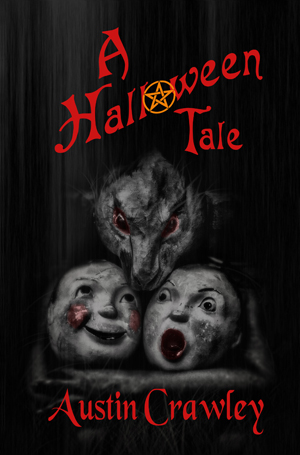
 Meghan's House of Books